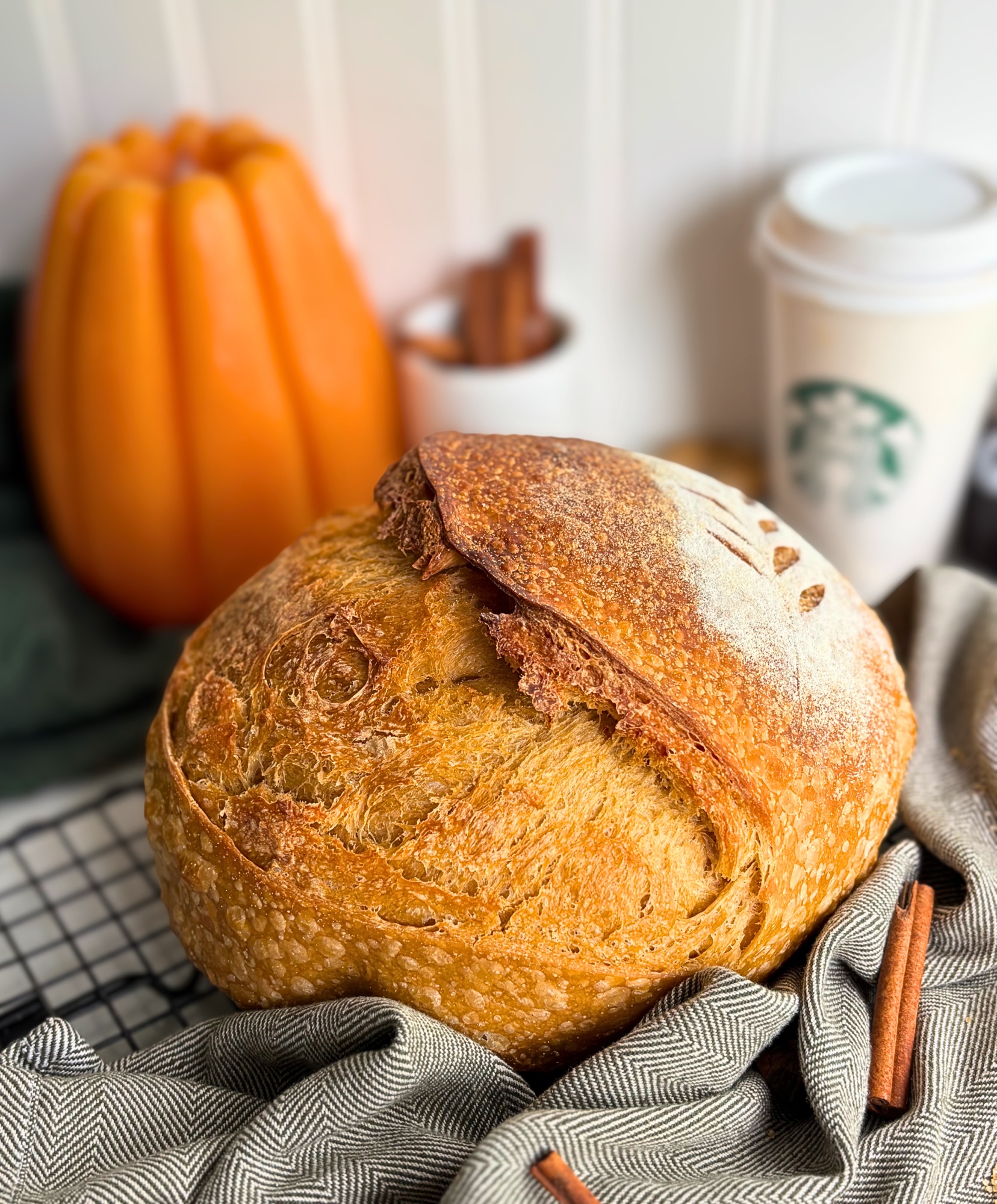
Every year the pumpkin spice latte comes back and every year I order one, take about four sips, and then remember that I like the idea of it far more than I like drinking it. That is a lot of flavor sitting in a cup going to waste, and it occurred to me that everything I actually love about that drink is the same thing I love about a good loaf of bread, which is warm spice, a little sweetness, and something soft to sink into. So I stopped drinking it and started fermenting it instead.
This loaf uses a full pumpkin spice latte as the entire liquid in the dough. There is no water in this recipe at all. The espresso, the milk, the sugar, and the spice syrup all go straight into the flour, which means the flavor is built into the crumb from the very first mix rather than swirled in at the end. What comes out of the Dutch oven is a soft, gently sweet, deeply spiced loaf that smells like fall the second you cut it open, and honestly, that latte makes a much better bread than it ever made a drink.

Table of Contents
- Why This Recipe Works
- What a Latte Does That Water Cannot
- Ingredients You Will Need
- Shop This Recipe
- How to Make Pumpkin Spice Latte Sourdough
- How to Know Bulk Fermentation Is Done
- Baking and Cooling
- Tips for Success
- Storage and Freezing
- Yeast Version
- Variations to Try
- Recipe
- Frequently Asked Questions
- More Sourdough Recipes
- Subscribe
Why This Recipe Works
The whole recipe rests on one swap, and it is a swap that does far more work than it looks like it should. A standard loaf of sourdough is flour, water, salt, and starter, and the water in that list is doing nothing except hydrating the flour. When you replace all of that water with a pumpkin spice latte, you are still hydrating the flour, but you are also adding milk fat, sugar, coffee, and spice at the same time, and every one of those things changes the bread.
The milk softens the crumb and gives the loaf a tenderness that a plain water dough will never have. The sugar in the syrup feeds the fermentation early and then caramelizes on the crust, which is why this loaf browns deeper and faster than a plain boule. The espresso pushes the spice forward instead of leaving it flat, the way coffee does in a chocolate cake. And because the flavor is dispersed through the entire dough rather than layered into a swirl, there is no gummy filling line, no leaking sugar, and no risk of the flavor concentrating in one spot and disappearing from the next slice.
It also happens to be one of the easiest flavored loaves you can make, because you are not managing an inclusion, a filling, or a second component. You are managing one loaf of bread that simply drinks something more interesting than water.

What a Latte Does That Water Cannot
This part matters if you want to read your dough correctly, because the number on paper and the dough in your hands are not going to agree.
A latte is mostly milk, and milk is roughly eighty seven percent water with the rest being fat, protein, and sugar. That means the liquid you are pouring in is not delivering as much free water as the same weight of plain tap water would. On paper the hydration looks like a familiar number, but the dough will feel a little stiffer and a little smoother than you expect at first, and then it will loosen as the milk sugars and fats work into the gluten during the folds. This is completely normal and it is not a sign that you need to add more liquid.
The fat is also doing something to the gluten. Fat coats the flour proteins and shortens the gluten strands slightly, which is exactly why enriched breads are softer than lean ones. You get a slightly tighter, more even crumb here rather than the wide open holes people chase in a plain country loaf, and that is the correct outcome for this bread. This is a loaf built for slicing, toasting, and covering in butter, not for holding up a puddle of olive oil.
One last thing worth knowing is that the latte must be completely cool before it touches the starter. Warm liquid will race the fermentation ahead of schedule and can genuinely damage a starter if it is hot enough, so let it come all the way down to room temperature before you mix.

Ingredients You Will Need
The full amounts and the volume conversions live in the recipe card at the bottom of the post. Here is what each thing is actually doing.
Pumpkin spice latte. This is your entire liquid, so the one you choose sets the flavor of the loaf. I order a grande from the coffee shop and let it sit on the counter until it is fully at room temperature, and I skip the whipped cream because it throws the weight off. A homemade latte works just as well as long as you weigh it rather than measuring it by the cup.
Bread flour. The higher protein content matters more than usual here because the milk fat is working against your gluten development. Bread flour gives you the structure to fight back. I use King Arthur Organic Bread Flour for this and for everything else I bake.
Active sourdough starter. It needs to be at peak, meaning risen, domed, and bubbly rather than sunk and hungry. A sluggish starter fed with a sugary, fatty liquid dough is going to give you a dense loaf, so this is not the recipe to test a starter you are unsure about. If you do not have one yet, my minimal waste sourdough starter guide will get you there in a couple of weeks.
Salt. Flavor and fermentation control, added after the initial rest so it is not sitting directly against the starter.
Vanilla extract and pumpkin spice. Both are optional and both are worth adding. Coffee shop syrup is sweeter than it is spiced, so a spoonful of pumpkin spice pushes the cinnamon, ginger, nutmeg, and clove back to the front where you want them, and the vanilla rounds out the sweetness so the loaf tastes like a bakery item rather than a beverage. Want to make your own Pumpkin Spice Blend? Check out my recipe HERE!

Shop This Recipe
These are the tools I reach for when I make this loaf. I earn a small commission from these links at no additional cost to you, which helps support the blog and keeps the recipes coming.
- Enameled Dutch oven. A heavy pot with a tight lid traps steam for the first half of the bake, which is the entire reason this loaf gets a crackly, deeply colored crust.
- Digital kitchen scale. Not optional in this recipe, because the latte has to be weighed rather than measured by volume in order for the hydration to land correctly.
- Banneton with a cotton liner. Holds the shape during the long cold proof and wicks just enough moisture off the surface for a clean score.
- Bread lame. A proper blade gives you a clean, decisive score, and a clean score is what lets the loaf open into an ear instead of tearing along the side.
- Bench scraper. For pre shaping and for moving a soft, slightly sticky dough around without deflating it.
- Instant read thermometer. The internal temperature is the only reliable way to know this loaf is finished, since the sugar in the latte browns the crust well before the center is baked through.

How to Make Pumpkin Spice Latte Sourdough
The recipe card carries every amount, temperature, and time, so use this section to understand what you are looking for at each stage and then work from the card.
Start with the mix. The cooled latte, the flour, and the starter go together into a shaggy dough with no dry flour left anywhere in the bowl, and then it rests. That rest is doing the work of a long knead for you, because the flour is hydrating and the gluten is beginning to link up on its own while you do absolutely nothing. Hold the salt back until after this rest.
Add the salt and the spices. After the rest, the salt, vanilla, and pumpkin spice go in with wet hands, and a small splash of reserved latte helps them work through the dough evenly instead of sitting in pockets. Squeeze and fold the dough through your fingers until you cannot feel any grit of undissolved salt.
Build strength with stretch and folds. Three sets is all this dough needs. Take the edge of the dough, pull it up, and fold it into the middle, working your way around the bowl about six times. Then put your fingers on the seam with your thumb against the side of the bowl, pull the dough up and flip it over onto itself so the seam ends up underneath, and run your hand along the edge pushing away and tucking under at the same time until the ball is taut. You will feel the dough change from slack and floppy in the first set to smooth and springy by the third.
Bulk ferment. Then it sits, covered, at room temperature until it is properly fermented rather than until a timer goes off. The next section covers exactly what you are looking for, and it matters more here than usual because the sugar in the latte speeds fermentation up. A dough that normally takes you eight hours may be ready in six.
Pre shape, rest, and shape. A loose round first, a short bench rest to let the gluten relax, then the final shape rolled up tight. Tension is what holds this loaf tall through a fourteen hour cold proof, and a slack shape will spread into a disc in the refrigerator instead of holding its dome.
Cold proof overnight. Seam side up in the lined banneton, covered, straight into the refrigerator. The cold slows fermentation to a crawl, deepens the flavor, and firms the dough so it scores cleanly the next morning. This is also where the recipe becomes convenient, because the loaf will wait for you.

How to Know Bulk Fermentation Is Done
This is the step that decides whether you get a light loaf or a dense one, and the sugar in the latte means you cannot lean on your usual timing. Watch the dough, not the clock. You are looking for all of these together rather than any single one on its own.
- The dough has grown by roughly fifty to seventy percent, not doubled
- It has stopped feeling sticky and now feels smooth and slightly tacky
- It releases from the side of the bowl cleanly when you tip it
- Bubbles are visible on the surface and along the sides of the container
- The dough jiggles as one loose mass when you shake the bowl gently
- When you poke it, the indentation springs back slowly and does not fill in completely
If the dough is soupy, has lost all its structure, and smells sharply of alcohol, it went too far, and while it will still bake, it will be flat and dense. If it has barely moved and still feels dense and stiff after eight hours, your kitchen is cold or your starter was not at peak, and the answer is patience rather than more time in the oven.

Baking and Cooling
The Dutch oven goes into the oven while it preheats and it needs to be genuinely, thoroughly hot before the dough goes in, because that blast of heat is what gives you oven spring. Score the loaf cold, straight out of the refrigerator, since a cold surface takes a blade far more cleanly than a room temperature one.
The bake runs covered for most of its time and then uncovered at the end to set the color. Keep an eye on it during that uncovered stretch, because the sugar from the latte browns considerably faster than a plain lean dough and this loaf can go from beautifully bronzed to too dark in a few minutes. The internal temperature is your finish line, and the card has the number.
Then comes the hardest part of the entire recipe, which is leaving it alone. This loaf needs a full four hours on a wire rack before you cut it. The crumb is still setting as it cools, and cutting early gives you a gummy, compressed slice and lets all the steam that was supposed to stay in the bread escape into your kitchen. I know exactly how unreasonable that sounds when your house smells like this. Do it anyway.
Tips for Success
- Weigh the latte, do not measure it. Coffee shop cups are not accurate measuring vessels and foam takes up volume without adding liquid. The scale is the only way to get this right.
- Order it without whipped cream. The cream adds weight without adding usable liquid, which throws the hydration off in a way you will feel during shaping.
- Let the latte cool completely. Room temperature, all the way through, before it meets the starter.
- Expect faster fermentation. The added sugar gives your wild yeast an easy meal, so start checking the dough earlier than your usual schedule tells you to.
- Do not add extra flour during shaping. This dough is a little softer than a lean one because of the milk fat and that is exactly how it should feel. Use a bench scraper and wet or lightly floured hands instead.
- Tent the loaf if it colors too fast. A loose piece of foil over the top during the uncovered stretch protects the crust while the center finishes.
Storage and Freezing
Because of the milk and sugar in the dough, this loaf stays soft longer than a plain sourdough does, which is one of the quiet benefits of the swap.
On the counter. Cut side down on a board, or in a bread box or paper bag, for up to three days. Skip the plastic bag if you want to keep the crust crisp, since plastic traps moisture and softens it overnight.
In the freezer. Slice the fully cooled loaf first, then freeze the slices in a zip top bag with the air pressed out for up to three months. Freezing it sliced means you can pull out exactly what you need and drop it straight into the toaster without thawing.
Refreshing a day old loaf. Run the cut surface briefly under water, then bake at 350 degrees Fahrenheit for about ten minutes. It comes back remarkably close to the first day.
This bread also makes outstanding French toast, which is not a coincidence, since the crumb is already carrying milk, sugar, and spice.

Yeast Version
You do not need a sourdough starter to use this idea, because the swap is the recipe and it carries over to commercial yeast without any trouble. If you already have a white sandwich loaf or a simple yeasted boule that you trust, make it exactly as written and replace all of the water with a cooled pumpkin spice latte at the same weight.
A few things change when you go this route. Yeast works much faster than a starter does, so your bulk rise will be a matter of hours rather than most of a day, and the sugar in the latte will speed it up further, meaning you should watch the dough rather than trusting the timing your recipe gives you. Add the pumpkin spice and vanilla along with the other dry ingredients. And keep the cold proof if your recipe allows for it, because an overnight rest in the refrigerator is where a lot of the flavor depth in this loaf comes from, and a fast yeasted dough benefits from it even more than a sourdough does.
I have not published my own yeasted version of this loaf yet, so use a base recipe you already know works in your kitchen and make the swap into that.
Variations to Try
The latte swap is a framework, and once you have made it once you will start seeing every seasonal drink menu differently.
- Chai latte sourdough. Swap the pumpkin spice latte for a chai latte and the pumpkin spice for a pinch of extra cardamom and black pepper.
- Mocha sourdough. A cooled mocha in place of the latte, with the spice left out entirely, gives you a loaf that is very good with salted butter.
- Maple pecan latte. Same method, and a handful of toasted pecans folded in during the last set of stretch and folds.
- Vanilla sweet cream cold brew. Lighter in flavor and lighter in color, with a coffee note that sits further back.
- Add a glaze. A thin drizzle of powdered sugar and milk over the cooled loaf takes this from breakfast bread into something closer to a coffee cake.
Recipe

Pumpkin Spice Latte Sourdough Bread
Equipment
- Digital Kitchen Scale
- Large mixing bowl
- bench scraper
- Banneton with a cotton liner
- Bread lame
- Dutch oven with a lid
- Instant read thermometer
- Wire cooling rack
Ingredients
- 360 g pumpkin spice latte cooled completely to room temperature, plus a splash reserved (1 1/2 cups)
- 500 g bread flour 4 cups
- 75 g active sourdough starter at peak 1/3 cup
- 10 g salt 1 3/4 teaspoons
- 4 g vanilla extract optional (1 teaspoon)
- 2 g pumpkin spice seasoning optional (1 teaspoon)
- 25 g brown sugar optional, if you want a sweeter loaf (2 tablespoons)
Instructions
- Combine the cooled pumpkin spice latte, bread flour, and active sourdough starter in a large bowl and mix until no dry flour remains and the dough is shaggy. Cover and rest for 1 hour.
- Add the salt, vanilla extract, and pumpkin spice to the rested dough with wet hands, along with the reserved splash of latte to help the additions work through evenly. Squeeze and fold the dough until everything is fully incorporated and you cannot feel any undissolved salt.
- Perform three sets of stretch and folds spaced 45 minutes apart. For each set, pull the edge of the dough up and fold it into the middle, working around the bowl about six times, then flip the dough over onto itself so the seam is underneath and push and tuck the edges until the ball is taut.
- Cover and bulk ferment at room temperature for 6 to 8 hours, until the dough has increased 50 to 70 percent, feels smooth rather than sticky, releases from the side of the bowl, shows bubbles on the surface, and springs back slowly when poked. The sugar in the latte speeds fermentation, so begin checking at 6 hours.
- Turn the dough onto a lightly floured surface, pre shape into a loose round, and rest uncovered for 20 to 30 minutes.
- Shape the dough into a tight boule or batard, rolling it up firmly to build surface tension, and place it seam side up in a banneton lined with a cotton liner.
- Cover and cold proof in the refrigerator for 14 hours.
- Place a Dutch oven with its lid into the oven and preheat to 450 degrees Fahrenheit for at least 45 minutes.
- Turn the cold dough out onto a piece of parchment, score the top with a lame, and lower it into the preheated Dutch oven using the parchment. Cover with the lid and bake for 45 minutes.
- Remove the lid and bake for another 5 to 10 minutes, until the crust is deeply golden and the internal temperature reaches 205 degrees Fahrenheit. Tent loosely with foil if the crust darkens too quickly.
- Transfer the loaf to a wire rack and cool completely for at least 4 hours before slicing. Cutting early will give you a gummy crumb.
Notes
Frequently Asked Questions
Can I use a homemade pumpkin spice latte instead of buying one?
Absolutely, and it is the cheaper way to do this. Build it however you normally would with espresso or strong brewed coffee, milk, sugar, and pumpkin spice, then weigh out the amount the recipe calls for once it has cooled. The weight is what matters, not how you got there.
Does the bread taste like coffee?
It tastes like a coffee shop rather than like a cup of coffee. The espresso reads as depth and warmth behind the spice instead of announcing itself, in the same way coffee behaves in a chocolate cake. If you want the coffee to come forward more, order a shot of espresso added to the latte.
Can I use decaf?
Yes, with no change to the recipe or the results. The caffeine has nothing to do with the fermentation.
What size latte should I order?
Order the medium or grande size, skip the whipped cream, and weigh out what the recipe calls for once it has cooled. You will have a small amount left over, and I use that splash to help work the salt and spices into the dough.
Can I use pumpkin puree instead of a latte?
That is a different recipe rather than a substitution. Puree brings a large amount of water bound up in fiber and it changes the hydration, the fermentation, and the crumb completely. This loaf is built specifically around the latte.
Why does my dough feel different from my usual sourdough?
The milk fat is coating the gluten and softening it, so the dough will feel smoother, slightly stiffer at first, and a little slacker later than a plain water dough. That is expected. Resist the urge to correct it with extra flour.
Can I bake this in a loaf pan instead of a Dutch oven?
You can, and it makes excellent sandwich slices. Shape it into a log, proof it in a greased ten by five pan, and bake it covered with a second inverted pan for the first stretch of the bake so it still gets its steam. Watch the internal temperature rather than the clock.
Do I really have to wait four hours to cut it?
Yes. The crumb finishes setting during cooling, and slicing into a warm loaf gives you a dense, gummy interior no matter how well you fermented and baked it.

More Sourdough Recipes
If this one goes over well in your kitchen, these are the ones to make next.
- The Easiest Cinnamon Swirl Sourdough Bread You Will Ever Make
- The Easiest Cheddar Everything Bagel Swirl Sourdough Bread
- High Protein Sourdough Bagels
- Apple Pie Croissant Hand Pies
- How to Create a Sourdough Starter
Subscribe
If you want more recipes like this one landing in your inbox, join the newsletter and I will send new bakes, seasonal ideas, and the occasional experiment that probably should not have worked as you go.
You can also find me on Instagram, TikTok, Facebook, and YouTube, where I am usually elbow deep in dough.
If you make this loaf, come back and leave a star rating on the recipe card. It genuinely helps other bakers find the recipe.






Leave a Reply