What You’ll Find in This Post
- My Family’s Fastnacht Story
- What Are Fastnachts?
- Why Sourdough Fastnachts?
- The Science Behind Potato in the Dough
- Tips for Perfect Sourdough Fastnachts
- Troubleshooting: Uneven Puffing
- Non-Sourdough Version
- Frequently Asked Questions
- A Note about Molasses
- Shop this Recipe
Every Fastnacht Day, I think about my great aunt Ida’s farm.
I was little. Old enough to help but young enough that everything about that kitchen felt huge. After dinner, we mixed the dough together. The next morning we were up before the sun, rolling that dough out on her floured table, cutting squares, and dropping them into whatever rendered fat she had saved. Lard, tallow, whatever had been optimized from years of making these the same way her family always had.
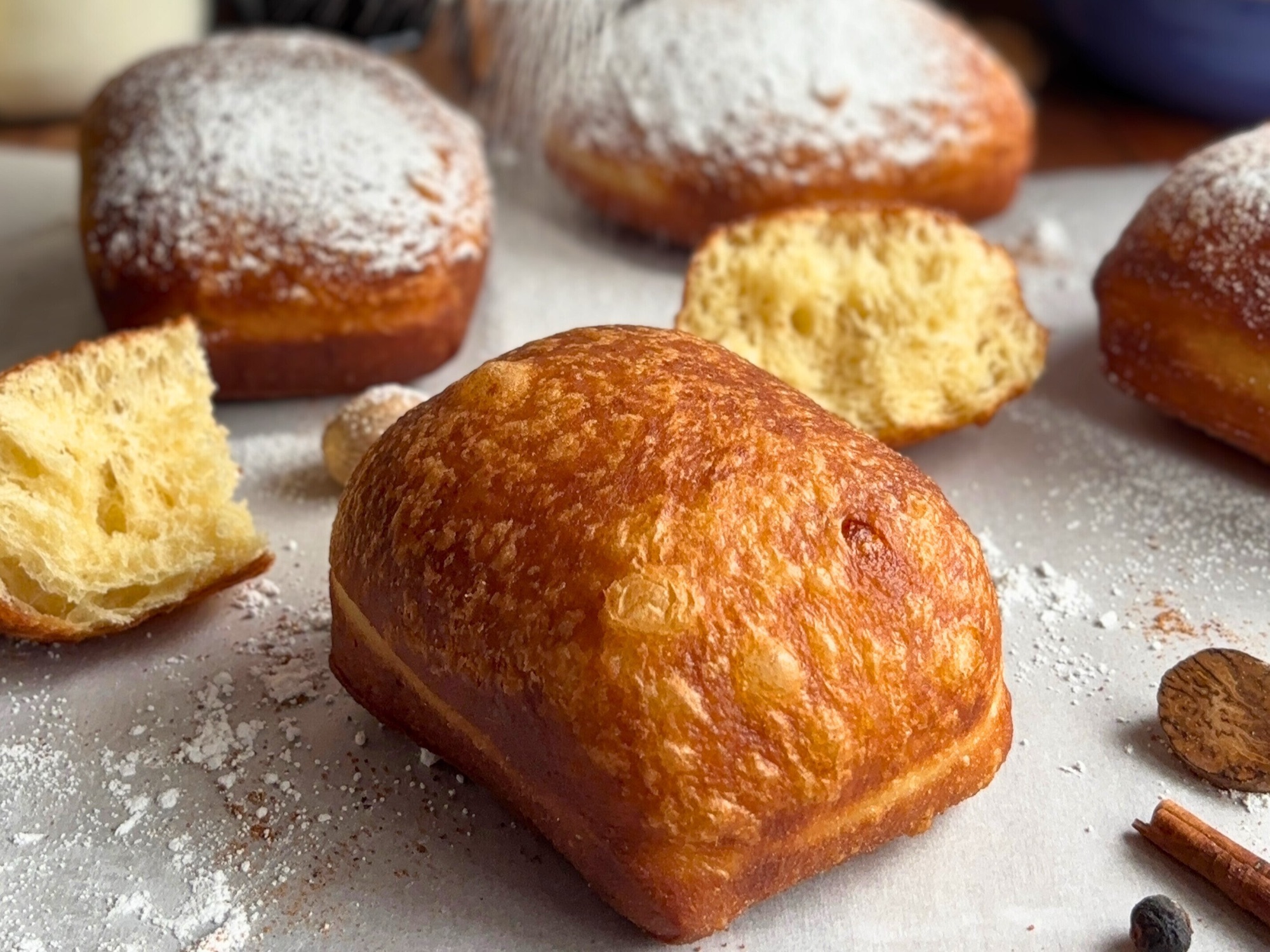
The smell of frying dough in her farmhouse kitchen. The way the squares puffed up in the huge pan of fat. The counter covered with finished Fastnachts. Then getting to eat one, still hot, with sticky dark molasses. That’s what I think about every Fastnacht Day.
That memory is why I converted the traditional fastnacht recipe into a sourdough version. No commercial yeast. (Although I have that option available!) Just starter, potatoes, and the same overnight method that Pennsylvania Dutch families have used for generations.
And while frying donuts always seemed overwhelming to me, this is truly very simple and pretty easy!


Sourdough Potato Fastnachts
Equipment
- Small Pot for boiling potatoes
- fork for mashing potatoes
- – Stand mixer with dough hook or hands for kneading
- Large bowl with lid or plastic wrap
- Rolling Pin
- knife to cut your dough
- sheet pan for proofing with lid or another sheet pan turned upside down on top to create a cover
- Parchment paper
- deep pot, dutch oven or electric fryer
- thermometer
- wire rack
- Paper towels
Ingredients
Dough
- 75 g active sourdough starter generous 1/2 cup, fed 4 to 8 hours earlier, bubbly and at peak
- 115 g mashed potatoes 1/2 cup, plain, mashed very smooth, no butter or milk added
- 120 g potato water 1/2 cup, cooled to below 90 degrees F
- 90 g granulated sugar scant 1/2 cup
- 57 g butter 1/4 cup, softened to room temperature, or lard
- 1 large egg room temperature
- 60 g whole milk 1/4 cup
- 6 g fine sea salt 1 teaspoon
- 1/8 teaspoon freshly grated nutmeg
- 525 g all purpose flour about 4 cups + 3 tablespoons
For Frying
- Avocado oil lard, vegetable shortening, or neutral oil, 3 to 4 inches deep in pot
- Oil heated to 360 degrees F
For Topping (choose your style)
- Powdered sugar
- Granulated sugar
- Cinnamon sugar
- Dark molasses or blackstrap molasses spread inside a split fastnacht
Instructions
Evening
- Boil 1 medium russet potato (peeled, cubed) in about 2 cups of water until very soft. Reserve the potato water. Mash the potato very smooth with no lumps. You need 115g (1/2 cup) mashed potato and 120g (1/2 cup) potato water. Let both cool to warm (below 90 degrees F) or room temperature before using.
- In a stand mixer fitted with the dough hook, combine the sourdough starter, mashed potatoes, potato water, sugar, egg, milk, salt, and nutmeg. Mix on low speed until combined.
- Add the 525g flour, then place the butter on top, broken into acorn size pieces. Mix on low until it comes together, then increase to medium low and mix for 5 minutes. The dough should be smooth, soft, and just slightly tacky, and it should pull cleanly from the sides of the bowl. If mixing by hand, knead for 8 to 10 minutes until the dough is smooth and springs back when poked. If you are measuring by weight, you should not need additional flour. If you are using cup measurements, there can be slight variation in volume, so if the dough is sticky and not clearing the sides of the bowl after 5 minutes, add a tablespoon of flour at a time, being sure it works in, until it does. But do not over flour it will make your fastnachts too dense.
- Transfer the dough to a greased bowl. Cover with a lid or plastic wrap. I like to use a plate
- Leave on the counter overnight, 8 to 12 hours. The dough should at least double, ideally close to triple in size. If your kitchen runs cold (below 68 degrees F), the dough will take longer to rise, so start your dough earlier in the day.

Morning
- Turn the risen dough out onto a well floured surface.
- Roll to about 3/4 inch thick. You don’t have to be precise, but if you want a guide, roll into a 9 by 12 inch rectangle and score lines every 3 inches to create a grid of 12 squares.

- Cut into rectangles with a knife.

- Place on a parchment lined sheet pan, spaced about 1.5 inches apart. Cover with a lid or an upside down sheet pan of the same size. You can also make/buy parchment paper squares and place the fastnachts on that. (see the frying instructions for why)

- Let proof for about 2 hours at room temperature, or until the pieces are noticeably puffy and pillowy. When you poke one with a floured finger, the indent should spring back slowly. In a cold kitchen this may take longer.
- Heat frying fat to 360 degrees F. Use a deep pot/Dutch oven or electric fryer with at least 3 to 4 inches of oil. Use a thermometer.
- Place fastnachts top side down into the oil. Fry 2 to 3 at a time, about 2 minutes per side, until deep golden brown. Do not crowd the pot. Give the oil time to recover between batches.
- Alternatively you can cut your parchment around the fastnacht and drop in parchment side up. fry for the 2 minutes and then flip and then gently remove the parchment paper from the oil.
- Drain on paper towels or a wire rack set over a sheet pan.
- Top while still warm with your choice of powdered sugar, granulated sugar, cinnamon sugar, or split open and spread with molasses.
Notes
- The potato water is full of starch that feeds the sourdough and creates the classic fastnacht texture. Do not skip it.
- Use your starter at peak activity. A sluggish starter will give flat fastnachts.
- If the dough hasn’t doubled overnight, your kitchen may be too cold or your starter wasn’t active enough. Give it more time in a warmer spot.
- A shorter fry time can leave the center slightly underdone, which shows up as a gummy texture when reheated. Make sure you are frying the full 2 minutes per side at 360 degrees F.
- If the dough only doubled overnight rather than tripled, give the cut pieces extra proofing time. Underproofed fastnachts will sink in the oil and puff unevenly.
- For leftovers, cut in half and place cut side down in a preheated pan to toast. They also reheat at 350 degrees F in the oven for about 5 minutes.
- Wrap individually in foil inside a freezer bag and freeze for up to 3 months.
For a yeasted version
Replace the sourdough starter with 7g active dry yeast (one packet or 2.25 teaspoons) dissolved in the warm potato water. Increase the flour to 560g (about 4.5 cups) and increase the milk to 100g (scant 1/2 cup). The method is the same. Mix in the evening, rise overnight, roll, cut, and fry in the morning. The yeast amount is low on purpose. A small amount of yeast with a long overnight rise develops better flavor than a fast rise with lots of yeast. more thorough instruction on the blog.What Are Fastnachts?
If you didn’t grow up in Pennsylvania Dutch country, you might not know what a fastnacht is, and that’s a shame worth correcting.
Fastnachts (also spelled fasnachts) are fried potato doughnuts made on Shrove Tuesday, the day before Ash Wednesday and the start of Lent. The word itself is German for “fast night,” meaning the night before the fast begins. In communities across Berks, Lancaster, Lebanon, and Lehigh Counties and even beyond, Fastnacht Day is a real thing. Bakeries sell out before noon. Church basements and fire halls run assembly lines. The news stations cover it. Families pull out recipes handwritten on index cards by grandmothers who are no longer here.
The tradition goes back to the 17th and 18th century German immigrants who became the Pennsylvania Dutch. The idea was simple: use up all the sugar, fat, and lard in the house before Lent began.
A real fastnacht is not a Krispy Kreme. It’s a potato dough, cut into squares or diamonds (never rounds with holes). The texture should be light and airy inside, golden and just barely crisp outside. Traditional toppings include powdered sugar, cinnamon sugar, or the most old school option: split it open and spread it with molasses.
In some Pennsylvania Dutch households, the last person out of bed on Fastnacht Day was called “the Fastnacht” for the rest of the day.
Fastnacht Day 2026 falls on Tuesday, February 17th.

Why Make Sourdough Fastnachts?
Sourdough and fastnachts are a natural fit. Traditional fastnachts already use an overnight rise. You mix the dough in the evening and fry in the morning. That’s exactly how sourdough works. The starter just replaces the packet of yeast, and the long fermentation does the rest.
When I decided to convert my family’s recipe to sourdough, the method barely had to change. The overnight timeline stayed the same. The potatoes, the butter, the egg, the sugar, all the same. The only real difference is that sourdough starter replaces the commercial yeast, and the long fermentation develops even more flavor and tenderness than the original.
What you get is a fastnacht with more depth. The natural acids from the sourdough complement the potato beautifully, and the long fermentation breaks down starches and gluten more thoroughly, which makes these incredibly tender. Same tradition, same shapes, same toppings. Just a little more complexity from the slow ferment.

Why Potato Matters in Fastnachts
You’ll see some fastnacht recipes out there without potato. I’m going to be direct about this: if it doesn’t have potato, it’s a doughnut. A good doughnut, maybe, but not a fastnacht. Potato is what makes a fastnacht a fastnacht.
Here’s what the potato is actually doing in the dough. Mashed potato is about 80% water and 20% starch, which means it’s adding moisture and structure at the same time. That starch gelatinizes during boiling and then acts like a sponge in the dough, holding onto water throughout fermentation and frying. This is what gives fastnachts their signature texture: moist and tender on the inside, with a crumb that pulls apart in soft layers.
The potato water is just as important. When you boil potatoes, starch leaches into the water. That starchy water feeds the sourdough starter during the overnight rise, giving it more fuel to produce gas and create lift. Do not pour that potato water down the drain.
For this recipe, I use one medium russet potato. You’ll need half a cup of mashed potato and half a cup of potato water. Mash the potato very smooth with no lumps. I just use a fork! Grandmum’s handwritten recipe said “FINE” next to the mashed potatoes, and she was right. Any lumps will show up as dense pockets in the finished fastnacht.

Tips for Perfect Sourdough Fastnachts
Your starter needs to be active. This is an enriched dough with butter, sugar, and egg, which means the wild yeast has to work harder. Feed your starter 4 to 8 hours before mixing and use it when it’s bubbly and at peak activity. A sluggish starter will give you flat fastnachts.
Watch the dough, not the clock. I let my dough rise overnight for about 8 to 12 hours at room temperature, and it close to tripled in size. If your kitchen is cold (below 68 degrees), put the bowl in your oven with just the light on for a shot amount of time to give it a boost, but make sure it doesn’t get too hot. The dough should be noticeably puffy and bubbly in the morning.
Don’t skip the second proof. After rolling and cutting, let the fastnachts proof for about 2 hours at room temperature, or until they’re noticeably puffy and pillowy. When you poke one with a floured finger, the indent should spring back slowly. In a cold kitchen, this may take longer. Underproofed fastnachts will sink in the oil and puff unevenly.
Oil temperature is everything. Heat your frying fat to 360 degrees and use a thermometer. Fry 2 to 3 at a time and give the oil a minute to recover between batches. I fry mine about 2 minutes per side until deep golden brown.
Can I make fastnachts without a sourdough starter?
Yes. See the non-sourdough version section above. Replace the starter with one packet of active dry yeast, increase the flour to 560g, and increase the milk to 100g. The method is the same.
Frying fat options. Lard is the most traditional and gives the best flavor. Real rendered lard from a butcher is the gold standard. Vegetable shortening works well as a substitute. Avocado oil is a great neutral option that handles high heat well. Other neutral oils like canola or vegetable oil also work.

Troubleshooting:
Why Did My Fastnachts Puff Up Unevenly?
I tested this recipe multiple times, and the biggest lesson I learned had nothing to do with the ingredients. It was all about proofing. The recipe I have was chicken scratch and basically minimal help when it came to this part. More like a guide, because these recipes were ingrained in their minds and in the feel and look of the dough, that they knew so well.
If your fastnachts come out of the oil with a big puffy top and a flat, dense bottom, or if you cut one open and find a hollow cavity in the center instead of an even crumb, your dough was underproofed. This is the most common issue with sourdough fastnachts, and it’s counterintuitive because it looks like too much rise when it’s actually not enough.
Here’s what’s happening. When underproofed dough hits hot oil, the yeast still has a lot of energy left. All that remaining fuel fires off at once in the fryer, creating a big burst of gas that tears through the gluten structure instead of expanding it gently and evenly. The result is a big air pocket on one side and dense, tight crumb on the other.
When the dough is properly fermented, the yeast has already done most of its work before frying. The gas is evenly distributed throughout a relaxed, mature gluten structure. When it hits the oil, you get gentle, even expansion and that tight, uniform crumb with small bubbles throughout.
The fix is simple: let the dough rise longer overnight (close to tripled, not just doubled) and give the cut pieces a full 2 hours to proof before frying. In a cold kitchen, this may take even longer. Do the poke test. If the indent springs back fast, they need more time. If it springs back slowly and leaves a slight impression, they’re ready.

Why Are My Fastnachts Darker Than Regular Donuts?
The darker color comes from the potato (high in amino acids and natural sugars), the egg, milk (lactose), and the long sourdough fermentation breaking starches into simpler sugars that brown faster. All of that gives the Maillard reaction way more fuel than a plain donut dough. It’s backed by the science and confirmed by traditional descriptions of fastnachts as having that dark golden, crispy exterior. And I flipped the script at the end: if yours came out pale, that’s the sign something went wrong (overproofing eating up all the sugars).
Don’t Have a Sourdough Starter? Make the Traditional Yeasted Version
Not everyone keeps a sourdough starter, and I didn’t want this recipe to leave anyone out. Here’s the full ingredient list for the yeasted version. The method is the same: mix it all in the evening, let it rise overnight, then roll, cut, and fry in the morning.
Yeasted Fastnacht Ingredients:
- 7g active dry yeast (one packet or 2.25 teaspoons), dissolved in the warm potato water
- 115g mashed potatoes (1/2 cup), plain, mashed very smooth
- 120g potato water (1/2 cup), warm
- 90g granulated sugar (scant 1/2 cup)
- 57g butter (1/4 cup), softened
- 1 large egg, room temperature
- 100g whole milk (scant 1/2 cup), warm
- 6g fine sea salt (1 teaspoon)
- 1/8 teaspoon freshly grated nutmeg
- 560g all purpose flour (about 4.5 cups)
The yeast amount is low on purpose. Traditional fastnacht recipes use a small amount of yeast with a long overnight rise, which develops better flavor than a fast rise with lots of yeast. Everything else, the frying temperature, the cut shapes, the proofing time, and the toppings, stays identical to the sourdough version.
If you want to learn more about building your own sourdough starter so you can try the sourdough version next time, check out my Sourdough Starter Guide.
How to Serve Fastnachts
Fastnachts are best eaten the same day, ideally still warm. The most traditional Pennsylvania Dutch way is to split them open and spread the inside with dark molasses (not blackstrap). The bitterness of the molasses against the slightly sweet, fried dough is something special. Other classic toppings include powdered sugar, granulated sugar, cinnamon sugar, or powdered sugar with a pinch of freshly grated nutmeg.
For leftovers, we like to cut them in half and place them cut side down in a preheated pan to warm them up and toast the inside. They also reheat well in the oven at 350 degrees for about 5 minutes. For longer storage, wrap individually in foil inside a freezer bag and freeze for up to 3 months.

Frequently Asked Questions
What is a fastnacht?
A fastnacht is a traditional Pennsylvania Dutch fried potato doughnut made on Shrove Tuesday, the day before Ash Wednesday. The word comes from the German for “fast night.” They were made to use up all the fat and sugar before Lent. Fastnachts are cut into squares or diamonds, never rounds, and traditionally fried in lard.
When is Fastnacht Day 2026?
Tuesday, February 17th. It always falls on Shrove Tuesday.
Do fastnachts have to have potato in them?
Yes. Potato is what makes a fastnacht a fastnacht. The mashed potato and potato water create the signature moist, tender texture that sets fastnachts apart from regular fried doughnuts.
Why are my fastnachts gummy when reheated?
The center was likely slightly underdone. Fry for 2.5 to 3 minutes per side and make sure your oil stays at 360 degrees. Don’t crowd the pot.
Can I bake these instead of frying?
Fastnachts are a fried tradition. The frying is the whole reason they exist, to use up fat before Lent.
How far ahead can I make the dough?
Mix it the evening before you plan to fry. The dough rises overnight on the counter and should be rolled, cut, and fried the next morning. The overnight rise is the make ahead step. Don’t try to stretch the timeline beyond that or the dough will overproof.
What is the best oil temperature for frying fastnachts?
360 degrees Fahrenheit. If the oil is too hot, the outside browns before the center cooks. Too cool, and they absorb oil and become greasy.

A Note on Molasses
The traditional way to eat a fastnacht is to split it open and spread the inside with molasses. But not all molasses is the same, and the type you choose changes both the flavor and the nutritional value of your fastnacht.
All molasses starts the same way. Sugar cane juice is boiled and the sugar crystals are removed. Each time the juice is boiled again, the molasses left behind gets darker, thicker, and less sweet.
Light molasses comes from the first boiling. It is the sweetest and mildest variety, closest to a syrup. It works well if you want something gentle and honey like.
Dark molasses comes from the second boiling. It is thicker with a deeper, richer flavor that has a slight bitterness to it. This is the most common type sold in grocery stores and what most baking recipes call for.
Blackstrap molasses comes from the third and final boiling. It is the thickest, darkest, and most intensely flavored of the three. It is noticeably bitter compared to the lighter varieties and much less sweet. But that bold, almost savory depth is exactly why it pairs so well with a rich, fried potato dough.
Blackstrap is also significantly more nutritious than regular molasses. Because most of the sugar has been extracted by the third boiling, what remains is a concentrated source of minerals. A single tablespoon of blackstrap molasses contains roughly 20% of your daily iron, 10% of your daily calcium, and meaningful amounts of copper, magnesium, potassium, and vitamin B6. It is one of the best plant based sources of iron available, and the copper content supports iron absorption and overall bone health. It also has a lower glycemic index than lighter molasses or refined sugar, meaning it will not spike your blood sugar as dramatically.
I personally use blackstrap molasses on my fastnachts. The bitterness is not a downside here. It cuts through the richness of the fried dough and butter in a way that lighter molasses just does not. If you have never tried it, start with a thin spread and see what you think. You might not go back.
Any molasses will work on a fastnacht. Use whatever you enjoy. But if you want the most flavor and the most nutrition in that spread, blackstrap is the way to go.
Shop This Recipe
You do not need a lot of specialty equipment to make fastnachts, but a few tools make the process significantly easier. Here is what I use and recommend.
Kitchen Scale
Weighing your ingredients is the single best thing you can do for consistency.
Candy or Deep Fry Thermometer
Oil temperature is everything when frying. Too cool and your fastnachts absorb oil and turn greasy. Too hot and they burn on the outside before the inside cooks through. A clip on candy thermometer lets you monitor the temperature the entire time you are frying. This is not optional.
Electric Deep Fryer
If you want to make this even simpler, an electric fryer takes all the guesswork out of temperature control. Set it to 360 degrees and it holds it there for you. No babysitting the stove, no temperature swings between batches. If you fry anything more than once or twice a year, this is worth the investment.
Fish Spatula
A fish spatula is the best tool for getting the dough in and out of the hot oil. The thin flexible blade slides right under the fastnacht without tearing it, and the slots let the oil drain off as you lift. So much better than tongs for something this soft and puffy.
Rolling Pin
Nothing fancy needed here. Any rolling pin you already own will work. You are just rolling to about three quarter inch thick.
Sheet Pan with Lid
A sheet pan with a matching lid is perfect for proofing your cut fastnachts. The lid traps moisture and warmth so the dough does not dry out during that two hour proof. I use the Nordic Ware set. It doubles as a cover when you flip it upside down over another pan, and you will use it for everything else in your kitchen too.
Parchment Paper
Line your sheet pan with parchment so nothing sticks during proofing or draining after frying.
If you make these sourdough fastnachts, leave a comment below and let me know how they turned out. Tag me on social media so I can see your Fastnacht Day spread.
For more sourdough recipes, check out my Sourdough Bread Recipe or my Sourdough Starter Guide if you’re just getting started.
Happy Fastnacht Day!

Never Miss a Recipe
Sign up for the H3art of the Home newsletter and get new recipes, baking tips, and seasonal content delivered straight to your inbox.


This post contains affiliate links, which means I earn a small commission if you make a purchase through them, at no extra cost to you. I only recommend tools I actually use in my own kitchen.

Leave a Reply