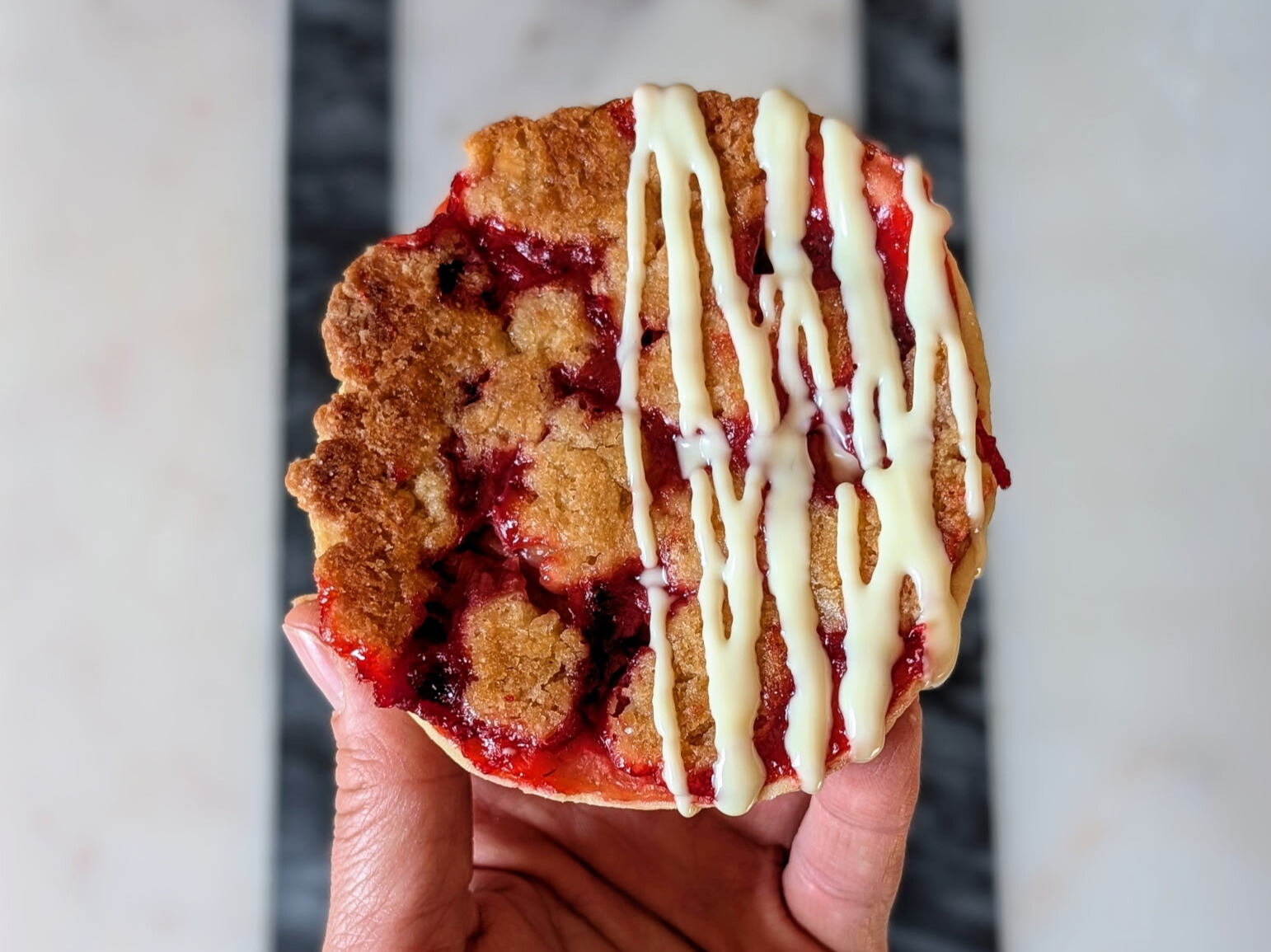
Buttery sourdough cookies topped with fresh strawberries and sweet crumble. Everything you love about strawberry shortcake in a handheld treat
These strawberry shortcake sourdough cookies are the dessert mashup you didn’t know you needed. Imagine all the buttery, sweet, slightly tangy flavors of classic strawberry shortcake, but in a soft, chewy cookie that you can eat with your hands. No fork required.
The secret? A 24-hour fermented sourdough cookie dough that creates the most incredible texture. Soft and tender on the inside with slightly crisp edges. Fresh strawberries get caramelized during baking, and a buttery crumble adds that signature shortcake texture. It’s like strawberry shortcake decided to become a cookie, and honestly, it made a brilliant career move.
Table of Contents
- Why You’ll Love This Recipe
- What Makes These Cookies Special
- Key Ingredients and Why They Matter
- Essential Equipment
- The Fermentation Process Explained
- Making the Strawberry Compote
- The Upside-Down Assembly Technique
- Baking and Cooling
- Adding the White Chocolate Drizzle
- Storage and Make-Ahead Tips
- How to Assemble the Cookies
- Tips for Success
- Recipe
- Storage and Make-Ahead Tips
- Variations and Substitutions
- Troubleshooting Common Issues
- Frequently Asked Questions
- Can I Make These Without Sourdough?
Why You’ll Love This Recipe
It uses sourdough discard productively. That jar of discard in your fridge finally has a purpose beyond sitting there making you feel guilty. The long fermentation breaks down the flour and creates complex flavor while making the cookies easier to digest.
The texture is unreal. That 24-hour fermentation gives these cookies a soft, almost cake-like crumb that stays tender for days. They’re substantial enough to hold toppings but still melt in your mouth.
They’re actually strawberry shortcake. Not strawberry-flavored cookies. Not cookies with strawberry jam. Actual layers of buttery cookie base, fresh strawberries, and sweet crumble topping, just like the classic dessert, reimagined.
The upside-down baking technique is genius. You assemble everything upside-down, bake, then flip. The strawberries caramelize against the pan, the crumble stays crispy, and you get picture-perfect cookies every time.
They’re a showstopper for summer. Strawberry season peaks from May through August, and these cookies are the perfect way to use those sweet, juicy berries. They look fancy enough for a dinner party but easy enough for a random Tuesday. And when summer is over…there is always frozen berries.
What Makes These Cookies Special
Most strawberry cookies use freeze-dried strawberries or jam because fresh berries add too much moisture and make cookies spread into puddles. But this recipe solves that problem with the upside-down baking method, the strawberries sit on the bottom of the pan where they can caramelize and release moisture without turning your cookies into soggy messes.
The sourdough starter does double duty here. It goes into both the cookie dough and the crumble topping, fermenting for up to 48 hours. This long fermentation develops complex, tangy flavors that balance the sweetness of the strawberries and creates a more tender texture. If you’ve ever wondered what makes bakery cookies taste better than homemade, fermentation is part of the secret.
The crumble topping is fermented too, which sounds weird but tastes incredible. It gets crispy and golden during baking, adding textural contrast to the soft cookie and jammy strawberries. It’s essentially a deconstructed biscuit topping, just like traditional strawberry shortcake would have.
Key Ingredients and Why They Matter
Active sourdough starter: This recipe works with either fed starter or discard. I usually use peaked because the easier digestion. Either way, you need 120g for the cookies and 30g for the crumble.
Two types of sugar in the cookie dough: Brown sugar creates chewiness and adds molasses flavor, while powdered sugar gives a more tender, cake-like crumb. The combination creates that perfect strawberry shortcake texture, not too dense, not too cakey.
Almond extract: This is optional. Just 1/2 teaspoon adds a subtle, sweet depth that makes people ask “what’s that flavor?” It complements the strawberries without tasting like marzipan.
Cream of tartar: A tiny amount (1/8 teaspoon) helps the cookies stay tender and prevents them from spreading too much during baking. It also enhances the tanginess from the sourdough.
Fresh strawberries: Use ripe, sweet strawberries for the best flavor. Underripe berries will be tart and won’t caramelize as well. The compote cooking process intensifies their flavor and removes excess moisture.
Cornstarch in the compote: This thickens the strawberry juices so they set into a jam-like consistency instead of making everything soggy. As the cookies cool, the cornstarch firms up even more, creating a sliceable layer.
Cold butter in the crumble: Keep that butter cold so it stays in pieces instead of melting into the flour. Those butter chunks create the crumbly, biscuit-like texture as they melt during baking.
White chocolate drizzle: This is optional but highly recommended. It adds sweetness and makes the cookies look bakery-professional. The coconut oil keeps the chocolate fluid enough to drizzle in thin lines.
Essential Equipment
Circle cutter or wide-mouth jar: You need something 2.5-3 inches in diameter to cut uniform circles. I use a wide-mouth canning jar because I always have one, but a biscuit cutter works perfectly too.
Parchment paper: Mandatory. These cookies have sticky strawberry compote on the bottom, and they will absolutely glue themselves to a bare baking sheet, unless a really good non stick.
Thin, flexible spatula: For removing the cookies after they’re baked. A regular spatula works, but a thin offset spatula makes the job much easier and reduces breakage.
Pastry cutter or your hands: For making the crumble topping. A pastry cutter gives you more control, but your hands work fine if you keep the butter cold.
The Fermentation Process Explained
Fermenting cookie dough isn’t traditional, but it creates incredible results. The wild yeast and bacteria in your sourdough starter break down some of the flour’s starches and proteins over 12-48 hours. This develops complex flavor, not sour, just deeper and more interesting than regular cookies.
The fermentation also makes the cookies more digestible. If you’re sensitive to gluten or find regular baked goods heavy, fermented dough is often easier on your stomach. The bacteria pre-digest some of the components that can cause issues.
You can ferment for as little as 12 hours or as long as 48 hours. Shorter fermentation is fine if you’re in a hurry. Longer fermentation creates more a more tender texture. I usually go for 24 hours, it’s the sweet spot.
The crumble topping ferments alongside the dough. This seems extra, but it’s worth it. The fermentation creates tiny air pockets in the crumble that make it lighter and crispier after baking. Unfermented crumble can be dense and heavy.
Making the Strawberry Compote
The compote is what makes these cookies actually taste like strawberry shortcake instead of just strawberry cookies. You’re cooking fresh strawberries with sugar, lemon juice, and cornstarch until they break down into a thick, jammy sauce.
Use ripe strawberries for the best flavor. Hull them and slice them about 1/4 inch thick, you want pieces, not mush. The cornstarch is crucial here. It absorbs the strawberry juices as they cook and thickens everything into a spreadable consistency.
Cook the compote over medium heat, stirring gently. You want the strawberries to soften but not completely fall apart. After 5-7 minutes, the mixture should look glossy and coat the back of your spoon. It’ll seem a bit loose in the pan, but it thickens considerably as it cools.
Let the compote cool completely before assembly. Warm compote will make your cold butter in the crumble start to melt, and it won’t spread as nicely. I usually make the compote while my dough is in the final hours of fermentation.
The lemon juice is important, it brightens the strawberry flavor and prevents the compote from being cloying. Fresh lemon juice is better than bottled because it has more vibrant flavor.
The Upside-Down Assembly Technique
This is where the magic happens. Instead of putting toppings on top of cookies (which would make them soggy), you build everything upside-down on the baking sheet.
First, spread circles of crumble topping directly on the parchment. Use your circle cutter as a guide and spread about 1 heaping tablespoon of crumble per cookie. Pack it down slightly but don’t compress it too much, you want it crumbly, not solid. If you want the marbled top be sure to add spots that have no crumb and the compote can reach the pan.
Next, add about 2 teaspoons of cooled strawberry compote to the center of each crumble circle. Don’t spread it all the way to the edges, leave a little border so the compote doesn’t ooze out during baking.
Then cut circles from your fermented cookie dough and place them on top. Press down gently so everything adheres together. The cookie dough will be cold and firm from the fridge, which makes it easier to handle.
During baking, the cookie dough becomes the bottom layer against the pan. The strawberries sit in the middle, releasing their juices and caramelizing slightly. The crumble topping stays on top, getting crispy and golden.
After baking and cooling, you flip everything over. The crumble is now on top where it belongs, perfectly crisp

Want to try the Chocolate Version of this? Check out the recipe HERE
Baking and Cooling
Bake at 350°F for 18-22 minutes. You’re looking for golden brown edges on the cookie base (which is facing up during baking). The cookies should look set and slightly puffed.
The cooling process is absolutely critical. These cookies need to cool almost completely on the baking sheet, at least one hour, preferably longer. During cooling, three important things happen:
The cornstarch in the strawberry compote continues to thicken and set. What seems like runny compote right out of the oven will firm up into a stable, sliceable layer. If you try to move the cookies too soon, the compote will still be liquid and will make a mess.
The butter in the crumble topping resolidifies. Hot butter is liquid, but as it cools it firms back up, which helps the crumble pieces stick together instead of crumbling apart when you handle the cookies.
The cookie base sets completely. Hot cookies are fragile, but cooled cookies have much more structural integrity. You need that strength to support the toppings when you flip everything over.
Don’t rush this step. I know it’s hard to wait, but trying to remove these cookies while they’re warm will result in broken cookies, sticky fingers, and lots of frustration. Go do something else for an hour and come back when they’re room temperature.

Adding the White Chocolate Drizzle
The white chocolate drizzle is optional, but it makes these cookies look professionally made. Melt white chocolate with a small amount of coconut oil—the oil keeps the chocolate fluid so you can drizzle it in thin lines instead of thick globs.
Use a spoon, fork, or piping bag to drizzle the chocolate back and forth across the cookies. You don’t need to cover them completely, thin, random drizzles look more elegant than heavy coating.
Let the chocolate set completely before storing the cookies. If you stack them while the chocolate is still soft, they’ll stick together. At room temperature, this takes about 30 minutes. In the fridge, it’s faster, about 15 minutes.
You can skip the chocolate entirely if you want. The cookies are delicious without it. But white chocolate pairs beautifully with strawberries and adds a touch of sweetness that complements the tangy sourdough.

Storage and Make-Ahead Tips
Store these cookies in an airtight container at room temperature for up to 3 days. The texture stays soft and tender thanks to the moisture from the strawberries. After 3 days, the cookies start to dry out and the crumble loses some of its crispness.
You can refrigerate them for up to 5 days if you need them to last longer. They’re delicious cold, almost like eating strawberry shortcake ice cream sandwiches. Just let them come to room temperature before serving for the best texture.
Make-ahead options: The cookie dough and crumble can ferment for up to 48 hours, so you have flexibility in your timeline. Make the dough on Monday, bake on Wednesday. Or make everything over the weekend and bake on Monday night.
The strawberry compote can be made up to 3 days ahead and stored in the fridge. Just bring it to room temperature before assembly so it spreads easily.
How to Assemble the Cookies

- Using your circle cutter as a guide, spread about 2 rounded tablespoons of fermented crumble mixture on the parchment in circles. Remember to leave gaps in the crumble if you are looking for that beautiful marble top
- Top each crumble circle with 2 teaspoons of cooled strawberry compote, gently spread

- Roll out the fermented cookie dough on a well floured surface to a rough rectangle, 13”x 12”, approximately 3/8” inch thick
- 3/8th inch is the sixth small mark from the left, right between ¼ and ½. It’s usually a bit longer than the other minor tick marks
- Using your circle cutter, cut out circles from the dough
- Gently gather scraps, press together to form another rectangle, and continue cutting until all dough is used


- Place each cookie circle on top of the crumble and strawberry layers
- Gently press down to adhere making sure the crumble and strawberry are under the cookie.

Bake:
- Bake for 18-20 minutes, until cookie tops are golden brown and set and you can see browning on the bottom edges
- Remove from oven and let cool completely on the baking sheet
- Letting the Compote Set:
After baking, the strawberry compote will continue to thicken and set as it cools. The cornstarch will firm up considerably during the cooling process, creating that perfect gel-like consistency that won’t be sticky to the touch. This cooling period is crucial – the compote goes from a hot, somewhat liquidy state to a stable, sliceable layer that holds its shape beautifully when you flip the cookies. Don’t rush this step – the patience pays off with cookies that are much easier to handle and won’t leave residue on your fingers!
- Letting the Compote Set:
Add white chocolate drizzle:
- Melt white chocolate with 1-2 teaspoons coconut oil in a microwave(mixing every 20 seconds) or double boiler, until smooth
- Using a spoon or piping bag, drizzle melted white chocolate over the cooled cookies
Serve:
- Serve immediately or store covered for up to 2 days. Place in the refrigerator after that.

Tips for Success
- Gentle handling: Use a thin, flexible spatula to remove cookies from parchment to prevent breaking
- Complete cooling is crucial – removing too early will cause the strawberry move around and the cookies to fall apart
- Dough thickness matters: 3/8 inch thick ensures the cookie bakes through without being too thick or thin
- Fermentation time: 12-24 hours develops the best sourdough flavor in both the dough and crumble. However this can be made with only aa short chill time
- Assembly spacing: Leave about 2 inches between cookies on the baking sheet to allow for slight spreading
Yield
Makes approximately 12-15 individual cookies (depending on cutter size)
Recipe

Strawberry Shortcake Sourdough Cookies
Ingredients
Sourdough Cookie Base
- 120 g active sourdough starter or discard
- 113 g unsalted butter softened
- 80 g powdered sugar
- 67 g brown sugar
- 50 g egg 1 large
- 5 g vanilla extract 1 teaspoon
- 2.5 g almond extract 1/2 teaspoon
- 270 g all-purpose flour
- 2 g baking powder 1/2 teaspoon
- 1.5 g salt 1/4 teaspoon
- 1/8 teaspoon cream of tartar
Fermented Crumble Topping
- 120 g all-purpose flour
- 80 g brown sugar
- 30 g active sourdough starter or discard
- 60 g cold butter cubed
- 1/2 teaspoon salt
- 5 g vanilla extract 1 teaspoon
- 30 g powdered sugar 2 tablespoons
Strawberry Compote
- 2.5-3 cups fresh strawberries hulled and sliced into 1/4" chunks frozen approx 375-400g.
- 30 g granulated sugar 2 tablespoons
- 16 g cornstarch 2 tablespoons
- 15 ml fresh lemon juice 1 tablespoon
White Chocolate Drizzle
- 100 g white chocolate chopped
- 1 to 2 teaspoons coconut oil
Instructions
Day 1: Prepare Dough and Crumble for Fermentation
- Make the cookie dough.
- In a large bowl, cream together softened butter, powdered sugar, and brown sugar until light and fluffy. Add egg, vanilla extract, and almond extract, mix well. Add sourdough starter and mix until combined. In a separate bowl, whisk together flour, baking powder, salt, and cream of tartar. Gradually add dry ingredients to wet ingredients, mixing until just combined. Wrap in plastic and refrigerate for 12 to 48 hours.
- Make the fermented crumble.
- By Hand
- In a medium bowl, mix flour, brown sugar, salt, powdered sugar, and sourdough starter. Add cold cubed butter and cut in using a pastry cutter or your fingers until mixture resembles coarse crumbs. Add vanilla and mix gently.
- With the Food Processor
- Add flour, sugars, salt, and butter. Pulse until combined and grainy. Add vanilla and sourdough starter, pulse until it turns into a wet sand or brown sugar consistency. You should be able to squeeze it together and it stay formed.
- Cover and refrigerate alongside the cookie dough for 12 to 48 hours.
Day 2: Assembly and Baking
- Prepare the strawberry compote.
- In a medium saucepan, combine sliced strawberries, granulated sugar, cornstarch, and lemon juice. Cook over medium heat, stirring gently, for 5 to 7 minutes until mixture thickens and becomes glossy. Strawberries should hold their shape but be coated in thick, jam-like syrup. Remove from heat and let cool completely, at least 30 minutes.
- Prepare for assembly. Preheat oven to 350°F (175°C). Line a large baking sheet with parchment paper. Get your 2.5 to 3 inch circle cutter or wide mouth canning jar ready.
- Assemble the cookies.

- Using your circle cutter as a guide, spread about 1 heaping tablespoon of fermented crumble mixture on the parchment in circles. Top each crumble circle with 2 teaspoons of cooled strawberry compote. Roll out the fermented cookie dough on a floured surface to a rough rectangle, approximately 1/4 to 1/2 inch thick. Using your circle cutter, cut out circles from the dough. Gently gather scraps, press together to form another rectangle, and continue cutting until all dough is used. Place each cookie circle on top of the crumble and strawberry layers. Gently press down to adhere.
- Bake.
- Bake for 18 to 22 minutes, until cookie tops are golden brown and set. Remove from oven and let cool completely on the baking sheet, at least 1 hour. The strawberry compote will continue to thicken and set as it cools. The cornstarch will firm up considerably during the cooling process, creating that perfect gel-like consistency that won't be sticky to the touch.
- Add white chocolate drizzle.
- Melt white chocolate with 1 to 2 teaspoons coconut oil in a microwave or double boiler until smooth. Using a spoon or piping bag, drizzle melted white chocolate over the cooled cookies.
- Serve.
- Once chocolate has set, carefully remove cookies from parchment using a thin spatula. Serve immediately or store covered for up to 3 days.
Notes
Storage and Make-Ahead Tips
- Store these cookies in an airtight container at room temperature for up to 3 days. The texture stays soft and tender thanks to the moisture from the strawberries. After 3 days, the cookies start to dry out and the crumble loses some of its crispness.
- You can refrigerate them for up to 5 days if you need them to last longer. They’re delicious cold, almost like eating strawberry shortcake ice cream sandwiches. Just let them come to room temperature before serving for the best texture.
Make-ahead options:
- The cookie dough and crumble can ferment for up to 48 hours, so you have flexibility in your timeline. Make the dough on Monday, bake on Wednesday. Or make everything over the weekend and bake on Monday night.
- The strawberry compote can be made up to 3 days ahead and stored in the fridge. Just bring it to room temperature before assembly so it spreads easily.
- You can make the dough and cut the circles, make the crumble and freeze them unbaked for up to 1 month. Remove from the freezer and let them thaw in the fridge overnight. Assemble and bake the next day.
- Baked cookies don’t freeze as well because the strawberries get mushy when thawed.
Variations and Substitutions
Different berries: Raspberries or blackberries all work with the same method. Adjust the sugar in the compote based on how sweet your berries are. Raspberries are tart and might need an extra tablespoon of sugar.
Frozen strawberries: If fresh strawberries aren’t available, you can skip the fresh and use frozen strawberries instead. Cook from frozen,
No almond extract: If you’re allergic to nuts or just don’t like almond flavor, leave it out or replace it with an extra 1/2 teaspoon of vanilla extract. The cookies will still be delicious, just without that subtle depth.
Gluten-free: I haven’t tested this recipe gluten-free, but a 1:1 gluten-free flour blend might work. The fermentation helps break down gluten anyway, so the texture might not be dramatically different. If you try it let me know!
Less sugar: You can reduce the sugar in the cookie dough by up to 25% without major texture changes. The cookies will be less sweet and slightly less tender. Don’t reduce the sugar in the compote, it needs that sweetness to balance the tartness of the strawberries and lemon juice.
Troubleshooting Common Issues
My cookies spread too much: Your butter was probably too soft when you mixed the dough, or your dough wasn’t cold enough when you baked it. Make sure the dough is well chilled after fermentation. You can also add an extra 2 tablespoons of flour to the dough if your sourdough starter is very wet.
The strawberry compote didn’t thicken: Make sure you used cornstarch, not flour. Cornstarch has much more thickening power. Cook the compote until it’s visibly thicker and glossy. If you pull your spoon through it, it should leave a trail. The compote will continue thickening as it cools.
The cookies fell apart when I tried to remove them: You didn’t let them cool long enough. These cookies need at least one hour of cooling time for the compote to fully set. Be patient, I know it’s hard, but it’s worth it.
My crumble topping is too dense: The butter might have been too warm when you made the crumble, or you might have over worked it too much. Keep that butter cold and handle the crumble gently. It should look like coarse sand or brown sugar, not a solid mass. If you do pulse it too far, place the dough in the fridge and when it is cold, break it apart into chunks and use.
The cookies taste too sour: Your sourdough starter might be acidic or you over fermented. Next time, use a freshly fed starter instead of discard, or reduce the fermentation time to 12-18 hours instead of 24.
The white chocolate seized up: Water got into your chocolate, probably from condensation or a damp bowl. Make sure everything is completely dry when you melt chocolate. If it does seize, add a bit more coconut oil and whisk vigorously, sometimes you can bring it back.
Frequently Asked Questions
Can I use sourdough discard instead of active starter?
Yes, absolutely. I usually use peaked starter for the added digestion benefits. If using discard, just make sure your discard is relatively recent—discard that’s been sitting in your fridge for weeks might have off flavors.
How long should I ferment the dough?
Minimum 2 hours, maximum 48 hours. The sweet spot is 24 hours for good sourdough flavor without being too sour. If making them without sourdough you can skip the ferement and bake once chilled.
Can I use frozen strawberries?
Fresh strawberries work best for the compote because they have better texture and flavor. If you use frozen strawberries, leave them frozen. Frozen strawberries release more water, so you might need to cook the compote a bit longer to thicken it properly.
Why do my strawberry cookies always spread too much?
Fresh strawberries add a lot of moisture, which is why most strawberry cookie recipes use freeze-dried berries instead. This recipe solves that problem by putting the strawberries in a compote that’s thickened with cornstarch, and using the upside-down method so the moisture releases onto the pan instead of into the dough.
Can I make these without a sourdough starter?
Technically yes, but they won’t be the same cookies. You could replace the sourdough starter with an equivalent amount of flour and water/milk. You’ll have a different texture that fermentation provides and those health benefits. You would replace the sourdough starter in the dough and crumble with…
- 60g flour + 60g milk for the 120g starter in the dough
- 15g flour + 15g milk for the 30g starter in the crumble
Can I freeze the cookie dough?
You can freeze the fermented dough for up to 3 months. Let it thaw in the fridge overnight before rolling and cutting. The crumble topping also freezes well.
What makes cookies chewy instead of crispy?
Brown sugar creates chewiness because it has more moisture than white sugar. Melted or very soft butter also makes cookies chewier, while cold butter makes them crisper. Underbaking slightly (so the centers are just barely set) gives you chewier cookies. These cookies are naturally on the softer, more tender side because of the sourdough fermentation.
Why did my cookies turn out cakey?
Too much flour or over-beating the butter and sugar can make cookies cakey. Make sure you’re measuring flour correctly. Spoon it into your measuring cup and level it off instead of scooping directly from the bag, which compacts the flour. The eggs should be mixed just until combined, not beaten until fluffy.
Can I make these without the upside-down technique?
You could, but it won’t work as well. If you put strawberries on top of raw cookie dough, they’ll make the dough soggy and the cookies won’t bake evenly. The upside-down method keeps the strawberries and crumble where they belong without compromising the cookie texture.
These strawberry shortcake sourdough cookies are my new favorite way to use sourdough discard during summer. The combination of fermented cookie dough, sweet jammy strawberries, and crispy crumble topping hits all the right notes. They’re impressive enough to serve at a party but easy enough to make on a random weeknight when you have discard to use up.
The upside-down baking method might seem fussy at first, but once you try it, you’ll understand why it’s worth the extra step. You get perfectly caramelized strawberries, crispy crumble, and soft cookies, all in one bite, and everything stays in place instead of sliding off when you pick up the cookie.
If you make these, tag me on Instagram @h3artofthehome
Disclosure: This post contains affiliate links. As an Amazon Associate, I earn from qualifying purchases. This means if you click on a link and make a purchase, I may receive a small commission at no extra cost to you. These commissions help support the content on this blog. I only recommend products I genuinely believe in or have personal experience with.



Leave a Reply