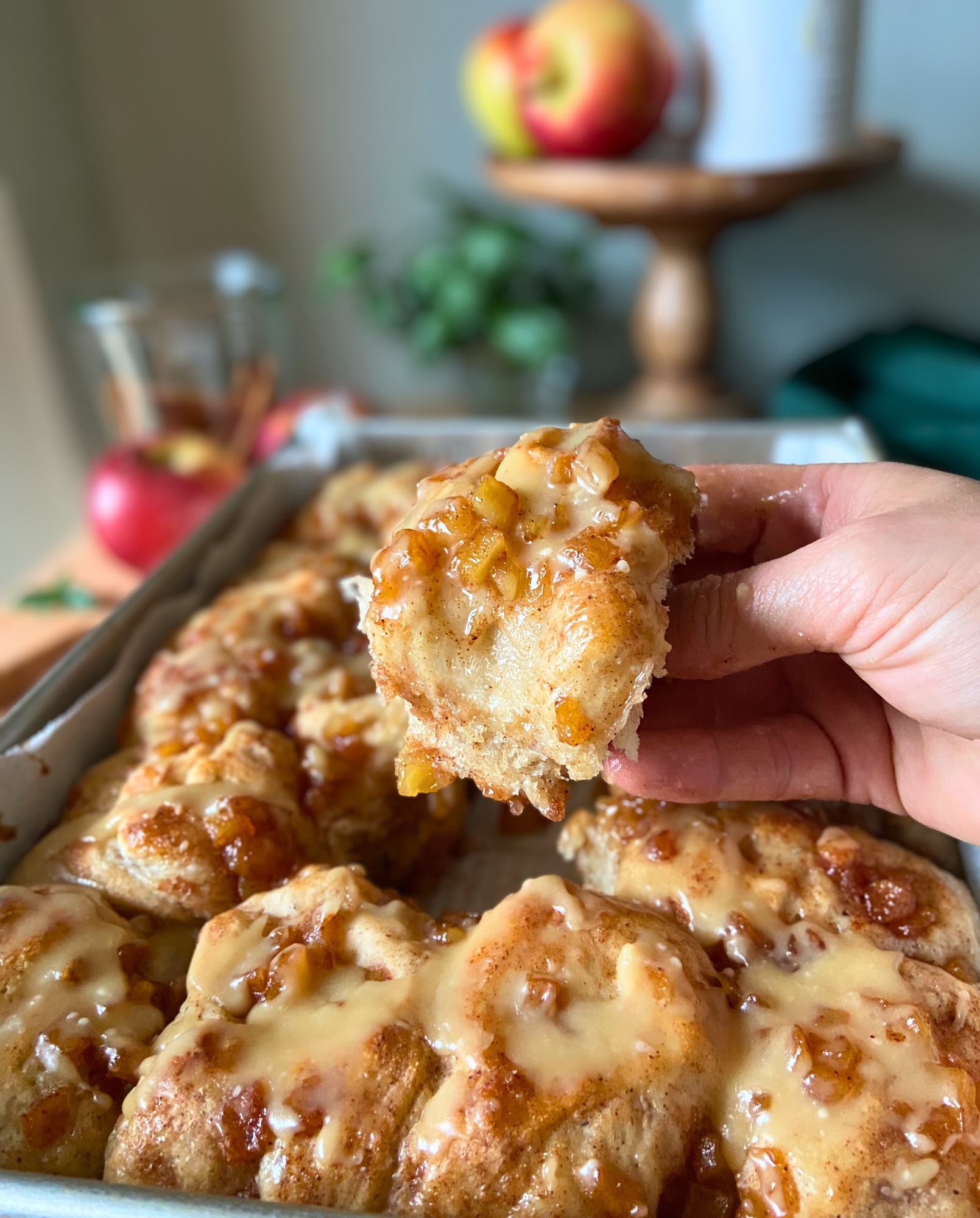
This caramel apple pie pull-apart focaccia takes everything I love about a warm slice of apple pie with caramel sauce and turns it into a pan of soft, fluffy focaccia pieces that you tear apart with your hands. Each ball of dough is dipped in a homemade spiced apple pie filling, rolled in cinnamon sugar, and baked until deep golden, then the whole pan gets a salted caramel glaze that sets into the most satisfying crackly shell, just like the coating on a real caramel apple.
I wanted a fall bake that felt like dessert but still worked on a breakfast table, something I could set out on Thanksgiving morning or a slow Saturday and watch disappear before it cooled, and this is the one I come back to every apple season. You can make it with an active sourdough starter and let the overnight rise do the work, or use the same day yeast version and have it on the table by the afternoon, and both recipes have their own printable cards below.
Table of Contents
- Why This Recipe Works
- About the Pull-Apart Focaccia Series
- Ingredient Breakdown
- Bread Flour vs All Purpose Flour
- Why Is My Dough So Sticky?
- How to Make Caramel Apple Pie Pull-Apart Focaccia
- 3 Minute Microwave Caramel Glaze
- The Best Apples for This Recipe
- The Sourdough Recipe
- The Yeast Recipe
- Tips for Success
- Troubleshooting
- Variations and Additions
- Have Fun With It
- Storage and Make Ahead
- Frequently Asked Questions
- More Pull-Apart Focaccia Recipes
- More Fall Recipes You Will Love
- Shop This Recipe
- Made This Recipe?
- Subscribe
Why This Recipe Works

- The filling goes on every single piece. Each ball of dough is dipped into warm apple pie filling before it is coated, so the spiced apples bake right into the bread and every bite tastes like pie.
- The cinnamon sugar coating has a job to do. A little cornstarch in the cinnamon sugar soaks up moisture from the filling and forms a thin crust that caramelizes in the oven, keeping the outside lightly crisp while the inside stays soft and fluffy.
- The caramel glaze sets like a caramel apple. Finishing a quick microwave caramel with powdered sugar gives you a glaze that pours easily over the warm bread and then firms into a glossy, crackly shell as it cools.
- It fits your schedule. The sourdough version rises overnight while you sleep, and the yeast version is built on my same day focaccia dough so you can start it after breakfast and serve it that afternoon.
- It is made for sharing. The pull-apart format means no slicing and no plates required, which makes it an easy centerpiece for brunch, a holiday table, or a fall get together.
About the Pull-Apart Focaccia Series
This recipe is part of my pull-apart focaccia series, which started with my Garlic Parmesan Pull-Apart Focaccia and took off with the Cinnamon Roll Pull-Apart Focaccia, whose reels have passed 50 million views across social media. Every recipe in the series follows the same idea: take a simple, high hydration focaccia dough, divide it into golf ball size pieces, dip each one in something flavorful, roll it in a coating, and let the balls rise together in the pan so they bake into one loaf that pulls apart into individual pieces.
Once you learn the method you can take it in almost any direction, sweet or savory, and this caramel apple pie version is my favorite way to bring the technique into fall.
Ingredient Breakdown
The exact amounts are in the recipe cards below, so this section covers what each ingredient brings to the pan.
- Bread flour gives the dough the structure it needs to hold the air bubbles from the rise and still bake up soft, chewy, and pillowy.
- Active sourdough starter or yeast is the only real difference between the two versions, with a fed, bubbly starter for the overnight version and instant or active dry yeast for the same day version.
- Sugar, cinnamon, and nutmeg go right into the dough, so the bread itself tastes like fall instead of relying only on the coating for flavor.
- Apples are the heart of the filling, and firm apples that hold their shape work best, which I break down in the apple section below.
- Brown sugar, lemon juice, vanilla, and warm spices turn the diced apples into a quick stovetop apple pie filling, and the butter gives it a rich, glossy finish.
- Cornstarch shows up twice, once to thicken the filling so it clings to the dough, and again in the cinnamon sugar, where it helps create that lightly crisp, caramelized exterior.
- Sugar, heavy cream, butter, and powdered sugar make the salted caramel glaze, and the powdered sugar is what helps it set into a crackly shell, so it is worth keeping.
Bread Flour vs All Purpose Flour
This recipe is written for bread flour because its higher protein content, usually around 12 to 14 percent compared with 10 to 12 percent for all purpose flour, builds a stronger gluten network that traps more gas during the rise and gives you a taller, fluffier, chewier bake.
All purpose flour still works well, and you will get a slightly softer, more tender crumb with a little less rise. Because all purpose flour absorbs less water, the dough needs a little less of it so it does not become too slack to shape, and the adjusted amount is in the notes of each recipe card.
Why Is My Dough So Sticky?
This is a high hydration dough at about 80 percent, which means the water weighs about 80 percent as much as the flour, and that extra water is exactly what gives focaccia its soft, open, airy crumb. It will feel sticky and loose, and if you are not used to working with wet dough it can seem strange at first, but sticky means you are on the right track.
The key is a light touch, so work with damp or lightly oiled hands, use quick and gentle movements, and during your stretch and folds keep your hand on the top surface of the dough as you lift and fold instead of pushing all the way in, since you are not kneading this dough the way you would a sandwich loaf. A light spray of oil on your counter and a bench scraper make portioning the balls much easier, and it is best to resist adding extra flour, which firms up the crumb you are working so hard to keep soft.
How to Make Caramel Apple Pie Pull-Apart Focaccia
This is the process at a glance, and the exact amounts, temperatures, and timing for both versions are in the recipe cards below.
Mix and Rise the Dough
The dough comes together in one bowl with no kneading, and the stretch and folds do the work of building strength. The sourdough version only needs one set before its long overnight rise, because that slow fermentation builds structure on its own, while the yeast version rises in a few hours and gets three sets of stretch and folds to make up the difference. Either way, the dough is ready to shape once it has doubled and looks puffy, bubbly, and jiggly.
Make the Apple Pie Filling
The diced apples cook down with brown sugar, lemon, vanilla, spices, and butter until they are just tender, then a cornstarch slurry thickens the juices so the filling clings to the dough instead of running off. Keeping the filling warm is what lets it coat evenly and hold the cinnamon sugar.
Dip, Coat, and Arrange

Each golf ball size piece of dough goes into the warm filling so it picks up a few apple chunks, then straight into the cinnamon sugar while it is still wet, and into the pan so the balls are touching. Touching is important, since the balls grow into each other during the second rise and that is what turns them into one pull-apart loaf.
Rise and Bake
The pan rises again until the balls are puffy and have grown together, then any leftover filling goes over the top before baking. A deep golden top and a fully baked center are what you are looking for, and an instant read thermometer is the easiest way to know for sure.
Make the Caramel Glaze
The glaze is made in about 3 minutes in the microwave, and I walk through exactly how to get it right in the section below.
3 Minute Microwave Caramel Glaze
The caramel glaze is the part of this recipe people tend to worry about, and it is also the easiest part once you know the method. I make it with my 3 minute Easy Microwave Caramel Sauce, which skips the stovetop and the candy thermometer entirely and gives you smooth, glossy caramel every time, then I whisk in a little powdered sugar so it sets into that crackly caramel apple shell once it hits the warm focaccia.

Here is how it comes together, and the exact amounts and microwave intervals are in both recipe cards below.
- Warm the cream first. Heat the cream while the focaccia bakes so it is hot when the caramel is ready, because cold cream hitting hot sugar is what makes caramel seize into clumps.
- Water goes in the bowl before the sugar. Pour the sugar slowly into the center of the water and do not stir at all, since stirring splashes sugar crystals onto the sides of the bowl and that is what turns caramel grainy.
- Use a clear bowl with high sides. A clear glass bowl lets you see the color change, and the high sides give the caramel room when it bubbles up.
- Microwave in shorter and shorter bursts. Start with a full minute, then check it in short intervals, and shorten them even more once it starts to color, since microwave wattages vary and the color is your real timer.
- Pull it at honey gold, not amber. This is the secret to never burning it. The caramel keeps cooking from its own heat, so a one minute rest on the counter carries it from honey gold to a rich amber on its own.
- Whisk in the cream slowly, then the butter. Add the warm cream a little at a time while whisking, because it bubbles hard, then whisk in the butter, salt, and vanilla until silky.
- Finish with powdered sugar. Once the caramel cools to just warm, the powdered sugar thickens it into a pourable glaze that sets into a crackly shell as it cools on the focaccia.
If you love having caramel on hand, the full Easy Microwave Caramel Sauce post makes a jar for ice cream, apple slices, and coffee too, and it keeps in the refrigerator for up to a week.
The Best Apples for This Recipe
- Granny Smith is my favorite because it is tart and firm, holds its shape well, and balances all the sweetness in the coating and glaze.
- Keepsake has a complex sweet and tart flavor with excellent texture that holds up beautifully when cooked.
- Honeycrisp is sweet and juicy with great texture and adds natural sweetness to the filling.
- A mix of Granny Smith and Honeycrisp gives you the best of both, with bright tartness and natural sweetness in every bite.
- Braeburn and Pink Lady both have a nice sweet and tart balance and stay firm during cooking.
- Golden Delicious is sweet and mild and softens a little more than the others, which some people love.
- Red Delicious and McIntosh are the two I would avoid, since they turn soft and mealy when cooked.
The Sourdough Recipe
This is the original version and the one that made this recipe take off. The overnight room temperature rise gives the bread a deeper, more developed flavor and a beautifully soft structure, and it means most of the work happens while you sleep. Use a fed, bubbly starter at its peak for the best rise, and if you need a starter, my Minimal Waste Sourdough Starter guide walks you through it.

Caramel Apple Pie Pull-Apart Sourdough Focaccia
Equipment
- Large mixing bowl
- Digital Kitchen Scale
- Danish dough whisk or large spoon
- Instant read thermometer
- 9×13 inch baking pan
- Medium saucepan with lid
- Two shallow bowls or plates (for dipping and coating)
- Microwave safe bowl (for the caramel)
- bench scraper
- Plastic wrap or a lid
Ingredients
Sourdough Focaccia Dough
- 500 g bread flour (4 cups plus 2 tablespoons, spooned and leveled)
- 400 g water room temperature (1⅔ cups)
- 75 g active sourdough starter fed and bubbly (⅓ cup)
- 10 g salt (1¾ teaspoons)
- 15 g sugar (1 tablespoon plus ½ teaspoon)
- 2.5 g ground cinnamon 1 teaspoon
- 1 g ground nutmeg optional, 1/4 teaspoon
Apple Pie Filling
- 450 g apples peeled and diced into 1/4-inch pieces (about 3 medium apples)
- 75 g brown sugar packed (⅓ cup)
- 15 g fresh lemon juice (1 tablespoon)
- 3 g vanilla extract (¾ teaspoon)
- 5 g ground cinnamon (2 teaspoons)
- 1 g ground nutmeg (½ teaspoon)
- 0.5 g ground ginger (¼ teaspoon)
- 1.5 g salt (¼ teaspoon)
- 15 g unsalted butter (1 tablespoon)
- 8 g cornstarch for the slurry (1 tablespoon)
- 30 g water for the cornstarch slurry (2 tablespoons)
Cinnamon Sugar Coating
- 100 g granulated sugar (½ cup)
- 30 g cornstarch (¼ cup)
- 8 g ground cinnamon 1 Tablespoon
Caramel Glaze
- 67 g granulated sugar (⅓ cup)
- 20 g water (1 tablespoon plus 1 teaspoon)
- 30 g heavy cream warmed, (2 tablespoons)
- 15 g unsalted butter (1 tablespoon)
- 2.5 g vanilla extract (½ teaspoon)
- Pinch of salt
- 40 g powdered sugar (⅓ cup)
Instructions
Day 1: Make the Sourdough Dough
- Mix the dough
- Mix the dough. In a large bowl, combine the 400 g water, 75 g active sourdough starter, 10 g salt, 15 g sugar, 5 g cinnamon, and nutmeg if using, and stir until combined. Add the 500 g bread flour and mix until no dry flour remains. The dough will be sticky and shaggy, which is exactly right.
- Rest
- Cover the bowl with a damp towel or plastic wrap and let rest for 1 hour at room temperature.
- Stretch and fold
- With a wet hand, take the edge of the dough, pull it up, and fold it into the middle, working your way around the bowl about six times. Then place your fingers on the seam and your thumb against the side of the bowl, pull the dough up, and flip it over onto itself so the seam ends up on the bottom. Run your hand along the edge, pushing away and tucking under at the same time, and repeat that push and tuck a few times until the dough is taut. One set is all this dough needs.
- Bulk fermentation
- Cover the bowl and let the dough rise at room temperature for 8 to 12 hours, until it has at least doubled and has a domed top, visible bubbles throughout, and a puffy, jiggly texture. Timing depends on your kitchen temperature and the strength of your starter, so watch the dough rather than the clock.
Day 2: Make Filling, Shape, Rise, and Bake
- Make the apple pie filling
- In the morning, combine the diced apples, brown sugar, lemon juice, vanilla, cinnamon, nutmeg, ginger, salt, and butter in a medium saucepan over medium heat. Cover and cook, stirring occasionally, until the apples soften, about 8 to 10 minutes. Whisk the 8 g cornstarch with the 30 g water until completely smooth, pour it into the apples, and stir constantly for 1 to 2 minutes until thickened. Remove from the heat and keep the filling warm and pourable while you shape.
- Prepare your pan
- Grease a 9×13 inch baking pan generously with butter or cooking spray.
- Prepare cinnamon sugar coating
- In a shallow bowl or plate, whisk together granulated sugar, cornstarch, and cinnamon. Set aside for dipping.
- Ball, Dip and Coat

- Turn the risen dough out onto a lightly oiled surface. With oiled hands, pinch off a golf ball size piece of dough, dip it into the warm apple pie filling so all sides are coated and a few apple chunks come along with it, then immediately roll it in the cinnamon sugar until completely covered. Place it in the prepared pan and repeat with the remaining dough, arranging the balls so they touch.
- Second rise
- Cover loosely with plastic wrap or a damp towel and let rise for 1-2 hours at room temperature, or until puffy and the balls have grown together. They should jiggle slightly when you shake the pan.
- Add remaining filling
- After the second rise, pour or spoon any remaining apple pie filling over the top of the proofed focaccia.
- Bake
- Preheat oven to 425°F (220°C). Bake for 35-40 minutes, or until deep golden brown on top. If the top is browning too quickly (check around 25 minutes), tent with foil. The internal temperature should reach about 200-205°F. Cool in the pan for 10 minutes.
- Make the Caramel Glaze (See notes section for alternative)
- Make caramel
- In a microwave safe bowl, combine the 67 g granulated sugar and 20 g water and do not stir. Microwave on high for 1 minute, then continue in 30 second intervals while watching closely, until the syrup turns a medium amber color, about 2½ to 3 minutes total. The sugar is extremely hot, so handle the bowl carefully.
- Add cream and butter
- Carefully stir in warmed heavy cream (it will bubble up dramatically!), butter, vanilla, and salt. The mixture will seize up at first but keep stirring. Let cool for 5-10 minutes until just warm to the touch.
- Finish glaze
- Whisk in powdered sugar until smooth. The glaze should be pourable but have some body to it.
- Glaze
- Drizzle the caramel glaze generously over the warm focaccia. Make sure every piece gets covered.
- Let the glaze set for a few minutes before serving.
- Serve
- Pull apart and enjoy! Each piece is like a mini caramel apple pie.
Notes
The Yeast Recipe
If you do not keep a sourdough starter, you can make this exact caramel apple pie pull-apart focaccia with instant or active dry yeast and have it ready the same day. The apple pie filling, the cinnamon sugar coating, the shaping, the bake, and the caramel glaze all stay the same, and the only things that change are the dough and the timeline.
The yeast version is built on my Same Day Focaccia dough, so instead of one set of stretch and folds and an overnight rise, the dough gets three sets of stretch and folds spaced 30 minutes apart, followed by a much shorter rise. Those folds build the strength that the long sourdough rise would normally develop on its own, which is what gives you a soft, airy crumb in just a few hours, and the full method for both instant and active dry yeast is in the printable card below.
Same Day Caramel Apple Pie Pull-Apart Focaccia (Yeast Version)
Equipment
- Large mixing bowl
- Digital Kitchen Scale
- Danish dough whisk or large spoon
- Instant read thermometer
- 9×13 inch baking pan
- Medium saucepan with lid
- Two shallow bowls or plates (for dipping and coating)
- Large clear microwave safe glass bowl with high sides (for the caramel)
- Plastic wrap or a lid
- Parchment paper
Ingredients
FOR THE SAME DAY FOCACCIA DOUGH:
- 500 g bread flour 4 cups plus 2 tablespoons, spooned and leveled
- 375 g warm water 1½ cups plus one Tablespoon, see notes for temperature
- 5 g instant yeast 1½ teaspoons OR 5 g active dry yeast (1½ teaspoons)
- 9 g fine sea salt 1½ teaspoons
- 15 g granulated sugar 1 tablespoon plus ½ teaspoon
- 5 g ground cinnamon 2 teaspoons
- 1.25 g ground nutmeg optional (½ teaspoon)
FOR THE APPLE PIE FILLING:
- 450 g apples peeled and diced into ¼ inch pieces (about 3 medium apples)
- 75 g brown sugar packed (⅓ cup)
- 15 g fresh lemon juice 1 tablespoon
- 3 g vanilla extract ¾ teaspoon
- 5 g ground cinnamon 2 teaspoons
- 1 g ground nutmeg ½ teaspoon
- 0.5 g ground ginger ¼ teaspoon
- 1.5 g salt ¼ teaspoon
- 15 g unsalted butter 1 tablespoon
- 8 g cornstarch 1 tablespoon
- 30 g water for the cornstarch slurry (2 tablespoons)
FOR THE CINNAMON SUGAR COATING:
- 100 g granulated sugar ½ cup
- 30 g cornstarch ¼ cup
- 8 g ground cinnamon 1 tablespoon
FOR THE CARAMEL GLAZE:
- 20 g water 1 tablespoon plus 1 teaspoon
- 67 g granulated sugar ⅓ cup
- 30 g heavy cream warmed (2 tablespoons)
- 15 g unsalted butter room temperature (1 tablespoon)
- 1 g salt ¼ teaspoon
- 2.5 g vanilla extract ½ teaspoon
- 40 g powdered sugar ⅓ cup
Instructions
Mix the dough.
- There are two ways to do this depending on your yeast. Follow only the method that matches your yeast, then continue with the rest of the recipe.
METHOD A: INSTANT YEAST (no blooming needed)
- Add the 500 g bread flour, 15 g sugar, 5 g cinnamon, and nutmeg if using to a large bowl. Place the 9 g salt on one side of the bowl and the 5 g instant yeast on the other side so they do not sit on top of each other. Pour in the 375 g warm water and mix until no dry flour remains. The dough will be very wet and sticky, which is exactly what you want, so do not add more flour. Check the back of your yeast packet for the recommended water temperature, since it varies by brand.
METHOD B: ACTIVE DRY YEAST (bloom the yeast first)
- Warm the 375 g water to 100 to 110°F, stir in the 5 g active dry yeast, and let it sit for about 10 minutes until foamy. If it does not foam, the yeast is dead and you need to start over with fresh yeast. Add the 500 g bread flour, 15 g sugar, 9 g salt, 5 g cinnamon, and nutmeg if using to a large bowl, pour in the yeast mixture, and mix until no dry flour remains.
Rest the dough.
- Cover the bowl and let the dough rest at room temperature for 30 minutes so the flour can fully hydrate before you start building structure.
Stretch and fold, first set.
- With a wet hand, take the edge of the dough, pull it up, and fold it into the middle, working your way around the bowl about six times and keeping your hand on the top surface of the dough rather than digging in. Then place your fingers on the seam and your thumb against the side of the bowl, pull the dough up, and flip it over onto itself so the seam ends up on the bottom. Run your hand along the edge, pushing away and tucking under at the same time, and repeat that push and tuck a few times until the dough is taut. Cover the bowl and rest 30 minutes.
Stretch and fold, second set.
- Repeat the same folds, flip, and push and tuck. The dough will already feel smoother and more cohesive than it did the first time. Cover and rest 30 minutes.
Stretch and fold, third set.
- Repeat the folds, flip, and push and tuck one final time. If the dough still feels slack and spreads out quickly, give it a fourth set after another 30 minutes.
Bulk rise.
- Cover and let the dough rise at room temperature until it has doubled in size and looks bubbly and jiggly, about 1 to 1½ hours after the final set. Watch the dough rather than the clock, because a warm kitchen moves much faster.
Make the apple pie filling.
- While the dough rises, combine the diced apples, brown sugar, lemon juice, vanilla, cinnamon, nutmeg, ginger, salt, and butter in a medium saucepan over medium heat. Cover and cook, stirring occasionally, until the apples soften, about 8 to 10 minutes. Whisk the 8 g cornstarch with the 30 g water until completely smooth, pour it into the apples, and stir constantly for 1 to 2 minutes until thickened. Remove from the heat and keep the filling warm and pourable while you shape.
Prepare the pan.
- Grease a 9×13 inch baking pan generously with butter or cooking spray.
Prepare the cinnamon sugar coating.
- Whisk together the granulated sugar, cornstarch, and cinnamon in a shallow bowl or plate.
Portion, dip, and coat.
- Turn the risen dough out onto a lightly oiled surface. With oiled hands, pinch off a golf ball size piece of dough, dip it into the warm apple pie filling so all sides are coated and a few apple chunks come along with it, then immediately roll it in the cinnamon sugar until completely covered. Place it in the prepared pan and repeat with the remaining dough, arranging the balls so they touch.
Second rise.
- Cover the pan loosely and let it rise at room temperature for 1 to 2 hours, until the balls are puffy, have grown together, and jiggle slightly when you shake the pan.
Add the remaining filling.
- Spoon any leftover apple pie filling over the top of the proofed focaccia.
Bake.
- Preheat the oven to 425°F (220°C) and make sure it is fully preheated before the pan goes in. Bake for 35 to 40 minutes, until deep golden brown on top. Check at 25 minutes and loosely tent the pan with foil if the top is browning too quickly. The internal temperature should reach 200 to 205°F. Let the focaccia cool in the pan for 10 minutes.
- Warm the cream.
- While the focaccia bakes, heat the 30 g heavy cream in the microwave or a small saucepan until hot but not boiling, and keep it warm. Measure out the butter, salt, and vanilla so they are ready to go.
Start the caramel.
- Add the 20 g water to a large, clear, microwave safe glass bowl with high sides, then slowly pour the 67 g granulated sugar into the center of the water. Do not stir, since stirring splashes sugar crystals onto the sides of the bowl and can make the caramel grainy.
- Microwave in intervals. Microwave on high for 1 minute, then continue in 30 second intervals, checking after each one. Once you pass the 2 minute mark, switch to 15 second intervals and stop the moment the syrup turns honey gold, about 2 to 3 minutes total depending on your microwave.
- Let it rest. Using oven mitts, set the bowl on a heat safe surface and leave it undisturbed for about 1 minute. The carryover heat will darken the caramel to a rich amber without any risk of burning it in the microwave.
- Add the cream and butter. Slowly add the warm cream about 1 tablespoon at a time, whisking constantly, since it will bubble up vigorously. Once the cream is fully incorporated, whisk in the butter until melted and smooth, then whisk in the salt and vanilla.
Finish the glaze.
- Let the caramel cool for 5 to 10 minutes until just warm to the touch, then whisk in the 40 g powdered sugar until the glaze is smooth, thick, and still pourable.
Glaze and serve.
- Drizzle the caramel glaze generously over the warm focaccia so every piece gets covered, let it set for a few minutes, then pull apart and enjoy while it is warm.
Notes
Tips for Success

- Use your starter at its peak. For the sourdough version, your starter should have roughly doubled since its last feeding and be full of bubbles when you mix the dough.
- Check your yeast packet. For the yeast version, the right water temperature depends on your brand, so read the packet and use a thermometer rather than guessing.
- Keep the filling warm. Warm filling coats the dough evenly and acts as the glue for the cinnamon sugar, while cold filling turns thick and clumpy, so rewarm it gently if it cools while you work.
- Work quickly when coating. Dip, roll, and place each ball in the pan right away so the filling is still wet enough for the sugar to stick.
- Watch the dough, not the clock. Look for balls that are puffy, have grown together, jiggle when you shake the pan, and spring back slowly when you press them gently, since an underproofed pan bakes up dense and an overproofed pan bakes up flat.
- Tent with foil if needed. The sugar on top browns quickly, so check partway through the bake and loosely cover the pan if the top is getting dark before the center is done.
- Stay with the caramel. Pull the caramel at honey gold. Let the one minute rest take it to amber, since that carryover heat is what keeps it from burning.
- Serve it warm. This focaccia is at its absolute best the day it is made, while the pieces are still warm and pull apart easily.
Troubleshooting
- My focaccia is dense and heavy. This almost always comes down to underproofing during the bulk rise or the second rise, so give the dough the time it needs to double and look for the puffy, jiggly signs above. An inactive starter, old yeast, or skipped stretch and folds can also leave the dough without enough strength to rise well.
- My caramel glaze is not setting. The glaze is likely too thin, so make sure you are using powdered sugar rather than granulated and are not adding extra cream. It should coat the back of a spoon and still pour, and it sets best on warm bread rather than bread straight out of the oven.
- My apple filling made the focaccia soggy. Whisk the cornstarch slurry until completely smooth before adding it, and keep stirring for the full time in the recipe card so the filling thickens properly.
- The cinnamon sugar fell off. The filling was probably too cool when you coated the balls, so keep it warm and roll each ball in the sugar immediately after dipping.
- My caramel tastes bitter. It went too far in the microwave, so next time stop at honey gold and let the resting minute darken it. If it seized when you added the cream, the cream was too cold, so warm it first and whisk gently over low heat to smooth it out.
- The top is browning too fast. Loosely tent the pan with foil and keep baking until the center reaches the temperature in the recipe card.
Variations and Additions
- Add some crunch. Stir 30 g chopped pecans or walnuts (¼ cup) into the apple pie filling, or sprinkle chopped toffee bits over the caramel glaze while it is still soft.
- Make it maple. Add 2 g maple extract (½ teaspoon) to the apple pie filling for a maple apple flavor.
- Make it grown up. Stir 30 g bourbon or rum (2 tablespoons) into the filling while it cooks.
- Try a cream cheese drizzle. Mix 113 g softened cream cheese (½ cup) with 30 g milk (2 tablespoons) and 15 g powdered sugar (2 tablespoons), or warm some store bought dulce de leche and drizzle it over the top.
- Skip the caramel. A simple vanilla glaze works beautifully here, and the full recipe for it is in the notes of both recipe cards.
- Make a smaller batch. Halve every ingredient and bake in an 8 or 9 inch square pan, starting to check for doneness a few minutes early.
Have Fun With It
This is the kind of recipe that makes people gather around the pan, so make it an event. Serve it warm with a scoop of vanilla ice cream for dessert, set it out with a pot of coffee or hot apple cider on a chilly morning, or bring it to a fall party and let everyone pull off their own piece. It is also a great way to use up the apples from a day of apple picking, and kids love helping with the dipping and rolling.
Storage and Make Ahead
This focaccia is best the day it is made, while it is still warm and the caramel is crackly, but it holds up well for a couple of days covered on the counter and a few more in the refrigerator, and a quick warm up in the microwave brings the pieces back to soft.
If you want to freeze it, freeze the baked focaccia before glazing, then thaw it, warm it, and add the caramel glaze fresh when you serve it. Freezing the glazed focaccia is not recommended, since the caramel does not hold its crackly texture after thawing.
For make ahead, the apple pie filling can be made a couple of days early and rewarmed, and for either version you can shape, dip, and arrange the balls the night before, cover the pan well, and refrigerate it overnight, then let it come to room temperature and finish rising in the morning before baking. The sourdough version also works on a night before schedule where the dough rises overnight on the counter and you shape in the morning. The exact storage times and both make ahead schedules are in the recipe card notes.
Frequently Asked Questions
Can I use store bought apple pie filling?
You can, although homemade takes only about 10 minutes and lets you control the sweetness and thickness. If you use store bought filling, chop any large apple slices into small pieces and thin the filling with a little water or apple cider so it coats the dough easily.
Does the yeast version taste different from the sourdough version?
There is a slight difference, since the sourdough version has a deeper, more developed flavor from its long overnight rise while the yeast version is milder and a little sweeter, which pairs beautifully with the caramel and apples, and both bake up soft, fluffy, and pull apart the same way.
Why does the yeast version use three sets of stretch and folds?
The sourdough dough builds strength slowly during its overnight rise, so one set of stretch and folds is all it needs. The yeast dough rises in a few hours, so three sets spaced out over the first 90 minutes build that same strength in much less time.
What if my apple filling is too thick or too thin?
If it is too thick, whisk in 15 g water or apple cider (1 tablespoon) at a time while it is warm until it coats easily. If it is too thin, mix 1 g cornstarch (½ teaspoon) with 15 g water (1 tablespoon), stir it into the filling, and cook for another minute until it thickens.
Can I assemble this the night before?
Yes, you can shape, dip, coat, and arrange the balls, cover the pan well, and refrigerate it overnight, then let it come to room temperature and finish rising in the morning before you bake and glaze.
How do I know when it is done baking?
The top should be a deep golden brown, and an instant read thermometer in the center should read the internal temperature listed in the recipe card.
Can I freeze caramel apple pie pull-apart focaccia?
Yes, as long as you freeze it before glazing. Let the baked focaccia cool completely, freeze it, then thaw, warm, and add the caramel glaze fresh when you serve it.
My sourdough starter is not very active. Will this still work?
It will, but the overnight rise will take longer, sometimes 14 to 16 hours. For the best results, feed your starter and use it once it has doubled and is at its peak.
What if I do not have a microwave?
You can make the caramel on the stovetop, and while it takes a little more attention and a candy thermometer, the method is simple. Add the water and then the sugar to a small, heavy, light colored saucepan and cook it over medium heat without stirring, gently swirling the pan instead and brushing any sugar crystals off the sides with a wet pastry brush. Once the syrup turns honey gold, about 330 to 340°F, take it off the heat and let it sit for a minute to deepen to amber, then slowly whisk in the warm cream, followed by the butter, salt, and vanilla. Since this is a small batch, tilt the pan so the thermometer tip sits in the syrup for an accurate reading. If you do have a microwave, my 3 minute microwave caramel is the easier route and skips the thermometer entirely.
Can I use all purpose flour?
Yes, just use slightly less water, since all purpose flour absorbs less than bread flour, and expect a softer crumb with a little less rise. The adjusted water amount is in the recipe card notes.
More Pull-Apart Focaccia Recipes
If you love this one, there is a whole series waiting for you.
Sweet
- Cinnamon Roll Pull-Apart Focaccia
- Jelly Donut Pull-Apart Focaccia
- Lemon Blueberry Pull-Apart Focaccia
- Carrot Cake Pull-Apart Focaccia
- Strawberry Shortcake Pull-Apart Focaccia
- S’mores Pull-Apart Focaccia
- Banana Bread Sourdough Focaccia
Savory
- Garlic Parmesan Pull-Apart Focaccia
- Pizza Pull-Apart Focaccia
- Pigs in a Blanket Pull-Apart Focaccia
- Buffalo Chicken Dip Pull-Apart Focaccia
- Pulled Pork Pull-Apart Focaccia
- Meatball Stuffed Pull-Apart Focaccia
- Chick-fil-A Pull-Apart Focaccia
The Base Doughs
More Fall Recipes You Will Love

- Caramel Apple Cinnamon Rolls
- High Protein Caramel Apple Cinnamon Rolls
- The Easiest Apple Cinnamon Swirl Sourdough Bread
- The Easiest Pumpkin Swirl Sourdough Bread
- Sourdough Pumpkin Jack O Lantern Bread with Butter Candle
- Sourdough Croissant Masterclass
Shop This Recipe
These are the tools I reach for every time I make a pan of pull-apart focaccia. Some of the links below are affiliate links, which means I earn a small commission at no extra cost to you, and it helps support the blog.
- 9×13 Inch Baking Pan A light colored metal pan bakes the focaccia evenly and gives the bottoms a golden finish without scorching the sugar.
- Digital Kitchen Scale Weighing the flour, water, and salt is the easiest way to get the same soft, airy result every single time.
- Danish Dough Whisk It mixes sticky, high hydration dough quickly without the dough clinging to it the way it does to a spoon.
- Bench Scraper It makes portioning sticky dough into even golf ball size pieces so much easier.
- Instant Read Thermometer It takes the guesswork out of knowing when the center of the focaccia is fully baked.
Made This Recipe?
I would love to hear how your caramel apple pie pull-apart focaccia turned out! Leave a star rating and a comment below letting me know whether you made the sourdough or yeast version and which apples you used, and tag me @h3artofthehome on Instagram so I can see your pan.
Subscribe
Subscribing to the H3art of the Home newsletter is completely free, and it is the easiest way to never miss a recipe, with new sourdough bakes, pull-apart focaccia flavors, and high protein recipes delivered straight to your inbox.


Leave a Reply