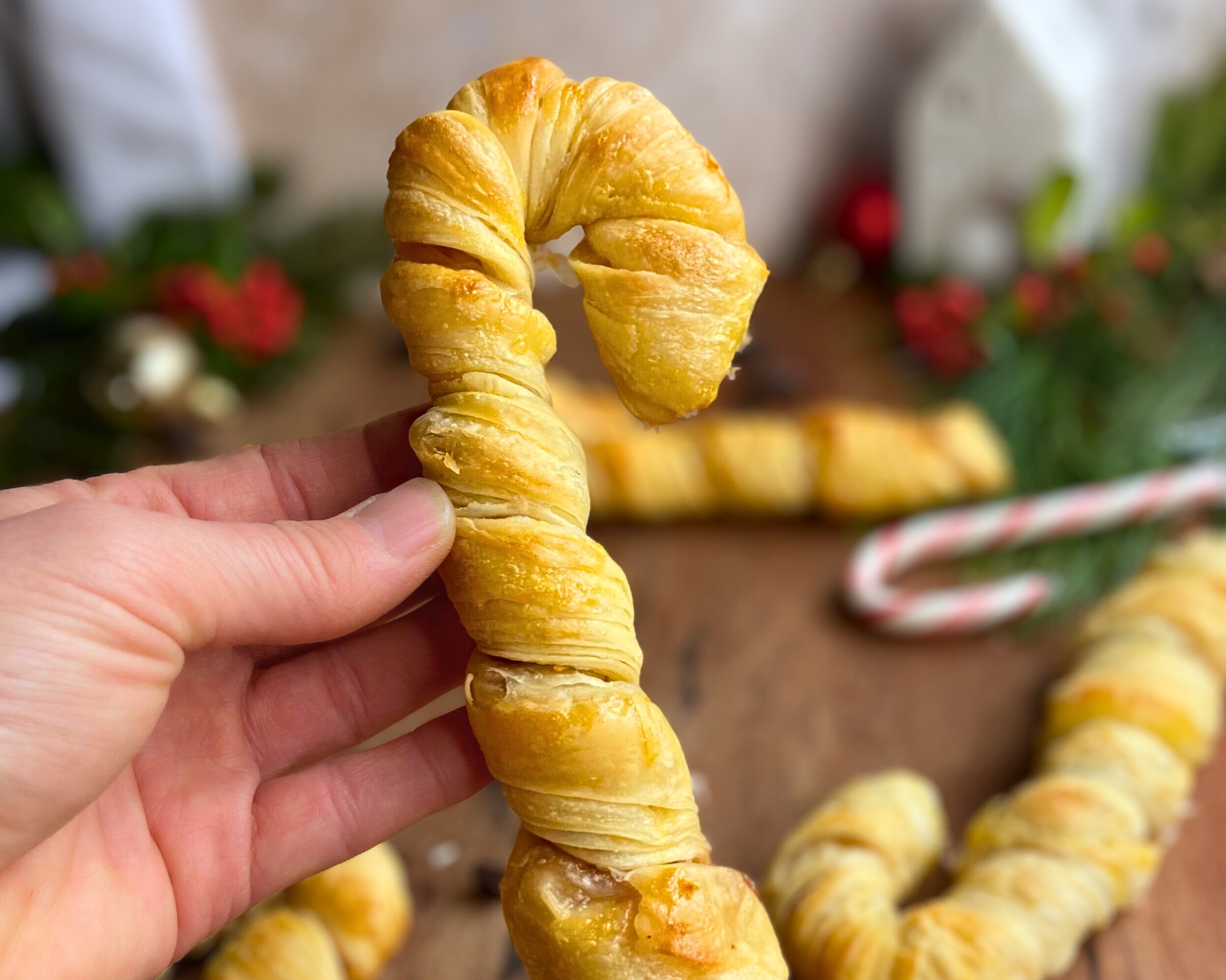
Listen, I know what you’re thinking. “Noelle, did you really just wrap laminated dough around a candy cane?” Yes. Yes I did. And you’re going to want to do it too, because these sourdough croissant candy canes are the most festive, flaky, buttery holiday creation you didn’t know you needed.
After spending over a year perfecting my sourdough croissant recipe, I’ve been having way too much fun coming up with creative ways to use that dough. This candy cane version hits different, though. The buttery layers, the peppermint bite from the candy cane, and if you add chocolate sticks (which, why wouldn’t you?), it’s basically Christmas morning in pastry form.
The technique is surprisingly straightforward if you already have my croissant dough recipe down. And if you don’t, grab my 60-page sourdough croissant guide because it includes everything: detailed visual guides, written instructions, all the tips and tricks from my croissant classes, and honestly, it’s just a really well-rounded resource. So many people have had excellent results with it, and I’m super proud of how it turned out.
Let’s make some candy canes, shall we?
Jump To:
- What Makes These Croissant Candy Canes Special
- Tips for Success
- About the Croissant Dough
- Candy Cane Selection
- The Chocolate Situation
- The Wrapping Technique
- Proofing: Watch the Dough, Not the Clock
- The Foil Trick for Perfect Hooks
- Baking Notes
- How to Make Sourdough Croissant Candy Canes (Recipe)
- Frequently Asked Questions
- Final Thoughts
- More Ways to Use My Sourdough Croissant Dough
What Makes These Croissant Candy Canes Special
These aren’t just cute (though they are ridiculously photogenic). The laminated dough creates these beautiful, flaky layers that spiral around the candy cane. When you bite into one, you get butter, flake, a bite of peppermint, and if you added chocolate, little pockets of melted chocolate throughout. It’s texture heaven.
Plus, they’re a total showstopper.
Tips for Success (Please Read These!)

About the Croissant Dough
This recipe starts with my classic sourdough croissant dough. You’ll follow all the instructions in that recipe up until the final rollout where you’d normally cut and shape traditional croissants. Any cold proofing or refrigerator time happens in those instructions, so make sure you’re working with properly laminated, chilled dough before you start this candy cane technique.
Candy Cane Selection (It Matters!)
Use standard size candy canes for this recipe. And here’s a pro tip that annoyed me to no end: about half the candy canes I bought were already broken in the box. Check them before you start wrapping because there’s nothing more frustrating than getting halfway through the twist and having it snap. If you want to use mini candy canes, you can totally do that, just cut your dough strips in half. I haven’t tested the exact measurements for minis, but it should work fine.
The Chocolate Situation
Adding chocolate is optional, but come on. It’s chocolate. I use Callebaut chocolate sticks because they’re the perfect size and don’t leak everywhere. The key is to add the chocolate stick AFTER you’ve done one complete wrap around the candy cane. This puts it in the middle of the long stem section and helps create a good seal at the base. Then you just keep wrapping over both the candy cane and the chocolate. To add some to the top, you can break a stick in half and add it to the straight part of the candy cane hook.
The Wrapping Technique
Start at the bottom of the candy cane and line up your dough strip. Make your first wrap overlap slightly at the beginning to seal it, then continue wrapping upward, overlapping each previous edge just a bit. Gently press down on the edge that you’re wrapping over as you go to help everything adhere. The hook part is tricky because you don’t want to pull too hard and snap the candy cane, so just take your time there.
If your dough starts feeling dry and isn’t sticking well, you can mist it very lightly with water. And I mean VERY lightly. You don’t want it soaking wet or the candy cane will start dissolving, which is a sticky nightmare nobody wants.
Proofing: Watch the Dough, Not the Clock
After shaping, place your candy canes seam side down on a parchment-lined baking sheet. Give them a gentle mist with water, cover them, and let them proof at room temperature. My kitchen usually sits around 70 to 74°F, and proofing takes anywhere from 6 to 12 hours. But here’s the thing: that’s just an estimate. If your kitchen is colder, it’ll take longer. If it’s warmer, they’ll move faster.
The most important thing is watching for the right signs of fermentation. Your candy canes should look puffy and be about 50% bigger than when you shaped them. Note: 50% bigger does NOT mean doubled in size. That’s a common misconception that leads to overproofed dough. You’re looking for a noticeable increase in size and, most importantly, you should start seeing the layers beginning to separate. That’s when you know they’re ready.
The Foil Trick for Perfect Hooks

Okay, this is my favorite little hack. Take a piece of nonstick aluminum foil and fold it over itself 3 or 4 times to create a little form. Loosely shape it around just the hook part of each candy cane before baking. This prevents the hook from expanding too much and losing its candy cane shape in the oven. After the first 15 minutes of baking, carefully remove the foil and let them finish baking uncovered for the last 5 minutes or so. Game changer.
Baking Notes
Bake these at 400°F for about 18 to 22 minutes total. I don’t recommend opening the oven or rotating the pan unless you see one side getting too dark. Croissants are temperamental, and opening the oven can mess with their rise. Just let them do their thing. The egg wash (egg yolk, milk or cream, and a touch of vanilla) gives them that gorgeous golden color.
They’re already pretty sweet from the candy cane, so I usually don’t add anything after baking, but if you want to dust them with powdered sugar for extra holiday vibes, go for it.
How to Make Sourdough Croissant Candy Canes
Step-by-Step Instructions
Prepare Your Dough

Start with your sourdough croissant dough that’s been laminated and chilled according to my croissant recipe When you’re ready for the final rollout (the point where you’d normally cut triangles for croissants), roll your dough out to a rough rectangle measuring approximately 12.5 x 8.5 inches.
Using a sharp knife or pizza cutter, trim about 1/4 inch off each edge. This creates clean edges so you can see those beautiful laminated layers and ensures an open, flaky crumb. After trimming, your rectangle should be roughly 12 x 8 inches. It doesn’t need to be perfect. Use a pastry brush to dust off any excess flour from the surface.
Cut Your Strips

Cut your dough into strips about 3/4 inch thick. You should get roughly 10 strips from this amount of dough, possibly 11 if you’re strategic about it. You don’t have to be worried about extreme precision with these, compared to regular croissants.
Wrap the Candy Canes

Take one candy cane and one strip of dough. Line up the end of the dough strip at the bottom of the candy cane (the straight end, not the hook). Begin wrapping the dough around the candy cane, overlapping the dough slightly at the very beginning to create a seal.
Continue wrapping upward in a spiral motion, slightly overlapping each wrap with the previous one. As you wrap, gently press the dough down to help it adhere to itself. Work slowly and steadily, especially when you get to the curved hook at the top. This is where candy canes are most likely to break, so don’t pull or tug.
If you’re adding chocolate: After completing one full wrap around the candy cane, place a chocolate stick against the candy cane. Continue wrapping the dough around both the candy cane and the chocolate stick together. This positions the chocolate in the middle section and creates a nice seal at the base. To add some to the top, you can break a stick in half and add it to the straight part of the candy cane hook.
If your dough feels dry or isn’t sticking well, very lightly mist the surface with water using a spray bottle. Be extremely sparing with the water because too much will start dissolving the candy cane.
Proof the Candy Canes
Place each wrapped candy cane seam side down on a parchment-lined baking sheet, spacing them a few inches apart. Lightly mist the tops with a fine spray of water. Cover the baking sheet with plastic wrap or a clean kitchen towel.
Let them proof at room temperature (ideally between 70 and 74°F) for 6 to 12 hours. The exact time will vary based on your room temperature and humidity. Colder environments will take longer; warmer environments will be faster.
They’re ready to bake when they look noticeably puffy and have increased in size by about 50%. This is NOT the same as doubling in size. You’re looking for a definite increase where the candy canes look fuller and softer, and most importantly, you can see the layers starting to separate from each other. That separation is your visual cue that fermentation is complete.
Prepare for Baking
Preheat your oven to 400°F.
Make your egg wash by whisking together 1 egg yolk, 2 tablespoons of milk or cream, and 1/4 teaspoon of vanilla extract. Using a pastry brush, gently brush the egg wash over each proofed candy cane, being careful not to deflate them.
Take a piece of nonstick aluminum foil and fold it over itself 3 to 4 times to create a thicker, more stable piece. Tear or cut smaller pieces and loosely shape them around just the hook portion of each candy cane. You’re creating a little protective barrier that doesn’t need to be crimped or sealed, just shaped around the curve to prevent over-expansion during baking.
Bake
Place the baking sheet in the preheated oven and bake for 15 minutes with the foil in place.
After 15 minutes, carefully open the oven and remove the foil pieces from around the hooks. Close the oven and continue baking for another 3 to 7 minutes (total baking time will be 18 to 22 minutes), until the candy canes are deep golden brown and the layers are fully separated and crispy.
Avoid opening the oven to rotate the pan unless you notice one side browning significantly faster than the other. Croissants are sensitive to temperature drops, and unnecessary opening can affect their rise.
Remove from the oven and let cool on the baking sheet for a few minutes before transferring to a wire rack. They’re best enjoyed the day they’re baked, but you can store them in an airtight container for up to 2 days. Reheat in a preheated 400°F oven for a few minutes to refresh the flakiness.

Sourdough Croissant Candy Canes with Optional Chocolate
Equipment
- Rolling Pin
- Ruler or measuring tape
- Sharp knife or pizza cutter
- Pastry brush for dusting flour
- Parchment paper
- Baking sheet
- Plastic wrap or lid for covering during proof
- Small bowl for egg wash
- Whisk or fork for egg wash
- Spray bottle filled with water
- Nonstick aluminum foil
- Wire cooling rack
Ingredients
- 1 batch sourdough croissant dough prepared through lamination see notes
- All purpose flour for dusting
- 10 standard size candy canes
- 10 chocolate sticks optional see notes for brand recommendation
- 1 egg yolk for egg wash
- 2 tablespoons milk or heavy cream for egg wash
- 1/4 teaspoon vanilla extract for egg wash
- Water in spray bottle for misting
- Nonstick aluminum foil for protecting hooks during baking
Instructions
- Roll your prepared and laminated sourdough croissant dough out to a rough rectangle measuring approximately 12.5 by 8.5 inches.
- Using a sharp knife or pizza cutter, trim about 1/4 inch off each edge of the dough rectangle to create clean edges and expose the laminated layers. After trimming, your rectangle should measure roughly 12 by 8 inches.

- Use a pastry brush to dust off any excess flour from the surface of the dough.
- Cut the dough into strips about 3/4 inch thick. You should get approximately 10 strips from this amount of dough.

- Take one candy cane and one strip of dough. Line up the end of the dough strip at the bottom of the candy cane at the straight end, not the hook.

- Begin wrapping the dough around the candy cane, overlapping the dough slightly at the very beginning to create a seal.
- Continue wrapping upward in a spiral motion, slightly overlapping each wrap with the previous one. As you wrap, gently press the dough down to help it adhere to itself.
- If you are adding chocolate, after completing one full wrap around the candy cane, place a chocolate stick against the candy cane. Continue wrapping the dough around both the candy cane and the chocolate stick together. If you want chocolate in the top hook, break a chocolate stick in half and add to the short, straight part of the hook.
- Work slowly and steadily when you reach the curved hook at the top. Be careful not to pull or tug too hard as this is where candy canes are most likely to break.
- If your dough feels dry or is not sticking well, very lightly mist the surface with water using a spray bottle. Be extremely sparing with the water because too much will start dissolving the candy cane.
- Repeat the wrapping process with the remaining candy canes and dough strips.
- Place each wrapped candy cane seam side down on a parchment lined baking sheet, spacing them a few inches apart.
- Lightly mist the tops of the wrapped candy canes with a fine spray of water.
- Cover the baking sheet with plastic wrap or a lid.
- Let them proof at room temperature for 6 to 12 hours. The exact time will vary based on your room temperature and humidity.
- They are ready to bake when they look noticeably puffy and have increased in size by about 50 percent. You should be able to see the layers starting to separate from each other.
- Preheat your oven to 400 degrees Fahrenheit.
- Make your egg wash by whisking together the egg yolk, milk or cream, and vanilla extract in a small bowl.
- Using a piece of paper towel or pastry brush, gently brush the egg wash over each proofed candy cane, being careful not to deflate them.
- Take a piece of nonstick aluminum foil and fold it over itself 3 to 4 times to create a thicker, more stable piece. Tear or cut smaller pieces and loosely shape them around just the hook portion of each candy cane.

- Place the baking sheet in the preheated oven and bake for 15 minutes with the foil in place.
- After 15 minutes, carefully open the oven and remove the foil pieces from around the hooks. Close the oven and continue baking for another 3 to 7 minutes, for a total baking time of 18 to 22 minutes, until the candy canes are deep golden brown and the layers are fully separated and crispy.
- Remove from the oven and let cool on the baking sheet for a few minutes before transferring to a wire rack.
Notes
Frequently Asked Questions

Can I make these without the chocolate?
Absolutely! The chocolate is completely optional. The candy cane alone provides plenty of flavor and sweetness. Some people prefer them plain, especially if they’re serving them at breakfast or brunch.
Do I have to use peppermint candy canes?
Traditional peppermint candy canes work best, but you could experiment with other flavors. Just make sure they’re the same size and shape as standard candy canes so the wrapping technique works the same way.
Can I make these ahead of time?
You can shape them and refrigerate them before the final proof if you need to break up the work. When you’re ready, take them out, let them come to room temperature, and then proceed with the room temperature proof as directed. I don’t recommend freezing them after shaping because the candy canes can get sticky and weird.
Why did my candy cane melt during proofing?
This usually happens if the dough got too wet from misting or if your proofing environment is too warm and humid. Use a very light hand with the water spray, and if your kitchen is particularly warm (above 75°F), try to find a cooler spot for proofing. That being said there will be some slight melting, but they will hold their shape.
My candy cane broke while I was wrapping it. Now what?
It happens! If it breaks near the end, you can sometimes still finish wrapping and the dough will hold the pieces together during baking. If it breaks early in the process, it’s better to start over with a new candy cane. This is why I always buy extra candy canes, because inevitably a few break. But if you can wrap it and get it onto the baking sheet. Usually you can adjust the dough to align the pieces.
Can I use a different type of chocolate?
You can, but chocolate sticks work best because they’re designed not to leak too much during baking. If you use chocolate chips or chunks, they might melt out more. Chocolate bars broken into stick shapes can work in a pinch.
How do I know if they’re proofed enough?
Look for these signs: the dough should look puffy and soft, about 50% larger than when you shaped them, and you should be able to see the individual layers starting to pull apart from each other. If you gently press the dough with your finger, it should slowly spring back but leave a slight indentation. If it springs back immediately, they need more time. If it doesn’t spring back at all and feels deflated, you’ve overproofed.
Why don’t my layers look as defined as yours?
This usually comes down to the lamination process in the original croissant dough. Make sure you’re following my croissant guide carefully, keeping your butter and dough at the right temperature during lamination, and doing the folds correctly. The candy cane shaping technique won’t fix lamination issues from earlier in the process.
Final Thoughts

These sourdough croissant candy canes are one of my favorite holiday creations. They’re festive, impressive, and honestly just really fun to make. If you’re already comfortable with my croissant dough, this technique is a great way to mix things up and create something that’ll make people stop.
If you haven’t grabbed my sourdough croissant guide yet, now’s the time. It took me over a year to develop that recipe, and the guide includes everything you need to succeed: detailed instructions, visual guides, troubleshooting tips, and all the knowledge from my croissant classes packed into 60 pages. So many people have had incredible results with it, and I can’t wait to see what you create.
Tag me in your candy cane croissant photos because I need to see how yours turn out. And if you have questions, drop them in the comments. Happy baking!
More Ways to Use My Sourdough Croissant Dough
If you loved these candy canes, you’re going to want to try these other creative takes on laminated dough:
- Croissant Pumpkins – Adorable fall pastries that look like actual pumpkins with flaky, buttery layers
- Peach Croissant Galette – Rustic, free-form tart with juicy peaches wrapped in croissant dough perfection
- Mini Croissant Croutons – The most extra (and delicious) way to top your soup or salad
- Croissant Mozzarella Sticks – Crispy, cheesy, flaky sticks of pure indulgence that’ll ruin regular mozzarella sticks for you forever
- Croissant Jalapeño Poppers– A spicy and cheesy twist on a classic.
- Apple Pie Braided Hand Pie– Flakey sourdough croissant dough, elegantly braided into a hand held treat.
Once you start making croissants, the possibilities are endless. What are you making first?


This post contains affiliate links to products I actually use and love in my kitchen. If you purchase through these links, I earn a small commission at no extra cost to you. Thanks for supporting H3art of the Home!


Leave a Reply