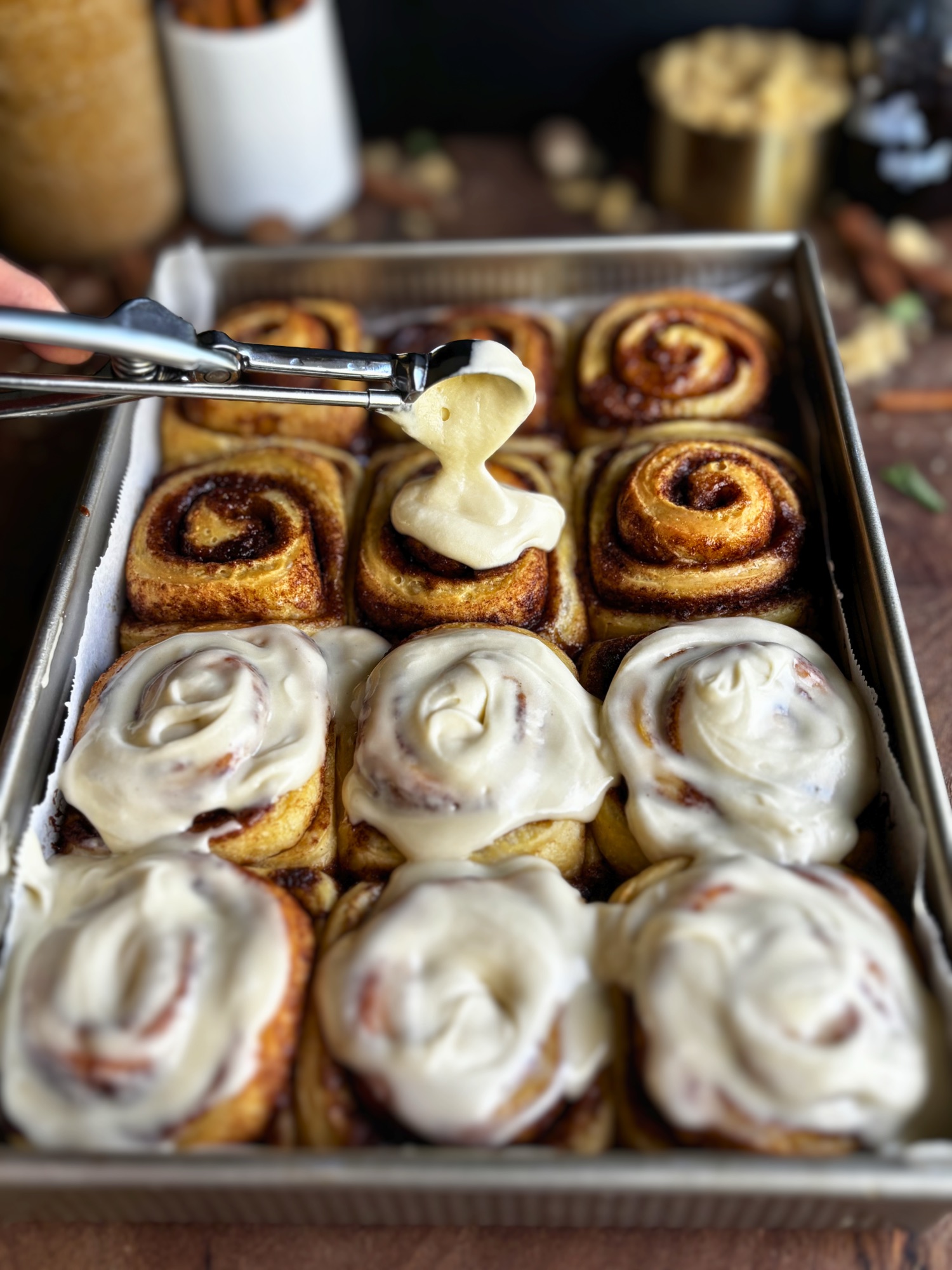
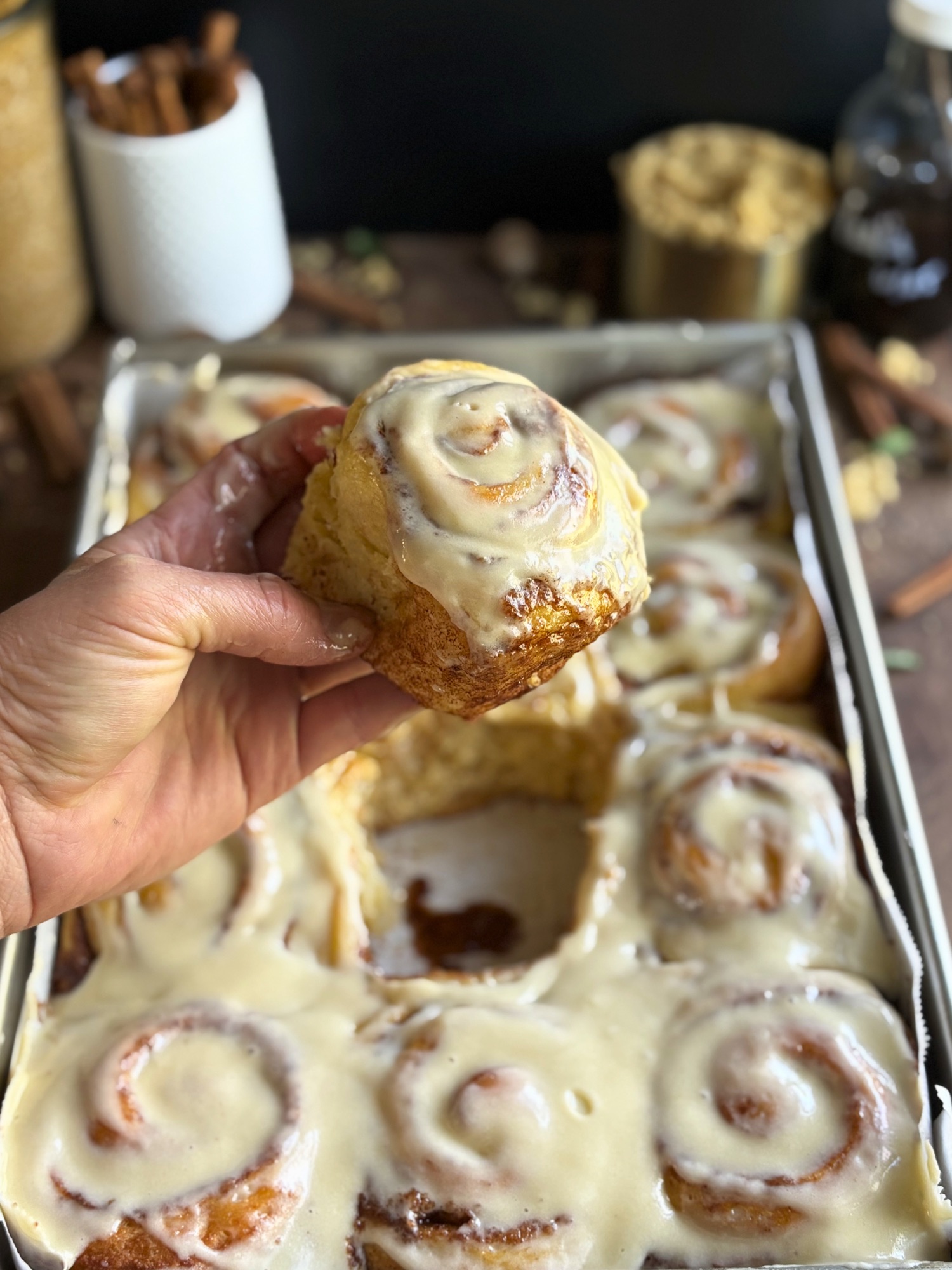
These rolls are not a compromise version of something better. They are the something better.
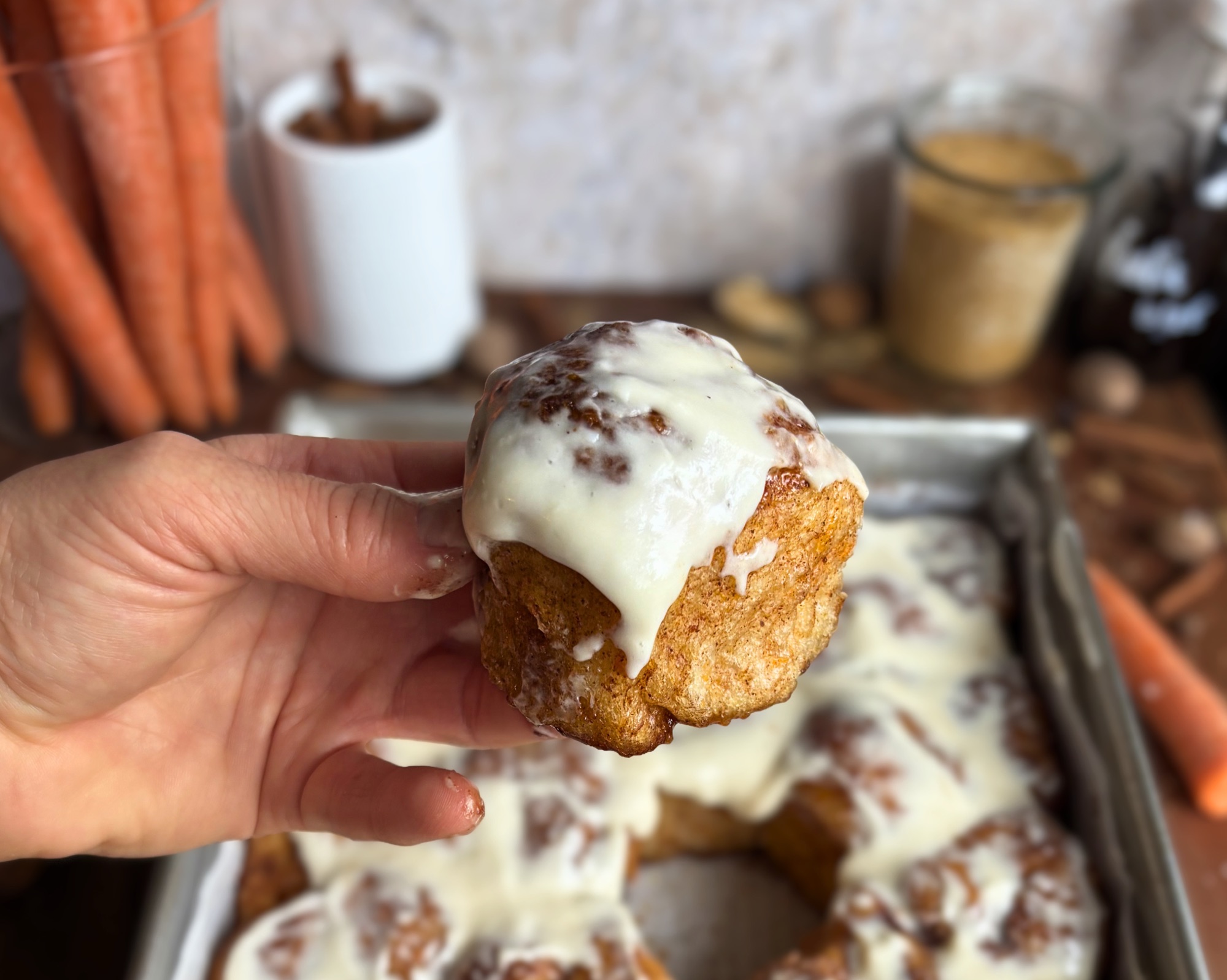
Pillowy soft, gooey filling, cream cheese glaze that melts into every layer while they are still warm. The kind of cinnamon roll that makes people stop what they are doing. The only difference between these and a traditional cinnamon roll is that these happen to deliver 12 grams of protein per roll, built entirely from real ingredients that belong in a baking recipe. Siggi’s plain nonfat skyr as the primary liquid. King Arthur Organic Bread Flour. Pasture raised eggs. Active sourdough starter doing the heavy lifting on leavening and flavor.
I started making these because I wanted the things I bake for my family to have a little more mileage without tasting like they were trying to. These do exactly that. You would never know these were anything other than the best cinnamon rolls you have ever had. Because they are.
Table of Contents
- Can I Make These Without Sourdough?
- Why These Rolls Are Higher in Protein
- The Protein Breakdown
- Ingredients and Why They Work
- The Filling
- How to Make High Protein Sourdough Cinnamon Rolls
- Recipe
- Tips for Success
- Overnight Option
- More High Protein Recipes
- Shop This Recipe
- Frequently Asked Questions
Can I Make These Without Sourdough?
Yes, and I have got you covered. I developed a yeasted version of these high protein cinnamon rolls specifically for bakers who do not have an active starter or want a faster timeline. The dough uses the same protein forward ingredients, the same filling, and the same cream cheese glaze. The only difference is instant yeast instead of sourdough starter, which cuts the total time down significantly. You can find that recipe right here: High Protein Cinnamon Rolls with Yeast.
Why These Rolls Are Higher in Protein
Most traditional sourdough cinnamon rolls land between 4 and 8 grams of protein per roll. That number is not bad for a pastry, but it is not doing much nutritional work either. These rolls more than double that without changing the flavor profile, without adding supplements, and without making any ingredient feel out of place in a baking recipe.
The protein comes from three primary sources working together. Siggi’s plain nonfat skyr is the biggest contributor. Siggi’s is technically an Icelandic skyr rather than a Greek yogurt, and the distinction matters here. Skyr is strained more aggressively than standard yogurt, concentrating the protein significantly and making it one of the highest protein dairy products you can bake with. Using it as the primary liquid in the dough rather than a small supplement means the protein contribution is real and meaningful.
King Arthur Organic Bread Flour adds to the picture with a protein content a full point higher than most national brands. And pasture raised eggs contribute slightly more protein per egg than standard eggs due to the denser nutrition profile that comes from hens raised on open pasture.
Put those three ingredients together and the protein math adds up in a way that most cinnamon roll recipes simply cannot match.

The Protein Breakdown
Each roll delivers approximately 12 grams of protein, which is roughly double what you get from a Cinnabon classic. And that comparison gets even more interesting when you factor in size. A Cinnabon roll is nearly twice the weight of one of these. So you are getting double the protein from half the roll. That is the number that actually matters.
The brand of skyr or yogurt you use will affect your final protein count. Siggi’s is specifically recommended because of its elevated protein content relative to most grocery store alternatives. If you substitute a standard nonfat Greek yogurt, your protein per roll will come in closer to 9 or 10 grams, which is still significantly above a traditional cinnamon roll.

Ingredients and Why They Work
Bread Flour
Bread flour is not optional in this recipe. Its higher protein content builds the gluten structure necessary for a tall, pillowy roll that holds its shape through proofing and baking and pulls apart in soft layers. All purpose flour will produce a flatter, denser result.
Active Peaked Sourdough Starter
Your starter needs to be active and at or near its peak when it goes into the dough. This is what leavens the rolls naturally and develops the complex flavor that sets a sourdough roll apart. If you are not sure whether your starter is ready, drop a small spoonful into a glass of water. If it floats, it is ready. If you are new to sourdough, [link to sourdough starter guide here].
Siggi’s Nonfat Skyr and Whole Milk
The skyr carries most of the liquid load in this dough and is warmed together with the milk before mixing. The mixture should be slightly warm, not hot. Too hot and you risk affecting your starter when they combine. The milk adds a small amount of additional richness and liquid.
Pasture Raised Eggs
Two whole eggs add structure, richness, and protein. Pasture raised eggs are recommended specifically because their nutritional density is higher than standard eggs, and that difference shows up in the protein count.
Butter
A moderate amount of butter in the dough keeps things tender without making the dough greasy or difficult to work with.
Vanilla Extract
A small addition that rounds out all the warm flavors in the dough and makes the rolls smell incredible while they bake.

The Filling
The filling uses a combination of light brown sugar and granulated white sugar rather than all brown sugar, and this is intentional. Brown sugar adds depth and a molasses note. White sugar melts more predictably in the oven and prevents the filling from producing excess syrup that pools at the bottom of the pan and burns. Together they give you a gooey, controlled filling that stays between the layers where it belongs.
Cornstarch is the binder. It gelatinizes around the melting butter as the oven heats and holds the filling in place as a cohesive layer rather than allowing it to run. Do not skip it.
The butter in the filling is whipped before the other ingredients are added. This aerates the fat so it spreads across the soft dough without dragging or tearing it, and releases more slowly in the oven giving the cornstarch time to bind everything before the butter can pool.

How to Make High Protein Sourdough Cinnamon Rolls with Greek Yogurt
The process follows a standard enriched sourdough timeline. Most of the work is hands off and happens while you sleep or go about your day.
Making the Dough
The dough comes together quickly by combining the wet ingredients first, then incorporating them into the dry. After a brief knead you are looking for a soft, slightly tacky dough with a partial windowpane. It will feel more relaxed and pillowy than a lean sourdough, which is exactly correct for an enriched recipe.

Bulk Fermentation
Bulk fermentation runs 6 to 10 hours at room temperature depending on your kitchen. You are looking for a 50 to 75 percent volume increase with a domed, jiggly surface. Enriched doughs do not always double, so go by feel and appearance rather than a specific size. At 65 degrees Fahrenheit the bulk can extend to 12 hours overnight.

Shaping and Rolling
Roll the dough to a rectangle 12 inches wide by 18 inches tall, with the 12 inch edge parallel to your body. This orientation gives you more swirl layers per roll as you roll upward away from you. Spread the filling in small dollops first, then connect them with an offset spatula using short strokes from the center outward. Roll from the 12 inch edge closest to you upward and away from you into a tight log, pressing gently as you go. Pinch the seam firmly. The log will be approximately 12 inches long. Using dental floss, trim any uneven ends off the log first, then cut into 12 equal rolls at 1 inch each. Run the floss under the log, cross the ends over the top, and pull tight for a clean cut that does not compress the layers the way a knife would.

Final Proof
The final proof runs 3 to 4 hours at room temperature. The rolls are ready when they pass the poke test. Press gently with one finger and the dough should spring back slowly, leaving just the faintest impression. If it springs back immediately they need more time. If it does not spring back at all they are over proofed. Do not rush this step. Under proofed rolls force the filling out during oven spring.

Baking
Bake at 375 degrees Fahrenheit for 25 to 30 minutes until deep golden brown. The center of a middle roll should read 190 degrees on an instant read thermometer. The glaze goes on after a 10 minute rest in the pan.

High Protein Sourdough Cinnamon Rolls with Greek Yogurt
Equipment
- – Stand mixer with dough hook
- kitchen scale
- 9×13 inch metal baking pan
- Offset spatula
- Instant read thermometer
- Parchment paper
- Dental floss (unflavored)
- Rolling Pin
- Hand mixer or whisk for glaze
Ingredients
For the Dough
- 560 grams bread flour 4 2/3 cups
- 140 grams active peaked sourdough starter 2/3 cup
- 265 grams nonfat Greek yogurt slightly warmed (1 cup + 2 tablespoons) (Siggi’s plain nonfat skyr preferred for higher protein content)
- 40 grams whole milk slightly warmed (2 tablespoons + 2 teaspoons)
- 75 grams unsalted butter softened (5 tablespoons)
- 45 grams granulated sugar 3 tablespoons + 1 teaspoon
- 9 grams fine salt 1 1/2 teaspoons
- 4 grams baking powder 1 teaspoon
- 2 large pasture raised eggs room temperature
- 1 teaspoon vanilla extract
For the Filling
- 85 grams unsalted butter room temperature, whipped (6 tablespoons)
- 85 grams light brown sugar packed (6 tablespoons packed)
- 85 grams granulated white sugar 6 tablespoons + 1 teaspoon
- 12 grams ground cinnamon 1 tablespoon + 1 teaspoon
- 20 grams cornstarch 2 tablespoons + 2 teaspoons
For the Egg Wash
- 1 large egg
- 1 splash of whole milk or water
For the Cream Cheese Glaze
- 113 grams full fat cream cheese room temperature (4 ounces)
- 60 grams unsalted butter softened (4 tablespoons)
- 120 grams powdered sugar sifted (1 cup)
- 2 to 3 tablespoons whole milk
- 1 teaspoon vanilla extract
- 1 pinch of salt
Instructions
- Warm the Greek yogurt and milk together in the microwave for 30 to 45 seconds until slightly warm but not hot. If the mixture is too hot it can affect your starter.
- In a large bowl whisk together the bread flour, baking powder, salt, and sugar. In a separate bowl whisk together the starter, warmed yogurt and milk mixture, vanilla extract, and eggs until smooth, then mix in the softened butter.
- Pour the wet mixture into the dry ingredients and mix until a soft, slightly tacky dough forms.
- Knead the dough on a lightly floured surface or in a stand mixer with the dough hook for 5 to 6 minutes until smooth and elastic, aiming for a partial windowpane. The dough will feel softer and more relaxed than a lean sourdough, which is correct for an enriched dough.
- Place the dough in a lightly oiled bowl and cover. Perform one set of stretch and folds after the first 30 to 45 minutes, then leave it alone. Bulk ferment at room temperature for 6 to 10 hours until the dough has increased 50 to 75 percent in volume and looks domed and jiggly. At 65 degrees Fahrenheit this can take up to 12 hours overnight.
- While the dough ferments, make the filling. Using a stand or hand mixer, whip the room temperature butter on medium speed until pale and fluffy, about 60 seconds. Add both sugars, the cinnamon, and cornstarch and mix on medium until a thick uniform paste forms. Set aside at room temperature.
- Turn the dough out onto a lightly floured surface and gently roll into a rectangle 12 inches wide by 18 inches tall with the 12 inch edge parallel to your body. If the dough springs back, let it rest for 5 minutes and try again.
- Spread the filling evenly over the entire surface of the dough going edge to edge on the short sides and leaving a half inch border along the far long edge. Work in small dollops first then connect them with an offset spatula using short strokes from the center outward.
- Starting from the 12 inch edge closest to you, roll the dough upward and away from you into a tight log, pressing gently as you go. Pinch the seam firmly to seal. The log will be approximately 12 inches long.
- Using unflavored dental floss, trim any uneven ends off the log first, then cut into 12 equal rolls at 1 inch each. Run the floss under the log, cross the ends over the top, and pull tight for a clean cut.
- Arrange the rolls cut side up in a lightly greased or parchment lined 9×13 pan with a little space between each. Cover and proof at room temperature for 3 to 4 hours until the rolls are puffed and touching each other and pass the poke test. Press gently with one finger and the dough should spring back slowly, leaving just the faintest impression.
- Preheat the oven to 375 degrees Fahrenheit. Brush the tops of the rolls gently with egg wash. Bake for 25 to 30 minutes until deep golden brown. The center of a middle roll should read 190 degrees Fahrenheit on an instant read thermometer.
- While the rolls bake, beat together the cream cheese and butter until smooth. Add the sifted powdered sugar, vanilla, salt, and enough milk to reach a smooth, pourable consistency. Add additional powdered sugar up to 120 grams more if you prefer a thicker icing.
- Let the rolls cool in the pan for 10 minutes, then pour or spread the cream cheese glaze generously over the top. Serve warm.
Notes
Tips for Success
Do not rush the proof. The poke test is more reliable than the clock. Under proofed rolls are the most common reason filling escapes during baking. Three to four hours at room temperature is normal for this dough.
Roll dimensions matter. A 12 by 18 inch rectangle with the 12 inch side parallel to your body gives you the right swirl to dough ratio. Rolling upward away from you creates more defined layers without stretching the dough too thin.
Use dental floss for everything. Trim the uneven ends of the log first before cutting, then cut at 1 inch intervals for 12 rolls. Run the floss under the log, cross the ends over the top, and pull tight. It gives you a clean cut every time without compressing the layers the way a knife does.
Pull at 190 degrees internally. The thermometer is the most reliable guide to a fully baked but not overdone roll. Enriched doughs can look done on the outside while still being underbaked at the center.
Yogurt brand matters for protein. Siggi’s nonfat skyr is specifically recommended for its protein content. Standard grocery store Greek yogurts will work in the recipe but will yield a lower protein count per roll.

Overnight Option
Shape the rolls and arrange them in the pan as directed. Cover tightly and refrigerate instead of proofing at room temperature. The rolls can stay in the refrigerator for 8 to 12 hours. The next morning pull them out and allow them to come fully to room temperature before the poke test and baking. Plan for the dough to take 1 to 2 hours just to come back to room temperature, plus the full 3 to 4 hour proof time before they are ready to bake. Give yourself plenty of time in the morning.
This method is ideal for fresh morning baking without an early start and is how most of these rolls actually get made in my house.

More High Protein Recipes from H3art of the Home
If you are building out a higher protein baking rotation, these posts are worth bookmarking:
- High Protein Sourdough Sandwich Bread
- High Protein Honey Whole Wheat Sandwich Bread
- High Protein Sourdough Dinner Rolls
- Cottage Cheese Sourdough Pretzels
- High Protein Cottage Cheese Chocolate Chip Scones
- High Protein Cottage Cheese Smoked Cheddar and Onion Savory Scones
Shop This Recipe
Here are the tools that make this recipe easier and more consistent every time. I only recommend things I actually use in my own kitchen. Links are Amazon affiliate links.
- Kitchen Scale — Sourdough baking is a weight game. Gram measurements are the only way to get consistent results batch after batch.
- Stand Mixer with Dough Hook — Enriched doughs benefit from a stand mixer. It handles the kneading without warming the dough the way hand kneading can.
- 9×13 Metal Baking Pan — Metal conducts heat more evenly than glass and gives you better browning on the bottoms and sides of the rolls.
- Offset Spatula — The best tool for spreading the filling without dragging or tearing the dough surface.
- Instant Read Thermometer — The most reliable way to know your rolls are fully baked. Pull at 190 degrees every time.
- Bench Scraper — Helpful for keeping your work surface clean and for tidying up the log before cutting.
- Parchment Paper — Lines the pan for easy release and cleanup.
Frequently Asked Questions
Can I use regular Greek yogurt instead of Siggi’s skyr?
Yes, any plain nonfat Greek yogurt will work in this recipe. The texture and behavior of the dough will be essentially the same. The main difference is protein content. Siggi’s nonfat skyr delivers 19 grams of protein per 170 gram serving, which is higher than most standard brands. Using a regular Greek yogurt will bring the protein per roll closer to 9 or 10 grams rather than 12.
Can I use sourdough discard instead of active starter?
This recipe is designed for active peaked starter. Discard does not have enough leavening strength to properly ferment an enriched dough of this weight and will result in rolls that are dense and do not rise adequately. If you want a discard version, look for a recipe that pairs discard with instant yeast.
Why is the filling leaking out of my rolls?
The most common cause is under proofing. When rolls are under proofed they have excess tension in the layers and oven spring forces the filling out as the rolls expand. Make sure your rolls are fully proofed and passing the poke test before baking. Three to four hours at room temperature is normal for this dough.
Can I make these ahead of time?
Yes. Shape the rolls, arrange them in the pan, cover tightly, and refrigerate for 8 to 12 hours. The next morning pull them out and allow them to come fully to room temperature before the poke test and baking. Plan for 1 to 2 hours to come back to room temperature plus the full 3 to 4 hour proof before they are ready to bake, so pull them early.
How do I store leftover rolls?
If the rolls are already glazed with cream cheese frosting, store them in an airtight container in the refrigerator for up to 5 days. Reheat individual rolls in the microwave for 20 to 30 seconds or in a 325 degree oven for about 8 minutes. If you prefer to keep the glaze separate, store the unfrosted rolls at room temperature in an airtight container for up to 2 days and add fresh glaze after reheating. Unglazed rolls freeze well for up to 2 months.
Do I have to use bread flour?
Bread flour is strongly recommended. Its higher protein content builds the gluten structure necessary for tall, pull apart rolls. All purpose flour will work but the rolls will be shorter, slightly denser, and will not have the same layered texture. If you do substitute all purpose flour, reduce the yogurt by about 20 grams or add an additional 20 to 30 grams of flour to compensate, since all purpose absorbs less liquid than bread flour and the dough will otherwise feel wetter and harder to handle.
What if my dough feels too sticky after kneading?
A slightly tacky enriched dough is normal and correct. If it is genuinely unworkable, add flour in small amounts of 10 to 20 grams at a time and incorporate fully before assessing. A wetter dough produces a softer roll so resist adding too much flour at once.

Let’s Hear From You
If you make these high protein sourdough cinnamon rolls with Greek yogurt, I want to know how they turned out. Leave a comment below with any questions or to tell me about your bake. Tag me on Instagram so I can see your rolls. And if you want new recipes sent directly to you without having to think about it, sign up for the newsletter at the bottom of the page.




Leave a Reply