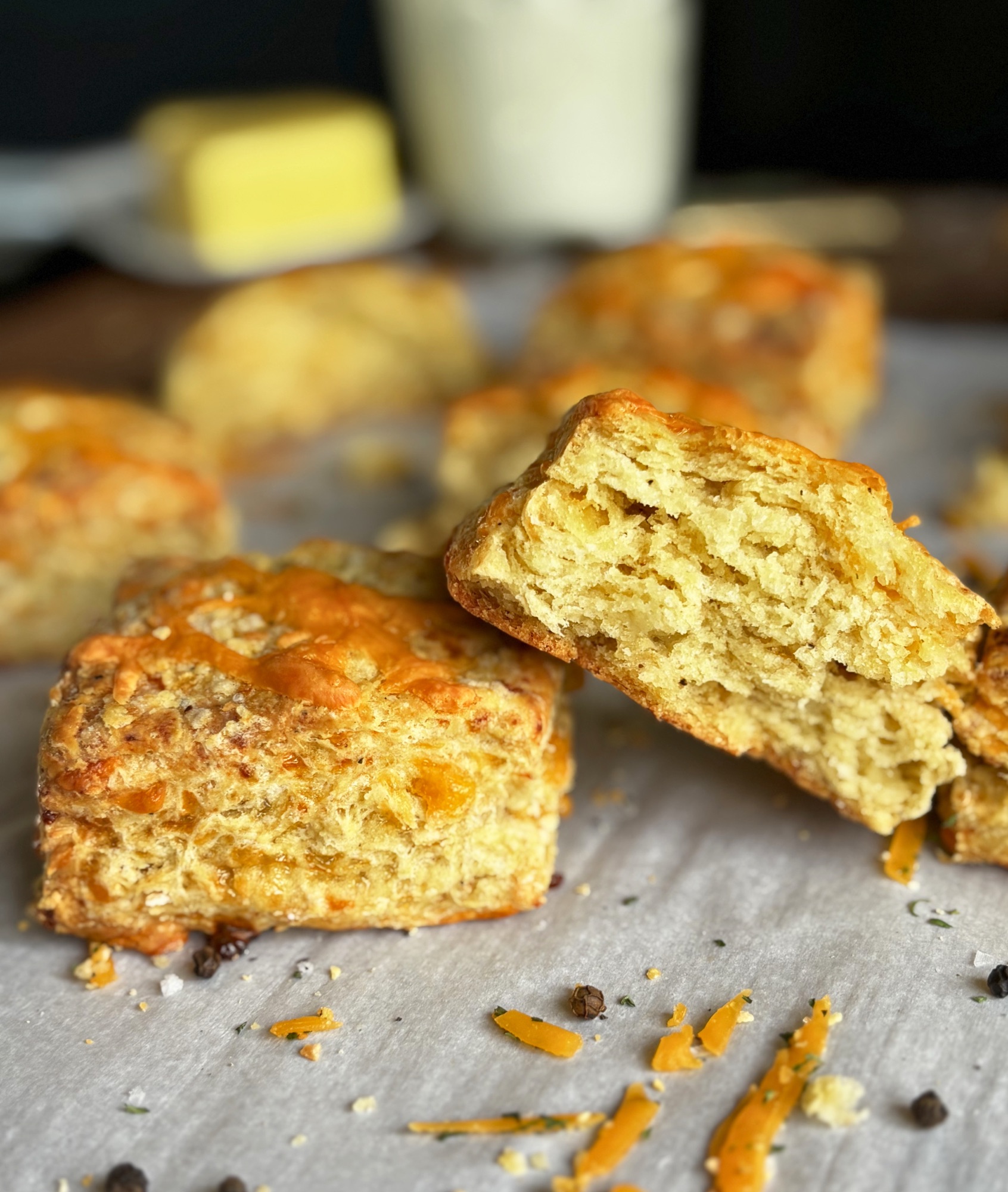
My chocolate chip cottage cheese scones have a serious fan base in this house. But there is one person who could not care less about chocolate, and that is my son. He is a savory kid through and through, and he deserves something just as good.
So I went back to one of my best selling flavor combinations for my microbakery, smoked cheddar and onion, and asked myself: what if that became a scone?
The answer is this recipe. Same cottage cheese base that makes my scone series so uniquely moist and even higher in protein, coming in at 14g a scone. Same cold fermented overnight process that develops flavor without any effort. But instead of chocolate chips and sugar, you get pockets of smoky melted cheddar, sweet rehydrated onion throughout the crumb, and that gorgeous caramelized cheese crust on top. My savory boy approved immediately, and I have a feeling yours will too.
Table of Contents
- Why Cottage Cheese Works in a Savory Scone
- The Protein Advantage
- Which Cottage Cheese Brand to Use
- Why the Cheese You Choose Matters
- The Mixing Method That Makes the Difference
- Why I Shape These as Squares (And How to Go Traditional)
- Why Cold Ferment These Scones
- Recipe
- No Sourdough Starter? No Problem
- Variations and Substitutions
- How to Store and Reheat
- Can You Freeze These Scones?
- Frequently Asked Questions
- More High Protein Scone Recipes
Why Cottage Cheese Works in a Savory Scone

If you have never baked with cottage cheese before, the idea can feel strange. But here is what happens when it goes into a scone: the curds melt completely into the dough during baking, leaving behind moisture, richness, and a significant amount of protein without any cottage cheese flavor or texture in the finished scone.
Traditional scones rely on cold butter and heavy cream to achieve their flaky, tender crumb. Cottage cheese does something different. It carries both fat and water into the dough in a way that keeps the interior incredibly moist without making the scone dense or greasy. Combined with the cold butter in this recipe, you get the best of both: flaky layers from the butter and a tender, almost pillowy interior from the cottage cheese.
The cottage cheese melts seamlessly into the dough during baking. You will not taste it in the finished scone. What you will taste is a savory, cheesy, deeply flavorful scone with an incredibly tender crumb that stays fresh longer than traditional recipes.
The Protein Advantage

Each scone in this batch contains roughly 12 to 14 grams of protein depending on the cottage cheese brand you use, and that is before accounting for the smoked cheddar folded in throughout the dough. That is a breakfast or snack that actually keeps you full.
That protein comes from real food, not powder or additives. The cottage cheese provides the bulk of it, with additional protein from the egg, flour, and smoked cheddar. If you use a high protein brand like Good Culture or Nancy’s, you will hit the higher end of that range.
Why does protein matter at breakfast? It slows digestion and keeps you satisfied through the morning. No mid-morning crash, no snack hunting an hour after eating. Just steady energy from a scone that actually tastes like something you want to eat.
Which Cottage Cheese Brand to Use

Not all cottage cheese is created equal and the brand you choose significantly impacts your final result.
Thicker brands (Good Culture, Nancy’s): These are ideal. They have lower moisture content and higher protein per serving. Pour off any pooled liquid on top before using. No draining required.
Wetter brands: These contain more whey and less structural protein. If your cottage cheese looks loose or pourable in the container, drain it through a fine mesh strainer for 15 minutes before using to remove excess liquid.
How to tell: Open the container and look. Visible liquid pooling on top and loose, soupy curds mean you need to drain it. Thick cottage cheese that holds together is ready to go.
Daisy is a widely available brand that also works well in this recipe and has been tested. Because the curds are larger, use a fork or immersion blender to break them up before mixing with the other wet ingredients. This prevents any visible cottage cheese in the finished scone without requiring a full blender.
For this savory version specifically, stick with 2% or 4% fat cottage cheese. Good Culture and Nancy’s are both tested and recommended. If you use Good Culture, make sure you are grabbing their classic variety and not the Double Cream version, which runs significantly wetter and will make your dough too slack, causing the scones to spread rather than rise. Fat free and 1% are generally too thin and watery for this recipe as well.
Why the Cheese You Choose Matters

Smoked cheddar is not a cheese you want to buy pre-shredded. The bags of pre-shredded cheese are coated in starches and anti-caking agents that prevent proper melting and can make the dough greasy and the cheese pockets gummy rather than melted and stretchy.
Buy a block and shred it yourself right before you use it. Keep the shredded cheese cold in the refrigerator until the moment it goes into the dough.
Smoked Gouda is an excellent substitution if you want a deeper, creamier smoke flavor. It melts beautifully and pairs just as well with the onion.
Sharp white cheddar works if you want the onion to be the dominant flavor with a more subtle cheese background.
Gruyere is a more luxurious option with a slightly nutty, complex finish.
The Mixing Method That Makes the Difference

The order you mix these ingredients matters more than you might think.
Start with your dry ingredients and whisk in the dehydrated onion flakes. Grate your cold butter directly from the refrigerator over the dry ingredients and cut it in until all the butter pieces are coated in flour. Then add your shredded smoked cheddar and toss to coat it in flour as well. The entire bowl goes into the freezer for 15 minutes. The cheese firms back up alongside the butter, which means it holds its shape in the dough and creates distinct pockets rather than blending into the crumb.
While the dry mixture is in the freezer, prepare your wet ingredients. You have two options. You can blend the cottage cheese completely smooth before adding the egg and sourdough discard, which guarantees zero visible cottage cheese in the final scone. Or if you are using Good Culture or Nancy’s, you can simply whisk everything together in a bowl. Those particular brands have smaller, finer curds that melt completely during baking even without blending.
Keep your wet ingredients in the refrigerator until the freezer timer goes off.
Here is the technique that makes a real difference in how smoothly the dough comes together: pour the dry ingredients into the wet ingredients rather than the other way around. It distributes moisture more evenly from the start and reduces the folding needed to bring the dough together. Less folding means less gluten development, which means a more tender scone.
Fold gently until a shaggy dough forms, press into a parchment lined 8 by 8 inch pan to an even 1 inch height, top with the reserved smoked cheddar, cover tightly, and refrigerate overnight.
Why I Shape These as Squares (And How to Go Traditional)

I have become a big fan of the square scone and here is why: squares bake more evenly than wedges. Every piece is the same thickness from edge to center, which means you are not fighting the thin pointed tips that can overbake while the center catches up. Every scone in the batch comes out the same.
There is also something fun about switching it up. A square scone looks intentional and a little unexpected on a plate, and it makes portioning completely foolproof. Press the dough into a parchment lined 8 by 8 inch pan, lift the whole slab out after the overnight rest, and cut into 9 equal squares with one clean grid. No guesswork, no uneven wedges.
If you prefer a traditional round scone cut into triangles, line a 9 inch cake pan with plastic wrap and press the dough in evenly. This scaled recipe fills a 9 inch round at the same 1 inch height as the 8 by 8 square pan. Follow the same overnight cold ferment and freezer process, then lift the disc out, place it on a cutting board, and cut into 8 equal wedges using a sharp knife straight down with no twisting. Transfer to a parchment lined baking sheet and bake as directed.
Both shapes work beautifully with this recipe. It really just comes down to what you are in the mood for.
Why Cold Ferment These Scones
The overnight cold fermentation is what takes these scones from good to exceptional.
The sourdough discard works slowly in the cold to develop flavor complexity you cannot get from a quick mix dough. The acidity it produces tenderizes the crumb and works beautifully against the richness of the smoked cheddar. The gluten relaxes, making the dough easier to handle and contributing to a more tender final texture.
The best part is that cold fermentation is completely hands off. Mix the dough in the evening, press it into the pan, and forget about it until morning. When you wake up you are 30 minutes from fresh baked scones.
The next morning, move the pan uncovered from the refrigerator directly to the freezer for 30 minutes to 1 hour. Then bake straight from frozen. Do not skip this step. When cold butter hits oven heat it releases steam rapidly, which creates flaky layers and gives the scones their lift.


High Protein Smoked Cheddar and Onion Scones (Cottage Cheese Recipe)
Equipment
- Large mixing bowl
- medium mixing bowl
- Box Grater
- Whisk
- Rubber spatula
- 8 by 8 inch baking pan or 9 inch round cake pan
- Parchment paper
- Sharp knife or bench scraper
- plastic wrap
- Blender or food processor (optional, see notes)
- Instant-read thermometer (optional but recommended)
Ingredients
WET INGREDIENTS
- 250 grams full fat cottage cheese 2% or 4% fat (about 1 cup, see notes)
- 125 grams sourdough discard or active starter cold (about 1/2 cup plus 1 tablespoon)
- 1 large egg cold
DRY INGREDIENTS
- 375 grams all purpose flour 3 cups plus 1 tablespoon, spooned and leveled
- 13 grams granulated sugar 1 tablespoon
- 13 grams baking powder 2 and 1/2 teaspoons
- 4 grams baking soda 3/4 teaspoon
- 8 grams salt 1 and 1/4 teaspoons
- 1/4 teaspoon freshly cracked black pepper about 30 cracks of a pepper grinder
- 13 grams dehydrated onion flakes dry (about 3 tablespoons plus 1 teaspoon)
FAT
- 70 grams unsalted butter cold from the refrigerator (5 tablespoons)
ADD-INS
- 100 grams smoked cheddar freshly shredded (about 1 cups loosely packed, folded into dough)
- 25 grams smoked cheddar freshly shredded (about 1/4 cup loosely packed, reserved for topping)
Instructions
- In a large mixing bowl, whisk together the flour, sugar, baking powder, baking soda, salt, and black pepper until thoroughly combined. Add the dehydrated onion flakes and whisk again to distribute evenly throughout the dry ingredients.
- Remove the cold butter from the refrigerator. Using a box grater, grate the butter directly over the dry ingredients. Toss the grated butter with the flour mixture using your hands until all butter pieces are coated in flour. Cut butter in with a pastry cutter or fork.
- Add the 100 grams of shredded smoked cheddar to the bowl and toss to coat the cheese in the flour mixture as well. Place the entire bowl in the freezer for 15 minutes. Chilling the butter and cheese together ensures both stay cold through mixing and create distinct pockets in the finished scone.
- While the bowl is in the freezer, prepare your wet ingredients using one of two methods. Method 1 (blended, guaranteed smooth): Add cottage cheese to a blender/ food processor or use an inversion blender and blend for 30 to 60 seconds until completely smooth. Add the cold egg and cold sourdough discard and pulse briefly for 10 to 20 seconds until just combined. Do not over-process. Method 2 (whisked, for Good Culture, Nancy’s, or Daisy): Whisk all wet ingredients together in a medium bowl. If using Daisy brand, use a fork or immersion blender to break up the larger curds before whisking in the remaining ingredients. Keep the wet ingredients in the refrigerator until the freezer timer goes off.
- Remove the bowl from the freezer. Pour the dry ingredients over the wet ingredients. Using a rubber spatula, fold gently until a shaggy, rough dough forms. The dough will look clumpy. Do not add more flour and do not overmix. Since there is such a difference in cottage cheese hydrations, if your dough would seem too dry, add 1 Tablespoon (14 grams) of buttermilk or milk at a time.
- Line an 8 by 8 inch square pan with parchment paper, leaving overhang on two sides. Transfer the dough to the pan and press evenly to a 1 inch height, making sure the edges are the same thickness as the center.
- Cover the pan tightly with plastic wrap and refrigerate for 8 to 12 hours. You can skip the long ferment and refrigerate for only 2 hours until the dough firms back up.
- Preheat the oven to 425 degrees Fahrenheit (218 C). Use the parchment overhang to lift the slab out of the pan and onto a cutting board. Cut into 9 equal squares using a sharp knife in a 3 by 3 grid pattern. Transfer the squares to a parchment lined baking sheet, spacing them about 2 inches apart.

- Sprinkle the reserved 25 grams of shredded smoked cheddar evenly over the top of the dough.
- Place in the freezer for 30 minutes to an hour.
- Place the frozen scones directly into the preheated oven. Reduce the temperature to 375 degrees Fahrenheit. (190 C)
- Bake for 20 – 25 minutes, until the tops are deep golden and the smoked cheddar on top is bubbling and set. The scones are done when an instant-read thermometer inserted into the center reads 200 degrees Fahrenheit.
- Remove from the oven and allow the scones to cool on the baking sheet for 5 minutes before serving. They are best served warm.
Notes
No Sourdough Starter? No Problem
This recipe is built around sourdough starter/discard, but if you do not have any, here is how to adapt.
Replace the 125 grams of sourdough starter/discard with
- 63 grams of cold full fat buttermilk
- increase your flour to 400 grams total. This matters because sourdough discard at 100% hydration contributes both water and flour to the dough. Substituting only the liquid without adjusting the flour will make the dough too wet and affect the rise.
Skip the overnight cold ferment if using buttermilk. Shape, top with cheese, and place the pan directly in the freezer for 30 minutes before baking.
If you want to get started with sourdough, my Minimal Waste Sourdough Starter guide walks you through everything from scratch.

Variations and Substitutions
The base dough in this recipe is extremely versatile. Once you have made it once you will start seeing endless directions to take it.
Smoked Gouda instead of smoked cheddar gives you a creamier, richer result with a slightly sweeter smoke note. The melt is exceptional.
Add crumbled cooked bacon to the dough alongside the cheese for a scone that works as a full breakfast in one piece.
Swap the dehydrated onion for roasted garlic for a completely different savory direction.
For a spicy version, add a quarter teaspoon of cayenne to the dry ingredients or fold in finely diced pickled jalapeno with the cheese.
Fresh chives stirred in with the cheese add a bright, grassy note that cuts through the richness of the smoked cheddar beautifully.
How to Store and Reheat
Fresh baked scones are always best, but these store well thanks to the moisture from the cottage cheese.
Room temperature: Keep baked scones in an airtight container at room temperature for up to 2 days.
Refrigerator: Scones keep in an airtight container for up to 5 days. The cold can dry them slightly but a quick reheat brings them right back.
Reheating: Place in a 300 degree oven for 7 to 8 minutes. This restores the crust and warms the cheese back to melty without drying out the crumb. A toaster oven works beautifully for single scones.
Can You Freeze These Scones?
Absolutely, and you have two options.
Freeze unbaked: After shaping and cutting, freeze solid on a parchment lined sheet before transferring to a freezer bag. Bake straight from frozen, adding 5 to 6 minutes to the bake time. The frozen butter creates extra steam in the oven, which actually improves the flaky texture.
Freeze baked: Let scones cool completely, then store in a freezer safe container for up to 3 months. Reheat from frozen at 325 degrees for 12 to 15 minutes.

Frequently Asked Questions
Can I taste the cottage cheese in these scones?
No. The cottage cheese disappears completely into the dough during baking. There is no cottage cheese flavor or texture in the finished scone. What you are left with is an unusually moist, tender crumb that you might otherwise assume came from extra butter or cream.
Does the fat percentage of cottage cheese matter?
Yes. Use full fat cottage cheese that is thick rather than loose or pourable. Cottage cheese that runs wet will add too much moisture to the dough and cause the scones to spread instead of rise. Good Culture and Nancy’s are both tested and recommended.
Can I make these without sourdough starter?
Yes. Replace the 125 grams of sourdough discard with 63 grams of cold full fat buttermilk and increase your flour to 400 grams. Skip the overnight cold ferment and go straight to the 30 minute freezer step before baking.
Why do I pour dry ingredients into the wet instead of the other way around?
Pouring the dry into the wet distributes moisture more evenly from the start and reduces the folding needed to bring the dough together. Less folding means less gluten development and a more tender scone.
Can I use pre-shredded smoked cheddar?
It is not recommended. Pre-shredded cheese is coated in starches that prevent proper melting and can make the dough greasy. Shred from a block just before using and keep cold until it goes into the dough.
Why do I need to freeze the scones before baking?
The 30 minute freeze keeps the butter cold right up until the moment the scones hit the oven. When cold butter hits oven heat it releases steam rapidly, which creates those flaky layers and gives the scones their lift. Skipping this step results in scones that spread rather than rise.
Why is there sugar in a savory scone?
The 13 grams of sugar in this recipe is not enough to taste sweet. It helps the cheese on top brown evenly, tenderizes the crumb, and balances the savory profile. Do not skip it.

Did You Make This Recipe?
If you made these scones, I want to see them! Tag me on Instagram so I can see your beautiful cheesy creations. And if you loved them, please leave a review in the comments below. It helps more people find this recipe and means the world to me.
Want new recipes sent straight to your inbox before they hit social media? Sign up for the H3art of the Home newsletter below and never miss a recipe.
More High Protein Scone Recipes
- High Protein Cottage Cheese Scones (the original)
- High Protein Chocolate Chip Cottage Cheese Scones
- High Protein Sourdough Sandwich Bread
- High Protein Sourdough Honey Wheat Sandwich Bread
- High Protein Sourdough Cinnamon Rolls with Greek Yogurt
- High Protein Dinner Rolls
- Sourdough Pizza Scones
- Sourdough Pesto Scones
Final Thoughts
These high protein smoked cheddar and onion scones are exactly what savory baking should look like. Big flavor, real protein, and a technique that does the hard work overnight while you sleep. The cottage cheese trick works just as beautifully here as it does in the sweet version of this recipe, and the smoked cheddar on top might be the most satisfying thing I have pulled out of my oven in a while.
Make a batch this weekend. Your savory people will love you for it.





Leave a Reply