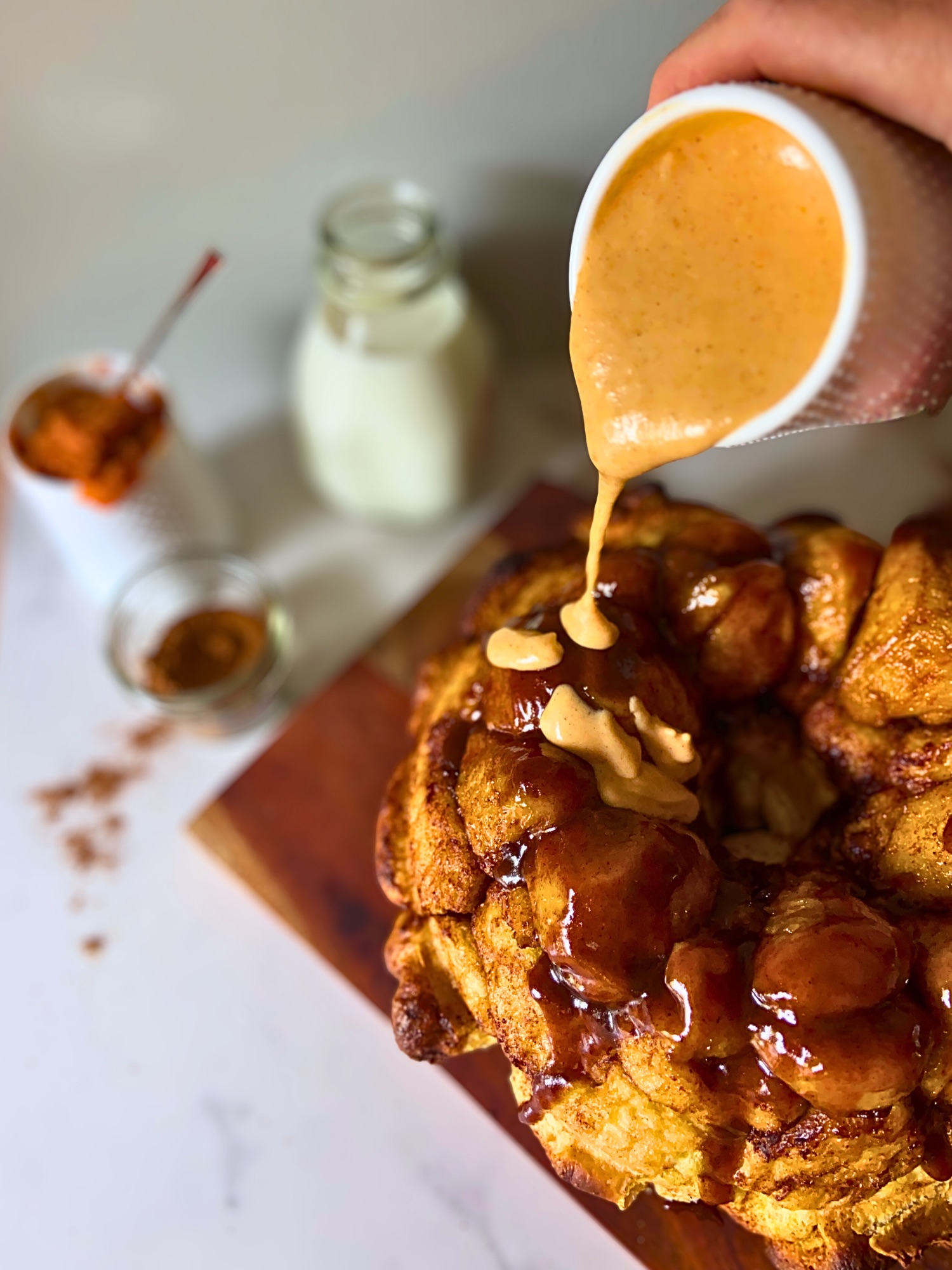
Pumpkin pie is my favorite part of fall, and what I really wanted was a way to put it on the table in the morning, something that tasted like a slice of pie but could still be torn apart with your hands and passed around with a cup of coffee. So I took the buttermilk brioche dough from my Pumpkin Pie Sourdough Rolls, sized it down to fit a Bundt pan, and turned it into sourdough pumpkin pie monkey bread.
Every little ball of dough gets dipped in a warm pumpkin butter, rolled in pumpkin pie spice sugar, and stacked into the pan, where the sugar melts into a sticky caramel coating as it bakes. Once it comes out of the pan, a pumpkin cream cheese glaze goes over the top while it is still warm, and it runs down into every crack between the pieces.
This is a real fermented sourdough bake rather than a can of biscuits, and the schedule bends around your week. You can bulk ferment the dough early in the morning or overnight, shape it into the pan, and then either bake it that same day or tuck the whole pan into the fridge and bake it whenever you are ready. If you do not keep a sourdough starter, there is a section below that walks you through making it with commercial yeast instead.

Table of Contents
- Why This Recipe Works
- Ingredient Breakdown
- The Pumpkin Pie Spice Coating
- Planning Your Baking Schedule
- How to Make Sourdough Pumpkin Pie Monkey Bread
- Sourdough Pumpkin Pie Monkey Bread Recipe
- No Sourdough Starter? Use Yeast Instead
- Tips for Success
- Troubleshooting
- Variations and Add Ins
- Storage and Make Ahead
- Frequently Asked Questions
- Shop This Recipe
- More Pumpkin and Fall Recipes
- Made This Recipe?
- Subscribe for Free
Why This Recipe Works
The dough is what sets this apart from most monkey bread you will find, because it is a true enriched sourdough made with buttermilk, eggs, and butter, which means it bakes up soft and tender inside while still being sturdy enough to handle all that dipping, rolling, and stacking without collapsing into a greasy heap. The long fermentation also builds real bread flavor underneath all that sugar, so every bite tastes like something you baked rather than something you opened.

The pumpkin shows up in two places instead of being mixed into the dough. It goes into the warm butter that every ball is dipped in, so each piece carries pumpkin flavor on its outside where the caramel forms, and it goes into the cream cheese glaze that finishes the whole thing. Keeping the pumpkin out of the dough itself means the dough behaves exactly the way my brioche always does, so you get a predictable rise without any guesswork about extra moisture.
Finally, this version is sized for the pan. The first time I made it, I used the full batch from my roll recipe and it climbed right over the top of the Bundt and onto the oven floor, so the dough in this recipe is scaled down to fill a 12 cup Bundt pan with room to rise and bake without spilling over.
Ingredient Breakdown

Active sourdough starter is the only leavening in this recipe, so it needs to be fed, bubbly, and at its peak when you mix the dough. This is not a recipe for discard, because an enriched dough full of butter, eggs, and sugar is heavy work for a starter and it needs all the strength yours can give it. If you are new to sourdough, my Minimal Waste Sourdough Starter guide walks you through making one from scratch.
Bread flour gives the dough the structure it needs to hold its shape through the dip and roll. I use King Arthur bread flour for all of my sourdough baking.
Buttermilk keeps the crumb soft and tender. Whole milk works too if that is what you have in the fridge.
Eggs and butter are what make this a brioche style dough. The butter goes in after the gluten has started to develop, which you will read more about in the method below.
Sugar can be granulated or packed brown sugar. Brown sugar adds a deeper, almost caramel note that plays really well with the pumpkin spice, and it is the one I reach for in the fall.
Salt and vanilla round out the dough so it tastes like a finished pastry rather than plain bread.
Pumpkin puree goes into the dipping butter and the glaze. Use plain canned pumpkin puree, not pumpkin pie filling, which is already sweetened and spiced.
Maple syrup in the pumpkin butter helps the coating turn glossy and sticky in the oven.
Cream cheese, powdered sugar, and heavy cream make the glaze, with a little more pumpkin and spice stirred in so it tastes like the inside of a pumpkin pie.
The Pumpkin Pie Spice Coating
The coating is a mix of granulated sugar, brown sugar, and four teaspoons of pumpkin pie spice, and that four teaspoons is exactly one batch of my Homemade Pumpkin Pie Spice, which is cinnamon, ginger, nutmeg, cloves, and a little cardamom. The cardamom is the part most store bought blends leave out, and it gives the coating a warm, almost floral finish that makes people ask what is in it.

If you use my homemade blend, it already includes a pinch of salt, so you can skip the salt listed in the coating. If you use a store bought pumpkin pie spice, keep the salt in, because a little salt is what keeps all that sugar from tasting flat.
Planning Your Baking Schedule
This recipe is far more flexible than it looks, because the only fixed rule is that the dough needs one full rise in the bowl before it gets shaped and one more rise in the pan before it bakes. Where you put those rises is up to you, and here are the two schedules I use most.
Morning bulk, bake when you want. Feed your starter the night before so it peaks in the morning, then mix the dough first thing and let it bulk ferment through the day. Shape it into the pan in the afternoon, cover it, and slide it into the fridge. The next morning, or whenever you are ready, let the pan sit out until the dough is puffy, then bake. This is how I make it most often, because it lets me serve warm monkey bread for breakfast without getting up at dawn.
Overnight bulk, bake the next morning. Feed your starter in the afternoon, mix the dough in the evening once the starter peaks, and let it bulk overnight. Check on it first thing in the morning, since an enriched dough on a warm night can easily go past doubled, then shape it, give it its final rise in the pan, and bake.
Either way, watch the dough rather than the clock. A warm kitchen moves everything faster and a cool one slows it down, so the timing in the recipe card is a guide and the look and feel of the dough is the real signal.
How to Make Sourdough Pumpkin Pie Monkey Bread
The recipe card below has every measurement, temperature, and time, so this section is about the why behind each step, which is what makes the difference between a monkey bread that pulls apart cleanly and one that sticks to the pan or stays doughy in the middle.

Mix, Rest, Then Add the Butter
Everything except the butter gets mixed together first and then rests for thirty minutes. That rest lets the flour fully hydrate before any real kneading starts, which makes the gluten much easier to build. The butter goes in afterward, one piece at a time, because fat coats the flour and gets in the way of gluten development, so adding it slowly to a dough that already has some strength gives you that soft, stretchy brioche texture instead of a greasy dough that never comes together.
Knead to a Windowpane
Keep kneading until you can stretch a small piece of dough thin enough to see light through it without it tearing. It takes a while with an enriched dough, but this is what gives the finished bread its tender, pull-apart texture, so it is not a step to rush.
Bulk Ferment Until Doubled
The dough is ready to shape when it has roughly doubled, looks domed and smooth on top, and feels soft and airy when you press it. Enriched dough rises more slowly than a lean loaf, so give it the time it needs.
Weigh the Pieces
I portion the dough by weight rather than by eye, because pieces that are all the same size bake at the same rate, which is how you avoid a pan with a few doughy centers hiding among the finished ones. The recipe card gives you the target weight and the number of pieces it makes. But if you make them similar in size. You should be fine.

Dip, Roll, and Stack
The pumpkin butter should be warm but not hot when you start dipping. If it is too hot, it melts the sugar coating right off the dough and you end up with bald spots, and if it cools too much, it thickens and goes on unevenly. Roll every ball generously in the spice sugar, stack them loosely in the pan, and drizzle whatever pumpkin butter is left over the top so nothing goes to waste.

Final Rise and Bake
The pan is ready for the oven when the balls look puffy and have grown into each other. If the dough has been in the fridge, give it time to come back up and finish rising before it goes in, because cold, underproofed dough is the most common reason for a dense center. The bread is done when it is deep golden and the center reads 190°F on an instant read thermometer, and I strongly recommend the thermometer here, since the outside of a Bundt pan browns well before the middle is baked through.

Invert at Ten Minutes
Let the bread cool in the pan for about ten minutes and then flip it out. If you flip it right away, it is too soft to hold together, and if you wait too long, the caramel sets up and glues the pieces to the pan. Ten minutes is the sweet spot, and then the glaze goes on while it is still warm.

Sourdough Pumpkin Pie Monkey Bread Recipe

Sourdough Pumpkin Pie Monkey Bread
Equipment
- – Stand mixer with dough hook
- kitchen scale
- 12 cup Bundt pan
- Small saucepan
- Two Medium Bowls
- bench scraper
- Instant read thermometer
- Sheet pan
- Hand mixer
Ingredients
Dough
- 100 g active sourdough starter at peak (scant 1/2 cup)
- 200 g buttermilk or whole milk 3/4 cup plus 1 tablespoon
- 55 g granulated sugar or packed brown sugar 1/4 cup plus 1 teaspoon
- 5 g vanilla extract 1 1/4 teaspoons
- 100 g eggs 2 large
- 500 g bread flour 4 cups plus 2 1/2 tablespoons
- 10 g fine sea salt 1 3/4 teaspoons
- 50 g unsalted butter softened and cut into pieces (3 1/2 tablespoons)
Pumpkin Pie Spice Coating
- 150 g granulated sugar for the coating 3/4 cup
- 55 g packed brown sugar for the coating 1/4 cup
- 10 g pumpkin pie spice for the coating 4 teaspoons
- 1.5 g salt for the coating 1/4 teaspoon, skip if using my homemade pumpkin pie spice
Pumpkin Butter
- 15 g softened butter for greasing the Bundt pan 1 tablespoon
- 85 g unsalted butter for the pumpkin dipping butter 6 tablespoons
- 60 g pumpkin puree for the dipping butter 1/4 cup
- 40 g maple syrup for the dipping butter 2 tablespoons
- 2 g vanilla extract for the dipping butter 1/2 teaspoon
Pumpkin Cream Cheese Glaze
- 115 g cream cheese for the glaze softened (4 ounces)
- 120 g powdered sugar for the glaze 1 cup
- 45 g pumpkin puree for the glaze 3 tablespoons
- 30 to 45 g heavy cream for the glaze 2 to 3 tablespoons
- 4 g vanilla extract for the glaze 1 teaspoon
- 2 g pumpkin pie spice for the glaze 3/4 teaspoon
Instructions
Make the Dough
- In the bowl of a stand mixer, combine the sourdough starter, buttermilk, sugar, vanilla, and eggs, and stir until the starter is broken up. If using brown sugar, break up any clumps.
- Add the bread flour and salt and mix with the dough hook on low speed until no dry flour remains. Cover and rest for 30 minutes.
- Mix on low to medium speed and add the butter one piece at a time, letting each piece disappear before adding the next.
- Knead for 10 to 15 minutes, until the dough is smooth and passes the windowpane test.
- Cover the bowl airtight and bulk ferment at room temperature, ideally 70 to 75°F, for 6 to 8 hours, until roughly doubled. For an overnight bulk, check it first thing in the morning so it does not go past doubled.
Prepare the Pan and Coatings
- Generously butter every groove of a 12 cup Bundt pan, including the center tube.
- Whisk the granulated sugar, brown sugar, pumpkin pie spice, and salt together in a medium bowl.
- Melt the 85 g of butter in a small saucepan over low heat. Remove from the heat, let it cool for 1 to 2 minutes, then whisk in the pumpkin puree, maple syrup, and vanilla until smooth. Pour into a second medium bowl. It should be warm, not hot, when you start dipping.
Shape and Proof
- Turn the dough out onto a lightly floured surface and divide it into 40 pieces of about 25 g each. Roll each piece into a smooth ball.
- Dip each ball in the pumpkin butter, let the excess drip off, and roll it generously in the spice sugar. Layer the coated balls loosely in the Bundt pan.
- Drizzle any remaining pumpkin butter over the top.
- To bake the same day, cover and proof at room temperature for 1 to 2 hours, until the balls are puffy and have grown together.
- To bake later, cover tightly and refrigerate overnight. When ready to bake, let the pan sit at room temperature for 1 to 2 hours, until the balls are puffy and have grown together.
Bake
- Preheat the oven to 350°F (175°C) during the last 20 minutes of proofing.
- Set the Bundt pan on a sheet pan and bake for 30 to 40 minutes, until deep golden brown and the center reads 190°F (88°C). Start checking at 30 minutes, and tent loosely with foil if the top browns before the center is done.
- Cool in the pan for 10 minutes, then invert onto a serving plate.
Make the Glaze
- Beat the cream cheese with a hand mixer until completely smooth.
- Beat in the pumpkin puree, then the powdered sugar, until smooth.
- Add 30 g of the heavy cream along with the vanilla and pumpkin pie spice and beat until it reaches a drizzling consistency, adding the remaining cream if needed.
- Pour over the warm monkey bread and serve.
Notes
No Sourdough Starter? Use Yeast Instead
The coating, the pumpkin butter, the stacking, and the glaze all work exactly the same with a yeasted dough, so if you do not keep a starter, you can still make this monkey bread. The part that changes is the dough, and the biggest difference is time: a yeasted enriched dough usually finishes its first rise in about one to two hours instead of a full day or night, and the final rise in the pan is quicker as well, so keep a closer eye on it than you would with sourdough.
I have not written out a separate yeast formula for this exact dough, but I do have a tested yeasted enriched dough on the blog that works well here. The dough from my High Protein Caramel Apple Cinnamon Rolls is a soft, same day brioche style dough made with Greek yogurt or cottage cheese, which gives you a pumpkin monkey bread with a lot more protein than anything you would find at a bakery. Make that dough through its first rise, then portion it into pieces the same size as in this recipe and carry on with the coating, stacking, and glaze as written here.
The one thing to watch is the size of the pan. Every dough recipe makes a slightly different amount, so fill the Bundt only until the balls reach about halfway up the sides, which leaves the dough room to rise and bake without spilling over, and bake any leftover pieces in a muffin tin as little monkey bread bites.
Tips for Success

Use your starter at its peak. A sluggish starter in an enriched dough means a slow, heavy rise, so wait until yours is bubbly and domed before you mix.
Weigh your dough pieces. Even pieces bake evenly, and that is what gets you a monkey bread with no doughy spots.
Keep the pumpkin butter warm, not hot. Warm butter helps the sugar stick, while hot butter melts it right off.
Butter every groove of the pan. A Bundt pan has a lot of corners for caramel to grab onto, so be generous, including the center tube.
Set the pan on a sheet pan in the oven. Even with the right amount of dough, a little caramel can bubble over, and a sheet pan underneath saves you from cleaning the oven floor.
Trust the thermometer. 190°F in the center means it is baked through, no matter how the top looks.
Flip it at ten minutes. That is the window where the bread holds together and the caramel is still loose enough to release.
Troubleshooting
My dough did not rise. Check your starter and your kitchen. A starter that was not fully active or a cold room can slow an enriched dough way down, so give it more time somewhere warm, like an oven with just the light turned on.
It overflowed in the oven. The pan was either too full or the dough rose too long in the pan. Fill the pan only as much as the recipe calls for, and bake as soon as the balls look puffy and have grown together rather than waiting for them to reach the rim.
Pieces stuck to the pan. Either the pan needed more butter in the grooves or the bread sat too long before flipping and the caramel hardened. If it does stick, set the pan back in a warm oven for a couple of minutes to loosen the caramel and try again.
The center is doughy. It came out of the oven too soon or went in underproofed. Check the center with a thermometer before pulling it, and if the top is browning faster than the middle is baking, tent it loosely with foil.
The glaze is too thick or too thin. Add a splash more cream to loosen it, or a spoonful more powdered sugar to thicken it. You want it to coat the back of a spoon and still drip off easily.

Variations and Add Ins
Nuts. Scatter toasted chopped pecans or walnuts between the layers as you stack the balls for crunch in every pull.
Chocolate. Mini chocolate chips tucked between the layers melt into little pockets that go surprisingly well with pumpkin.
Cream cheese pockets. Tuck small cubes of cream cheese between some of the balls for a cheesecake bite hidden inside.
Brown butter. Brown the butter for the pumpkin butter mixture before stirring in the pumpkin for a deeper, nuttier coating.
Mini monkey breads. Divide the coated balls among a greased muffin tin, three or four per cup, and bake until the centers reach 190°F. They bake much faster than the full Bundt, so start checking early.
Storage and Make Ahead
Make ahead. The easiest way to get this on the table for a holiday morning or a brunch is to shape it into the pan the day before, cover it tightly, and refrigerate it overnight. In the morning, let the pan sit out until the dough is puffy and has grown together, then bake it as written.
Storage. Monkey bread is at its best warm on the day it is baked. Because the glaze is made with cream cheese, store glazed leftovers covered in the fridge for up to four days.
Reheating. Warm pieces in a 300°F oven for a few minutes until soft again, or in the microwave for about fifteen seconds.
Freezing. Freeze the baked bread unglazed, wrapped tightly, for up to three months. Thaw it at room temperature, warm it gently in the oven, and make a fresh batch of glaze to pour over the top.
Frequently Asked Questions
Can I use sourdough discard for this recipe?
No. This recipe needs an active starter at its peak, because the butter, eggs, and sugar in an enriched dough slow fermentation down, and discard simply does not have the strength to raise it well.
Can I use store bought pumpkin pie spice?
Yes. Use the same four teaspoons and keep the salt in the coating. If you make my homemade blend, skip the extra salt, since the blend already has it.
Can I make sourdough monkey bread the night before?
Yes, and it is one of my favorite ways to make it. Shape it into the pan, cover it, and refrigerate it overnight, then let it finish rising at room temperature in the morning before baking.
What size Bundt pan do I need?
A standard 12 cup Bundt pan. A smaller pan will overflow, so if yours is smaller, bake the extra dough balls in a muffin tin.
Can I use pumpkin pie filling instead of pumpkin puree?
Stick with plain pumpkin puree. Pumpkin pie filling is already sweetened and spiced, which throws off both the coating and the glaze.
Can I use regular milk instead of buttermilk?
Yes. Whole milk works in the same amount and still gives you a soft dough.
How do I know when it is done?
The top will be deep golden brown, and an instant read thermometer in the center should read 190°F. If the top gets dark before the center is ready, tent it loosely with foil.
Shop This Recipe
These are the tools I use to make this monkey bread. I earn a small commission from these affiliate links at no extra cost to you, which helps support the blog.
- 12 Cup Bundt Pan is what this recipe is sized for, and a heavy pan with a light interior bakes the caramel evenly without scorching.
- Stand Mixer does the long knead that an enriched dough needs and adds the butter slowly without wearing out your arms.
- Kitchen Scale is how I measure everything and weigh the dough pieces so they bake evenly.
- Instant Read Thermometer tells you when the center of the Bundt is actually done instead of guessing from the top.
- Bench Scraper makes quick work of dividing the dough into even pieces.
More Pumpkin and Fall Recipes
If you are baking your way through pumpkin season, here are a few more you will want to try.
The Easiest Pumpkin Swirl Sourdough Bread has a spiced pumpkin ribbon feathered through every slice, with no rolling out dough.
The Pumpkin Spice Latte Sourdough turns your favorite coffee order into a loaf of bread.
The Sourdough Pumpkin Jack O’Lantern Bread with Butter Candle is the showstopper for any fall table.
The Pumpkin Pie Sourdough Rolls are where this dough started.
The Hard Boiled Egg Pumpkin Pie Protein Pudding gives you pumpkin pie flavor with a serious protein boost.
The Cinnamon Roll Pull-Apart Focaccia and the Caramel Apple Pie Pull-Apart Focaccia give you the same dip, roll, and pull fun in a focaccia pan.
And don’t forget the Homemade Pumpkin Pie Spice that seasons this whole recipe.
Made This Recipe?
I would love to see your sourdough pumpkin pie monkey bread! Leave a comment and a rating below to let me know how it went and which schedule you used, and if you share it on Instagram or TikTok, tag me at @h3artofthehome so I can see your bake.
Subscribe
Want recipes like this one delivered straight to your inbox? Subscribe to the H3art of the Home newsletter for free, and you will never miss a new sourdough bake, high protein recipe, or seasonal treat.


Leave a Reply