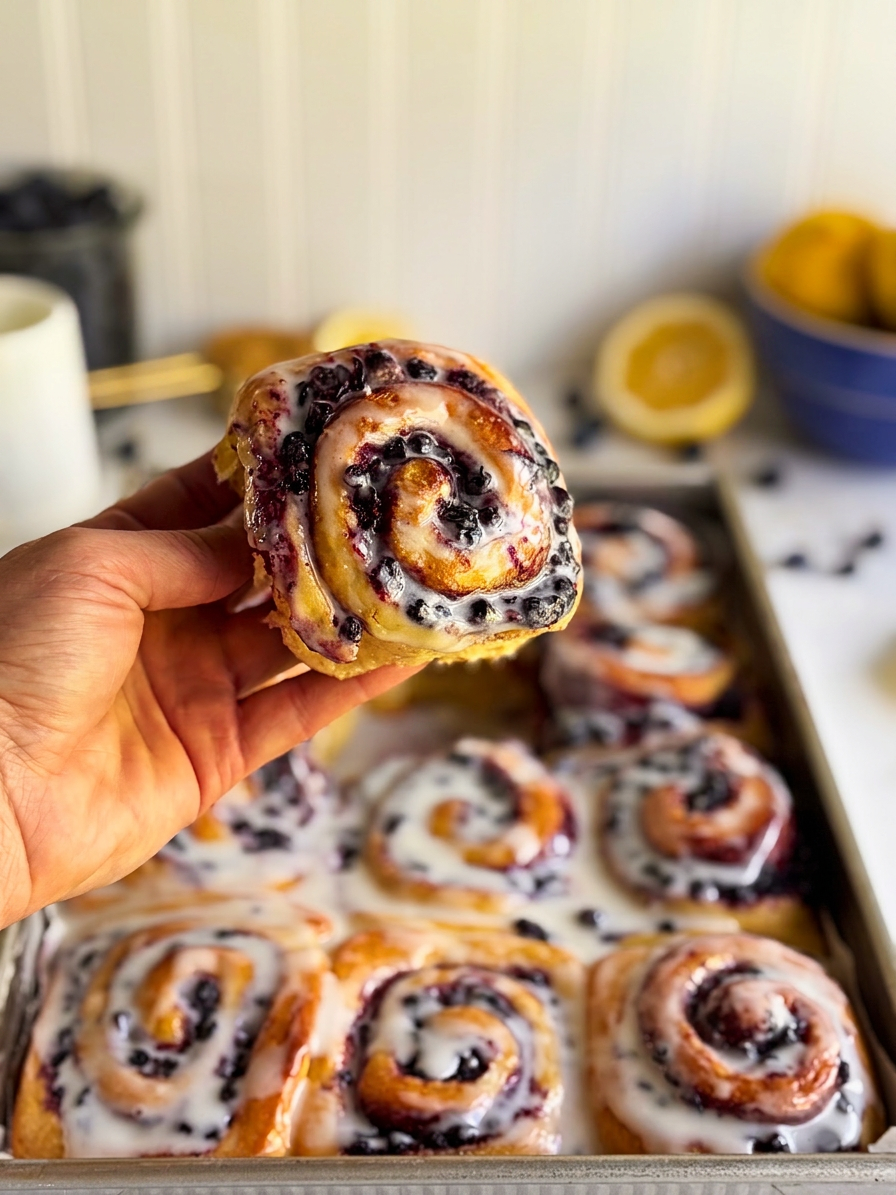
If you have been waiting for a lemon blueberry sweet roll that does not require a sourdough starter, a multi day process, or a protein powder shortcut, this is it. These rolls are ready start to finish in about three to four hours using active dry yeast, and every gram of protein comes from real whole food ingredients: skyr or Greek yogurt, bread flour, and eggs. Twelve grams of protein per roll, pillowy enriched dough, jammy blueberry lemon filling that stays where its supposed to, and a lemon cream cheese glaze that runs into every crevice without covering the purple swirl underneath.
This recipe is the yeasted sister to my Blueberry Lemon Sourdough Sweet Rolls with Greek Yogurt. Same dough philosophy, same three layer filling system, same glaze. Different leavening, same day timeline.

Table of Contents
- Why This Recipe Works
- The Science Behind Protein and Blood Sugar
- Skyr, Greek Yogurt, and Why It Matters
- Ingredients Overview
- How to Make These Rolls
- Recipe
- Make Ahead Options
- Storage and Freezing
- Substitutions and Variations
- Frequently Asked Questions
- More High Protein Baking from H3art of the Home
Why This Recipe Works
Most sweet roll recipes that market themselves as high protein are adding protein powder, which changes the texture. This recipe does not. The protein comes entirely from the skyr or Greek yogurt that replaces most of the liquid in the dough.
Skyr is an Icelandic cultured dairy product that is strained to a thick, almost paste like consistency. Nonfat plain skyr has roughly double the protein of regular yogurt by volume. When it replaces the milk in an enriched dough, the protein content of the finished rolls increases significantly without any change to how the dough handles or how the rolls taste.
The dough itself is built on the same base as my High Protein Cinnamon Rolls with Greek Yogurt, with the addition of lemon zest worked into the dough from the start. The lemon flavor runs through every layer: the dough, the filling, and the glaze.
The filling uses a three layer system designed specifically to prevent the blueberry compote from gapping away from the dough during baking, which is the most common failure point in fruit filled rolls. The compote is cooked, thickened, and chilled before it ever touches the dough. Cold filling on dough, spread thin, gives you defined layers that hold their shape from the pan to the plate.

The Science Behind Protein and Blood Sugar
Here is the real reason to build protein into a baked good, and it has nothing to do with macros or diet culture.
When you eat a meal that is heavy in carbohydrates without much protein alongside it, your blood sugar rises quickly and drops just as fast. That cycle is what creates the mid morning crash after a pastry breakfast. You feel satisfied for about forty five minutes and then you are hungry, foggy, and reaching for something else. The carbohydrate is not the problem. The absence of protein alongside it is.
Protein slows digestion. When it is present in a meal with carbohydrates, the body processes everything more gradually. That produces a slower, more sustained rise in blood sugar rather than a sharp spike. The result is that you stay full longer and the energy crash does not come.
Greek yogurt and skyr are particularly well suited to this role in baking. Both are strained dairy products with a high protein to carbohydrate ratio, which means they contribute meaningful protein without significantly changing the carbohydrate load of the recipe. Nonfat plain skyr has one of the highest protein to carbohydrate ratios of any yogurt on the market, which is why it is the preferred choice here. It dissolves seamlessly into the dough, contributes to a soft crumb, and does not change the flavor at all. You would never know it was there. That is the point.
When you eat one of these rolls, you are eating a carbohydrate forward breakfast the way it should be eaten: with enough protein built in to give your body something to work with. The flavor does not change. The experience does not change. The outcome is just better.

Skyr, Greek Yogurt, and Why It Matters
Nonfat plain skyr is the preferred choice for this recipe. It is thicker than most Greek yogurts, higher in protein, and lower in moisture, which means it behaves more predictably in the dough. Any thick nonfat Greek yogurt works as a direct substitute, though the protein count per roll will vary slightly depending on the brand. Both are used in exactly the same way throughout the recipe.
A few things to know about baking with skyr and Greek yogurt:
Always warm it before adding it to the dough. Cold skyr or Greek yogurt inhibits yeast activity and makes the dough stiff. Thirty seconds in the microwave, stirring once, brings it to the right temperature without cooking it.
Do not substitute low fat or full fat without adjusting the recipe. The water content and fat levels are different enough to affect the dough hydration and final texture. They will work however the outcome will be different.
The dough will feel slightly tacky off the mixer. This is correct. Skyr and Greek yogurt can hydrate flour more slowly than regular liquid. After a ten minute rest the dough smooths out considerably. Do not add extra flour.
I have my favorites for a reason. I always reach for Siggi’s Brand Skyr when i can find it. For greek yogurt my go to is Kirkland Brand Organic Non-Fat Yogurt. However if you are not a Costco member, Fage 0% and Stonyfield Nonfat Organic are great options. Avoid yogurts with additives and flavors, as they can change the consistency and texture of the dough, which changes the final outcome.
Ingredients Overview

The Dough
The dough uses bread flour rather than all purpose. Bread flour has a higher protein content, which builds more gluten structure and gives the rolls their pull-apart texture. The combination of bread flour and nonfat skyr or Greek yogurt is what puts these rolls in the 11 to 12 gram protein range without any additives.
Lemon zest goes directly into the dough, rubbed into the sugar first to release the essential oils. This small step makes a noticeable difference in how much lemon flavor comes through in the finished roll.
The Blueberry Lemon Compote
Frozen blueberries are used here by design, not by convenience. They are more consistent in size and sugar content than fresh, and cooking them from frozen gives you better control over the final texture of the compote. Regular frozen blueberries are strongly recommended. Wild blueberries are smaller and release less liquid during cooking, which makes the compote harder to spread evenly. They will work if that is what you have, but the process is less forgiving.
The compote is thickened with a cornstarch slurry made with lemon juice rather than water. The acid produces a smoother, less gummy set. The compote must be fully chilled before it goes on the dough. Warm compote will melt the whipped butter layer beneath it, changing the consistency of the filling and increasing the likelihood of leaking during baking.
The Three Layer Filling
The filling system has three components that work together:
Layer one is whipped butter spread directly on the dough. It acts as a grip layer and a fat barrier between the dough and the wet compote above it.
Layer two is a lemon cornstarch sugar: granulated sugar rubbed with lemon zest and whisked with cornstarch. It goes over the butter and is pressed lightly into the surface. This layer absorbs any moisture that migrates down from the compote before it can reach the dough.
Layer three is the cold blueberry lemon compote, spread thin over the sugar layer. Thin is the operative word. The compote is rich and concentrated. A thick layer will overflow during baking no matter how well it was thickened.
The Glaze: Two Options
The glaze is poured, not spread. A thick frosting would cover the blueberry swirl, which is the main visual appeal of these rolls fresh from the pan. The drizzle runs into the crevices and lets the purple color show through.
Two versions are included in the recipe card: the classic lemon cream cheese glaze and a higher protein Greek yogurt version. The Greek yogurt version swaps the butter for nonfat Greek yogurt and adds a small amount of heavy cream for richness. The flavor and drizzle consistency are nearly identical. The order of operations is the same for both: lemon juice goes in first, before the powdered sugar, to prevent the cream cheese from curdling.
How to Make These Rolls
The full step by step instructions are in the recipe card below. Here is what to expect at each stage.

Start with the compote. It needs at least two hours to chill, so it goes first. Cook the blueberries and sugar until fully broken down and bubbling, add the cornstarch slurry, cook two more minutes until thickened, then press plastic wrap directly against the surface and refrigerate. It can also be made up to three days ahead.

Make the dough. Add the skyr or Greek yogurt and the warm milk together in the same microwave safe bowl and microwave for 30 seconds, then stir to combine. This saves a bowl and brings both to the right temperature at once. Add the warmed dairy, proofed yeast, lemon sugar, eggs, vanilla, and salt to the bowl of the stand mixer and mix briefly to combine. Add the flour, placing the salt on top of the flour before mixing. Once no dry streaks remain, drop the butter in chunks around the dough and mix on medium for about six minutes until smooth and supple. Cover and let rise until doubled. In a warm kitchen at 75 to 80 degrees F this takes about 60 to 90 minutes. In a cooler kitchen around 68 degrees F, plan for closer to two hours. Watch the dough rather than the clock.

Roll, fill, and shape. Roll the dough to a 12 by 18 inch rectangle. Layer whipped butter, lemon cornstarch sugar, and cold compote in that order. Roll away from you, trim the ends, and cut into 12 rolls using unflavored dental floss or oiled fine baker’s twine.

Second rise. Arrange in the pan and let rise until puffed and touching, about 60 to 90 minutes. Do not rush this rise. Underproofed rolls will spring sharply in the oven and push the compote out of the layers. Use the poke test: press a lightly floured finger gently into a roll. If the indent springs back quickly, the rolls need more time. If it springs back slowly and holds a slight impression, they are ready.

Bake at 375 degrees F for 30 to 35 minutes until deep golden brown. Pull at 190 degrees F internal temperature. Cool ten minutes before glazing.

Glaze while warm. Pour the glaze over the rolls so it melts slightly into the swirls.
Recipe

Lemon Blueberry Rolls with Greek Yogurt (Yeasted)
Equipment
- – Stand mixer with dough hook
- kitchen scale
- Medium saucepan
- Small Bowl
- 9 by 13 inch baking pan
- Parchment paper
- Rolling Pin
- Unflavored dental floss or oiled fine baker’s twine
- Instant read thermometer
- Hand mixer or stand mixer for glaze
Ingredients
Blueberry Lemon Compote
- 315 grams frozen blueberries approximately 2 cups
- 85 grams granulated sugar 6 tablespoons + 2 teaspoons
- 15 grams fresh lemon juice 1 tablespoon
- 16 grams cornstarch 2 tablespoons
- 1 gram fine sea salt small pinch
Dough: Yeast Bloom
- 50 grams whole milk warmed to 110 degrees F (3 tablespoons + 1 teaspoon)
- 7 grams active dry yeast Red Star preferred (2 and 1/4 teaspoons)
- 4 grams granulated sugar 1 teaspoon
Dough: Wet Ingredients
- 265 grams nonfat plain skyr or Greek yogurt slightly warmed (1 cup + 1 tablespoon)
- 2 large eggs room temperature
- 5 grams vanilla extract 1 teaspoon
- 41 grams granulated sugar 3 tablespoons
- zest of 2 lemons
Dough: Dry Ingredients
- 560 grams bread flour 4 and 2/3 cups
- 9 grams fine sea salt 1 and 1/2 teaspoons
Dough: Fat
- 75 grams unsalted butter softened (5 tablespoons)
Filling:
- Layer 1-
- 85 grams unsalted butter, whipped room temperature (6 tablespoons)
- Layer 2-
- 60 grams granulated sugar 4 tablespoons + 2 teaspoons
- zest of 2 lemons
- 10 grams cornstarch 1 tablespoon + 1 teaspoon
- Layer 3-
- all of the prepared and chilled blueberry lemon compote
Lemon Cream Cheese Glaze
- 113 grams full fat cream cheese room temperature (4 oz)
- 60 grams unsalted butter softened (4 tablespoons)
- 120 grams powdered sugar sifted (1 cup)
- zest of 1 lemon
- 20 grams fresh lemon juice 1 tablespoon + 1 teaspoon
- 5 grams vanilla extract 1 teaspoon
- 1 gram fine sea salt small pinch
- 15 to 30 grams whole milk only if needed to thin (1 to 2 tablespoons)
Higher Protein Greek Yogurt Glaze (variation)
- 113 grams full fat cream cheese room temperature (4 oz)
- 60 grams nonfat plain Greek yogurt room temperature (1/4 cup)
- 120 grams powdered sugar sifted (1 cup)
- zest of 1 lemon
- 15 grams fresh lemon juice 1 tablespoon
- 5 grams vanilla extract 1 teaspoon
- 1 gram fine sea salt small pinch
- 15 grams heavy cream to consistency (1 tablespoons)
Instructions
Make the Blueberry Lemon Compote
- Combine the frozen blueberries and sugar in a medium saucepan over medium heat. Cook, stirring occasionally, until the berries have fully broken down and the mixture is bubbling and deep purple, about 8 minutes.
- While the blueberries cook, whisk the cornstarch into the cold lemon juice in a small bowl until completely smooth with no lumps remaining. Using cold liquid prevents the cornstarch from clumping before it hits the hot compote.
- Once the compote is fully bubbling and the berries have broken down, slowly drizzle the cornstarch slurry into the pot while whisking constantly.
- Cook 2 more minutes, stirring constantly, until the compote thickens noticeably and a line drawn through it holds for at least 3 seconds.
- Remove from heat and stir in the salt. Transfer to a bowl and press plastic wrap directly against the surface to prevent a skin from forming. Cool to room temperature, then refrigerate until cold and firm, at least 2 hours. The compote can be made up to 3 days ahead.
Bloom the yeast
- Warm your milk to 110 degrees fahrenheit. Sprinkle in your sugar and stir. Sprinkle your yeast on top and stir gently to combine.
- Let sit 5 to 10 minutes until foamy and fragrant. If the yeast does not foam, it is not active and you should start again with fresh yeast.
Make the Dough
- Add the skyr or Greek yogurt in a microwave safe bowl. Microwave for 30 seconds and stir to combine. The mixture should feel warm but not hot.
- Add the warmed yogurt and milk mixture, the proofed yeast, eggs, vanilla, granulated sugar, and lemon zest to the bowl of a stand mixer fitted with the dough hook. Mix briefly on low to combine the wet ingredients.
- Add the bread flour to the bowl, sprinkling the salt on top of the flour. Drop the softened butter in chunks around the top of the flour layer. Mix on low until no dry streaks remain and a shaggy dough forms.
- Mix on medium for about 6 minutes until the dough is smooth, supple, and pulls cleanly away from the sides of the bowl.
- The dough will feel slightly tacky when it comes off the mixer. This is correct for a yogurt dough and not a sign that more flour is needed. Transfer to a lightly oiled bowl.
- Cover the bowl and let the dough rise at 75 to 80 degrees F for 60 to 90 minutes until doubled in size. In a cooler kitchen around 68 degrees F, plan for up to 2 hours. Watch the dough rather than the clock.
Assemble and Shape
- Beat the room temperature butter for the filling with a hand mixer or stand mixer until light and almost frosting like, about 2 minutes. Set aside.
- Make the lemon cornstarch sugar by combining the sugar and lemon zest in a small bowl. Add the cornstarch and whisk to combine. Set aside.
- On a lightly floured surface, roll the dough into a 12 by 18 inch rectangle with the 12 inch edge parallel to your body.
- Spread the whipped butter evenly over the entire surface of the dough, all the way to the edges. This layer acts as a grip layer and fat barrier between the dough and the wet compote above it.
- Sprinkle the lemon cornstarch sugar evenly over the butter. Press lightly with the palm of your hand to adhere. This layer absorbs any moisture that migrates down from the compote before it can reach the dough.
- Spoon the cold compote over the lemon sugar layer and spread in an even, thin layer, leaving a 1 inch border along the top edge. Cold compote is essential here. Warm compote will melt the butter layers beneath it.
- Starting at the edge closest to your body, roll the dough tightly upward, away from you, into a log approximately 12 inches long.
- Cut into 12 rolls at 1 inch intervals using unflavored dental floss or oiled fine baker’s twine for clean cuts that do not compress the dough. Mint or cinnamon floss is fine and will not affect the flavor.
- Arrange the rolls cut side up in a parchment lined 9 by 13 inch pan.
Second Rise and Bake
- Cover the pan loosely and let the rolls rise at room temperature for 60 to 90 minutes until puffed and touching each other. Do not rush this rise. Underproofed rolls will spring sharply in the oven and push the compote out of the layers. Use the poke test: press a roll gently with a lightly floured finger. If the indent springs back quickly the rolls need more time. If it springs back slowly and holds a slight impression, they are ready.
- Preheat the oven to 375 degrees F while the rolls complete their second rise.
- Bake for 30 to 35 minutes until the tops are deep golden brown. The blueberry compote adds moisture to the filling so these rolls benefit from the full bake window. Begin checking at 30 minutes.
- Pull the rolls at 190 degrees F internal temperature on an instant read thermometer inserted into the center of a middle roll, avoiding filling pockets. Cool in the pan for 10 minutes before glazing.
Make the Glaze
- If the cream cheese is cold, microwave on a microwave safe plate for 20 seconds until soft but not warm. Cold cream cheese will not beat smooth.
- For the standard lemon cream cheese glaze: Beat the cream cheese and butter together until completely smooth with no lumps. Add the lemon juice one teaspoon at a time, beating between each addition. Adding acid into the fat base before any dry ingredients prevents the cream cheese from curdling. Once all lemon juice is incorporated, add the sifted powdered sugar, lemon zest, vanilla, and salt. Beat until glossy and pourable. Thin with milk one tablespoon at a time only if needed.
- For the higher protein Greek yogurt glaze: Beat the cream cheese and Greek yogurt together until completely smooth, about 2 minutes. Add the lemon juice one teaspoon at a time, beating between each addition. Once all lemon juice is incorporated, add the sifted powdered sugar, lemon zest, vanilla, and salt. Beat until glossy and pourable. Add heavy cream one tablespoon at a time until the glaze reaches a drizzleable consistency.
- Drizzle the glaze over the warm rolls. The drizzle style keeps the blueberry swirl visible in the pan. Serve warm.
Notes
Make Ahead Options
Make the compote ahead. It keeps covered in the refrigerator for up to three days. This is the most useful make ahead step because it eliminates the two hour chill time on baking day.
Refrigerate after shaping. After the first rise and shaping, cover the pan tightly and refrigerate overnight. In the morning, remove the pan from the refrigerator and let the rolls sit at room temperature for about 30 minutes to take the chill off, then complete the full second rise before baking. Do not bake them cold straight from the refrigerator.
Storage and Freezing
Store leftover rolls covered at room temperature for up to two days, or refrigerated for up to five days. Warm before serving.
To freeze, cool completely without glazing and freeze individually on a baking sheet before transferring to an airtight container. Freeze for up to two months. Thaw overnight in the refrigerator, warm in a 300 degree F oven for ten minutes, and glaze after warming.
Substitutions and Variations
Instant yeast: Substitute at the same weight without proofing. Add directly to the dry ingredients. Combine the skyr or Greek yogurt and the milk together in the same microwave safe bowl and microwave for 30 seconds before adding to the mixer with the other wet ingredients.
Greek yogurt in place of skyr: Any thick nonfat Greek yogurt works as a direct substitute at the same weight. Avoid low fat or full fat without adjusting the recipe. Protein content will vary by brand.
Fresh blueberries: Can be substituted for frozen. They will release moisture faster, so reduce the cook time on the compote slightly and watch for the line test rather than relying on the clock.
Higher protein glaze: Use the Greek yogurt glaze variation in the recipe card in place of the standard lemon cream cheese glaze. The flavor and texture are nearly identical with a modest protein boost.
Thick frosting variation: For either glaze, reduce the lemon juice to 10 grams and omit the cream or milk entirely. Follow the same method with lemon juice added slowly into the fat first. The result is thick and spreadable for readers who prefer full coverage over visible swirl.
For additional substitution guidance, see the full notes section of the recipe card.

Frequently Asked Questions
Can I use all purpose flour instead of bread flour?
You can, but the texture will be softer and slightly less structured. Bread flour builds more gluten, which gives the rolls their pull-apart quality. If all purpose is all you have, the rolls will still work, but the layers will be more tender and less defined.
Why does the dough feel tacky when it comes off the mixer?
Skyr and Greek yogurt can hydrate flour more slowly than regular liquid. The dough may feel slightly tacky immediately after kneading, but after a ten minute rest it smooths out considerably. Do not add flour to compensate. Adding flour at this stage will result in dry, dense rolls.
Can I use wild blueberries?
Wild blueberries will definitely work. However, they are smaller and release less liquid during cooking, which makes the compote harder to spread evenly. Regular frozen blueberries produce a better result. If wild blueberries are all that is available, they will work, but the spreading step requires more patience.
My compote seems too thick. Is that right?
Yes. The compote should be firm and spreadable when cold, similar to a thick jam. It loosens slightly as it warms against the dough during rolling, then sets again during baking. Thin compote will leak.
Can I make the dough the night before?
Yes. After the first rise, shape the rolls, place them in the pan, cover tightly, and refrigerate overnight. The next morning, let them rest at room temperature for about 30 minutes, then complete the full second rise before baking.
Why do you add the lemon juice to the cream cheese before the powdered sugar?
Adding acid directly into powdered sugar and then into dairy can cause the cream cheese to curdle and turn grainy. Adding the lemon juice into the softened fat base first prevents this. The order matters for both the standard glaze and the Greek yogurt version.
Can I double the recipe?
The dough can be doubled if your mixer bowl is large enough. You will need two 9 by 13 inch pans. Everything else scales directly.
Do I have to use a 9 by 13 pan?
No, but the pan you choose will affect the final result. A 9 by 13 pan is what this recipe was developed and tested in and gives you those tall, pillowy, pull apart rolls because the walls of the pan contain the dough as it proofs and bakes, encouraging it to rise up rather than spread out.
If you want a different style, a half sheet pan works as a substitute. Without pan walls to contain them, the rolls will spread outward as they proof and bake, giving you wider, flatter rolls with crispier caramelized edges along the bottom and sides. Think more bakery style open baked roll than classic pan roll.
If you go the half sheet pan route, keep an eye on the bake time. Without the insulation of the pan walls, the rolls may bake a few minutes faster. Start checking at 18 to 20 minutes and pull when an instant read thermometer reads 190 degrees Fahrenheit in the center of a middle roll.
How do I know when the rolls are done?
Color and internal temperature are the most reliable indicators. The tops should be deep golden brown and the internal temperature of a center roll should read 190 degrees F on an instant read thermometer inserted away from the filling. The blueberry compote makes these rolls slightly wetter than a standard sweet roll, so do not pull them early based on color alone.
What if my yeast does not foam?
The yeast is not active. Do not proceed. This happens when the milk is too hot (above 115 degrees F), too cold, or the yeast is old. Start again with fresh yeast and milk that feels warm but not hot to the touch, around 110 degrees F.
Can I use lemon extract in the dough?
Lemon extract is not needed. The zest of two lemons worked into the dough provides bright, natural lemon flavor that carries through baking. That said, if you want a more pronounced lemon flavor, one teaspoon of lemon extract added with the other wet ingredients is a reasonable addition. More than that and it can tip into artificial.
Do I have to use dental floss to cut the rolls?
Dental floss gives the cleanest cuts because it slips through the dough rather than compressing it. Any plain, unflavored floss works, but mint or cinnamon floss is also fine and will not affect the flavor of the rolls at all. Oiled fine baker’s twine is another good option. If you use a knife, a sharp serrated blade with a gentle sawing motion is the least damaging approach.

More High Protein Baking from H3art of the Home
If you loved these rolls, the rest of the high protein series uses the same whole food approach: real dairy, real flour, real results.
High Protein Cinnamon Rolls with Greek Yogurt uses this same dough base with a classic cinnamon sugar filling and vanilla cream cheese glaze.
Blueberry Lemon Sourdough Sweet Rolls with Greek Yogurt is the sourdough sister to this recipe for bakers who want the long fermentation version.
High Protein Sandwich Bread(Yeasted) uses the same yogurt base to produce a soft, pillowy loaf with a significant protein boost over store bought.
High Protein Honey Wheat Sandwich Bread brings white whole wheat flour and nonfat skyr together with a deep honey sweetness.
High Protein Chocolate Chip Muffins yogurt is again the star of the show creating a tender and flavorful muffin, boasting 8 grams of protein and zero additives.
How to Create a Thriving Sourdough Starter is the place to start if you want to eventually try the sourdough version of this recipe.
Made These? I Want to Hear About It.
Leave a comment below and tell me how your rolls turned out. Did you use skyr or Greek yogurt? How did the compote hold up? I read every single comment and I love hearing about your bakes.
If you share your rolls on Instagram or Facebook, tag me so I can see them and share them with the community. There is nothing better than watching this recipe work in someone else’s kitchen.
And if you want new recipes sent directly to your inbox before they hit the blog, sign up for the H3art of the Home newsletter below. You will never miss a drop.





Leave a Reply