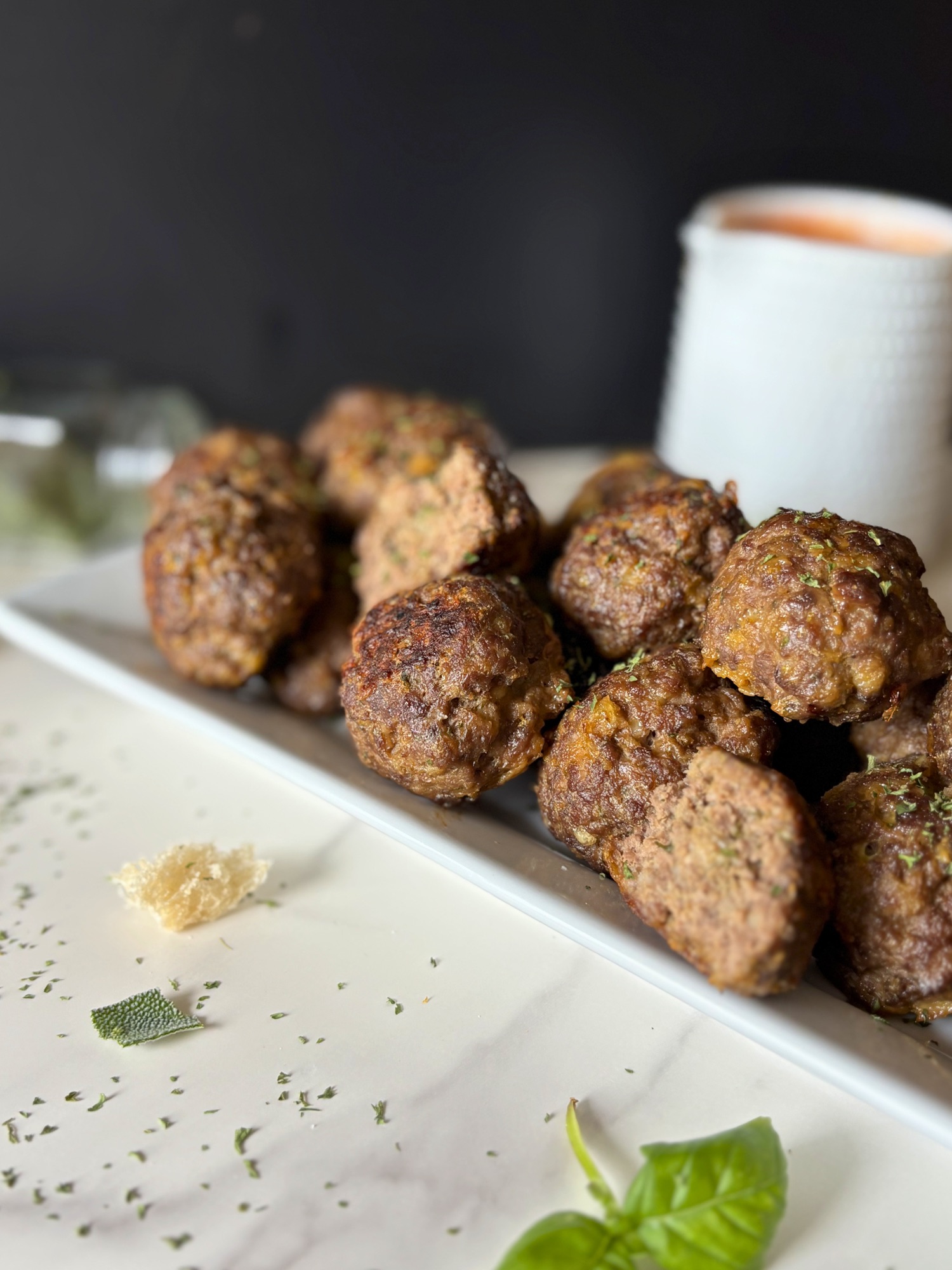
There are recipes you follow, and then there are recipes you just know. My meatballs have always been the second kind. For years I made them entirely by feel, a handful of this, a pinch of that, never once stopping to write anything down. My kids never complained. In fact, they requested them constantly. But one day I realized that if something ever happened to me, this recipe would disappear with it. So I finally paid attention, measured everything, and wrote it all down. What you have here is that recipe: the one my family asks for by name, now documented for the first time.
What makes these different from every other baked meatball recipe on the internet? The panade. Instead of dry breadcrumbs, I use torn sourdough bread soaked in buttermilk. That wet bread mixture, known as a panade, keeps the interior of each meatball incredibly tender and moist no matter how long they spend in the oven. If you are a sourdough baker, this is one of the best ways to put a stale loaf to work. If you are not, any good bread will do, but trust me, sourdough takes it somewhere special.
These meatballs are simple, deeply flavorful, and endlessly versatile. Serve them over pasta, tuck them into a hoagie roll, freeze them for later, or use them as the centerpiece of a meatball stuffed pull-apart focaccia (more on that below). However you use them, this is the only meatball recipe you will ever need.
Table of Contents
- Why This Recipe Works
- The Sourdough Panade Secret
- Ingredients You Will Need
- How Fat Content Affects Your Meatballs
- How to Make Homemade Baked Meatballs
- Baking Temperature and the Maillard Reaction
- Recipe
- Make Ahead and Storage Tips
- Ways to Serve These Meatballs
- Substitutions and Variations
- Frequently Asked Questions
- Subscribe
Why This Recipe Works

Most meatball recipes fall into one of two camps: flavorless and dry, or so complicated they take all afternoon. This recipe lands in neither. Here is why it consistently delivers:
The panade keeps everything moist. Soaking torn bread in buttermilk and working it through the meat mixture before adding anything else gives the meatballs a tender, almost pillowy interior. The buttermilk adds a subtle richness that you will not be able to put your finger on but will absolutely notice.
The seasoning is intentional but not complicated. Salt, onion powder, garlic powder, black pepper, dried parsley, Worcestershire sauce, and freshly grated Parmesan. Every ingredient is there for a reason. The Worcestershire adds umami depth. The Parmesan adds saltiness and richness. Together they create a meatball that does not need to hide behind sauce.
Baking at high heat gives you that caramelized crust. Frying meatballs on the stovetop is messy and time consuming. Baking them at 430°F and flipping halfway through gives you that same deep, dark, flavorful crust without standing over a splatter screen.
The recipe is make-ahead friendly. Mix the meat mixture the night before and let it rest in the refrigerator overnight. The flavors develop significantly and the texture improves. This is not a shortcut. It is genuinely better.
The Sourdough Panade Secret

A panade is simply wet bread worked into a meat mixture. It is a classic French technique used in everything from meatballs to meatloaf to burgers. The bread absorbs the liquid and creates a soft matrix within the meat that stays tender during cooking, even at high heat.
Most recipes call for dry breadcrumbs soaked in milk. That works. But using real bread, torn into pieces and soaked in buttermilk, works better. The larger pieces of bread create pockets of softness throughout the meatball rather than an evenly distributed fine texture. The result is a meatball that feels more handmade and less processed.
Using sourdough bread specifically adds another layer of flavor. The slight complexity that sourdough develops during fermentation carries through into the finished meatball in a quiet but noticeable way. If you have a stale sourdough boule sitting on your counter, this is exactly where it belongs. Two large slices is all you need.
The method matters too. Rather than just mixing the bread and buttermilk in with everything else, I soak the torn bread in the buttermilk first, mash it together with the eggs until it forms a cohesive wet paste, and then let it sit for a few minutes before adding the seasonings and meat. That extra step ensures the bread is fully hydrated and evenly distributed throughout the mixture.
Ingredients You Will Need

Here is a breakdown of what goes into these meatballs and why each ingredient earns its place:
Ground beef. I use 80/20 ground beef for the best balance of flavor and moisture. The fat keeps the meatballs juicy during baking and helps them brown properly. You can go leaner, but if you do, increase your bread toward the higher end of the range to compensate.
Sourdough bread. Two large slices of a sourdough boule, torn into rough pieces. No need to remove the crust. If you do not have sourdough, four slices of a standard sandwich loaf work well too.
Buttermilk. The liquid component of the panade. It adds richness and a very subtle tang that plays well with the Parmesan and Worcestershire. No buttermilk on hand? Combine regular whole milk with a teaspoon of white vinegar and let it sit for five minutes.
Egg. One large egg acts as an additional binder, helping the meatballs hold their shape during baking.
Parmesan cheese. Freshly grated from a block makes a significant difference here. Run it through a food processor until it reaches a fine, sandy texture. Pre-grated Parmesan from a canister is dryer and more salty. If that is all you have, reduce the added salt slightly.
Worcestershire sauce. One of those ingredients that you cannot taste distinctly but will immediately notice if it is missing. It adds umami depth and a subtle savory sweetness.
Seasonings. Onion powder, garlic powder, black pepper, and dried parsley. Simple, classic, and exactly right. Optional upgrades are included in the recipe card for when you want to take things a step further.
How Fat Content Affects Your Meatballs
This is something most meatball recipes gloss over, but it genuinely matters. The fat content of your ground beef directly affects how moist your finished meatball will be, and it should inform how much bread you use in your panade.
80/20 ground beef has enough fat to stay juicy with less bread needed. Use the lower end of the bread range (around 80g or two standard slices).
85/15 ground beef is the most common choice for meatballs. It produces a slightly leaner result that still has excellent flavor. Use the middle of the bread range.
90/10 or leaner will benefit significantly from a more generous panade. Use the full 100g of bread and make sure your buttermilk measurement is accurate. The bread and buttermilk are doing more work here to compensate for the reduced fat.
The good news is that this recipe is forgiving. The panade gives you built-in insurance against dry meatballs regardless of which fat percentage you choose.
How to Make Homemade Baked Meatballs

The process is straightforward, but a few steps are worth doing in the right order for the best result.
Start with the panade. Tear your sourdough bread into rough pieces and place them in a large mixing bowl. (Or pulse a few times in a food processor) Pour the buttermilk over the bread and crack in the egg. Use your hands or a fork to mash everything together until the bread has fully absorbed the buttermilk and the mixture looks like a rough paste. Let it sit for two to three minutes.
Add your seasonings. Add the salt, onion powder, garlic powder, black pepper, dried parsley, Worcestershire sauce, and freshly grated Parmesan directly to the panade. Mix until evenly combined.
Add the meat last. This is important. Adding the ground beef last and mixing only until combined prevents overmixing, which is the primary cause of tough, dense meatballs. Use your hands and work gently. Stop the moment you no longer see streaks of plain meat.
Rest the mixture. Cover the bowl and refrigerate for at least one hour, or overnight if you are planning ahead. This step is optional but genuinely improves both flavor and texture.
Portion using a scoop. A standard ice cream scoop is my preferred tool here. It portions the meat quickly and consistently at roughly 38 to 40 grams each before baking, and this recipe yields 25 meatballs at that size. Cookie scoops work too, but they tend to leave the meatballs misshapen. The ice cream scoop releases the meat in a rounder form to begin with, which means less work for your hands.
Roll lightly. Roll each portioned ball gently between your palms just enough to smooth it out. Do not compress the meat. Place on a parchment lined baking sheet with space between each ball.
Bake and flip. Bake at 430°F for approximately 10 minutes, flip each meatball, and bake for another 8 to 10 minutes until deeply caramelized on the outside and cooked through. Internal temperature should read 160 to 165°F.
Baking Temperature and the Maillard Reaction

Most baked meatball recipes call for 400°F. That temperature works well. But I bake mine at 430°F, and here is why.
The Maillard reaction is the chemical process responsible for browning on the surface of cooked meat. It creates hundreds of flavor compounds that simply do not exist in a pale, steam cooked meatball. The reaction happens most efficiently at high heat with a dry surface. At 400°F you get good browning. At 430°F with a flip halfway through, you get deep, caramelized, almost lacquered color on the outside of each meatball. That is the kind of color that tells you something delicious is happening.
The key to making this work without drying out the interior is the panade. Because the bread and buttermilk are protecting the inside of the meatball, you can push the oven temperature higher and go after that crust without sacrificing moisture.
Always bake meatballs uncovered. Covering them traps steam and prevents browning, which defeats the entire purpose of using the oven.
RECIPE

Easy Homemade Baked Meatballs
Equipment
- Large mixing bowl
- kitchen scale
- Ice cream scoop
- Rimmed baking sheet
- Parchment paper
- Meat thermometer
Ingredients
- 680 grams ground beef 80/20 (1.5 lbs)
- 80 to 100 grams sourdough bread torn into rough pieces (2 large boule slices or 4 sandwich loaf slices) Alternatively use a food processor for coarse crumbs.
- 120 grams buttermilk 1/2 cup
- 50 grams egg 1 large egg
- 30 grams Parmesan cheese finely grated (1/4 cup)
- 15 grams Worcestershire sauce 1 tablespoon
- 6 grams salt 1 teaspoon
- 3 grams onion powder 1 teaspoon
- 3 grams garlic powder 1 teaspoon
- 1 gram black pepper 1/2 teaspoon
- 1 gram dried parsley 1/2 teaspoon
Optional Add-ins:
- 1 gram fennel seed 1/4 teaspoon
- 1 gram red pepper flakes 1/4 teaspoon
- 16 grams tomato paste 1 tablespoon
Instructions
- Place the torn sourdough bread into a large mixing bowl. Pour the buttermilk over the bread and crack in the egg. Use your hands or a fork to mash everything together until the bread has fully absorbed the buttermilk and the mixture resembles a rough paste. Let it sit for two to three minutes to fully hydrate.
- Add the salt, onion powder, garlic powder, black pepper, dried parsley, Worcestershire sauce, and finely grated Parmesan to the panade. Mix until evenly combined. If using any optional add-ins, add them now.
- Add the ground beef to the bowl last. Using your hands, mix gently until the meat is just combined with the panade. Stop mixing as soon as you no longer see streaks of plain meat. Overmixing develops the proteins and results in tough, dense meatballs.
- Cover the bowl tightly and refrigerate for at least one hour, or overnight. This rest period allows the flavors to develop and improves the texture of the finished meatball. The longer rest is recommended when time allows.
- When ready to bake, preheat your oven to 430 degrees F. Line a rimmed baking sheet with parchment paper.
- Use an ice cream scoop to portion the meat mixture into equal portions of approximately 38 to 40 grams each. An ice cream scoop releases the meat in a rounder shape than a cookie scoop, making the rolling step easier and more consistent.
- Roll each portion gently between your palms just enough to smooth the surface. Do not compress the meat. Place each meatball on the prepared baking sheet with space between each one.
- Bake for 10 minutes, then remove the pan from the oven and flip each meatball using tongs or a spoon. Return to the oven and bake for an additional 8 to 10 minutes until the exterior is deeply caramelized and the internal temperature reads 160 to 165 degrees F on a meat thermometer.
- Allow the meatballs to rest for five minutes before serving. They will continue to carry over cook slightly and the juices will redistribute.
Notes
Make Ahead and Storage Tips

These meatballs are one of the most freezer-friendly things you can make. Here is how to handle them at every stage:
Mix the meat mixture the night before. Cover tightly and refrigerate for up to 24 hours. The flavors develop and the texture improves.
Freeze before baking. Portion and roll the raw meatballs, place them on a parchment lined sheet pan, and freeze until solid. Transfer to a zip-top freezer bag and store for up to three months. Bake from frozen at 400°F for 25 to 30 minutes, flipping halfway.
Freeze after baking. Cool completely, then freeze on a sheet pan before transferring to a bag. Reheat directly from frozen in a 350°F oven for 15 minutes, or in a simmering sauce for 10 minutes.
Refrigerator storage. Cooked meatballs keep in an airtight container in the refrigerator for up to four days.
Ways to Serve These Meatballs

The honest answer is almost any way you want. These meatballs are seasoned to work alongside pasta, inside bread, or entirely on their own. A few favorites:
Classic spaghetti and meatballs. Simmer the baked meatballs in your favorite marinara for 10 to 15 minutes and serve over pasta with extra Parmesan.
Meatball subs. Split a hoagie roll, layer in three or four meatballs, spoon over marinara, and top with shredded mozzarella. Broil for two to three minutes until the cheese bubbles.
Meatball stuffed pull-apart focaccia. This is the recipe that inspired this post. Each meatball is pressed into a ball of sourdough focaccia dough, topped with a small spoon of marinara, and baked until the bread is golden and the cheese is melted. It is the kind of recipe that disappears in minutes. [Link to Meatball Stuffed Pull-Apart Focaccia post]
As an appetizer. Serve warm with toothpicks and a bowl of warm marinara for dipping. Nobody will leave them alone.
Substitutions and Variations
No buttermilk? Combine half a cup of whole milk with one teaspoon of white vinegar. Let it sit for five minutes until slightly curdled. It works exactly the same way in the panade.
No sourdough bread? Any bread you have works here. White sandwich bread, a day old baguette, ciabatta, or even a dinner roll. The technique is what matters, not the specific bread. That said, sourdough is worth seeking out if you bake regularly.
Want more flavor? The recipe card includes optional add-ins: fennel seed, red pepper flakes, and tomato paste. Fennel is the ingredient that makes meatballs taste distinctly Italian to most people. Even a small amount makes a difference.
Fresh aromatics instead of powder? Finely dice half a small onion and cook it down in a little butter until soft and translucent before adding it to the mixture. Swap the garlic powder for two to three cloves of minced fresh garlic. Both upgrades add complexity and moisture.
Leaner meat? If you use 90/10 or leaner ground beef, increase the bread to the full 100g and make sure your panade is well saturated. The bread is doing more work to keep the meatballs moist.

Frequently Asked Questions
Why are my meatballs tough?
Overmixing is almost always the cause. Once you add the ground beef to the panade, mix only until the ingredients are just combined. Overworking the meat develops the proteins too aggressively and results in a dense, rubbery texture. Use your hands and stop early.
Can I use a different type of meat?
Yes. Ground pork mixed half and half with ground beef is a classic combination that adds richness and flavor. Ground turkey or chicken works as well, though leaner poultry benefits even more from a generous panade. Adjust salt to taste since poultry seasons differently than beef.
Do I have to use sourdough bread for the panade?
Not at all. Any bread works here. I use sourdough because it is what I almost always have on hand as a sourdough baker, but a regular boule, a soft sandwich loaf, or even leftover dinner rolls all produce excellent results. I have even used my high protein sourdough dinner rolls when I had them sitting on the counter. The technique matters more than the specific bread. That said, a bread with a more open crumb like a boule or sourdough will hydrate faster in the buttermilk than a tight sandwich loaf, so give it an extra minute to soak if you are using something denser.
Do I have to flip the meatballs?
If you want even browning on all sides, yes. You can skip the flip and bake them entirely on one side, but the bottom will be much darker than the top. Flipping halfway gives you a more consistently caramelized result.
Can I bake these in a sauce?
You can, but you will lose the crust. If you plan to simmer meatballs in marinara, I recommend baking them first to develop the exterior, then finishing them in the sauce. You get the flavor of both methods.
How do I know when meatballs are done?
The most reliable method is a meat thermometer. Ground beef meatballs should reach an internal temperature of 160°F. At 430°F they typically reach this in 18 to 20 minutes total with a flip halfway through.
Can I make these ahead for a party?
Absolutely. Bake them fully, cool completely, and refrigerate for up to four days or freeze for up to three months. Reheat in a 350°F oven or directly in a simmering sauce. They reheat beautifully.
What size scoop should I use?
An ice cream scoop is the best tool for this job. It portions the meat quickly, releases it in a rounder shape than a cookie scoop, and makes the rolling step much easier. A standard ice cream scoop gives you meatballs that are approximately 1.5 inches in diameter before baking, which is the ideal size for pasta, subs, and stuffed pull-apart focaccia. For smaller appetizer meatballs, use a one tablespoon cookie scoop and reduce baking time by three to four minutes.

Make This Recipe
If you make these Easy Homemade Baked Meatballs, I want to hear about it. Leave a comment below and let me know how they turned out, what you served them with, or any tweaks you made along the way. Reader feedback is genuinely how these recipes get better over time.
If you share a photo on Instagram or Facebook, tag me so I can see your batch. There is nothing better than seeing this recipe land in someone else’s kitchen.
And if you want recipes like this delivered directly to your inbox before they go live on the blog, sign up for the H3art of the Home newsletter below. No spam, just recipes.



Leave a Reply