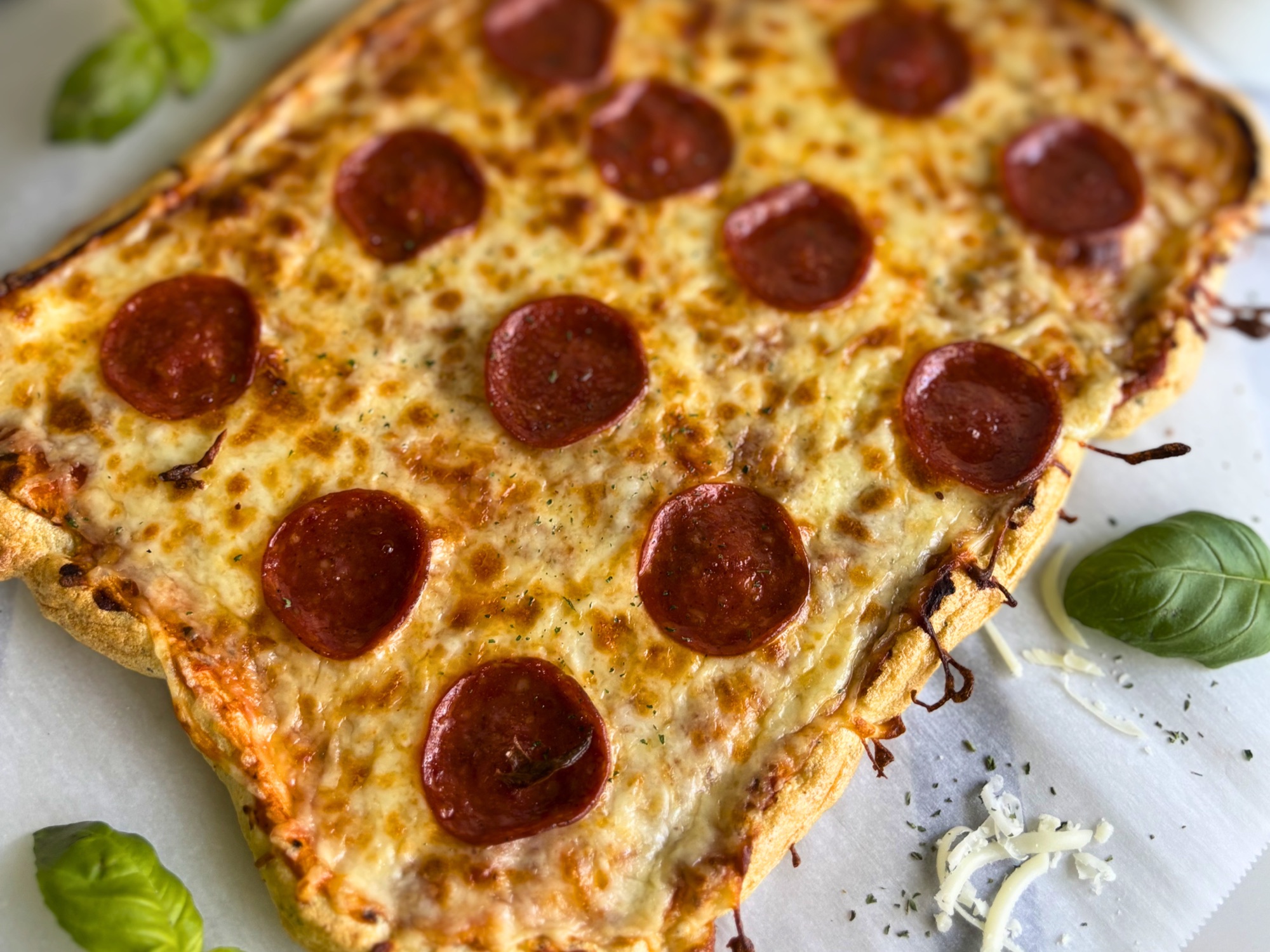
If you have a jar of sourdough discard sitting in your fridge and a bowl of leftover egg whites from your last baking project, stop what you are doing. This recipe was made for exactly this moment.
This high protein egg white pizza crust has been a staple in my kitchen for close to 10 years. However, recently I started adding my sourdough discard to it, turning an already amazing recipe into an even better one. No flour. No yeast. No dough to wrestle. Just whipped egg whites, a handful of pantry seasonings, and about 30 minutes.
In fact, I make this so often that I now have the opposite problem. I make the pizza just to have the egg whites, and then I have to figure out what to do with all the yolks. My Super Fudgy Brownies, is my favorite.
And if you do not have discard on hand? It works beautifully without it too. One recipe, two ways, both worth making on repeat.

Table of Contents
- Why You Will Love This Recipe
- Ingredients and What They Do
- The Science Behind Whipping Egg Whites
- How to Fold in Sourdough Discard
- How to Scale This Recipe
- Making It Without Sourdough Discard
- Recipe
- Baking Tips for the Perfect Crust
- Topping Ideas
- Shop This Recipe
- More High Protein Recipes
- Frequently Asked Questions
Why You Will Love This Recipe
This is not cloud bread dressed up as pizza. This is a real, holdable, sliceable pizza crust that just happens to be made entirely from whipped egg whites. Here is why it works so well:
It is genuinely high in protein. Five egg whites plus a cup of low moisture mozzarella and a light tomato sauce brings the total pizza to roughly 500 calories with 51 grams of protein. That is a full meal for one person, or an easy split for two with a side salad.
It uses up what you already have. If you bake cookies, croissants, or any enriched dough, you are constantly left with egg whites. This recipe was built for exactly that. And if you have sourdough discard on hand, it goes right in.
It comes together in under 30 minutes. No rise time, no proofing, no kneading. Whip, spread, bake, top, done.
It is naturally low in carbohydrates. Without the discard the crust is nearly carb free. With 75 grams of room temperature sourdough discard folded in, you are adding minimal carbs from a fermented source, which many people find easier to digest.

Ingredients and What They Do
Egg whites: The entire structure of this crust comes from whipped egg whites. When beaten to stiff peaks, the proteins in the whites unfold and trap air, creating a foam that sets firm in the oven. No flour required.
Cornstarch: Just one tablespoon for five egg whites. Cornstarch stabilizes the foam, helps the crust set with a slightly crisp texture, and prevents it from becoming rubbery. Do not skip it.
Dried oregano: One teaspoon adds classic pizza flavor that bakes right into the crust so every bite tastes seasoned, not just the toppings.
Garlic powder: Half a teaspoon goes a long way here. It gives the crust a savory backbone without being overpowering.
Onion powder: Optional but recommended. Another half teaspoon rounds out the flavor and adds a subtle sweetness that plays well with tomato sauce.
Sourdough discard (optional): Seventy five grams of room temperature, past peak sourdough discard folded in after whipping adds just enough structure to make every bite more satisfying. At 15 grams per egg white it scales cleanly no matter how many you are working with. More on this below.
Avocado oil spray: A light mist on the parchment paper before spreading the egg whites ensures the crust releases cleanly after baking. This adds negligible calories since it stays on the parchment, not the crust.
Low moisture mozzarella: Shredding your own is strongly recommended. Pre-shredded cheese contains anticaking agents that affect how the cheese melts. Low moisture mozzarella melts faster and cleaner than fresh mozzarella, which releases too much water and can make the crust soggy.
Shredded Parmigiano Reggiano: Three tablespoons mixed in with your mozzarella adds a significant protein boost and a sharp savory depth that makes the cheese layer taste more complex. Parmigiano Reggiano has one of the highest protein to calories ratios of any cheese, which is exactly why it earns a spot here. Do not substitute with the green lid, shelf stable kind. Use the real thing, freshly shredded if possible
Pizza sauce: A quarter to a third of a cup is all you need. Look for a no sugar added sauce, or use a low sugar option. Less sauce means a crisper crust.

The Science Behind Whipping Egg Whites
Getting stiff peaks is everything with this recipe. Here is what you need to know before you start.
Use room temperature egg whites. Room temperature egg whites whip faster and reach a greater volume than cold ones. This is because the proteins are more flexible at room temperature, meaning they unfold more readily and trap air more efficiently as you whip. Simply separate your eggs at room temperature and go straight into whipping. You do not need to refrigerate them first.
Your bowl must be completely clean and dry. Any trace of grease or moisture on your bowl or beaters will prevent the whites from reaching stiff peaks. Wipe everything down with a paper towel before you start.
Add the cornstarch and seasonings at the beginning. Add the cornstarch, oregano, garlic powder, and onion powder directly to the egg whites before you start whipping. Everything incorporates evenly as the whites build volume and you do not have to worry about deflating the foam by adding ingredients mid whip.
Whip to stiff peaks. Stiff peaks means the whites stand straight up on the beater without drooping. The mixture should look glossy and smooth. If you go past that point the whites become dry, grainy, and start to separate. If that happens, add one fresh room temperature egg white and gently fold it in to bring the mixture back.

How to Fold in Sourdough Discard
This step is where most people would go wrong if they rushed it. The sourdough discard needs to be handled gently so it does not deflate the foam you just worked to build.
Your sourdough discard must be at room temperature. This is not optional. When sourdough discard is cold from the refrigerator it thickens considerably, and a thick cold discard requires more folding to incorporate, which deflates the egg white foam. Room temperature sourdough discard at 100% hydration that is past peak has a smooth, loose, batter like consistency that folds in quickly and cleanly with minimal disturbance to the structure. Pull your sourdough discard out of the fridge at least 30 to 60 minutes before you plan to make this.
For five egg whites, use 75 grams of sourdough discard, which is 15 grams per egg white. This amount adds structure and body to the finished crust without weighing down the foam.
Once your egg whites are at stiff peaks, drizzle the sourdough discard over the top of the foam in a slow, steady stream rather than dumping it in all at once. Using a silicone spatula, fold it in with slow, deliberate strokes, going down through the center of the bowl and sweeping up and over the sides. Stop as soon as the sourdough discard is fully incorporated and the mixture looks smooth and slightly glossy. You are not stirring, you are folding.

The sourdough discard adds structure and body that makes this pizza feel more substantial than the egg white only version. It is a genuine upgrade, and a great way to put that jar in your fridge to work.
How to Scale This Recipe
One of the best things about this recipe is how easy it is to scale up or down. Use the chart below to adjust for however many egg whites you have on hand.
| Egg Whites | Cornstarch | Dried Oregano | Garlic Powder | Onion Powder | Sourdough Discard (optional) |
|---|---|---|---|---|---|
| 1 | 1 tsp (3g) | 1/4 tsp | 1/8 tsp | 1/8 tsp | 15g |
| 2 | 2 tsp (6g) | 1/2 tsp | 1/4 tsp | 1/4 tsp | 30g |
| 3 | 1 tbsp (9g) | 3/4 tsp | 3/8 tsp | 3/8 tsp | 45g |
| 4 | 1 tbsp + 1 tsp (12g) | 1 tsp | 1/2 tsp | 1/2 tsp | 60g |
| 5 (base recipe) | 1 tbsp + 2 tsp (15g) | 1 tsp | 1/2 tsp | 1/2 tsp | 75g |
| 6 | 2 tbsp (18g) | 1 1/4 tsp | 1/2 tsp | 1/2 tsp | 90g |
| 8 | 2 tbsp + 2 tsp (24g) | 1 1/2 tsp | 3/4 tsp | 3/4 tsp | 120g |
| 10 | 3 tbsp + 1 tsp (30g) | 2 tsp | 1 tsp | 1 tsp | 150g |
General rules when scaling:
• Cornstarch scales directly with egg whites at roughly one teaspoon per egg white.
• Seasoning does not need to scale as aggressively.
• For six or more egg whites, keep oregano at one to one and a half teaspoons total and garlic and onion powder at half a teaspoon each.
• Discard scales at 10 to 15 grams per egg white if using.

Making It Without Sourdough Discard
The discard is an upgrade, not a requirement. I made this crust for years before I ever added sourdough discard to it, and it is excellent on its own.
Without the discard you get a slightly crispier, more neutral flavored crust that is essentially carb free and even higher in protein per calorie. It is a great option if you do not keep a sourdough starter, or if you just do not have any discard on hand.
Everything else in the recipe stays exactly the same. Simply skip the discard and proceed directly from stiff peaks to spreading on the parchment.
If you are new to sourdough and want to start keeping a starter so you can make recipes like this one, check out my complete sourdough starter guide , Minimal Waste Sourdough Starter post for a low maintenance approach to keeping starter without throwing half of it away.
Baking Tips for the Perfect Crust

Spread to the right thickness, not a specific size. The 9×13 inch guideline is for five egg whites specifically. If you are scaling up or down, focus on thickness rather than dimensions. Aim for about half an inch thick when spread raw regardless of how many egg whites you are using. One egg white spread to 9×13 will be paper thin and overbake quickly. Match your pan size to your quantity and keep that half inch thickness as your guide.
Baking time will vary based on quantity. The 15 minute bake time is calibrated for five egg whites at the right thickness. Fewer egg whites in a smaller spread may be done in 10 to 12 minutes. More egg whites spread thicker may need a full 18 to 20 minutes. Watch for the same visual cues regardless of quantity: edges pulling away from the parchment, surface completely matte and dry with no shiny spots, and light golden color forming.
Use parchment paper and spray it. A light mist of avocado oil on the parchment before spreading the egg whites makes all the difference for clean release. Do not skip this step.
Bake at 375 degrees F (190 degrees C) for 15 minutes for a five egg white pizza. This sets the crust fully before toppings go on.
Add toppings and return to the oven for 10 minutes. Keep the oven at 375 degrees F (190 degrees C). This gives the sauce time to heat through and the cheese time to melt properly before the final step.
Broil on high, up to 500 degrees F (260 degrees C) if your oven allows, for about 2 minutes. Watch it the entire time. The broiler finishes the cheese with that golden bubbly top and gives the edges extra color. Two minutes is usually exactly right but every oven is different so do not walk away.
Cool 5 minutes then move to a wire rack. Leaving the crust on the parchment traps steam underneath and softens the base. Transfer to a wire rack as soon as it is cool enough to handle and let it breathe until you are ready to slice.


High Protein Egg White Pizza Crust with Sourdough Discard
Equipment
- Half sheet pan
- Parchment paper
- Hand mixer or stand mixer with whisk attachment
- Large mixing bowl
- Silicone spatula
- kitchen scale
- Wire cooling rack
Ingredients
- 5 egg whites room temperature
- 15 grams cornstarch 1 tablespoon
- 1 grams dried oregano 1 teaspoon
- 1.5 grams garlic powder 1/2 teaspoon
- 1.5 grams onion powder 1/2 teaspoon, optional
- 75 grams sourdough discard room temperature, past peak, optional
- avocado oil spray for parchment
- 80 grams low moisture mozzarella shredded (1 cup)
- 21 grams Parmigiano Reggiano shredded (3 tablespoons)
- 65 grams pizza sauce no sugar added (1/4 to 1/3 cup)
- pepperoni or toppings of choice
Instructions
- Preheat your oven to 375 degrees F (190 degrees C) and line a half sheet pan with parchment paper. Lightly spray the parchment with avocado oil and set aside.
- Add the egg whites, cornstarch, oregano, garlic powder, and onion powder to a large clean mixing bowl. Make sure your bowl and beaters are completely free of any grease or moisture, as even a small amount will prevent the whites from whipping properly.
- Using a hand mixer or stand mixer fitted with the whisk attachment, whip the egg whites on medium speed until foamy, then increase to medium high and continue whipping until stiff peaks form. The mixture should be glossy and smooth, and the peaks should stand straight up on the beater without drooping.
- If using sourdough discard, drizzle the room temperature discard slowly over the top of the whipped egg whites. Using a silicone spatula, gently fold the discard in with slow deliberate strokes, going down through the center and sweeping up and over the sides of the bowl. Stop folding as soon as the discard is fully incorporated and the mixture looks smooth. Do not overfold or the foam will deflate.
- Transfer the egg white mixture to the prepared sheet pan. Using the back of a spoon or a spatula, spread it into a rectangle approximately 9×13 inches, about half an inch thick. Focus on keeping an even thickness rather than hitting an exact size, as this ensures the crust bakes evenly all the way through.
- Bake at 375 degrees F (190 degrees C) for 15 minutes, until the surface looks completely matte and dry with no shiny spots and the edges are just beginning to pull away from the parchment. Baking time may vary slightly depending on how thick you spread the crust.
- Remove the crust from the oven and spread the pizza sauce all the way to the edges, not just the center. The sauce soaks into the edges as it bakes, adding flavor all the way through. Add the shredded cheese and any additional toppings.
- Return the pizza to the oven and bake for an additional 10 minutes at 375 degrees F (190 degrees C) until the cheese is melted and beginning to bubble.
- Switch the oven to broil on high, up to 500 degrees F (260 degrees C) if your oven allows you to select a broil temperature. Broil for approximately 2 minutes, watching closely the entire time, until the cheese is golden and bubbly and the edges have a little color. Do not walk away during this step.
- Remove the pizza from the oven and allow it to cool for 5 minutes. Carefully slide the crust off the parchment and transfer it to a wire cooling rack. Allowing air to circulate underneath keeps the base from going soft. Slice and serve immediately.
Notes
Topping Ideas
Keep toppings on the lighter side and avoid anything with high water content like fresh tomatoes or raw mushrooms, which can release moisture and soften the crust during baking.
Classic: Low moisture mozzarella, no sugar added tomato sauce, pepperoni.
White pizza: A thin layer of ricotta, shredded mozzarella, garlic, and fresh basil added after baking.
Veggie: Roasted red peppers, olives, and artichoke hearts with mozzarella.
Extra protein: Add grilled chicken or crumbled turkey sausage on top of the sauce before the cheese.
For the sauce, a low sugar option like Rao’s homemade marinara keeps the carb count minimal and the flavor clean. A quarter to a third of a cup is plenty. Spread it all the way to the edges of the crust, not just the center. The sauce soaks into the edges as it bakes, becoming part of every bite and adding flavor all the way through.

Shop This Recipe
Here are the tools I use to make this recipe. Nothing complicated, but the right equipment makes a real difference.
- Half Sheet Pan — This is the pan I use for this recipe. A half sheet pan gives you the perfect surface area for five egg whites spread to the right thickness. It bakes evenly and the rimmed edges keep everything contained.
- Parchment Paper — Non negotiable for this recipe. The egg white crust will stick without it. Pair it with a light spray of avocado oil for a clean release every time.
- Hand Mixer — You need a mixer to get to stiff peaks efficiently. A hand mixer works perfectly and gives you good control over the process.
- Stand Mixer – You need a mixer to get to stiff peaks efficiently. A stand mixer works perfectly.
- Spatula — Essential for folding in the sourdough discard without deflating the foam. A flexible silicone spatula lets you get under the mixture and fold with minimal strokes.
- Wire Cooling Rack — Moving the crust to a wire rack after baking lets air circulate underneath and keeps the base from going soft. Do not skip this step.
- Avocado Oil Spray — A light mist on the parchment before spreading the egg whites ensures the crust lifts off cleanly. Avocado oil has a neutral flavor and high smoke point, making it ideal here.
- Kitchen Scale — Weighing your sourdough discard and cornstarch takes the guesswork out of scaling this recipe up or down accurately.
More High Protein Recipes from H3art of the Home
If you are building out a high protein recipe rotation, here are some other favorites from the blog:
- High Protein Sourdough Sandwich Bread
- High Protein Yeasted Sandwich Bread
- High Protein Honey Whole Wheat Sourdough Sandwich Bread
- High Protein Sourdough Dinner Rolls
- High Protein Sourdough Pretzel Bites
- High Protein Smoked Cheddar and Onion Scones
- High Protein Chocolate Chip Scones
Frequently Asked Questions
Can I use carton egg whites instead of fresh egg whites?
Fresh egg whites are strongly preferred. Carton egg whites have often been pasteurized, which can make them harder to whip to stiff peaks and may result in a less stable foam. If fresh eggs are not available, look for carton whites that specifically state they are suitable for whipping.
Does this crust taste eggy?
No. Once it is baked and topped with sauce and cheese, the egg flavor is completely undetectable. The oregano, garlic, and onion powder season the crust from the inside so every bite tastes like pizza.
Is this recipe gluten free?
Without the sourdough discard, yes, this crust is naturally gluten free. With discard added, the crust contains a very small amount of flour from the starter. The fermentation process does break down some of the gluten, making it more digestible for many people, but it is not technically gluten free with discard included.
Can I make this ahead of time?
The crust bakes best fresh. You can bake the crust only, cool it completely on a wire rack, and store it uncovered at room temperature for a few hours before adding toppings and finishing in the oven. Refrigerating the baked crust before topping is not recommended as it can make the base soft.
Can I freeze it?
Yes. Bake the crust without toppings, cool completely on a wire rack, then freeze flat wrapped in parchment. Reheat directly from frozen at 375 degrees F for 8 to 10 minutes before adding toppings and finishing.
Why did my crust turn out soft in the middle?
The most common reasons are spreading too thick, not baking long enough in the first stage, or leaving it on the parchment after baking instead of transferring to a wire rack. Make sure the surface looks completely matte and dry before adding toppings.
Do I need to use a mixer?
A hand mixer or stand mixer is strongly recommended. Whipping egg whites by hand to stiff peaks is possible but takes significantly longer and is much harder to control.
Why does the sourdough discard need to be at room temperature?
Two reasons. First, most baking works best when ingredients are at a similar temperature, and your egg whites are at room temperature so your sourdough discard should be too. Second, cold sourdough discard thickens considerably in the refrigerator. A thick cold discard requires more folding to incorporate into the egg white foam, and more folding means more deflation. Room temperature sourdough discard has a smooth, loose consistency that folds in quickly and cleanly with just a few strokes, preserving the structure you worked to build.

Let’s Connect
If you make this recipe I would love to see it! Leave a comment below and let me know how it turned out, and tag me on Instagram or Facebook so I can share your pizza. And if you want recipes like this one sent straight to your inbox, make sure you are signed up for the H3art of the Home newsletter.




Leave a Reply