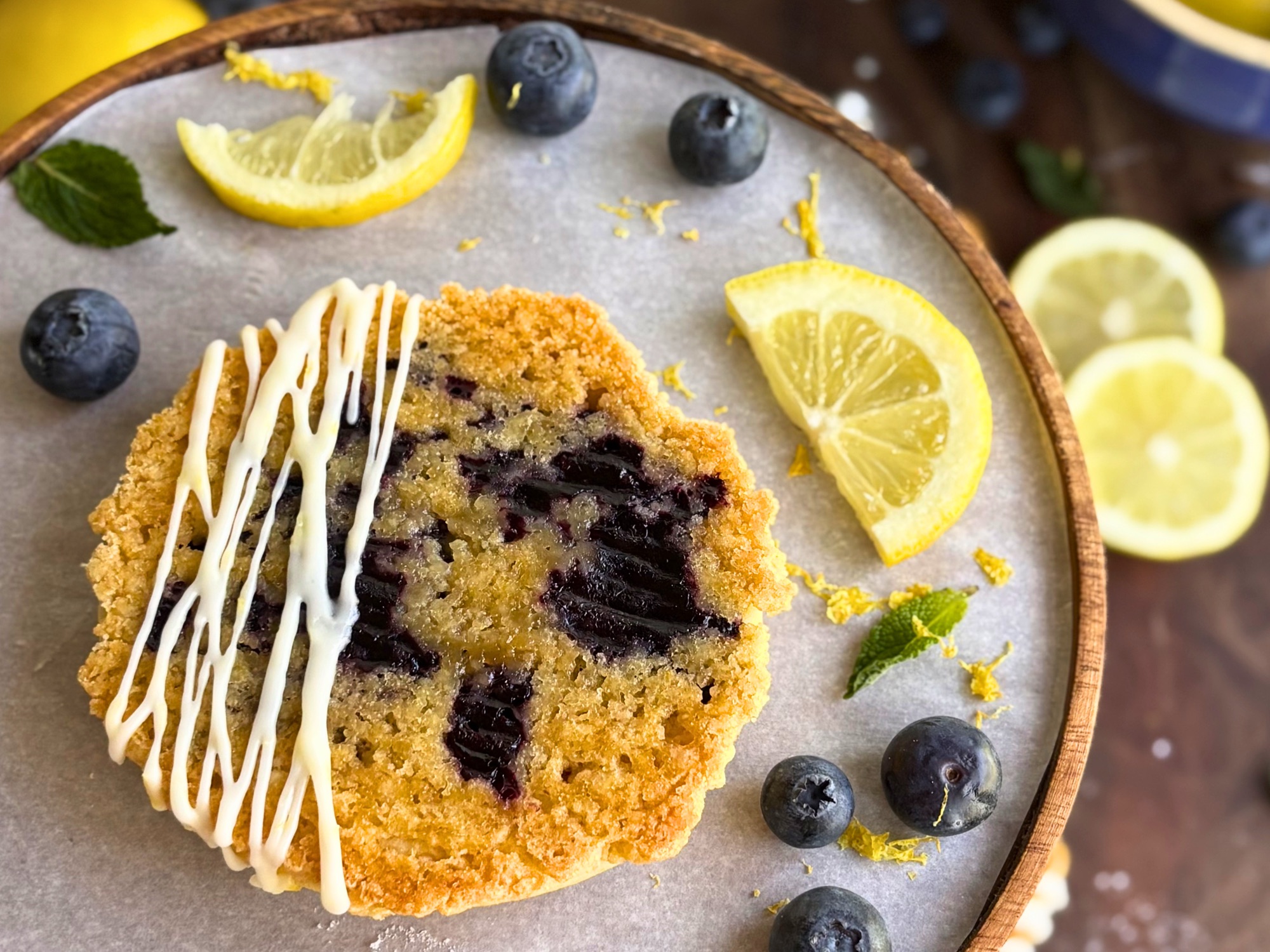
Soft, buttery lemon cookies with jammy blueberries and crispy crumble topping. A completely unique creation you won’t find anywhere else.
When I created my blueberry pie cookies, I knew I had something special. But I kept thinking about how incredible they’d be with lemon. Not just a drizzle or a hint, lemon everywhere. Lemon zest in the cookie dough, lemon in the crumble, lemon juice in the blueberry compote, and a bright lemon glaze on top. These lemon blueberry crumble cookies are that vision brought to life, and they might be even better than the original.
Table of Contents
- Why You’ll Love These Lemon Blueberry Cookies
- What Makes These Cookies Different
- The Upside Down Method Explained
- Key Ingredients and Why They Matter
- Essential Equipment
- The Fermentation Process
- Making the Lemon Blueberry Compote
- Creating the Lemon Crumble Topping
- Assembly and Baking
- The Lemon White Chocolate Drizzle
- Recipe
- Storage and Make Ahead Tips
- Tips for Success
- Can I Make These Without Sourdough?
- Variations and Substitutions
- Troubleshooting Common Issues
- Frequently Asked Questions
- More Cookie Recipes
Why You’ll Love These Lemon Blueberry Cookies
No bleeding blueberries. This is the number one complaint about blueberry cookies, and the upside down method solves it completely. The blueberries sit in a compote layer that stays where it belongs instead of turning your dough purple or making everything soggy.
Lemon flavor in every layer. Fresh lemon zest goes into the cookie dough and the crumble topping during the 12 to 24 hour fermentation, infusing everything with bright citrus flavor. Lemon juice brightens the blueberry compote. And the lemon glaze on top ties it all together.
The texture is incredible. Fermentation creates a soft, tender cookie base that stays fresh for days. The crumble topping bakes up crispy and golden. The blueberry compote layer is jammy and thick. Three distinct textures in every bite.
They look bakery professional. The marbled top where the cookie dough, crumble, and compote meet creates a beautiful pattern. The lemon glaze drizzle makes them look like they came from an expensive bakery, not your home kitchen.
They’re a completely unique creation. Sweet lemon sugar cookie base, jammy blueberry compote, crispy fermented crumble topping, and a bright lemon glaze. The upside down baking method creates something you simply won’t find in any bakery or cookbook.

What Makes These Cookies Different
Most lemon blueberry cookie recipes mix berries directly into the dough and cross their fingers. The berries bleed, the cookies spread into puddles, or the fruit makes everything soggy. Some recipes use freeze dried blueberries or jam to avoid these problems, but then you lose that fresh fruit flavor.
This recipe takes a completely different approach. The upside down assembly method puts the blueberries in a thick compote layer that sits between the cookie base and the crumble topping. During baking, everything is flipped. The cookie dough faces up in the oven so it bakes properly. The blueberries and crumble are protected underneath. After cooling, you flip the cookies over to reveal the gorgeous crumble top with jammy blueberries peeking through.
The sourdough fermentation sets these apart from every other lemon blueberry cookie recipe out there. The cookie dough and crumble both ferment for 12 to 24 hours with active sourdough starter. This creates complex flavor that balances the sweetness of the blueberries and sugar. The fermentation also develops a more tender texture and makes the cookies easier to digest.
The lemon integration is next level. Fresh lemon zest infuses the cookie dough and crumble during fermentation. Lemon juice brightens the blueberry compote and prevents it from being cloying. The lemon glaze on top gives that final punch of citrus that makes these cookies completely unique.

The Upside Down Method Explained
This technique might seem complicated at first, but it’s actually quite simple and solves multiple problems at once.
You start by spreading circles of lemon crumble directly onto parchment paper. The crumble is slightly wet from the lemon juice, which helps it hold its shape. Then you add the cooled blueberry compote to the center of each crumble circle. Finally, you top everything with circles of lemon cookie dough.
During baking, the cookie dough is facing up in the oven. It bakes into a tender base without getting soggy from the fruit. The blueberries sit in the middle, protected and caramelizing slightly. The crumble topping is on the bottom against the parchment, getting crispy and golden.
After baking, the cookies cool completely on the baking sheet. This cooling period is critical. The cornstarch in the blueberry compote continues to thicken and set as it cools. The butter in the crumble resolidifies. Everything firms up enough to flip without falling apart.
Once cool, you use a thin spatula to carefully lift each cookie and flip it over. The crumble is now on top where it belongs, perfectly crispy. The blueberries are a jammy layer in the middle. The cookie base is tender on the bottom. It’s architectural brilliance in cookie form.

Key Ingredients and Why They Matter
Active sourdough starter: You need 120g for the cookie dough and 30g for the crumble. Fed starter or discard both work. The active starter provides leavening and drives the fermentation that creates complex flavor. If you don’t have a sourdough starter yet, you can learn how to create one here.
Fresh lemon zest: You’ll need about 1.5 lemons total. One large lemon provides zest for the cookie dough, and half a lemon provides zest for the crumble. Always zest before you juice. The zest contains oils that infuse the dough and crumble with bright lemon flavor during fermentation.
Fresh lemon juice: Bottled lemon juice won’t give you the same vibrant flavor. You need fresh squeezed for the compote, the crumble topping, and the glaze. The acidity brightens the blueberries and helps the compote set properly.
Two types of sugar in the cookie dough: Brown sugar creates chewiness and adds depth of flavor. Powdered sugar gives a more tender, cake-like crumb. Together they create that perfect soft cookie texture.
Almond extract: Omitted from this recipe to let the lemon and blueberry flavors shine.
Cream of tartar: A tiny amount helps the cookies stay tender and prevents them from spreading too much during baking. It also enhances the bright flavors from the sourdough and lemon.
Fresh blueberries: Use ripe, sweet blueberries for the best flavor. The compote cooking process intensifies their flavor and removes excess moisture. Fresh works beautifully. Frozen wild blueberries tend to have more concentrated blueberry flavor, which is interesting, but I’ve tested these with fresh blueberries and they taste just as delicious.
Cornstarch in the compote: This is what thickens the blueberry juices into a jam-like consistency. As the cookies cool after baking, the cornstarch firms up even more, creating a sliceable layer that won’t make your fingers sticky.
Cold butter in the crumble: Keep that butter cold so it stays in pieces instead of melting into the flour. Those butter chunks create the crumbly, streusel-like texture as they melt during baking.

Essential Equipment
Circle cutter or wide-mouth jar: Something 2.5 to 3 inches in diameter to cut uniform circles. I use a wide-mouth canning jar because I always have one, but a biscuit cutter works perfectly.
Parchment paper: Mandatory. These cookies have sticky blueberry compote, and they will absolutely glue themselves to a bare baking sheet.
Thin, flexible spatula: For removing the cookies after baking and flipping them. An offset spatula makes the job easier and reduces breakage.
Microplane or zester: For fine lemon zest. You want tiny pieces that distribute evenly through the dough and crumble, not big chunks.
Food processor: Optional but highly recommended for making the crumble. It takes 30 seconds versus several minutes of arm work.

The Fermentation Process
Fermenting cookie dough creates results you simply cannot get from quick recipes. The wild yeast and bacteria in sourdough starter break down some of the flour’s starches and proteins over 12 to 24 hours. This develops complex flavor that’s deeper and more interesting than regular cookies.
The fermentation also makes the cookies more digestible. If you’re sensitive to gluten or find regular baked goods heavy, fermented dough is often easier on your stomach. The bacteria pre-digest some of the components that can cause issues.
You can ferment for as little as 12 hours or as long as 24 hours. Shorter fermentation works if you’re in a hurry. Longer fermentation creates more tender texture and allows the lemon flavor to infuse throughout. I usually go for 24 hours for the best results.
The crumble topping ferments alongside the dough with both lemon zest and lemon juice. This creates tiny air pockets that make the crumble lighter and crispier after baking. The lemon flavor also has time to mellow and integrate.

Making the Lemon Blueberry Compote
The compote technique is important for getting the right consistency. Start by whisking the cornstarch and lemon juice together in a small bowl. This creates a slurry that will thicken the blueberries without forming lumps.
Cook the blueberries with sugar and lemon zest over medium heat. Stir gently. You want the berries to burst and release their juices, but some should stay intact for texture. After 5 to 7 minutes, the mixture will be bubbling and fragrant.
Temper the cornstarch slurry by whisking in a few spoonfuls of the hot blueberry liquid. This gradually brings the temperature up so the cornstarch doesn’t seize when you add it to the hot pan. Pour the tempered slurry back into the saucepan and cook for 2 to 3 more minutes, stirring constantly.
The compote should look thick and glossy. It will seem a bit loose in the pan, but it thickens considerably as it cools. The extra lemon juice compared to regular blueberry compote gives bright citrus flavor that balances the sweetness without making the berries too tart.
Let the compote cool completely before assembly. Warm compote will make the cold butter in your crumble start to melt. I usually make the compote while my dough is in the final hours of fermentation so everything is ready at the same time.

Creating the Lemon Crumble Topping
The lemon crumble is what sets these apart from regular lemon blueberry cookies. Flour, sugars, salt, lemon zest, and sourdough starter get mixed together first. Then cold cubed butter gets cut in until the mixture resembles coarse crumbs. Finally, vanilla and lemon juice get added.
If you’re using a food processor, this takes about 30 seconds total. Pulse the dry ingredients and starter to combine, add the cold butter and pulse until crumbly, then add the vanilla and lemon juice and pulse just to incorporate. Done.
If you’re making it by hand, use a pastry cutter or your fingers to work the cold butter into the dry ingredients. The key is keeping everything cold so the butter doesn’t melt and turn the mixture into paste. You want coarse, crumbly pieces. I say it should remind you of the texture of brown sugar. You can squeeze it together, BUT it will break back apart into crumble pieces.
The lemon juice makes the crumble slightly wet, which is perfect. It helps everything hold together during assembly and creates a more cohesive topping after baking. The crumble ferments alongside the cookie dough for 12 to 24 hours in the refrigerator.

Assembly and Baking
Preheat your oven to 350°F and line a large baking sheet with parchment paper. Get your circle cutter ready.
Using the circle cutter as a guide, spread about 2 rounded tablespoons of lemon crumble directly on the parchment in circles. Space them about 2 inches apart. Pack the crumble down slightly but don’t compress it too much. If you want that beautiful marbled top, leave little spots and gaps in the crumble where the compote can touch the pan directly. This creates gorgeous color peek-through between the crumble after baking.
Add 2 teaspoons of cooled lemon blueberry compote to the center of each crumble circle. Spread it gently but leave a little border so it doesn’t ooze out during baking.
Roll out your fermented lemon cookie dough on a well floured surface to about 3/8 inch thick. This specific thickness matters. Too thick and the cookies won’t bake through. Too thin and they’ll be fragile. Use your circle cutter to cut out rounds and place them on top of the crumble and compote layers. Press down gently to adhere.
Bake for 18 to 20 minutes. The cookie tops (which are facing up in the oven) should be golden brown and set. You should see browning on the bottom edges through the parchment.
Let the cookies cool completely on the baking sheet. This is not optional. The compote needs at least an hour to set properly. The cornstarch continues to thicken as it cools, transforming from a somewhat liquid state to a stable, jammy layer. If you try to move the cookies too soon, everything will fall apart.

The Lemon White Chocolate Drizzle
Once the cookies are completely cool and you’ve flipped them over so the crumble is on top, make the lemon white chocolate drizzle. Melt white chocolate with coconut oil until smooth. Add lemon extract and stir well to combine. Finally, fold in fresh lemon zest for extra lemon flavor and visual appeal.
The drizzle should be fluid enough to drizzle in lines but thick enough to hold its shape. If it’s too thick, add a bit more coconut oil. If it’s too thin, let it cool for a minute or two to thicken slightly.
Use a spoon or pour the drizzle into a piping bag and drizzle it back and forth across the cookies in a zigzag pattern. You don’t need to cover them completely. Thin, random drizzles look more elegant than heavy coating.
Let the drizzle set for about 30 minutes at room temperature before serving or stacking the cookies. In the fridge, it sets faster, about 15 minutes. The lemon white chocolate adds sweetness and that final punch of lemon flavor that makes these cookies special, and it stays stable without reacting with the blueberry compote.


Lemon Blueberry Crumble Cookies
Equipment
- 2.5 to 3 inch circle cutter or wide mouth canning jar
- Large baking sheet
- Parchment paper
- Rolling Pin
- Medium saucepan
- Small bowl for cornstarch slurry
- Thin flexible spatula or offset spatula
- Microplane or zester
- Food processor (optional, for crumble)
- Mixing bowls
- Whisk
- plastic wrap
Ingredients
Sourdough Cookie Base
- 120 g active sourdough starter 1/2 cup
- 113 g unsalted butter softened (1/2 cup)
- 80 g powdered sugar 2/3 cup
- 67 g brown sugar packed (1/3 cup)
- 50 g egg 1 large egg
- 5 g vanilla extract 1 teaspoon
- 1 tablespoon lemon zest from about 1 large lemon
- 270 g all-purpose flour 2 1/4 cups
- 2 g baking powder 1/2 teaspoon
- 1.5 g salt 1/4 teaspoon
- 1/8 teaspoon cream of tartar
Fermented Lemon Crumble
- 120 g all-purpose flour 1 cup
- 80 g brown sugar packed (1/3 cup)
- 30 g powdered sugar 1/4 cup
- 2.5 g salt 1/2 teaspoon
- 1 teaspoon lemon zest
- 30 g active sourdough starter 2 tablespoons
- 60 g cold unsalted butter cubed (1/4 cup)
- 2.5 g vanilla extract 1/2 teaspoon
- 10 g fresh lemon juice 2 teaspoons
Lemon Blueberry Compote
- 450 g fresh or frozen blueberries 3 cups
- 60 g granulated sugar 1/4 cup
- 24 g cornstarch 3 tablespoons
- 25 g fresh lemon juice 1 tablespoon plus 2 teaspoons
- 1 teaspoon lemon zest
Lemon White Chocolate Drizzle
- 100 g white chocolate finely chopped (about 3/4 cup)
- 1 to 2 teaspoons coconut oil
- 1/4 to 1/2 teaspoon lemon extract
- 1 teaspoon lemon zest
Instructions
Prepare Dough and Crumble for Fermentation
- Make the lemon cookie dough.
- In a large bowl, cream together softened butter, powdered sugar, and brown sugar until light and fluffy.
- Add egg and vanilla extract. Mix well.
- Add sourdough starter and lemon zest. Mix until combined.
- In a separate bowl, whisk together flour, baking powder, salt, and cream of tartar.
- Gradually add dry ingredients to wet ingredients, mixing until just combined.
- Wrap dough in plastic and refrigerate for 12 to 24 hours.
- Make the fermented lemon crumble (Hand Method).
- In a medium bowl, mix flour, brown sugar, salt, powdered sugar, lemon zest, and sourdough starter.
- Add cold cubed butter and cut in using a pastry cutter or your fingers until mixture resembles coarse crumbs.
- Add vanilla and lemon juice. Mix gently until just incorporated.
- Cover bowl and refrigerate alongside the cookie dough for 12 to 24 hours.
- Make the fermented lemon crumble (Food Processor Method – Easier).
- Add flour, brown sugar, salt, powdered sugar, lemon zest, and sourdough starter to food processor.
- Pulse 3 to 4 times to combine dry ingredients.
- Add cold cubed butter and pulse 10 to 15 times in short bursts until mixture resembles coarse crumbs.
- Add vanilla and lemon juice. Pulse to incorporate. Youre looking for a brown sugar texture. You should be able to take some in your hand and squeeze it and it stays together, but be able to break it back apart.

- Transfer to a bowl, cover, and refrigerate alongside the cookie dough for 12 to 24 hours.
Assembly and Baking
- Prepare the lemon blueberry compote.
- In a small bowl, whisk together cornstarch and lemon juice until smooth to create a slurry.
- In a medium saucepan, combine blueberries, granulated sugar, and lemon zest.
- Cook over medium heat, stirring gently, for 5 to 7 minutes until blueberries begin to burst and release their juices.
- Spoon a few spoonfuls of the hot blueberry liquid into the cornstarch slurry, whisking constantly to temper it.
- Pour the tempered cornstarch slurry back into the saucepan with the blueberries.
- Continue cooking, stirring gently, for 2 to 3 more minutes until mixture thickens and becomes glossy.
- Remove from heat and let cool completely for at least 30 minutes.
- Prepare for assembly.
- Preheat oven to 350°F (175°C).
- Line a large baking sheet with parchment paper.
- Get your 2.5 to 3 inch circle cutter or wide mouth canning jar ready.
- Assemble the cookies.
- Using your circle cutter as a guide, spread about 2 rounded tablespoons of fermented lemon crumble directly on the parchment in circles. Space them about 2 inches apart.
- If you want a beautiful marbled top, leave little spots and gaps in the crumble where the compote can touch the pan directly. This creates gorgeous color peek through between the crumble after baking.

- Top each crumble circle with a tablespoon of cooled lemon blueberry compote. Gently spread, leaving a little border.
- Roll out the fermented lemon cookie dough on a well floured surface to a rough rectangle, approximately 13”x 12”, about 3/8” inch thick.
- Using your circle cutter, cut out circles from the dough.
- Gently gather scraps, press together to form another rectangle, and continue cutting until all dough is used. If the dough becomes resistant, wrap well and place in the fridge for 15-30 minutes to allow the gluten to relax.
- Place each cookie circle on top of the crumble and blueberry layers.
- Gently press down to adhere, making sure the crumble and blueberry compote are underneath the cookie.

- Bake the Cookies
- Bake for 18 to 23 minutes, until cookie tops are golden brown and set. You should see browning on the bottom edges.
- Remove from oven and let cool on the baking sheet for at least 1 hour. This is crucial for the compote to set properly.
- Once cool, use a thin flexible spatula to carefully flip each cookie over so the crumble is on top.
- Add lemon white chocolate drizzle.
- Melt white chocolate with coconut oil in a microwave (stirring every 20 seconds) or in a double boiler until smooth.
- Add lemon extract and stir well to combine.
- Fold in lemon zest.
- Using a spoon or piping bag, drizzle the lemon white chocolate over the cooled cookies in a zigzag pattern.

- Let chocolate set for about 30 minutes at room temperature before serving.
- Serve and store.
- Serve immediately or store covered at room temperature for up to 3 days.
- Refrigerate after 3 days for up to 5 days total.
Notes
Storage and Make Ahead Tips
Store these cookies in an airtight container at room temperature for up to 3 days. The texture stays soft and tender thanks to the moisture from the blueberries and the fermented dough. After 3 days, the cookies start to dry out and the crumble loses some crispness.
You can refrigerate them for up to 5 days if you need them to last longer. They’re delicious cold. Just let them come to room temperature before serving for the best texture.
I have successfully baked these cookies and frozen them. Pull out and let them come to room temperature before serving. I would suggest skipping the drizzle before freezing and do it after they’re defrosted.
Quick turnaround option:
These cookies can be made in as little as 2 hours if you skip the long fermentation. Make the compote first and put it in the refrigerator to cool quickly. Mix your cookie dough and crumble, then refrigerate both to chill. For faster chilling, dump your mixed cookie dough onto a plastic wrap lined counter, fold it up with the plastic wrap to form a wide, flat disc (not a big chunk), and stick it directly in the fridge. The flatter shape chills much faster. Once the dough is cold enough to roll, you can assemble and bake.
Make ahead options:
The cookie dough and crumble can ferment for up to 24 hours, giving you flexibility in your timeline. This is a great recipe to prep ahead:
Option 1: Mix your dough and make your compote in the evening. Refrigerate everything overnight. The next morning, roll out your dough, assemble, and bake.
Option 2: Mix everything, roll out your dough and cut your circles, make your compote, and refrigerate all components separately. The next day, just assemble and bake. This is the fastest assembly process.
The blueberry compote can be made up to 3 days ahead and stored in the refrigerator. Bring it to room temperature before assembly so it spreads easily.

Tips for Success
Gentle handling: Use a thin, flexible spatula to flip the cooled cookies. Work slowly and support the entire cookie as you turn it over.
Complete cooling is crucial: Removing cookies from the pan too early will cause them to fall apart. The compote needs time to fully set. Wait at least an hour, preferably longer.
Dough thickness matters: 3/8 inch thick ensures the cookie bakes through without being too thick or thin. Use a ruler if you’re unsure. It’s the sixth small mark on most rulers, right between 1/4 and 1/2 inch.
Fermentation time: 12 to 24 hours develops the best flavor in both the dough and crumble. 24 hours is the sweet spot for tender texture and lemon infusion.
Assembly spacing: Leave about 2 inches between cookies on the baking sheet. They don’t spread much, but you want good air circulation for even baking.
Fresh lemon is essential: Bottled lemon juice won’t give you the bright, vibrant flavor that makes these cookies special. Always use fresh squeezed lemons.
Cold butter for crumble: If your butter warms up while making the crumble, refrigerate the mixture for 10 minutes before continuing. Cold butter creates the best texture.
Can I Make These Without Sourdough?
Yes, you can make these without sourdough starter, but the texture and flavor will be different. The fermentation creates complexity that you simply cannot replicate with a quick recipe.
To make these without sourdough:
- Replace the 120g starter in the cookie dough with 60g flour and 60g milk.
- Replace the 30g starter in the crumble with 15g flour and 15g milk.
You can skip the long fermentation and simply chill the dough for 2 hours before rolling and cutting.
The cookies will still be good, but they won’t have the same tender texture or complex flavor that fermentation provides. They’ll taste more like standard lemon cookies instead of having that depth that makes people ask for the recipe.
If you’re interested in the benefits of sourdough baking, you can learn how to create a sourdough starter here.
Variations and Substitutions
Different berries: Raspberries, blackberries, or a berry mix all work with the same method. Adjust the sugar in the compote based on how sweet your berries are. Raspberries are more tart and might need an extra tablespoon of sugar.
White chocolate drizzle instead of lemon glaze: This is now the main recipe! The lemon white chocolate drizzle is stable and won’t react with the blueberry compote.
No almond extract: Omitted from this lemon blueberry version to let the citrus and berry flavors shine through.
Dairy alternatives: You can try plant based butter and milk in this recipe, though I haven’t tested it myself. The texture may vary slightly. If you try it, let me know how it works!
Less sugar: You can reduce the sugar in the cookie dough by up to 25% without major texture changes. The cookies will be less sweet and slightly less tender. Don’t reduce the sugar in the compote as it needs that sweetness to balance the tart blueberries and lemon juice.

Troubleshooting Common Issues
My cookies fell apart when I flipped them: You didn’t let them cool long enough. These cookies need at least an hour of cooling time for the compote to fully set. Be patient.
The blueberry compote didn’t thicken: Make sure you used cornstarch, not flour. Cornstarch has much more thickening power. Also, you need to cook the compote until it’s visibly thick and glossy. It will continue thickening as it cools.
My crumble topping is too dense: The butter was probably too warm when you made it, or you over-worked the mixture. Keep the butter cold and handle the crumble gently. It should look like coarse sand or wet cookie crumbs.
The cookies spread too much: Your butter might have been too soft when you mixed the dough, or your dough wasn’t cold enough when you baked it. Make sure the dough is well chilled after fermentation. You can also add an extra 2 tablespoons of flour if your sourdough starter is very wet.
The lemon drizzle is too thick: Add more coconut oil, a few drops at a time, until it reaches drizzling consistency.
The lemon drizzle is too thin: Let it cool for a minute or two. White chocolate thickens as it cools.

Frequently Asked Questions
Can I use sourdough discard instead of active starter?
Yes, absolutely. Discard works fine in this recipe. Just make sure your discard is relatively recent. Discard that’s been sitting in your fridge for weeks might have off flavors.
How long should I ferment the dough?
Minimum 12 hours, maximum 24 hours. The sweet spot is between those for the best flavor and texture. I have done up to 48 hours with great results. You can also skip the long fermentation and start making these in as little as 2 hours ( the below faq).
Can I use frozen blueberries?
Yes! Frozen wild blueberries actually have more concentrated blueberry flavor, which is interesting. I’ve also tested these with fresh blueberries and they taste just as delicious. If you use frozen blueberries, add them frozen (don’t thaw first). You might need to cook the compote a bit longer to thicken it properly since frozen berries release more water.
Why do these cookies use the upside down method?
Fresh blueberries add a lot of moisture, which is why most berry cookie recipes use freeze dried fruit instead. The upside down method puts the berries in a compote that’s thickened with cornstarch, and positions everything so the moisture releases onto the pan instead of into the dough. This solves the soggy cookie problem completely.
Do I have to use the lemon white chocolate drizzle?
No, the drizzle is optional. The cookies are delicious without it. But the lemon white chocolate adds that final punch of lemon flavor and makes them look bakery professional. Plus, it stays stable and won’t react with the blueberry compote like a powdered sugar glaze would.
Can I make these gluten free?
I haven’t tested this recipe gluten free. A 1:1 gluten free flour blend might work since the fermentation helps break down gluten anyway. If you try it, let me know how it turns out!
How do I get that marbled top look?
When spreading your crumble on the parchment, leave little spots and gaps where the compote can touch the pan directly. This allows the blueberry color to peek through between the crumble pieces after baking, creating that beautiful marbled effect.
How do I know when the compote is thick enough?
It should coat the back of your spoon and leave a trail when you drag your spoon through it. It will seem a bit loose in the pan but will thicken considerably as it cools.
Can I freeze these cookies?
I haven’t tested freezing the assembled unbaked cookies yet. The blueberry compote may behave differently when frozen and baked from frozen. How ever i have frozen the baked cookies and pulled out to enjoy. I would recommend skipping the chocolate drizzle before freezing and adding the drizzle after defrosted.
Can I make these faster without the long fermentation?
Yes! While the 12 to 24 hour fermentation creates the best flavor and texture, you can make these cookies in as little as 2 hours. Make the compote first and refrigerate to cool it quickly. Mix your dough and crumble, then chill both. For faster chilling, shape your cookie dough into a wide, flat disc wrapped in plastic wrap instead of a thick ball. Once everything is cold, roll out the dough and assemble. The cookies will still be delicious, just without that extra depth from fermentation.
Can I prep components ahead and assemble later?
Absolutely! This is one of the best make ahead cookies. You can mix your dough and compote in the evening, refrigerate overnight, then assemble and bake the next day. Or go one step further and roll out your dough, cut your circles, and have all components ready in the fridge. Then you just assemble and bake when you’re ready.

More Cookie Recipes
These lemon blueberry crumble cookies are everything I love about summer baking. Bright lemon flavor, jammy blueberries, crispy crumble topping, and a tender fermented cookie base. The upside down method means no bleeding berries or soggy cookies. The sourdough fermentation creates complexity you simply can’t get from quick recipes.
If you make these, I’d love to see them! Tag me on Instagram @h3artofthehome so I can see your beautiful cookies. And if you love these, you’ll definitely want to try some of my other dessert cookies:
- Sourdough Blueberry Pie Cookies – The original that inspired this lemon version
- Sourdough Strawberry Shortcake Cookies – Fresh strawberries and vanilla
- Sourdough Peach Pie Cookies – Summer peaches at their finest
- Sourdough Caramel Apple Pie Cookies – Spiced apples for fall
- Sourdough Pecan Pie Cookies – Rich and nutty
- Sourdough Cherry Pie Cookies – Tart cherries and almond
- Sourdough Caramel Apple Cookie Cups – Caramelized apples with cinnamon
Don’t forget to leave a comment below if you try these! And sign up for my newsletter to get new recipes delivered straight to your inbox every week.






Leave a Reply