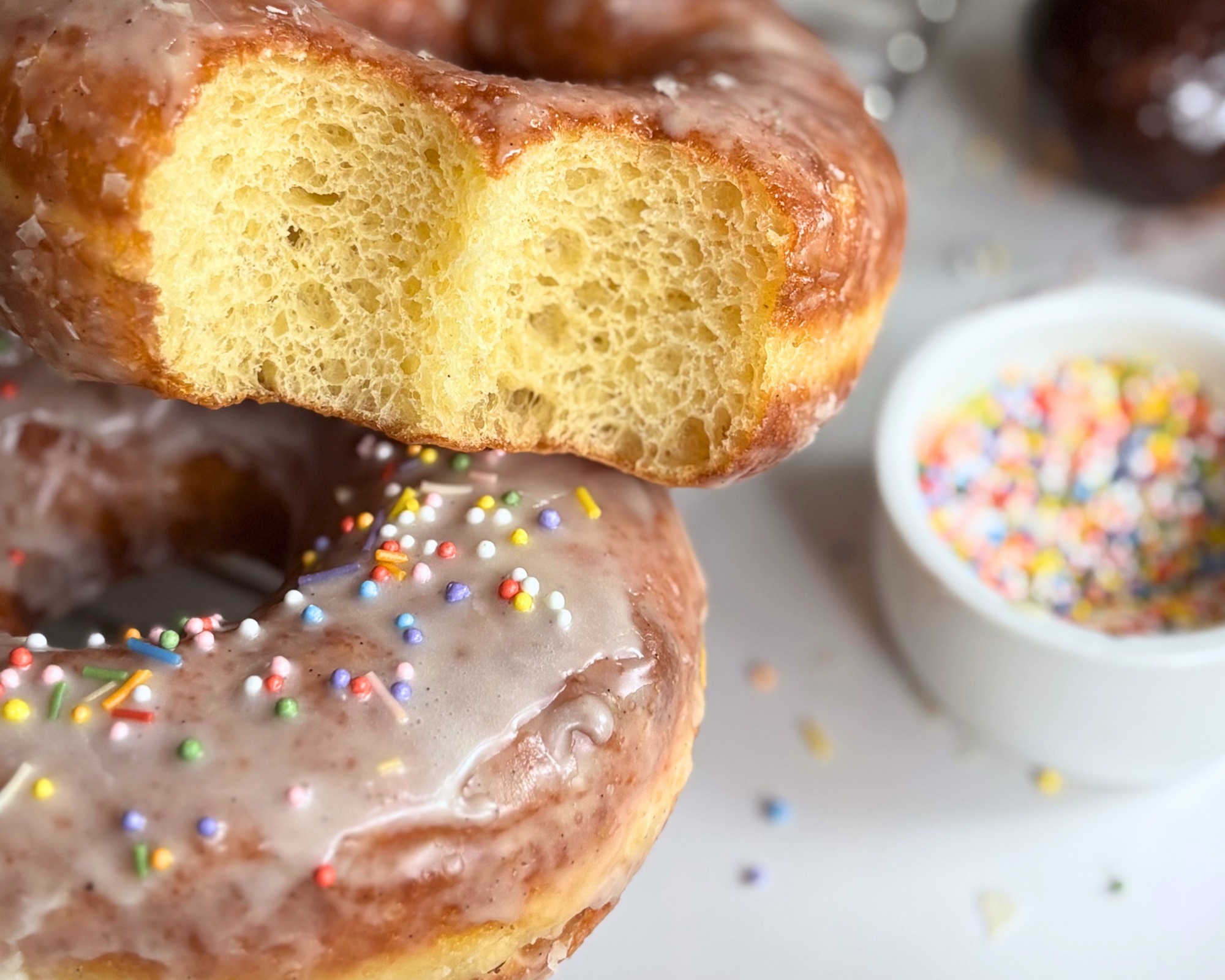
Back in February I started working on a high protein sourdough donut recipe. I had the idea, I had the recipe all tested out, and then life kept moving and it sat untouched for months.
Fast forward to a few weeks ago. I had just baked a batch of my High Protein Sourdough Hamburger Buns and ended up with a few extra rolls after the second proof. On a whim, I dropped them in hot oil instead of the oven. What came out stopped me in my tracks.
The crumb was pillowy and perfect. The exterior was deep golden with that signature fried donut shell. I immediately went back to my February donut recipe, compared the two formulas, and merged the best of both into what you have here. Sometimes a recipe needs a detour to find its best version.
Here is the part I love the most: I genuinely do not feel bad giving these to my kids for breakfast. Fried in avocado oil, made with nonfat Greek yogurt, and naturally leavened with a long sourdough ferment, every donut delivers around 14 to 15 grams of protein with no protein powder and no shortcuts. That is better than most breakfast cereals and it comes in a vanilla or chocolate glaze. That is a win I will take every single time.
These are real donuts. Deep fried, fluffy, properly fermented sourdough donuts with a crumb that holds up to any glaze you put on them.

Table of Contents
- Why These High Protein Sourdough Donuts Work
- The Greek Yogurt Difference
- Why Sourdough Fermentation Matters for Donuts
- Ingredients Overview
- How to Shape Your Donuts
- How to Fry Sourdough Donuts
- Chocolate Glaze and Vanilla Glaze
- Recipe
- Tips for Success
- Substitutions and Variations
- Shop This Recipe
- Storage
- Frequently Asked Questions
- Can I Bake These Instead of Frying Them?
- Macros Per Donut
- Make These and Share the Love
Why These High Protein Sourdough Donuts Work
Most high protein donut recipes fall into one of two categories. Either they are baked in a donut pan and only loosely resemble an actual donut, or they rely on protein powder to hit their numbers and end up with a dense, chalky result that no amount of glaze can fix.
These donuts are neither of those things.
This recipe uses nonfat Greek yogurt as the primary protein source, worked into a properly enriched dough with bread flour, butter, eggs, and an active sourdough starter. The dough proofs long and slow, develops real flavor through fermentation, and then goes straight into the fryer after the second proof. The result is a donut with a tight, uniform, pillowy crumb and a golden fried shell that sets a glaze beautifully.
Per 100 grams, these donuts have roughly 57% less sugar than a standard glazed donut from a donut shop and about 150% more protein. That is not a protein bar pretending to be a donut. That is an actual donut that happens to be built on a smarter foundation.
If you do not have an active sourdough starter or you want donuts on the table within a few hours, the High Protein Donuts with Greek Yogurt (Same Day, Yeasted) uses the same dough philosophy with active dry yeast instead.

The Greek Yogurt Difference
Nonfat Greek yogurt is the foundation of everything in this recipe. It contains around 10 grams of protein per 100 grams, and when worked into an enriched dough alongside bread flour and eggs, it builds a protein count that no standard donut recipe can touch without specialty ingredients.
Beyond the nutrition, Greek yogurt does something important for the texture of this dough. Its natural acidity works in harmony with the sourdough starter, gently relaxing the gluten for a softer, more tender crumb while still giving the dough the structure it needs to hold up through a long ferment and a deep fry. The result is a crumb that is simultaneously light and substantial, which is exactly what a fried donut should be.
One critical step: warm the Greek yogurt before mixing. Thirty seconds in the microwave removes the chill without overheating it. Cold yogurt slows the starter down significantly and can extend your fermentation time by hours. Warm to the touch is the target, not hot.
You will not taste the yogurt in the finished donut. What you get is a soft, rich dough that fries up golden and holds its glaze without any of the heaviness you might expect from a protein-forward recipe.
Why Sourdough Fermentation Matters for Donuts
Choosing sourdough for a donut recipe is not just about trend. The long fermentation process does real work that instant yeast simply cannot replicate in a few hours.
During the bulk ferment, wild yeast and beneficial bacteria work through the dough, developing complex flavor compounds that give these donuts a depth that goes far beyond sweet fried dough. That flavor is subtle in the finished donut. You are not biting into something that tastes like sourdough bread. You are biting into a donut with a richness and warmth that makes you want another one.
The fermentation also partially breaks down the starches and proteins in the flour, which makes the final product more digestible than a quick-rise dough. For anyone making these for their family, that matters.
This recipe uses a higher starter ratio than most enriched sourdough doughs. The extra starter compensates for the weight of the Greek yogurt and keeps the timeline manageable without sacrificing fermentation quality. You are not waiting two days for these donuts. Plan for a same day bake with a longer active window, and the fermentation takes care of the rest.

Ingredients Overview
Bread flour. Bread flour has a higher protein content than all purpose flour, which builds better gluten structure and helps the donut hold up through the frying process without absorbing excess oil. It also contributes to the overall protein count per donut. Do not substitute all purpose here.
Active peaked sourdough starter. This recipe requires a starter that has been fed and has reached its peak activity. Unfed discard will not provide the leavening strength needed for a properly risen donut. Feed your starter 6 to 8 hours before you plan to mix the dough and look for it to have doubled and domed before using.
Nonfat Greek yogurt. Use nonfat, not full fat. The protein content is higher in nonfat yogurt and the dough behaves more predictably. Siggi’s plain nonfat skyr is an excellent substitute that bumps the protein even higher. Warm it before using.
Butter. Softened unsalted butter adds richness and tenderness to the crumb. Cut it into small pieces before adding to the mixer so it incorporates evenly.
Eggs. Two large eggs at room temperature. The eggs contribute to the protein count, add structure, and give the crumb its characteristic richness.
Sugar, vanilla, and cinnamon. A small amount of sugar keeps the dough from tasting savory without making it cloying. Vanilla and a pinch of cinnamon round out the flavor so the donuts taste complete on their own, even before any glaze.
Avocado oil for frying. Avocado oil has a high smoke point and a neutral flavor that lets the donut shine. It is the oil used in this recipe and the one I recommend for both the result and the peace of mind that comes with frying in a cleaner oil.

How to Shape Your Donuts
There are two shaping methods for this recipe and both work beautifully. The method you choose depends on the look you are going for and how you plan to photograph or serve them.
Rolled and cut ring donuts. Turn the dough out onto a lightly floured surface and roll it gently to 3/4 inch thickness. Use a 2.5 to 3 inch round cutter for the donut body and a 1 inch cutter for the hole. This method gives you the classic ring shape with that defined equator line that appears during frying, which photographs exceptionally well. The cutout holes become donut holes that can be tossed in powdered sugar or cinnamon sugar for photos and snacking. Handle the dough with a light touch when rolling. The second proof has built air into the dough and you want to preserve as much of that as possible. Roll to an even thickness without pressing down aggressively.

Hand shaped solid rounds. Divide the dough into 100 gram portions and roll each piece into a tight smooth ball, similar to shaping a hamburger bun. Press very gently to flatten slightly. These fry up as solid filled donuts that are perfect for glazing, filling, or simply eating as is. The crumb on a hand shaped donut tends to be slightly more irregular and rustic, which is its own kind of beautiful for a crumb shot.
For both methods, place each shaped donut on its own small square of parchment paper. This makes transferring them to the oil easy without deflating the proof.
How to Fry Sourdough Donuts
Frying sourdough donuts is straightforward once you understand a few key things.
Oil temperature is everything. Keep the oil at 350 degrees F throughout the frying process. Too hot and the outside sets before the inside has a chance to expand evenly, which can cause blowouts and large bubbles on the sides. Too cool and the donuts absorb excess oil and come out heavy. An instant read thermometer clipped to the side of the pot makes maintaining temperature easy.
Use the parchment method. Lower each donut into the oil parchment side down using tongs or a slotted spoon. Within about 30 seconds the parchment will release on its own and can be pulled out with tongs. This method protects the proofed donuts from deflating when they hit the oil.
Do not crowd the pot. Fry 2 to 3 donuts at a time depending on the size of your pot. Adding too many at once drops the oil temperature and affects the fry. Give each donut room.
Fry for 1 minute 20 seconds to 1 minute 30 seconds per side. Flip once using tongs or a slotted spoon. The donut should be deep golden brown on both sides. Transfer to a wire rack or paper towel lined sheet to drain.
Wait before glazing. Let the donuts rest for 3 to 5 minutes before dipping in glaze. Too hot and the glaze runs straight off. Fully cold and the glaze goes dull and thick instead of glossy. That 3 to 5 minute window is where you get the crackly hardened shell that sets beautifully.

Chocolate Glaze and Vanilla Glaze
Both glazes set to a crackly shell when applied at the right temperature. Make the glaze right before you are ready to dip. It starts to thicken as it sits.
Chocolate glaze: Whisk the powdered sugar and cocoa together first to knock out any lumps, then whisk in the melted butter, vanilla, salt, and whole milk one tablespoon at a time until smooth and glossy. The butter is what gives the glaze its sheen and helps it set properly. Use whole milk, not half and half. The higher fat in half and half can slow the set and leave the glaze softer.

Vanilla glaze: Whisk powdered sugar, vanilla, salt, and whole milk together until smooth and pourable. Add milk a little at a time until you reach a consistency that coats the back of a spoon. Apply the vanilla glaze the same way as the chocolate, at 3 to 5 minutes out of the oil. The same rule applies: too hot and it runs off, fully cold and it goes dull and thick rather than setting with a smooth finish.

Dip the top of each donut into the glaze, let the excess drip off, and set on a wire rack. Add sprinkles, flaky salt, or any other topping immediately before the glaze sets.
Recipe

High Protein Sourdough Donuts
Equipment
- – Stand mixer with dough hook
- Large mixing bowls
- Digital Kitchen Scale
- Electric Deep fryer Heavy bottomed pot or Dutch oven with Instant read thermometer
- 2.5 to 3 inch round cutter
- 1 inch round cutter
- Parchment paper cut into squares
- Wire cooling rack
- Tongs or slotted spoon
Ingredients
For the Dough
- 530 grams bread flour 4 cups plus 2 tablespoons
- 215 grams active peaked sourdough starter scant 1 cup
- 310 grams nonfat Greek yogurt 1 and 1/4 cups
- 50 grams unsalted butter softened (3 and 1/2 tablespoons)
- 35 grams granulated sugar 2 tablespoons plus 1 teaspoon
- 5 grams fine sea salt 1 teaspoon
- 2 grams baking powder 1/2 teaspoon
- 2 large eggs room temperature
- 5 grams vanilla extract 1 teaspoon
- 1 gram ground cinnamon 1/4 teaspoon
For Frying
- Avocado oil enough for 2 to 3 inches depth in pot
For the Chocolate Glaze
- 120 grams powdered sugar 1 cup
- 20 grams unsweetened cocoa powder 3 tablespoons
- 15 to 22 grams whole milk 1 to 1 and 1/2 tablespoons
- 1 gram vanilla extract 1/4 teaspoon
- 4 grams unsalted butter melted (generous 1/2 tablespoon)
- Pinch of fine sea salt
For the Vanilla Glaze
- 120 grams powdered sugar 1 cup
- 8 to 15 grams whole milk 1/2 to 1 tablespoon
- 1 gram vanilla extract 1/4 teaspoon
- Pinch of fine sea salt
- 1 vanilla bean pod, scraped out optional
Instructions
- Warm the Greek yogurt. Place the nonfat Greek yogurt in a microwave safe bowl and microwave for 30 seconds until slightly warm to the touch. Do not overheat. Cold yogurt will slow the starter significantly and extend your fermentation time.
- Combine wet ingredients. In the bowl of a stand mixer fitted with the dough hook, combine the active sourdough starter, warmed Greek yogurt, eggs, granulated sugar, and vanilla extract. Mix on low speed until just combined.
- Add dry ingredients. In a separate bowl, whisk together the bread flour, baking powder, fine sea salt, and ground cinnamon. Add the dry ingredients on top of the wet mixture. Cut the softened butter into small pieces and add to the bowl.
- Mix the dough. Mix on low speed for 2 minutes until a shaggy dough forms and the flour is fully incorporated. The dough will feel sticky at this stage. This is normal for a yogurt based sourdough dough.
- Rest the dough. Cover the bowl and let the dough rest for 30 minutes. This hydration rest is essential. Do not add flour before the rest period is complete.
- Knead. After the rest, mix on low for 1 minute to bring the dough back together, then increase to medium low and knead for 6 to 8 minutes until the dough is smooth, soft, and slightly tacky. It should pull away from the sides of the bowl. It will be tacky. Only add bread flour in 10 gram increments after the full knead if the dough is still sticking to the sides.
- Bulk ferment. Transfer the dough to a lightly oiled bowl and cover. Let rest at room temperature for 1 hour. After 1 hour, perform one set of stretch and folds with lightly dampened hands. Cover and continue to ferment for 5 to 6 more hours until the dough looks noticeably puffed and airy. Total bulk ferment is approximately 6 to 7 hours, however the environment of your kitchen can slow or speed up the process. Watch the dough, not the clock.
- Divide and shape. Turn the dough out onto a lightly floured surface. For ring donuts, gently roll the dough to 3/4 inch thickness and cut rounds using a 2.5 to 3 inch cutter. Use a 1 inch cutter to cut the center holes. For solid rounds, divide the dough into 100 gram portions and roll each into a tight smooth ball. Place each shaped donut on its own small square of parchment paper.
- Second proof. Cover loosely and proof at room temperature for 1 to 3 hours. In a kitchen at 74 degrees, 2 hours was my sweet spot. If your kitchen runs warmer, check at 1 hour. If it runs cooler, give them the full 3 hours. The donuts are ready when visibly puffed. To test, place one donut gently in the oil. If it floats immediately the whole batch is ready to fry.
- Heat the oil. Pour avocado oil into an electric fryer, heavy bottomed pot or Dutch oven to a depth of 2 to 3 inches. Heat slowly to 350 degrees F using an instant read thermometer to monitor the temperature. While heating up mix your glaze(s), if using.
- Make the chocolate glaze. Whisk the powdered sugar and cocoa powder together first to remove lumps. Add the melted butter, vanilla extract, and pinch of salt. Whisk in the whole milk one tablespoon at a time until the glaze is smooth and glossy.
- Make the vanilla glaze. Whisk the powdered sugar, vanilla extract, vanilla bean pulp(if using), salt, and whole milk together until smooth and pourable. Add milk gradually until you reach a consistency that coats the back of a spoon.
- Fry the donuts. Lower each donut into the oil parchment side down using tongs. Within about 10-15 seconds the parchment will release on its own and can be removed with tongs. Fry 2 to 3 donuts at a time. Do not crowd the pot. Fry for 1 minute 20 seconds to 1 minute 30 seconds per side until deep golden brown. Transfer to a wire rack or paper towel lined sheet to drain. Check the oil temperature between batches and let it return to 350 degrees F before adding the next round.
- Glaze the donuts. Let the donuts rest for 3 to 5 minutes after frying before dipping. Dip the top of each donut into the glaze of your choice and let the excess drip off. Set on a wire rack. Add sprinkles or toppings immediately before the glaze sets. The glaze will begin to set and harden within about 10-15 minutes.
Notes
Tips for Success
Warm the yogurt. This is the most important step in the entire recipe. Cold yogurt will slow your starter significantly. Thirty seconds in the microwave is all it takes.
Trust the 30 minute rest after mixing. The dough will feel genuinely sticky when it first comes together. This is normal for a yogurt based sourdough. Do not add flour. Cover and walk away for 30 minutes. The rest transforms the dough completely and makes it manageable to work with.
Watch the dough, not the clock, during bulk ferment. Kitchen temperatures vary. The dough is ready when it has puffed noticeably and feels light and airy when you gently shake the bowl. In a warm kitchen this can happen faster than the recipe suggests.
Second proof time depends on your kitchen temperature. Plan for 1 to 3 hours. In my kitchen at 74 degrees, two hours is the sweet spot. If your kitchen runs warmer, start checking at 1 hour. If it runs cooler, give it up to 3 hours. The donuts are ready when they look visibly puffed and float immediately when placed in the oil.
Float test. Place one donut gently in the oil before adding others. If it floats right away the whole batch is ready to fry. If it sinks, give the rest another 15 to 20 minutes.
Keep oil at 350 degrees F. Check the temperature between batches and let it come back up before adding the next round if needed.
Substitutions and Variations
Siggi’s plain nonfat skyr instead of Greek yogurt. An excellent swap that bumps the protein per donut even higher. The dough behaves almost identically. Warm it the same way before using.
Full fat Greek yogurt. Will work but the protein per donut drops and the dough may run slightly wetter. Add bread flour in 10 gram increments if needed after the 30 minute rest and knead.
Cinnamon sugar coating instead of glaze. Skip the glaze entirely and toss the warm donuts in a cinnamon sugar mixture immediately after frying. This works especially well with the donut holes.
Filled donuts. The solid round donuts are ideal for filling. Once cool, use a piping bag with a bismarck tip to fill with pastry cream, jam, Nutella, or whipped cream.
Donut holes. The cutout centers from ring donuts can be fried at the same temperature for 60 to 90 seconds per side. Toss in powdered sugar or cinnamon sugar while still warm.

Shop This Recipe
- Digital kitchen scale
- Stand mixer with dough hook
- Electric Fryer
- Instant read thermometer
- Donut cutter or round biscuit cutters
- Wire cooling rack
- Parchment paper squares
- Fryer Scoop
Storage
These donuts are best eaten the day they are made. Fried donuts of any kind lose their texture as they sit, and glazed donuts begin to soften as the glaze absorbs into the dough overnight.
If you have leftovers, store unglazed donuts in an airtight container at room temperature for up to 1 day. Reheat in an air fryer at 325 degrees F for 2 to 3 minutes to bring back some of the exterior crispness before glazing.
For make ahead options, the dough can be made through the bulk ferment, then shaped and placed on parchment lined sheet pans and refrigerated overnight. The next day, let the shaped donuts proof at room temperature for 1 to 3 hours before frying, watching for them to look visibly puffed.

Frequently Asked Questions
How much protein is in each donut?
Each 100 gram donut delivers approximately 14 to 15 grams of protein from bread flour, nonfat Greek yogurt, and two eggs. No protein powder needed.
Do these taste like sourdough bread?
Not in any sharp or noticeable way. The sourdough contributes depth of flavor and helps build the crumb structure, but the enriched dough with Greek yogurt, butter, eggs, and sugar softens that flavor considerably. You get warmth and complexity without any bread-like quality in the finished donut.
Can I taste the Greek yogurt?
No. It disappears completely into the dough. What you taste is a soft, rich, well-rounded donut.
My dough is really sticky after mixing. Is that normal?
Yes. Yogurt based sourdough doughs hydrate differently than water or milk based doughs, and the dough will feel genuinely sticky right after mixing. Do not add flour. Cover and let it rest the full 30 minutes. After the rest and the knead, the dough transforms into something smooth, soft, and manageable. Only add flour in 10 gram increments after the full rest and knead if it is still sticking to the sides of the bowl.
Can I bake these instead of frying them?
Yes, and I have tested it. The baked version produces a different result than the fried version but it is genuinely good and worth knowing about.
Preheat your oven to 400 degrees F. Place the proofed donuts on a parchment lined sheet pan and bake for 5 minutes at 400 degrees F to set the exterior. Then drop the temperature to 350 degrees F and continue baking for 10 to 15 minutes until golden brown and cooked through. The higher initial temperature gives you some color on the outside without drying the interior out before it finishes cooking.
The crumb on the baked version is slightly more compact than the fried version but still soft, pillowy, and genuinely delicious. The exterior will not have the same golden fried crust but it holds glaze well and makes for a beautiful donut if frying is not an option for you.
A generous spray of avocado oil or cooking spray on the tops before baking helps develop color and gives the exterior a better finish.

Air fryer option: While I have not personally tested this specific dough in the air fryer, research for yeast raised donuts from scratch consistently points to 320 to 325 degrees F. Because these donuts are larger at 100 grams each, plan for 8 to 10 minutes total, flipping halfway through. Spray the basket generously with avocado oil spray and lightly on top of the donuts before cooking. Do a test donut first since air fryers vary significantly.
What oil should I use for frying?
Avocado oil is the recommendation here. It has a high smoke point, a neutral flavor, and is one of the cleaner frying oils available. However if you have a favorite oil feel free to use it.
Can I make the dough ahead of time?
Yes. Complete the bulk ferment, shape the donuts, and refrigerate them on parchment lined sheet pans overnight. The next day pull them out and let them proof at room temperature for 1 to 3 hours before frying, using the float test to know when they are ready.
Do I need a sourdough starter for this recipe?
Yes. This is a true sourdough recipe that uses active peaked starter as the only leavening. If you do not have a starter or want to make these in a few hours, the High Protein Donuts with Greek Yogurt (Same Day, Yeasted) uses active dry yeast and comes together in a fraction of the time with the same protein forward approach.
Why is there baking powder in the recipe?
A small amount of baking powder acts as backup leavening to keep the recipe reliable even if your starter is running a little sluggish or your kitchen is cool. It does not replace the sourdough leavening. Think of it as insurance.
What is the difference between a ring donut and a solid round in this recipe?
Both shapes use the same dough. Ring donuts are rolled out and cut, giving you that classic equator line and a lighter, more uniform result. Solid rounds are hand shaped like burger buns, producing a thicker donut ideal for filling or a more rustic look. Both fry beautifully and both hold glaze well.

Macros Per Donut
All numbers below are per large donut, approximately 100g.
| Preparation | Calories | Protein | Carbs | Fat | Protein % |
|---|---|---|---|---|---|
| Baked, un-iced | 245 | 14-15g | 33g | 6g | 24% |
| Baked, iced | 270 | 14-15g | 39g | 6g | 22% |
| Fried, un-iced | 310 | 14-15g | 33g | 13g | 19% |
| Fried, iced | 335 | 14-15g | 39g | 13g | 18% |
Vanilla glaze adds 25 calories, 6g carbs, and no fat per teaspoon. Chocolate glaze adds 24 calories, 6g carbs, and under 0.5g fat per teaspoon. The iced rows above are calculated on 1 teaspoon of glaze per donut.
The fat difference between baked and fried comes entirely from oil absorbed during frying. Dough fat on its own is about 6g per donut. Research says a fried donut picks up additional oil in the fryer, which is where that number climbs to 13g.
For context, a standard glazed donut delivers about 6% of its calories from protein. These donuts deliver 18 to 24% depending on how you prepare them. In the baked versions, fat is actually the lowest macro by percentage, not protein.
These donuts are not here to replace your eggs, your steak, your Greek yogurt, or your protein shake. Those foods have a different job. What this recipe is designed to do is help control the blood sugar spike you would get from a standard donut and get more nutritional mileage out of something you are already making for your family. That is a smaller, more specific goal, and it is a good one.
Make These and Share the Love
If you make these high protein sourdough donuts, I want to hear about it. Leave a comment below and let me know which glaze you went with, or whether you tossed them in cinnamon sugar instead. If you share your bake on social media, tag me so I can cheer you on.
And if you want more high protein sourdough recipes delivered straight to your inbox, sign up for the H3art of the Home newsletter. New recipes every week, no fluff.

More High Protein Sourdough Recipes You Will Love
- High Protein Sourdough Hamburger Buns
- High Protein Sourdough Dinner Rolls
- High Protein Honey Whole Wheat Sourdough Sandwich Bread
- High Protein Sourdough Cinnamon Rolls with Greek Yogurt
- High Protein Sourdough Sandwich Bread




Leave a Reply