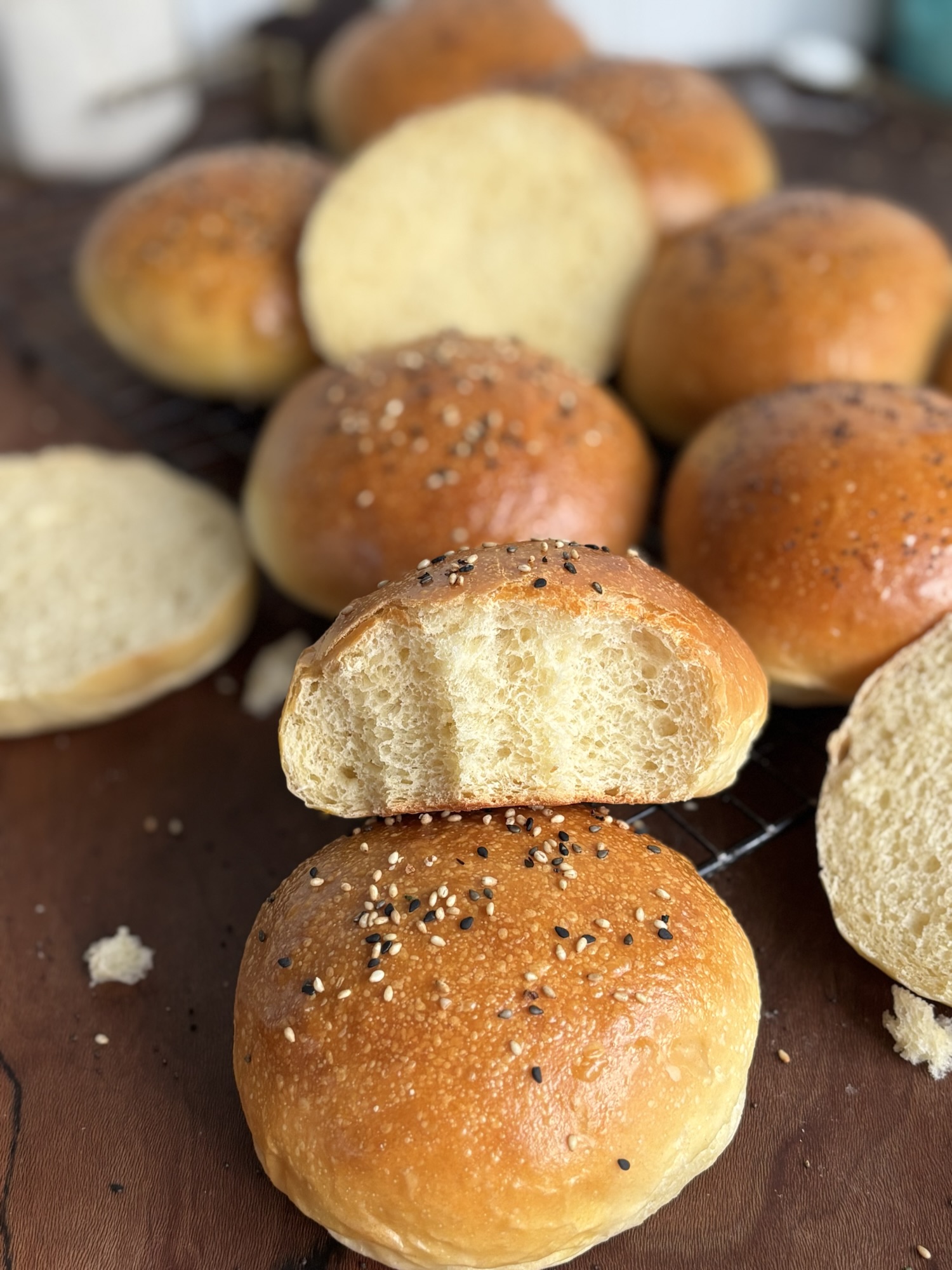
Burger buns are one of those things most people stop thinking about the moment they drop them in the cart at the grocery store. But if you have ever bitten into a homemade burger bun, pillowy soft, golden on top, sturdy enough to hold a thick patty without falling apart, you already know there is no going back.
These high protein sourdough burger buns are the kind of bun I have been chasing for a while now. Soft and fluffy on the inside. Deep golden and lightly crisp on the outside. Sturdy enough to hold up to a messy burger with all the toppings, yet tender enough to pull apart with your hands. And every single bun has around 10-11 grams of protein, thanks to nonfat Greek yogurt/skyr worked right into the dough.
No protein powder. No weird fillers. Just real, whole food ingredients doing the protein work while the sourdough fermentation takes care of flavor and structure.
If you have been following along with the rest of the high protein sourdough series, from the High Protein Cinnamon Rolls, High Protein Sourdough Sandwich Bread to the High Protein Sourdough Cinnamon Rolls with Greek Yogurt to the High Protein Cottage Cheese Scones, you already know the approach. Whole food protein. Real ingredients. Soft, pillowy results every time.

Table of Contents
- Why These Burger Buns Work
- The Greek Yogurt Difference
- Sourdough Version vs Yeasted Version
- Tips and Tricks for Soft, Fluffy Buns
- How to Shape Your Buns
- How to Get Flat, Wide Burger Buns (Not Dinner Rolls)
- Recipe
- Substitutions and Variations
- Storage and Make Ahead
- Shop This Recipe
- Nutrition and Protein Breakdown
- Frequently Asked Questions
- Recipe
Why These Burger Buns Work
There are two problems with most homemade burger bun recipes. The first is that they skew dry. A lot of buns are built around bread flour, water, and a little bit of oil or butter, which creates a structured bun but not a particularly soft or flavorful one. The second is that most recipes are built for bread structure, not for nutrition. A standard burger bun from a traditional recipe delivers around 4 grams of protein.
This recipe solves both at once.
Nonfat Greek yogurt replaces the liquid you would normally use in a burger bun dough. Instead of milk or water, the yogurt does triple duty. It hydrates the flour, adds tenderness and softness through its acidity and fat, and delivers around 10 grams of protein per 100 grams of yogurt. That means every bun in this batch lands at roughly 10 grams of protein without a single scoop of protein powder or a single adjusted ingredient that compromises texture.
On top of that, active sourdough starter handles the leavening and flavor development. The bulk ferment allows the wild yeast in your starter to work through the dough, creating light, airy texture and depth of flavor you cannot get from a quick bread recipe. A small amount of baking powder is added as backup leavening, which keeps the buns reliable and light even if your starter is running a little sluggish or your kitchen runs cool.

The Greek Yogurt Difference
Nonfat Greek yogurt is one of the most effective whole food ways to boost protein in baked goods. It contains around 10 grams of protein per 100 grams, and when worked into an enriched bread dough, it disappears completely into the crumb. You do not taste yogurt in the finished buns. What you get is softness, tenderness, and a subtle richness that store bought buns simply cannot match.
The acidity of the yogurt works beautifully alongside the sourdough starter. Both ingredients contribute lactic acid to the dough, which relaxes the gluten slightly and creates a tender crumb. This is the same principle that makes milk bread and brioche so soft. The difference here is that you are getting that texture while also loading each bun with real, whole food protein.
One important step: warm the Greek yogurt before mixing. Thirty seconds in the microwave takes the chill off without making it hot. Cold yogurt slows down fermentation significantly because it drops the temperature of your dough, which means a slower rise and less flavor development. But do not overheat it. Hot yogurt can damage or kill the wild yeast in your starter. Slightly warm to the touch is the sweet spot.
If you have baked with this method before in my High Protein Sourdough Dinner Rolls (which is the parent recipe this was adapted from) or the High Protein Honey Whole Wheat Sourdough Sandwich Bread, this technique will feel familiar.

Sourdough Version vs Yeasted Version
Not everyone has an active sourdough starter ready to go, and that is exactly why there are two versions of this recipe.
The sourdough version on this page uses active, peaked sourdough starter and a 6 hour bulk ferment. The result is a bun with deeper flavor, more complex crumb, and the added digestive benefits of a long fermentation. If you have a starter that you are feeding regularly and you want the full flavor payoff, this is the version for you.
The yeasted version uses active dry yeast and comes together in about 3 hours from mixing to baking. The flavor is slightly less developed but the buns are still soft, fluffy, and full of protein from the Greek yogurt. If you do not have a sourdough starter, or you need burger buns ready by dinner tonight, head over to the High Protein Yeasted Burger Buns post for the full recipe.
Both versions yield 12 buns at roughly 100 to 110 grams each. Both deliver the same protein content per bun. The only real difference is the leavening and the flavor profile.

Tips and Tricks for Soft, Fluffy Buns
Warm the yogurt. This is the single most important step. Thirty seconds in the microwave is all you need. Cold yogurt will slow your starter down dramatically and extend your bulk ferment by hours.
Use bread flour. Bread flour has a protein content around 12 to 13 percent, which is higher than all purpose flour at 10 percent. That extra protein means more gluten development, better structure, and a small protein boost to each bun. For buns that need to hold up to a juicy patty without falling apart, this matters.
Use a bench scraper to your advantage. A simple, inexpensive bench scraper is one of the most useful tools for working with this dough. After the initial mix, use the scraper to pull the dough cleanly off the sides of the bowl and gather it into the center before its rest. This keeps bits of dough from drying out on the edges of the bowl and makes the whole process less messy. The scraper is also your best friend during dividing and shaping, especially with a yogurt based dough that has a little more give than a standard bread dough.
Respect the 30 minute rest. After the initial mix, the dough will feel sticky. Not just tacky, genuinely sticky to the touch. This is normal and expected with a yogurt based sourdough. The yogurt hydrates the flour differently than plain water or milk, and everything needs time to come together. Do not panic and do not add extra flour at this stage. Cover and walk away for 30 minutes.
After the rest, mix on low for another minute to bring it back together, then knead on medium low for 6 to 8 minutes. The dough will transform. It goes from sticky and shaggy to smooth, soft, and slightly tacky but cohesive. The texture change between the end of the initial mix and the end of the knead after the rest is dramatic. Trust the process.
Work with wet or damp hands during stretch and folds. When you perform the stretch and fold at the 1 hour mark, lightly dampen your hands (damp, not dripping wet) to keep the dough from sticking to you. The dough will still feel soft and a little tacky at this stage, which is exactly right. After the stretch and fold, add one or two slap and folds to seat the seam underneath and build tension on the top of the dough ball. By the end of the bulk ferment, the dough should feel light, airy, and manageable. Night and day from how it felt at the initial mix.
Lightly flour the counter during shaping, not heavily. When you turn the dough out for dividing and shaping, a light dusting of flour on the counter is all you need. If the dough is still sticking to your hands, a tiny bit of flour on your palms helps. Go light. Heavy flouring at this stage will throw off your hydration and leave streaks of dry flour on the surface of your shaped buns. If you have a gentle touch and the dough is properly proofed, you will not have sticking issues.
Adjust flour by feel after the rest. Every Greek yogurt brand is a little different in thickness. Every kitchen has different humidity. If after the 30 minute rest and the full knead your dough is still sticking to the sides of the bowl and not coming together into a cohesive ball, add flour 10 grams at a time until it pulls away from the sides. Do not skip the rest and start adding flour to a freshly mixed dough. You will end up with dry, dense buns.
Be patient with the bulk rise. Enriched doughs with butter, egg, sugar, and yogurt always take longer to rise than lean doughs. Plan for about 6 hours total from mixing to shaping. Do not rush this step. Watch the dough, not the clock. When it has puffed up noticeably and feels light and airy when you gently shake the bowl, you are ready.
Use the oven light trick. If your kitchen runs cool, place the shaped and covered buns in the oven with just the light on for the last hour of proofing. The gentle warmth from the light gives sluggish dough a push without overheating it. Check periodically since some oven lights run warmer than others.
Brush with butter after baking. The egg wash before baking gives you that beautiful golden shine. But the melted butter brushed on hot out of the oven is what makes these buns irresistible. It soaks into the crust and adds one more layer of richness that separates a homemade bun from a store bought one.

How to Shape Burger Bun Dough into a Tight Ball
Getting a tight, smooth dough ball with good surface tension is the step that separates a bun that holds its shape beautifully through the proof and bake from one that spreads out flat or bakes up uneven. Once you feel it click, you will do it on autopilot every time.

Start with your piece of dough on a lightly floured surface. Cup your hand into a C shape around the dough, with the pinky side of your hand lightly touching the counter. Push the dough up and away from you, then drag it back toward you in one smooth motion, keeping that C shape the whole time. As you drag it back, the bottom of the dough catches slightly on the counter and the top pulls tight. That friction is what builds the surface tension.
Repeat this motion while rotating the dough clockwise in a full circle, working your way around until the top of the ball is smooth and taut and the seam has gathered at the bottom. Flip it seam side down and you should see a dough ball that holds its shape cleanly without spreading.
From there, flatten it firmly with your palm to about 3.5 to 4 inches wide before it goes in for the final proof. That flattening step is what gives you the classic wide burger bun shape instead of a tall dinner roll dome.
How to Get Flat, Wide Burger Buns (Not Dinner Rolls)
This is the tip most recipes leave out, and it is the single biggest difference between a bun that works for a burger and a bun that is just a round dinner roll with sesame seeds on top.
After you shape each piece of dough into a tight ball, press it down firmly with your palm to flatten it to about 3.5 to 4 inches wide. This is the shape you want them going into the final proof. During the proof they will puff up, and during the bake they will spring up even more, giving you that proper domed burger bun shape that is wide enough to hold a patty.
Do not press them down after the final proof. That deflates them and they will not recover. Shaping them flat before the proof is the move.
If you forget this step and your buns come out tall and round, do not worry. They are still delicious. They just function more like a slider bun or a small brioche dinner roll. Next time, remember to press them flat before the proof.


High Protein Sourdough Hamburger Buns
Equipment
- – Stand mixer with dough hook
- kitchen scale
- Large mixing bowl
- Whisk
- bench scraper
- Two half sheet pans
- Parchment paper
- – Pastry brush
- Instant read thermometer
- Wire cooling rack
Ingredients
For the Dough
- 530 grams bread flour 4 1/3 cups
- 215 grams active peaked sourdough starter 1 cup
- 310 grams nonfat Greek yogurt slightly warmed (1 1/4 cups)
- 65 grams unsalted butter softened (4 1/2 tablespoons)
- 26 grams granulated sugar 2 tablespoons
- 9 grams fine sea salt 1 1/2 teaspoons
- 4 grams baking powder 1 teaspoon
- 2 large eggs room temperature
For the Egg Wash
- 1 large egg
- 15 grams water or milk 1 tablespoon
- Sesame seeds Poppy seeds or everything bagel seasoning, optional
For Finishing (Optional)
- 28 grams unsalted butter melted (2 tablespoons)
Instructions
- Warm the Greek yogurt in the microwave for 30 seconds until slightly warm to the touch, not hot. Hot yogurt can damage the wild yeast in your sourdough starter.
- In the bowl of a stand mixer fitted with the dough hook, combine the sourdough starter, warmed Greek yogurt, eggs, and sugar. Mix on low to combine.
- In a separate bowl, whisk together the bread flour, baking powder, and salt. Add the dry ingredients on top of the wet mixture. Cut the softened butter into marble sized pieces and add them to the bowl.
- Mix on low speed until a shaggy dough forms and the flour is fully incorporated, about 2 minutes. The dough will feel sticky at this stage, which is normal for a yogurt based sourdough.
- Cover and let rest 30 minutes. This hydration rest is essential. The yogurt needs time to fully integrate with the flour, and skipping this step leads to a dough that feels impossible to work with.
- After the rest, mix on low for 1 minute to bring the dough back together, then increase to medium low and knead for 6 to 8 minutes until the dough is smooth, soft, and slightly tacky. The dough should pull away from the sides of the bowl. If after kneading the dough is still sticking to the sides, add flour 10 grams at a time until it reaches the right consistency.
- Use a bench scraper to pull the dough cleanly off the sides of the bowl and gather it into a ball. Place the dough in a lightly oiled bowl, cover with plastic wrap or a damp towel, and let rest at room temperature for 1 hour.
- After 1 hour, perform one set of stretch and folds. With lightly dampened hands, grab one side of the dough, stretch it up, and fold it over the center. Rotate the bowl and repeat three more times. Finish with one or two slap and folds to seat the seam underneath and build tension on the top of the dough ball.
- Cover and continue to rise at room temperature for about 6-7 more hours, until the dough has noticeably puffed up and feels light and airy, approximately 6-8 hours total from mixing. Timing varies based on kitchen temperature. Warmer kitchens go faster, cooler kitchens take longer.
- Turn the dough out onto a lightly floured surface and weigh it. Divide into 12 equal pieces of approximately 100 to 110 grams each using a bench scraper. Roll each piece into a tight, smooth ball by tucking the edges underneath and creating surface tension.

- Flatten each ball firmly with your palm to about 3.5 to 4 inches wide. This step is what gives you a proper domed burger bun shape rather than a tall dinner roll. Do not skip it and do not press the buns down after the final proof.
- Place the shaped buns on two parchment lined baking sheets, spaced at least 2 inches apart. Cover with a lid or large plastic bag and proof at room temperature for 1.5 to 2 hours, until noticeably puffy. If your kitchen is cool, place the rolls in the oven with the light on for 30 – 60 minutes. Preheat the oven to 375 degrees Fahrenheit during the last 20 minutes of proofing.
- Alternatively, Place in 4 rows of three across on one parchemnt lined pan. The rolls will still bake well, but you pull them apart like a store boight bun. They may require a few minutes more of baking.
- Whisk the egg with the water until smooth. Brush each bun gently with the egg wash. Sprinkle with sesame seeds or everything bagel seasoning if desired.
- Bake for 18 to 22 minutes, rotating the pans halfway through, until deep golden brown on top. Internal temperature should read 190 to 195 degrees Fahrenheit on an instant read thermometer.
- (Optional)Brush the hot buns immediately with melted butter the moment they come out of the oven. This soaks into the crust and adds one more layer of richness. Let cool on a wire rack for at least 15 minutes before slicing.
Notes
Substitutions and Variations
Cottage cheese instead of Greek yogurt. This substitution works in the parent High Protein Sourdough Dinner Rolls recipe, so it should translate here too. Replace the 310 grams of Greek yogurt with 275 grams of cottage cheese pureed with 35 grams of whole milk. Use a thick cottage cheese like Nancy’s or Good Culture, never a runny or watery variety. Puree completely smooth with no lumps, warm the mixture 20 seconds in the microwave, and let the dough rest a few extra minutes after the initial mix to give the flour time to fully absorb the moisture. I have not independently tested this substitution in burger bun form yet, but the principle is the same as the dinner roll. If you try it, let me know how it goes.
Full fat Greek yogurt. Full fat yogurt will work here. The buns will be a touch richer and slightly softer, but the protein per bun will drop because full fat yogurt has less protein per gram than nonfat. You may also need to add a small amount of flour since full fat yogurt runs a little wetter. Add in 10 gram increments if needed.
All purpose flour. All purpose flour will work, but the buns may be slightly more delicate and the protein content per bun will drop. You may also need slightly less flour since all purpose absorbs less liquid. Start with 500 grams and add more if needed.
Salted butter. If salted butter is what you have, reduce the salt in the dough by 2 grams to compensate.
Honey instead of sugar. You can swap the 26 grams of sugar for 20 grams of honey. The dough may feel slightly wetter from the added moisture. Add flour a few grams at a time if needed. The tops will also brown a little faster, so keep an eye on them in the last few minutes of baking.
Slider buns. Divide the dough into 20 pieces of roughly 60 grams each for slider buns. Reduce bake time to 14 to 16 minutes. Everything else stays the same.
Topping variations. Sesame seeds, everything bagel seasoning, poppy seeds, or flaky sea salt all work beautifully. For a plain bun, skip the seeds entirely. Just egg wash and bake.

Storage and Make Ahead
Room temperature. Store baked buns in an airtight container at room temperature for up to 3 days. For the softest texture, slice just before using.
Freezer. Let the buns cool completely, then place them in a freezer safe bag and freeze for up to one month. To reheat, wrap in foil and warm in a 325 degree oven for 8 to 10 minutes. For a crustier reheat, skip the foil.
Make ahead option. Complete the bulk ferment, then shape the buns and place them on the parchment lined sheet pans. Cover tightly with plastic wrap and refrigerate overnight. The next morning, pull them out and let them proof at room temperature for 2 to 3 hours, or until noticeably puffy, before baking. This is a great strategy for weekend cookouts.

Shop This Recipe
- Digital kitchen scale
- Stand mixer with dough hook
- Parchment paper
- Two half sheet pans
- Pastry brush
- Bench scraper (an inexpensive one works beautifully for pulling this dough off the sides of the bowl and for dividing)
- Wire cooling rack
- Instant Read Thermometer
Nutrition and Protein Breakdown
Each bun contains approximately 10 grams of protein when made with bread flour and nonfat Greek yogurt. For comparison, a standard store bought burger bun contains around 4 grams of protein. These buns deliver more than double the protein without any specialty ingredients or protein powders.
Pair one of these buns with a quality burger patty and you are looking at roughly 40 grams of protein from the bun and patty alone, before any cheese or sauce enters the picture. That turns a summer cookout into a meal that actually holds you over until bedtime.
Why Pairing Protein with Carbohydrates Matters
The reason a high protein bun is actually worth the effort comes down to how your body handles carbohydrates when protein is along for the ride.
When you eat a carbohydrate heavy meal without much protein, blood sugar rises quickly and drops just as fast. That spike and crash is what leaves you hungry and tired an hour later. Protein slows the process down. When protein is present in a meal, your body digests everything more gradually, which produces a smoother, more sustained rise in blood sugar instead of a sharp peak. That smoother curve keeps you full longer and prevents the afternoon crash that follows a carb only lunch.
When the protein is baked right into the bread instead of only coming from the patty, you are getting that benefit in every single bite, not just the ones where you happen to catch some burger. For anyone cooking for a family and trying to get more mileage out of regular meals, that math adds up quickly. You are not asking anyone to eat differently. You are just making the bread work a little harder.

Frequently Asked Questions
Can I make these without sourdough starter?
Yes. There is a fully tested yeasted version of this recipe available as the High Protein Yeasted Burger Buns. It uses active dry yeast and comes together in about 3 hours instead of 8. The flavor profile is slightly different but the soft, fluffy texture and high protein content are the same.
Do these taste like sourdough?
Not in the sharp, noticeable way some people expect. The sourdough contributes flavor complexity and helps develop the crumb, but the enriched dough with Greek yogurt, butter, egg, and sugar softens that flavor considerably. You get depth without a strong sourdough flavor.
Can I taste the Greek yogurt?
No. Between the sourdough, the butter, and the sugar, the yogurt disappears completely. What you get is a soft, rich bun. Most people who eat these buns have no idea they were made with yogurt until you tell them.
Why are my buns too tall and round?
You likely skipped the flattening step before the final proof. After shaping each piece into a ball, press it firmly with your palm to about 3.5 to 4 inches wide before proofing. This is what gives you the classic domed burger bun shape. Next batch, press them flat and you will see the difference.
My dough is really sticky. What should I do?
This is the number one question about this recipe, and the short answer is: it is supposed to be sticky at the start. Yogurt based sourdough doughs hydrate very differently than plain water or milk doughs. Right after the initial mix, the dough will feel genuinely sticky. That is normal. Cover it and let it rest the full 30 minutes without adding flour. After the rest plus the 6 to 8 minute knead, the dough transforms completely. It becomes soft, smooth, and slightly tacky but cohesive. Work with lightly dampened hands during stretch and folds to keep the dough from sticking to you, and use only a light dusting of flour on the counter during shaping. If after the rest and the full knead the dough still refuses to come together and is sticking to the sides of the bowl, then add flour 10 grams at a time until it pulls away. Greek yogurt brands vary in thickness and kitchen humidity plays a role too, so a small flour adjustment is sometimes needed. See the Tips and Tricks section above for full details on managing the dough through each stage.
How much protein is actually in each bun?
Around 10 grams per bun when made with bread flour and nonfat Greek yogurt. The protein comes from the flour, the yogurt, and the eggs working together. No protein powder needed.
Can I freeze the baked buns?
Absolutely. Cool completely, then freeze in an airtight bag for up to one month. Reheat wrapped in foil at 325 degrees for 8 to 10 minutes.
Can I use full fat Greek yogurt?
Yes, but protein per bun will drop and the dough may run slightly wetter. Add flour in small increments if needed.
How many buns does this recipe make?
12 buns at roughly 100 to 110 grams each, or 20 slider buns at 60 grams each.
Why is there baking powder in a sourdough recipe?
The baking powder is a small backup leavener that makes this recipe reliable even if your starter is running sluggish or your kitchen is cool. It also helps counteract the weight of the yogurt, which can make enriched doughs heavier. It does not replace the sourdough leavening. It is insurance.

Make These Buns and Share the Love
If you make these high protein sourdough burger buns, I would love to hear how they turned out. Leave a comment below and let me know what you built on top of them. If you share your bakes on social media, tag me so I can see them and cheer you on.
And if you want more sourdough recipes like this delivered straight to your inbox, sign up for the H3art of the Home newsletter. New sourdough recipes, high protein baking guides, and behind the scenes content every week.






Leave a Reply