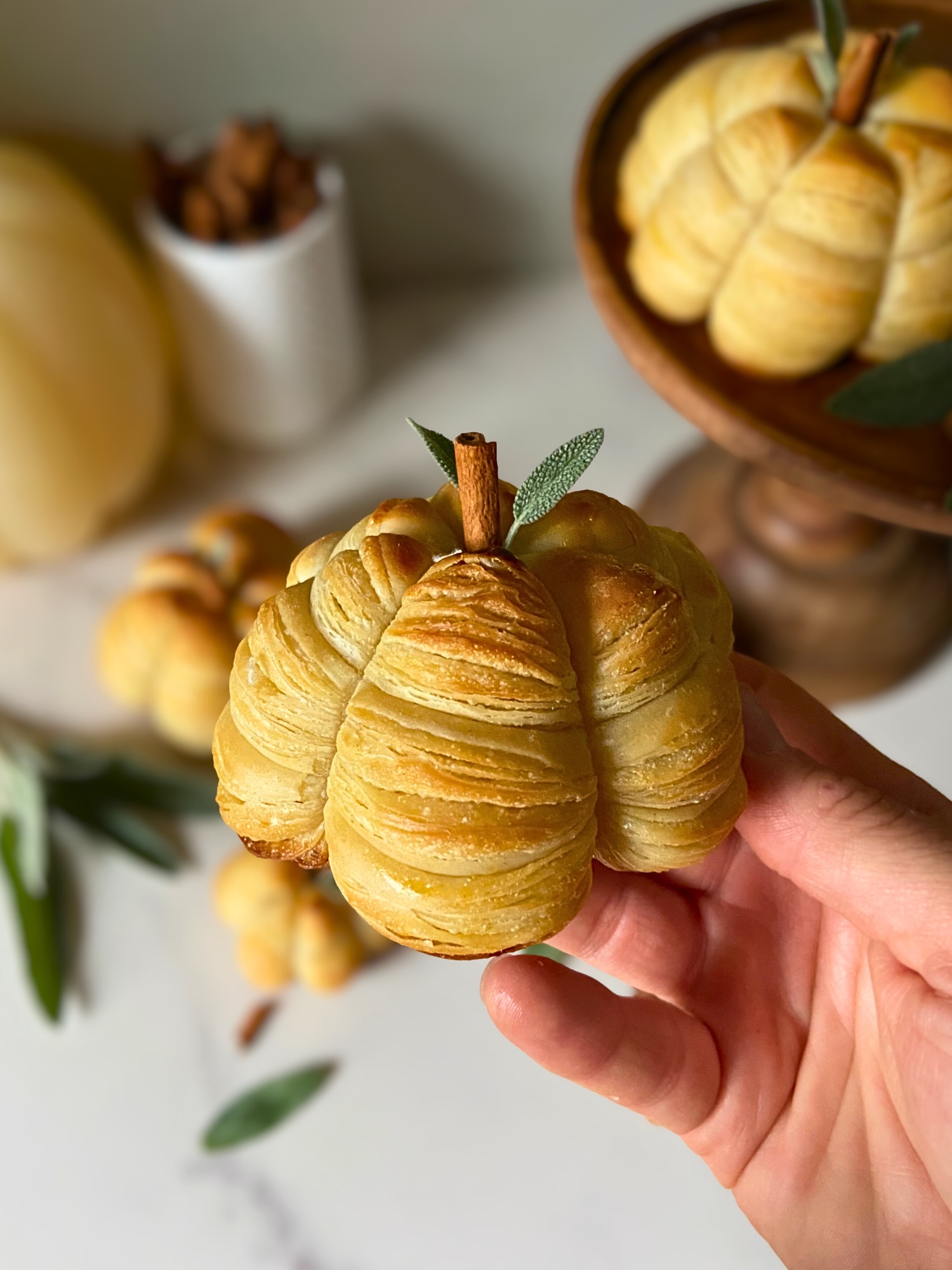
When the baker’s twine pumpkin loaves started showing up everywhere, I loved the shape but kept thinking about what that same trick would look like with croissant dough, where every one of those flaky, buttery layers could show through between the strings. These sourdough croissant pumpkins are what came out of that idea: circles of laminated dough stacked from wide to narrow, tied with baker’s twine after the final proof, and baked into little pumpkins that look like fall decor and pull apart like a croissant.
You make your croissant dough exactly the way you normally would, all the way through lamination, and the only thing that changes is the final rollout and shaping. If you have made croissants before, this is a fun way to put your lamination on display, and if you haven’t, this is a good reason to start.
Table of Contents
Why You’ll Love These
These croissant pumpkins take a dough you already know how to make and turn it into something people stop and stare at on a brunch table or a Thanksgiving spread.

- The layers are the whole show. Stacking cut circles leaves the laminated edges exposed all the way around, so every flaky layer is visible from the side instead of hidden inside a rolled shape.
- They actually look like pumpkins. Graduated circles give a wide base and a narrower top, and the twine pulls each one into six rounded sections.
- No special equipment. Two round cutters, some baker’s twine, and parchment squares are all it takes.
- Nothing goes to waste. The scraps become a pull-apart croissant dish that bakes right alongside the pumpkins.
How I Landed on This Method
My first thought was to roll croissant dough into balls and tie them the same way people tie bread dough, but rolling laminated dough into a ball buries the layers, which was the entire reason I wanted to do this with croissants in the first place. I also considered rolling the dough up like a cinnamon roll and tying the slices, but that gives you a flat top, and I wanted something round that actually reads as a pumpkin from across the table.
Stacking cut circles solved both problems, since the cut edges stay exposed and a smaller circle on top gives the stack that domed pumpkin taper. Two 2.5 inch circles with a 2 inch circle on top gave me the shape I wanted without the stack getting too tall to hold together.
A few things changed once I started making them. I originally knotted the strings together in the center, but the knot sat under the dough and made the base wobble and bake unevenly, so now I just lay the strings across each other flat. I settled on three strings, which gives you six sections, and I tie them only after the final proof, because tying first squeezes the dough before it has had a chance to rise. I also skip oiling the twine, since the butter in the dough has always been enough to keep it from sticking for me.
Back to Table of Contents | Jump to Recipe
What You Need
Beyond the croissant dough itself, the assembly list is short, and the exact amounts are in the recipe card.
- Laminated croissant dough taken through every fold and ready for the final rollout
- Egg wash made from an egg yolk and a little milk or heavy cream, which glues the circles together and gives the pumpkins their deep golden color
- Baker’s twine cut into 16 inch pieces, three per pumpkin
- Parchment paper cut into 4 x 4 inch squares, one per pumpkin
- Cinnamon sticks and fresh sage for the stems and leaves
Back to Table of Contents | Jump to Recipe
The Dough
These start with my classic sourdough croissant dough, the same recipe and lamination process I teach in my Sourdough Croissant Masterclass and 60 page guide. You follow it exactly as written through every fold and stop when you reach the final rollout, which is where the pumpkin shaping takes over.
If you want something more seasonal, my free Pumpkin Spice Sourdough Croissants recipe uses real pumpkin in the dough and a spiced butter block, and it works for these pumpkins as well. Also check out my Chocolate Peppermint Sourdough Croissant Recipe, for a fun flare to your season. I also have a London Fog Croissant, Apple Cider Croissant, and Champagne Croissant, Eggnog Croissant, and Triple Chocolate Croissant Recipes available for free.
If you still need a starter, my Minimal Waste Sourdough Starter guide walks you through building one from scratch.
Back to Table of Contents | Jump to Recipe
How to Shape Croissant Pumpkins
The final rollout is a rough 10 x 12 inch rectangle, which gives you enough dough to cut all the circles for six pumpkins while keeping the dough thick enough to rise into tall, flaky layers.

Cut the large circles first and keep them as close together as you can, then fit the smaller circles into the spaces that are left. Whatever you do, don’t gather the scraps and roll them out again, because pressing them back together smears the butter into the dough and the lamination is gone. Instead, chop the scraps into pieces, drop them into a small baking dish (tossing them with a little brown sugar and cinnamon if you like), and proof and bake them right alongside the pumpkins for a pull-apart croissant treat.

Before you stack anything, set up the base for each pumpkin by laying three pieces of twine across a parchment square so they cross in the center and the ends fan out evenly like the spokes of a wheel. The parchment and twine stay under the pumpkin through proofing and baking, so you never have to move the shaped dough once it is stacked.

Center the first large circle right over the spot where the strings cross, brush it lightly with egg wash, add the second large circle, brush again, and finish with the small circle on top. The egg wash between the layers is what helps the circles bake into one pumpkin instead of sliding apart, so don’t skip it, but keep a light hand so the layers don’t get soggy.
Back to Table of Contents | Jump to Recipe
Proofing and Tying
The stacks proof untied, covered with a dome lid or a plastic bag tented over a tall object so nothing touches the dough, with a light mist of water before you close them in. Sourdough croissants take their time here, and depending on your kitchen it can be anywhere from 6 to 8 hours or longer.

You are looking for the stacks to grow about 50% larger, which means one and a half times their original size and not doubled, with the layers starting to separate and the dough looking airy and delicate. A gentle poke should leave a slight dent that slowly springs back. Underproofed pumpkins come out dense and won’t puff the way you want, and overproofed ones can slump and lose their shape.
Once they are ready, bring the strings up and over the stack one at a time and tie each one snug but gentle, since you want clear sections without squashing the proofed dough, then gather the loose ends at the top and tie them together. The pumpkins stay right where they proofed on the baking sheet the whole time.
Back to Table of Contents | Jump to Recipe
Baking and Finishing
Right before they go in the oven, brush egg wash on the top of each section between the strings, using a light hand so it doesn’t pool in the creases. A hot oven gives the layers their dramatic puff, and you want to bake them until they are a deep golden brown all over, since pale croissants taste underdone even when they are cooked through.

Snip and pull the twine while the pumpkins are still warm, when it slides out easily, then press a small dip into the center of each top and tuck in half a cinnamon stick for the stem and a sprig of fresh sage for the leaf.
Back to Table of Contents | Jump to Recipe
Yeast Version
The shaping in this post doesn’t depend on sourdough at all, so the same stacking and tying technique works with a yeasted croissant dough. The biggest difference is the final proof, which is usually much shorter with commercial yeast, so go by the same visual cues (about 50% larger, layers separating, airy and delicate) rather than the 6 to 8 hour window written for sourdough. Follow your yeasted croissant recipe through lamination, then pick up with the final rollout here.
Back to Table of Contents | Jump to Recipe
Expert Tips
Most of what makes these work comes down to temperature and patience.

- Keep the dough cold. If the dough warms up while you are cutting and stacking, the butter melts into the dough and you lose the flaky layers, so slide it back into the fridge whenever it starts to feel soft.
- Lay the strings flat. Knotting the strings in the center leaves a lump under the base that makes the pumpkin sit crooked, so just cross them on top of each other.
- Tie after the proof, not before. Tying first squeezes the dough before it rises, and tying a proofed stack gently gives you clean sections without deflating it.
- No oil needed on the twine. The butter in the dough keeps the twine from sticking, though a light coat of oil won’t hurt if you are worried about it.
- Keep the oven door closed early on. Leave the door shut for the first 15 minutes so the oven holds its heat while the layers puff, then start checking at 18 minutes.
Back to Table of Contents | Jump to Recipe
Serving Ideas
These are at their best warm, with salted butter and jam, next to a mug of coffee or warm apple cider. They make a beautiful centerpiece for a fall brunch board or a Thanksgiving morning spread with a few real mini pumpkins scattered around them, and they are just as good beside a bowl of soup for a cozy fall dinner. For a homemade fall table, pair them with my butter candle and you have a centerpiece you can eat.
Back to Table of Contents | Jump to Recipe
Storage
Croissant pumpkins are best the day they are baked, but they keep in an airtight container at room temperature for up to 2 days. For longer storage, freeze the baked pumpkins for up to 1 month, let them thaw at room temperature, and refresh them in a 350°F oven for 5 to 7 minutes to bring back the crisp, flaky outside.
Back to Table of Contents | Jump to Recipe
FAQ
These are the questions I get most about making croissant pumpkins.

How many croissant pumpkins does one batch of dough make?
One batch of my croissant dough rolled to 10 x 12 inches makes about 6 pumpkins, each built from two 2.5 inch circles and one 2 inch circle, with the scraps going into a small pull-apart dish.
Can I use store bought croissant dough or puff pastry?
I haven’t tested this myself, but store bought croissant dough or puff pastry should work in a pinch. Homemade sourdough croissant dough gives you the best flavor and the most dramatic layers.
Why do the circles need egg wash between them?
The egg wash acts like glue, so the stacked circles bake into one pumpkin instead of separating or sliding as they puff in the oven.
Do I need to oil the baker’s twine?
I never have, since the butter in the croissant dough keeps the twine from sticking, but you can oil it lightly if you want the extra insurance.
Why shouldn’t I knot the twine underneath?
A knot sits under the center of the dough and lifts the base, so the pumpkin sits unevenly and can bake lopsided. Laying the strings across each other flat keeps the base level.
What if I don’t have both cutter sizes?
Any two round cutters about half an inch apart in size will work, and even drinking glasses will do the job. just make sure it has a sharp edge so the layers don’t become compressed. The difference in size is what creates the pumpkin taper.
Can I make these ahead?
These are best shaped, proofed, and baked on the same day you plan to serve them, since the dough needs to stay cold while you shape it and should go into the oven as soon as it is proofed.
Why didn’t my croissant pumpkins puff?
Usually the dough was underproofed or the oven wasn’t fully preheated. Wait for the visual signs of a full proof and give the oven plenty of time to come up to temperature.
What else can I use for the stems?
Pretzel sticks, rosemary sprigs, or a little twist of extra dough all make good stems if you don’t have cinnamon sticks.
Back to Table of Contents | Jump to Recipe
Shop This Recipe
These are the tools I use for my croissant pumpkins. I earn a small commission from these affiliate links at no extra cost to you, which helps support the blog.
- Round biscuit cutters: I use the 2.5 inch and 2 inch rounds from this set to cut the stacked circles. Shop here
- Baker’s twine: This is the twine I use for tying the pumpkin sections, and it pulls out cleanly after baking. Shop here
- Spray bottle: A fine mist keeps the stacks from drying out during the long proof. Shop here
- Baking sheet: My favorite sheet pan for croissants, since the pumpkins proof and bake on it without moving. Shop here
- Proofing bags: These are the bags I tent over the tray for the final proof. Shop here
- Dome lids: If you would rather skip the bag, these lids cover the pumpkins while they proof. Shop here
Recipe

Sourdough Croissant Pumpkins
Equipment
- Rolling Pin
- 2.5 inch round biscuit cutter
- 2 inch round biscuit cutter
- Baker's twine
- Parchment paper
- – Pastry brush piece of paper towel
- Spray Bottle
- Baking sheet
- Dome lid or plastic bag for proofing
- Small baking dish (for the scraps)
Ingredients
Croissant Dough
- 775 g laminated sourdough croissant dough chilled and ready for the final rollout (1 full batch)
Egg Wash
- 1 large egg yolk
- 30 g milk or heavy cream 2 tablespoons
Shaping and Decorating
- 18 pieces baker’s twine each 16 inches long
- 6 parchment paper squares 4 x 4 inches
- 3 cinnamon sticks broken in half
- 6 small fresh sage sprigs
Instructions
- Roll the chilled croissant dough into an approximate 10 x 12 inch rectangle. you want it about ⅜ inch (9-10 mm) thick
- Cut 12 circles with the 2.5 inch cutter and 6 circles with the 2 inch cutter, cutting the large circles first and keeping all of them close together. Do not roll the scraps out again; chop them into pieces, place them in a small baking dish, and toss with a little brown sugar and cinnamon if you like.
- Whisk the egg yolk and milk or cream together for the egg wash.
- Lay a parchment square on the baking sheet and set 3 pieces of twine across it so they cross in the center with the ends fanned out evenly. Do not knot the twine. Repeat for all 6 pumpkins, spacing them apart.
- Center one 2.5 inch circle over the spot where the twine crosses and brush it lightly with egg wash. Add a second 2.5 inch circle, brush lightly with egg wash, and top with a 2 inch circle.
- Mist the stacks and the scrap dish lightly with water, then cover with a dome lid or a plastic bag tented over a tall object so nothing touches the dough. Proof at room temperature for 6 to 8 hours or longer, until the stacks are about 50% larger (not doubled), the layers are starting to separate, and a gentle poke leaves a dent that slowly springs back.
- Preheat the oven to 400°F.
- Bring each piece of twine up over the stack one at a time and tie it snug but gently, without squashing the dough. Gather the loose ends at the top and tie them together.
- Brush egg wash lightly over the top of each section between the strings, without letting it pool in the creases.
- Bake for 18 to 22 minutes, keeping the oven door closed for the first 15 minutes, until the pumpkins are puffed and a deep golden brown. Bake the scrap dish alongside until golden.
- While the pumpkins are still warm, snip and pull out the twine. Press a small dip into the center of each top, insert half a cinnamon stick as the stem, and tuck a sage sprig beside it.
Notes
More Recipes
If you love fall baking with sourdough, these are next on the list.
- Pumpkin Spice Sourdough Croissants
- Sourdough Pumpkin Jack O’Lantern Bread with Butter Candle
- The Easiest Pumpkin Swirl Sourdough Bread
- Pumpkin Spice Pull-Apart Focaccia with Brown Butter Maple Glaze
- How to Make a Butter Candle
Back to Table of Contents | Jump to Recipe
Subscribe
If you want new sourdough, croissant, and high protein recipes sent straight to your inbox, join my email list. It’s completely free, and you’ll be the first to know when a new recipe goes live.


Disclosure: As an Amazon Associate, I earn from qualifying purchases. This means that if you click on an Amazon link on this blog and make a purchase, I may receive a small commission at no additional cost to you. This helps support the blog and allows me to continue creating content.
I only recommend products that I personally use, have researched, or believe will add value to my readers. Your support through these affiliate links is greatly appreciated!

Leave a Reply