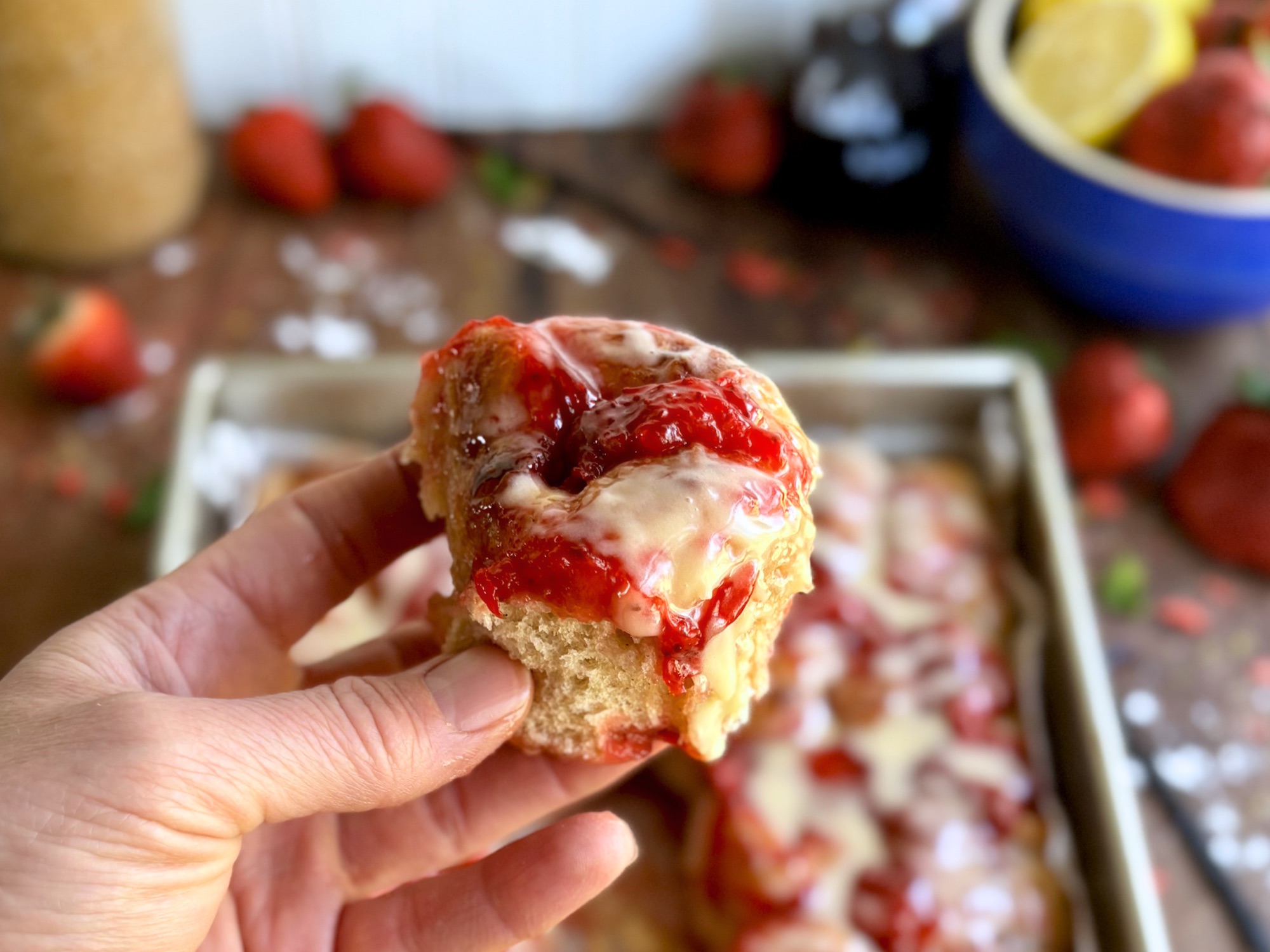
There is something about strawberry season that just resets everything. The gray is gone, the garden is starting, and the first pint of strawberries at the market feels like a promise that the good months are finally here. I did not need a complicated reason to develop this recipe. I love strawberries. I love cake. I love whipped cream. Strawberry shortcake is one of those things that is exactly as good as it sounds, and it does not need to be overthought.
This strawberry shortcake pull-apart sourdough focaccia takes everything that makes strawberry shortcake so universally beloved and rebuilds it in pull-apart form. Each piece of sourdough is dipped in a thick, jammy strawberry compote and rolled in a cornstarch lemon zest sugar coating before going into the pan. After baking, the whole thing gets a generous drizzle of crackly vanilla glaze that sets hard over the top, finishing the shortcake picture in the most satisfying way. It is the newest addition to my Idle Hands Pull-Apart Focaccia Series, and it is the one I want to eat every single morning from now until October.
No sourdough starter? No problem. There is a full yeast version included in the Table of Contents below, and it is just as fluffy and jammy as the original. Check the table of contents or the notes section of the printable recipe card.
New to sourdough entirely? Start here: How to Make a Minimal Waste Sourdough Starter. That post will walk you through everything you need to get your starter going before you bake anything else.
Table of Contents
- Why You Will Love This Recipe
- About the Pull-Apart Focaccia Series
- Ingredient Breakdown
- The Technique: Dip, Coat, and Bake
- Why Sourdough Makes This Better
- Recipe
- Substitutions and Variations
- No Sourdough Starter? Use Yeast
- Storage and Reheating
- More Pull-Apart Focaccia Recipes
- Frequently Asked Questions
- Shop This Recipe
Why You Will Love This Recipe
This is not a focaccia with strawberries pressed into the top. The pull-apart method is completely different, and the eating experience reflects that. Every single piece has its own fully caramelized shell from the lemon zest sugar cornstarch coating, its own deep pocket of jammy strawberry from the compote dip, and its own crackly hit of vanilla glaze. You are not hoping the toppings reached your slice. Every piece is fully loaded from the outside in.
The vanilla focaccia dough is what makes this feel like shortcake rather than just strawberry bread. Most pull-apart focaccia recipes use a plain base dough. Adding a small amount of sugar and vanilla extract shifts the flavor profile into something that reads more like a bakery pastry than a savory bread, which is exactly what strawberry shortcake calls for. It is subtle but unmistakable.
The crackly vanilla glaze is the finishing touch that pulls the whole shortcake picture together. It drizzles on in thick white ribbons that pool into every crevice and set hard as the bread cools. The contrast of the white glaze against the deep red compote is exactly what makes this look like strawberry shortcake. Want to take it a step further? Stir in a tablespoon of freeze-dried strawberry powder for a little extra color and strawberry flavor, or crush freeze-dried strawberries and sprinkle them over the wet glaze before it sets.

About the Pull-Apart Focaccia Series
If you are new here, the Idle Hands Pull-Apart Focaccia Series is my ongoing collection of recipes built around one central technique: tear sourdough dough into pieces, dip each piece into something delicious, roll it in a coating that creates a caramelized barrier between the pieces, arrange them in a pan, let them rise, and bake them into one gorgeous pull-apart loaf. Each piece bakes with its own crust, its own flavor layer, and its own interior. There is no slicing. You just pull.
The series started with my Garlic Parmesan Pull-Apart Focaccia, which proved the technique worked beautifully for savory applications. The sweet versions followed: the Cinnamon Roll Pull-Apart Focaccia (which has now surpassed 50 million views across social media platforms, she’s a star for a reason), the Jelly Donut, and then the Caramel Apple Pie Pull-Apart Focaccia, which went wildly viral and proved that a fruit compote dip is one of the best things you can do with this dough. The fruit compote family continued with my Lemon Blueberry Pull-Apart Focaccia, which became the first recipe in the series designed specifically for spring. This strawberry shortcake version is the natural next step.
If the lemon blueberry version resonated with you, this one will too. The technique is identical. The result is completely its own thing.
Ingredient Breakdown
Bread flour is the foundation of this dough. Its higher protein content develops stronger gluten strands that hold up to the dipping and coating process without tearing apart. You can use all-purpose flour, but the texture will be slightly softer and less airy. If you make the swap, reduce the water to 350 grams since all-purpose flour absorbs less liquid.
Active sourdough starter is the leavening. It needs to be fed, bubbly, and at or just past its peak, meaning it has at least doubled in size and shows visible bubbles throughout. A starter that has not peaked will give you a slower rise and a denser result.
Vanilla is the detail that makes this recipe read as shortcake rather than just strawberry bread. The dough calls for vanilla extract plus the seeds scraped from one vanilla bean, which gives you those beautiful flecks throughout and a deep, fragrant vanilla flavor that most people register as something special without being able to identify exactly what it is. If you do not have a vanilla bean on hand, vanilla bean paste is a perfect 1:1 swap for the extract. Plain vanilla extract on its own also works beautifully. Any way you go, do not skip the vanilla.
Strawberries can be fresh or frozen, and both produce a genuinely delicious compote. Fresh strawberries give you a brighter, more vibrant color and a slightly fresher flavor. Frozen strawberries release more juice during cooking, which creates a richer and more deeply flavored compote. If you are using frozen, add them straight from the freezer with no thawing needed and allow an extra minute or two of cooking time as they release more liquid.
Cornstarch does two jobs in this recipe. In the strawberry compote, it is whisked with water and vanilla into a slurry before being added to the hot fruit, thickening the filling into something thick, scoopable, and stable enough to coat the dough balls properly. In the lemon zest sugar coating, it creates the caramelized, slightly crispy shell around each piece as it bakes. This is the same technique used in the lemon blueberry and caramel apple versions, and it is the reason the coating caramelizes instead of just dissolving into the dough.
Lemon zest appears in the sugar coating but not in the compote itself. It brings brightness that balances the sweetness of the strawberry without competing with the vanilla glaze. One lemon is all you need for the coating.
Butter in the compote adds richness and rounds out the brightness of the strawberries. If you need a dairy-free version, coconut oil or another solid plant-based fat works as a substitute.

The Technique: Dip, Coat, and Bake
The pull-apart method is straightforward once you have done it once. After your dough has completed its bulk fermentation and is beautifully puffy and jiggly, you dump it out onto a greased surface and pinch off golf ball sized pieces. Working one at a time, each piece gets fully coated in the cooled strawberry compote, then immediately rolled in the lemon zest sugar cornstarch mixture until covered on all sides, then placed in a parchment-lined pan. The pieces should be touching but not crammed in.
The most important rule of this recipe: the strawberry compote must be fully cooled before you begin dipping. Making it the night before and refrigerating it overnight is the most reliable approach. Warm compote will not coat the dough balls properly, and heat can affect the active yeast and slow or stop the second rise. Cold or room temperature compote is what you want.
After the second rise, the pieces will have puffed and grown together into one cohesive loaf. Dimple the surface with your fingers and slide it into a preheated 425 degrees F oven. Bake for 20 minutes, then pull it out and spoon any remaining strawberry compote generously over the top. Return it to the oven for another 10 minutes or until the internal temperature reaches 200 to 205 degrees F. Adding the compote partway through protects the jammy strawberry pieces from darkening or drying out during the full bake time.
The vanilla glaze goes on while the focaccia is still warm. It drizzles on in thick ribbons that pool into every crevice and hardens as the bread cools into that satisfying crackly shell that has become the signature of this entire series.

Why Sourdough Makes This Better
Beyond the flavor, there are real reasons to use a naturally fermented sourdough base here. The overnight bulk fermentation does more than just develop the dough. During the long fermentation process, lactic acid bacteria break down phytic acid, an antinutrient found in grain that can inhibit mineral absorption. The result is a bread that is gentler on the digestive system and offers better bioavailability of nutrients like iron, zinc, and magnesium.
Long fermentation also reduces the FODMAP content of the dough, which means many people who struggle with commercial bread find traditionally fermented sourdough much easier to digest. It is not gluten free and is not appropriate for people with celiac disease, but for those with general gluten sensitivity, the difference is often significant.
And practically speaking, the overnight fermentation fits into a real schedule. You mix the dough and make the compote in the evening, let both do their thing overnight, and wake up ready to dip, coat, rise, and bake. The focaccia can be on your table by mid-morning with minimal active effort.

Recipe

Strawberry Shortcake Pull-Apart Sourdough Focaccia
Equipment
- Large mixing bowl
- Medium saucepan
- Small Bowl
- Shallow bowl or plate
- 9×13 inch metal baking pan
- Parchment paper
- kitchen scale
- Whisk
- Rubber spatula
- Wire cooling rack
Ingredients
SOURDOUGH FOCACCIA DOUGH
- 500 grams bread flour 4 cups
- 375 grams water room temperature (1 2/3 cups)
- 75 grams active sourdough starter fed and bubbly (1/3 cup)
- 15 grams granulated sugar 1 tablespoon
- 10 grams salt 1 3/4 teaspoons
- 10 grams vanilla extract 2 1/4 teaspoons
- 1 vanilla bean seeds scraped (optional)
- Note: You can use 2 teaspoons vanilla bean paste in place of both the extract and vanilla bean or simply 2 teaspoons vanilla extract on its own.
STRAWBERRY COMPOTE
- 450 grams strawberries fresh or frozen, hulled and quartered (3 cups)
- 60 grams granulated white sugar 1/4 cup plus 1 tablespoon
- 15 grams fresh lemon juice 1 tablespoon
- 15 grams unsalted butter 1 tablespoon
- 1.5 grams salt 1/4 teaspoon
- 5 grams vanilla extract 1 teaspoon
Cornstarch Slurry, whisk together before adding to compote:
- 16 grams cornstarch 2 tablespoons
- 30 grams water 2 tablespoons
LEMON ZEST SUGAR CORNSTARCH COATING
- 150 grams granulated sugar 3/4 cup
- 30 grams cornstarch 1/4 cup
- zest of 1 lemon
VANILLA GLAZE
- 120 grams powdered sugar 1 cup
- 15 grams milk or heavy cream 1 tablespoon
- 5 grams vanilla extract 1 teaspoon
Instructions
DAY 1: MAKE THE DOUGH
- In a large bowl, combine the water, active sourdough starter, salt, sugar, vanilla extract, and vanilla bean seeds (if using). Mix until the starter has fully dissolved into the water.
- Add the bread flour and mix until no dry flour remains. The dough will look sticky and shaggy at this point, which is completely normal for a high hydration focaccia dough.
- Cover the bowl with a lid or plastic wrap and let the dough rest at room temperature for 1 hour. This rest allows the flour to fully hydrate before you develop the gluten.
- After resting, perform one set of stretch and folds to build strength. Wet your hands, grab one side of the dough, stretch it up as far as it will go without tearing, and fold it over itself. Rotate the bowl 90 degrees and repeat until you have worked all the way around, about 4 to 6 folds total. Finish with one final slap and fold, tucking the seam under on the bottom, to get a smooth surface on top.
- Cover the bowl and let the dough bulk ferment at room temperature for 8 to 12 hours, or until it has at least doubled or even tripled in size. You are looking for a domed top, visible bubbles throughout, and a puffy, jiggly texture when you gently shake the bowl.
MAKE THE COMPOTE (recommended night before)
- In a small bowl, whisk together the cornstarch and 2 tablespoons of water until completely smooth. Set the slurry aside while the compote cooks.
- In a medium saucepan over medium heat, combine the strawberries, sugar, lemon juice, butter, salt, and vanilla extract. Cook, stirring occasionally, until the strawberries break down and release their juices, about 6 to 8 minutes. If using frozen strawberries, allow an extra minute or two as they release more liquid.
- Pour in the cornstarch slurry and stir constantly for 1 to 2 minutes until the compote thickens noticeably. Remove from heat, let cool slightly, then cover and refrigerate overnight. The compote must be fully cooled and thick before you begin dipping your dough balls.
DAY 2: SHAPE, RISE, AND BAKE
- Remove the compote from the refrigerator and allow it to come to room temperature while you prepare your pan and coating.
- Line a 9×13 inch metal baking pan with parchment paper.
- In a shallow bowl or plate, whisk together the granulated sugar, cornstarch, and lemon zest for the coating. Set aside.
- Dump the proofed dough out onto a greased surface. Pinch off a golf ball sized chunk of dough (You can make the balls as large or as small as you desire) and, working one piece at a time, dip it into the cooled strawberry compote and coat generously on all sides. Immediately roll it in the lemon zest sugar cornstarch mixture until fully coated, then place it in the prepared pan. Repeat until all the dough has been used, arranging the pieces so they are touching each other in the pan.
- You will not use all the compote. Save the leftover compote to apply after baking for 20 minutes. See baking instructions below.
- Cover the pan loosely with plastic wrap or a bag and let rise at room temperature for 1 to 2 hours, until the pieces have puffed up, grown together, and jiggle gently when you shake the pan.
- Preheat your oven to 425 degrees F. Once the dough has completed its second rise, dimple the surface firmly with your fingers all over.
- Bake for 20 minutes. Remove the pan from the oven and spoon any remaining strawberry compote generously over the top, spreading it into the crevices between the balls. Adding the compote to the top partway through rather than at the start protects the strawberry pockets from drying out during the full bake time.
- Return the pan to the oven and bake for an additional 10 minutes, or until the internal temperature reaches 200 to 205 degrees F and the edges are deep golden brown. If the top is browning too quickly at any point, tent loosely with foil. Cool in the pan for 10 minutes.
- While the focaccia cools, make the vanilla glaze. Sift the powdered sugar into a bowl. Add the vanilla extract and cream one tablespoon at a time, whisking until smooth and thick. The glaze should be thick and spreadable. Add more cream to make it thinner to when drizzles slowly off a spoon. A thick glaze is what gives you that crackly shell once it sets.
- Apply the glaze generously over the warm focaccia, making sure every piece gets covered. For a fun variation, stir 1 to 2 tablespoons of freeze-dried strawberry powder into the glaze before drizzling, or crush freeze-dried strawberries and sprinkle them over the wet glaze before it sets. Let the glaze set for a few minutes before serving. It will harden into a crackly white finish as it cools.
- Pull apart and enjoy. Each piece is fluffy, jammy, and fully loaded with strawberry shortcake flavor.
Notes
- In a small bowl, combine the warm water and yeast and let sit for 5 to 10 minutes until foamy. If nothing happens, your yeast is expired.
- Once foamy, add it along with the flour and all remaining dough ingredients and mix until combined.
- Let the dough rest 30 minutes, then perform one set of stretch and folds.
- Bulk ferment at room temperature for 2 to 3 hours until doubled, puffy, and jiggly.
- Then proceed with the recipe exactly as written.
Substitutions and Variations
Fresh vs. frozen strawberries: Both work beautifully in the compote. Fresh strawberries produce a brighter, more vibrant color and a slightly fresher flavor. Frozen strawberries release more juice as they cook, creating a richer and more deeply colored compote. Add them straight from frozen with no thawing needed. The cornstarch slurry will thicken either version to the right consistency.
Dairy free: Swap the butter in the strawberry compote for coconut oil or another solid plant-based fat. Skip the optional heavy cream in the vanilla glaze and use a little extra milk of your choice or simply water instead. The rest of the recipe is naturally dairy free.
All-purpose flour: You can use all-purpose flour instead of bread flour. If you make the swap, reduce the water in the dough to 350 grams since all-purpose flour absorbs less liquid. The crumb will be slightly softer and less chewy, but the finished focaccia is still delicious.
The glaze: The recipe uses a plain crackly vanilla glaze, which creates a beautiful white contrast against the deep red strawberry compote. For a fun variation, stir in 1 to 2 tablespoons of freeze-dried strawberry powder or crush freeze-dried strawberries and sprinkle them over the top of the wet glaze before it sets. It adds a pop of pink and an extra hit of strawberry flavor without competing with the compote visually.
Serving with whipped cream: For the full strawberry shortcake moment, skip the vanilla drizzle and serve each pulled piece alongside a dollop of fresh whipped cream. The combination of the jammy compote, the fluffy interior, and fresh whipped cream on the side is exactly as good as it sounds. It does not reheat well with the whipped cream, so serve that fresh at the table.
Other berries: The compote method works with raspberries, blackberries, or a mixed berry blend. Keep the same ratios and adjust the cornstarch slightly depending on how much liquid the berries release. Raspberries with lemon zest would be a beautiful variation.

No Sourdough Starter? Use Yeast
No sourdough starter? No problem. This strawberry shortcake pull-apart focaccia works beautifully with yeast and the results are just as fluffy, jammy, and covered in that crackly vanilla glaze. The dough comes together faster and the whole process can be done in a single day. Everything else stays exactly the same: the strawberry compote dip, the lemon zest sugar cornstarch coating, the second rise, the baking method, and the vanilla glaze.
What to Replace
Remove the 75 grams of active sourdough starter from the recipe. Replace it with the following:
37 grams all-purpose or bread flour
37 grams water
7 grams instant yeast (also called Rapid Rise or Quick Rise)
OR 9 grams active dry yeast if that is what you have on hand
Everything else in the dough stays exactly the same: 500 grams bread flour, 375 grams water, 10 grams salt, 15 grams sugar, and 5 grams vanilla extract.
Using Instant Yeast (Rapid Rise or Quick Rise)
Instant yeast is the easiest option and requires no activation. If you have a packet of Rapid Rise or Quick Rise yeast in your pantry, this is what you are working with.
Step 1: Combine the 37 grams of water, 37 grams of flour, and 7 grams of instant yeast with all of the other dough ingredients in your mixing bowl at the same time. No activation needed. Instant yeast goes straight in with everything else.
Step 2: Mix until no dry flour remains. The dough will look sticky and shaggy. This is completely normal for a high hydration focaccia dough.
Step 3: Cover the bowl and let the dough rest for 30 minutes. This gives the flour time to fully hydrate before you develop the gluten.
Step 4: Perform one set of stretch and folds. Wet your hands, grab one side of the dough, stretch it up as far as it will go without tearing, and fold it over itself. Rotate the bowl 90 degrees and repeat until you have worked all the way around the dough, about 4 to 6 folds total.
Step 5: Bulk fermentation. Cover the bowl and let the dough rise at room temperature for 2 to 3 hours until it has doubled in size and looks puffy, domed, and jiggly when you gently shake the bowl. A warmer kitchen means a faster rise. A cooler kitchen will take closer to 3 hours.
Step 6: Once doubled, proceed with the recipe exactly as written. Dip, coat, arrange in the pan, let rise for the second time, then bake and glaze.
Using Active Dry Yeast
Active dry yeast requires activation before it goes into the dough. This takes about 10 minutes and is an important step you do not want to skip.
Step 1: Activate the yeast. In a small bowl, combine the 37 grams of warm water with the 9 grams of active dry yeast. The water should feel warm to the touch but not hot. If the water is too hot it will kill the yeast. Let the mixture sit for 5 to 10 minutes. You are looking for it to become foamy and bubbly on the surface. If nothing happens after 10 minutes, your yeast is expired and you will need to start over with a fresh packet.
Step 2: Once the yeast is foamy and activated, add it to your mixing bowl along with the 37 grams of flour and all of the remaining dough ingredients: 500 grams bread flour, 375 grams water, 10 grams salt, 15 grams sugar, and 5 grams vanilla extract. Mix until no dry flour remains.
Step 3: Cover the bowl and let the dough rest for 30 minutes.
Step 4: Perform one set of stretch and folds following the same method described in the instant yeast section above.
Step 5: Bulk fermentation. Cover the bowl and let the dough rise at room temperature for 2 to 3 hours until doubled in size, puffy, and jiggly.
Step 6: Once doubled, proceed with the recipe exactly as written.
Important Notes for the Yeast Version
New to wetter doughs? If you find the dough hard to handle, reduce the water in the main recipe to 360 grams. The dough will be slightly easier to work with and the finished focaccia will still have a beautiful open crumb.
Watch the dough, not the clock. Bulk fermentation timing is a guideline. Your dough is ready when it has doubled in size and jiggles when you shake the bowl. In a warm kitchen this could happen in 2 hours. In a cool kitchen it may take closer to 3. Use visual cues rather than the timer.
The compote must still be fully cooled. This rule applies whether you are using sourdough or yeast. Warm compote will prevent the lemon zest sugar coating from adhering properly and can affect how the dough rises during the second proof. Make the compote the night before and pull it out of the fridge when you start prepping your pan and coating.
Everything else is identical. The strawberry compote recipe, the lemon zest sugar cornstarch coating, the dipping and rolling process, the second rise, the baking time and temperature, and the vanilla glaze are all exactly the same whether you use sourdough starter or yeast. Once your dough has completed its bulk fermentation, just follow the rest of the recipe as written.
Storage and Reheating
This focaccia is at its absolute best warm, right after the glaze has set. If you have leftovers, store them in an airtight container at room temperature for up to two days. To reheat, place individual pieces in a 350 degrees F oven for 5 to 10 minutes until warmed through. The oven preserves the lemon zest sugar crust and crackly glaze much better than the microwave, which will soften both.
For longer storage, wrap individual pieces tightly in plastic wrap and freeze for up to three months. Thaw at room temperature and reheat in a 350 degrees F oven. The bread itself holds up beautifully from frozen, though the crackly glaze will soften after thawing.

More Pull-Apart Focaccia Recipes
If this recipe has you hooked on the pull-apart format, here is the full series so far:
- Garlic Parmesan Pull-Apart Focaccia: the savory original that started the series
- Cinnamon Roll Pull-Apart Focaccia: vanilla butter, cinnamon sugar, and sweet glaze
- Jelly Donut Pull-Apart Focaccia: raspberry jam dip and crackly vanilla glaze
- Caramel Apple Pie Pull-Apart Focaccia: tastes like apple pie in focaccia form
- Pizza Pull-Apart Focaccia: pizza sauce, Parmesan coating, melted mozzarella
- Pesto Pull-Apart Focaccia: herbaceous, cheesy, and perfect for sharing
- Celebration Pull-Apart Focaccia: funfetti flavors for any occasion worth celebrating
- Lemon Blueberry Pull-Apart Focaccia: the spring version that started the fruit compote season
- Carrot Cake Pull-Apart Focaccia: cream cheese drizzle and all the warm spices
- Pulled Pork Pull-Apart Focaccia: the savory showstopper for a crowd
And if the strawberry compote element caught your attention, you might also love my Strawberry Shortcake Upside Down Sourdough Cookie, which uses a similar jammy strawberry approach in sugar cookie form. And here it is in CHOCOLATE — Chocolate Covered Strawberry Cookies
Frequently Asked Questions
Can I use frozen strawberries instead of fresh?
Yes, and they work beautifully. Frozen strawberries release more juice than fresh when cooked, which creates a richer and more deeply flavored compote. Add them straight from frozen with no need to thaw first. Fresh strawberries give you a brighter color and a slightly fresher flavor. Both produce a delicious result, and the cornstarch slurry will thicken either version to the right consistency.
Why does the compote need to be fully cooled before dipping?
Two reasons. First, warm compote will not cling to the dough pieces properly, and the lemon zest sugar coating will not adhere correctly around it. Second, heat from warm compote can affect the active yeast in your dough. Make the compote the night before and refrigerate it. Pull it out when you start prepping your pan and coating, and it will be perfectly ready to use by the time you are ready to dip.
How do I know when my sourdough focaccia dough is ready to shape?
Look for these signs together: the dough should have at least doubled in size, it should have a domed top, you should see visible bubbles throughout, and when you gently shake the bowl the dough should jiggle. If you press a wet finger lightly into the surface, it should slowly spring back but leave a small indentation. All of these together mean you are ready to go.
Can I make this ahead of time?
Yes. The best approach is to make your dough and compote the evening before. The dough proofs on the counter overnight. The compote cools and goes into the fridge overnight. In the morning, pull the compote out to come to room temperature while you prep your pan and coating. Dip, coat, arrange in the pan, let rise 1 to 2 hours, then bake and glaze. For an even further ahead option, after arranging the dough balls in the pan you can cover tightly and refrigerate overnight. The next morning, let the pan sit at room temperature for 1 to 2 hours until the dough is puffy and jiggly before baking.
Why is my glaze not setting hard and crackly?
The crackly finish comes from keeping the glaze thick and drizzling it over the focaccia while it is still warm but not straight from the oven. If your glaze is too thin, it will absorb into the bread rather than sitting on top and hardening. Err on the side of thicker. You can always thin it slightly with a few extra drops of milk, but you cannot thicken it once it is already on the bread.
What size pan should I use?
A 9×13 inch metal baking pan lined with parchment paper. Metal conducts heat better than glass or ceramic and gives you crispier, more caramelized edges. The parchment makes removal clean and easy, which matters with a sticky, coated dough.
Can I use all-purpose flour instead of bread flour?
Yes. All-purpose flour will give you a slightly softer and less chewy crumb. If you make the swap, reduce the water by 25 grams and use 350 grams instead of 375 grams, since all-purpose flour absorbs less liquid than bread flour.
Can I substitute something for cornstarch?
Yes. Arrowroot powder is the best direct swap and works as a 1:1 replacement in both the strawberry compote and the lemon zest sugar coating. It behaves almost identically to cornstarch and gives you the same glossy compote finish. Tapioca starch is another solid option and also substitutes 1:1. In a pinch, all-purpose flour can thicken the compote if it is all you have, use twice the amount called for, but flour does not work as a substitute in the sugar coating, so stick with arrowroot or tapioca starch for that part.

Shop This Recipe
Everything you need to make this strawberry shortcake pull-apart sourdough focaccia. I only recommend tools and ingredients I actually use in my own kitchen.
Tools
- 9×13 Metal Baking Pan — Metal conducts heat better than glass and gives you those crispy golden edges. Do not skip this one.
- Kitchen Scale — Sourdough baking is a weight game. A scale is non-negotiable for consistent results.
- Parchment Paper — Makes cleanup a breeze and keeps the bottom of your focaccia from sticking.
- Shallow Dipping Bowl — Wide enough to roll your dough balls in the compote and coating without making a mess.
- Whisk — For the cornstarch slurry and the glaze.
- Rubber Spatula — For stirring the compote and spreading it over the top during the second bake.
- Wire Cooling Rack — Lets air circulate under the pan so your edges stay crispy.
Ingredients I Love
- King Arthur Bread Flour — My go-to for every sourdough bake. Higher protein content means better structure and chew.
- Pure Vanilla Extract — Goes into the dough, the compote, and the glaze. Use the real stuff.
- Freeze-Dried Strawberries — Optional but fun. Crush them and stir into the glaze or sprinkle over the top for extra strawberry flavor and a pop of color.
- Freeze-Dried Strawberry Powder — Make life easy and buy the freeze dried strawberries already in powder form
- Powdered Sugar — For that crackly glaze finish.
- Cornstarch — To thicken the compote and caramelize the coating.

This post contains affiliate links. I earn a small commission at no extra cost to you. Thank you for supporting H3art of the Home!
Made This Recipe?
I would love to see your strawberry shortcake pull-apart focaccia. Leave a comment below and let me know how it turned out. If you share it on Instagram or TikTok, tag me so I can see your bake. There is nothing better than watching someone else pull apart one of these for the first time.
Want new recipes delivered straight to your inbox? Sign up for the H3art of the Home newsletter below and never miss a new pull-apart, a sourdough deep dive, or a recipe I am completely obsessed with that week.





Leave a Reply