There is a specific kind of chaos that happens when you serve meatball subs. The sauce goes everywhere, the filling slides out the back, and somehow you can end up eating mostly bread while the meatballs pile up on the plate. I love a meatball sub as much as anyone, but the engineering is deeply flawed.
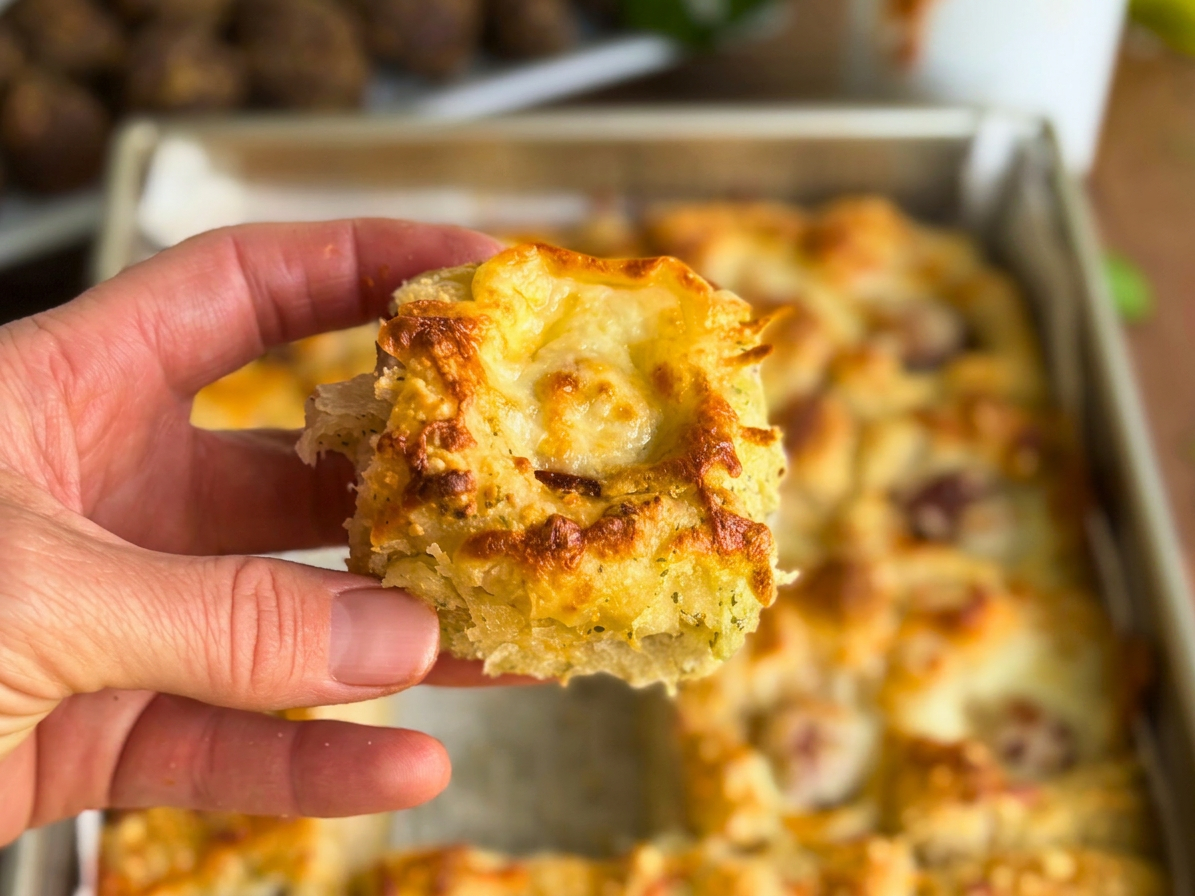
This recipe fixes that. Each ball of sourdough focaccia dough wraps around its own meatball, gets a spoon of marinara tucked inside, bakes up golden and cheesy, and tears apart into its own self contained little meatball sandwich. No mess, no fallen filling, no complaints. Just the flavors everyone loves in a format that actually works, especially at the table with kids.
This is the third savory STUFFED pull-apart focaccia I have developed, after my Pulled Pork Pull-Apart Focaccia and Buffalo Chicken Dip Pull-Apart Focaccia, and it might be the one that disappears fastest. The combination of that garlicky, Parmesan crusted focaccia dough with a juicy meatball and a bubble of marinara inside is exactly what it sounds like. Make it once and your family will ask for it on rotation.

Table of Contents
- Why This Recipe Works
- What You Need to Know About the Focaccia Dough
- The Garlic Butter and Parmesan Coating
- The Meatballs
- How to Assemble Meatball Stuffed Pull-Apart Focaccia
- Baking Tips
- Sourdough Recipe
- Yeast Version
- Substitutions and Variations
- Make Ahead and Storage
- More Pull-Apart Focaccia Recipes
- Frequently Asked Questions
- Subscribe
Why This Recipe Works
This recipe brings together two things that are already great on their own and makes them better together. The focaccia dough is made the night before, which means most of the work is done before you go to sleep. The meatballs can be baked the same morning or also made ahead and refrigerated. Assembly takes about 20 minutes, and then the oven does the rest.
What makes this different from other meatball bread recipes is the focaccia dough itself. This is not biscuit dough or store bought roll dough. It is a properly fermented sourdough that develops flavor overnight, coated in garlic butter and finely grated Parmesan before it ever sees the oven. Each ball of dough is soft and pillowy on the inside with a lightly crisp, cheesy exterior. The meatball baked inside stays juicy because it is protected by the surrounding dough, and the marinara on top caramelizes slightly against the cheese.
The result looks impressive, tastes like a restaurant appetizer, and is genuinely simple to pull off at home.

What You Need to Know About the Focaccia Dough
The focaccia dough for this recipe is a simple overnight sourdough. You mix it the evening before, do one round of stretch and folds, tuck it, cover it, and let it ferment at room temperature for 8 to 12 hours depending on the temperature of your kitchen. By morning it is airy, bubbly, and ready to shape.
The dough uses 500 grams of bread flour and 375 grams of water, which gives you a 75% hydration. This is a wet dough. That is intentional. The high hydration is what gives focaccia its open, airy crumb and pillowy texture. Do not be tempted to add more flour when it feels sticky. Work with damp hands instead.
The stretch and fold technique is important here. Rather than kneading, you stretch the dough up from one side and fold it over itself, rotating the bowl and repeating. One round of this, followed by a slap and fold to build surface tension, is all this dough needs before its overnight rest. The long fermentation does the rest of the work for you.
Timing your fermentation depends on your kitchen temperature. In a warmer kitchen, around 75 to 78°F, the dough will be ready closer to the 8 hour mark. In a cooler kitchen, give it the full 12 hours. You are looking for a dough that has doubled or tripled, feels airy when you press it, and has visible bubbles on the surface.
If you are new to sourdough or do not yet have an active starter, Sourdough Starter Recipe and Guide. The yeast version of this recipe is also included below if you want to skip the overnight process entirely.

The Garlic Butter and Parmesan Coating
This coating is what takes the focaccia from good bread to something people reach for before the pan even makes it to the table. Each ball of dough gets dipped in a warm garlic butter and oil mixture, then rolled in a Parmesan and cornstarch blend before being placed in the pan.

The garlic butter mixture is 60 grams each of butter and avocado oil or olive oil, melted together with one clove of minced garlic and a half teaspoon of dried parsley. Melting butter with oil rather than using butter alone gives you better coverage and a slightly lighter result. The garlic infuses into the warm fat and coats each dough ball as you dip it.
The Parmesan coating is where the texture comes from. Two tablespoons of cornstarch, finely grated Parmesan, and a half teaspoon of dried parsley combined into a sandy mixture. The cornstarch is the trick here. It helps the Parmesan adhere to the dough and creates a slightly crispier exterior as it bakes. If you are starting from a block of Parmesan, which I strongly recommend, cut it into cubes and run it through a food processor a few pulses, Add the cornstarch and continue pulsing until it reaches a fine, sand like consistency. Add the cornstarch and then the parsley last. Pregrated Parmesan from the refrigerated section of the grocery store also works well and saves time.
Dip each dough ball in the butter mixture, roll it thoroughly in the Parmesan coating, and place it in a parchment lined pan in five rows of four or five rows of five, or whatever arrangement fits your pan. There shouldn’t be much room between the balls they will expand toward each other as they proof and bake, which is exactly what you want.

The Meatballs
The meatballs for this recipe are baked separately first, allowed to cool down, and then pressed into the dough balls before the final bake. This two step process is important. You do not want to place a raw or frozen meatball into the dough because it will not cook through properly in the time it takes the bread to bake, and a frozen meatball will drop the temperature of the dough and prevent it from rising correctly.
I use my Easy Homemade Baked Meatballs for this recipe. They are made with a sourdough bread and buttermilk panade that keeps them tender and juicy even after a second round in the oven. If you want to make this recipe on a weeknight without making meatballs from scratch, store bought frozen meatballs work as a shortcut. Just bake them fully according to the package directions and allow them to cool to at least room temperature before assembling.
The meatballs should be roughly golf ball size, or about 1.5 inches in diameter. They need to be small enough that the dough can partially surround them without being stretched so thin it tears. You want each meatball to sit nestled into the dough with a little bit of the top peeking out, not fully enclosed, but cradled.

How to Assemble Meatball Stuffed Pull-Apart Focaccia
Assembly is straightforward once your meatballs are baked and cooled and your dough has had its morning proof.
After arranging all 25(ish depending on your ball size) coated dough balls in the 9 x 13 pan, cover the pan with a lid or plastic wrap and allow them to rest for approximately two hours. This secondary proof gives the dough time to relax and puff slightly before the meatballs go in. While the dough is proofing is the ideal time to bake your meatballs if you have not done so already.
Once the meatballs have cooled and the dough has proofed, press one meatball firmly into the center of each focaccia ball. Push it down into the dough so that it is surrounded on the sides but still has the top exposed. The dough will come up around the meatball naturally.
Add approximately half a teaspoon of marinara sauce on top of each meatball, spooned directly into the opening where the dough meets the meat. You are not looking for the dough to close over the top. The meatball should still be visible, sitting in its own little well of sauce.

Baking Instructions
Preheat your oven to 425°F. Bake the assembled pan for 20 minutes.
Remove the pan from the oven and add a generous pinch of shredded mozzarella on top of each ball, directly over the meatball and sauce. Return the pan to the oven for an additional 10 to 15 minutes until the cheese is melted and beginning to bubble and the tops of the dough balls are golden.
If the cheese is browning faster than you would like, loosely tent the pan with foil for the last few minutes.
If you prefer your focaccia without cheese, skip the cheese addition and bake for a full 30 to 35 minutes total in a single stretch.
Allow the pan to cool for 10 to 15 minutes before serving. The meatballs retain heat significantly, so give it a few minutes or you will burn your fingers pulling it apart.

Sourdough Recipe

Meatball Stuffed Pull-Apart Focaccia
Equipment
- Large mixing bowl or proofing container with lid
- kitchen scale
- 9×13 inch baking pan
- Parchment paper
- Two shallow bowls for coating
- Food processor (for grating Parmesan to fine texture)
- Rimmed baking sheet (for meatballs)
Ingredients
Focaccia Dough
- 500 grams bread flour 4 cups
- 375 grams water 1 and 1/2 cups plus 2 tablespoons
- 75 grams active sourdough starter 1/3 cup
- 10 grams salt 2 teaspoons
Garlic Butter Coating
- 60 grams unsalted butter melted (4 tablespoons)
- 60 grams avocado oil or olive oil 1/4 cup
- 1 clove garlic minced
- 2 grams dried parsley 1/2 teaspoon
Parmesan Cornstarch Coating
- 16 grams cornstarch 2 tablespoons
- 180 grams finely grated Parmesan cheese approximately 2 cups
- 2 grams dried parsley 1/2 teaspoon
Assembly
- 25 baked and cooled meatballs see Easy Homemade Baked Meatballs recipe
- 120 grams marinara sauce 1/2 cup, approximately 1/2 teaspoon per ball
Optional Topping
- 112 grams shredded mozzarella 1 to 2 cups, amount to taste
Instructions
- The evening before you plan to serve, combine the bread flour, water, active sourdough starter, and salt in a large bowl. Mix until no dry flour remains. The dough will be very sticky. This is expected with a high hydration focaccia dough.
- Cover the bowl and let the dough rest for 30 minutes at room temperature.
- With wet hands, perform one round of stretch and folds. Grab one edge of the dough, stretch it up, and fold it over to the opposite side. Rotate the bowl 90 degrees and repeat four times total around the bowl. This builds gluten structure without kneading.
- After the stretch and fold, perform a slap and fold by turning the dough out onto a clean unfloured surface and slapping it down, then folding it over itself repeatedly until the dough feels slightly smoother and holds its shape. Tuck the seam under the bottom to create surface tension.
- Place the dough seam side down back into the bowl or a lidded proofing container. Cover tightly and leave at room temperature to ferment overnight for 8 to 12 hours depending on the temperature of your kitchen. In a warmer kitchen around 75 to 78 degrees F, check around 8 hours. In a cooler kitchen, allow the full 12 hours. The dough is ready when it has doubled or tripled and feels airy and jiggly.
- When ready to assemble, prepare the garlic butter coating by melting the butter and oil together in a small bowl. Stir in the minced garlic and dried parsley. Set aside.
- Prepare the Parmesan cornstarch coating by combining the finely grated Parmesan, cornstarch, and dried parsley in a shallow bowl. For the finest texture, cut a block of Parmesan into cubes, process in a food processor until it resembles coarse sand, then add the cornstarch and pulse briefly. Pre-grated refrigerated Parmesan also works well.
- Line a 9×13 inch baking pan with parchment paper. Working quickly, tear off a golf ball sized piece of dough. Dip it in the garlic butter mixture, coating all sides, then roll it in the Parmesan cornstarch mixture until evenly coated. Place in the prepared pan. Repeat until all 25 balls are coated and arranged in five rows of five with a small amount of space between each ball. This recipe is customizable, for the size of balls you want. I would stay around 5×5 (25 balls) or 4×5 (20 balls) for the meatball size suggested, so you have enough dough around the meatballs. But feel free to experiment meatball size and focaccia ball size!
- Cover the pan with a lid or plastic wrap and allow the dough balls to proof at room temperature for approximately 2 hours. They should puff noticeably and expand toward each other. While the dough is proofing, bake your meatballs if you have not already done so and allow them to cool completely.
- Once the dough has proofed and the meatballs are cooled, press one meatball firmly into the center of each focaccia ball. Push it down so the dough comes up around the sides but the top of the meatball remains visible and exposed. Add approximately half a teaspoon of marinara sauce on top of each meatball, spooning it directly into the well where the dough meets the meat.
- Preheat your oven to 425 degrees F.
- Bake the assembled pan for 20 minutes until the dough is set and beginning to turn golden. Remove the pan from the oven and add a generous pinch of shredded mozzarella on top of each ball directly over the meatball and sauce.
- Return the pan to the oven for an additional 10 to 15 minutes until the mozzarella is fully melted and bubbling and the tops of the dough balls are deep golden. If the cheese begins to darken faster than you would like, loosely tent the pan with foil for the final few minutes.
- If you prefer to skip the cheese, bake for a total of 30 to 35 minutes in a single stretch without removing the pan.
- Allow the pan to cool for 10 to 15 minutes before serving. The meatballs retain significant heat so give it a few minutes before tearing in.
Notes
Yeast Version
Not a sourdough baker yet? This recipe works beautifully with a same day yeasted focaccia dough. Everything from the coating to the assembly to the baking is identical. The only thing that changes is the dough itself and the timeline.

Yeasted Meatball Stuffed Pull-Apart Focaccia
Equipment
- Large mixing bowl
- Digital Kitchen Scale
- Danish dough whisk or large spoon
- 9×13 inch baking pan
- Parchment paper
- Two shallow bowls or plates (for dipping and coating)
- Food processor (for grating parmesan to a fine texture) if needed
- Rimmed baking sheet (for meatballs)
- Plastic wrap or a lid
Ingredients
FOR THE SAME DAY FOCACCIA DOUGH:
- 500 g bread flour 4 cups plus 2 tablespoons, spooned and leveled
- 375 g warm water 1½ cups plus 1½ tablespoons, see notes on hydration
- 5 g instant yeast 1½ teaspoons OR 5 g active dry yeast (1½ teaspoons)
- 9 g fine sea salt 1½ teaspoons
FOR THE GARLIC BUTTER COATING:
- 60 g unsalted butter melted (about 4 tablespoons)
- 60 g avocado oil or olive oil about ¼ cup
- 1 clove garlic minced
- 2 g dried parsley about ½ teaspoon
FOR THE PARMESAN CORNSTARCH COATING:
- 16 g cornstarch about 2 tablespoons
- 180 g finely grated parmesan cheese about 2 cups
- 2 g dried parsley about ½ teaspoon
FOR THE ASSEMBLY:
- 25 baked and cooled meatballs see Easy Homemade Baked Meatballs recipe
- 120 g marinara sauce about ½ cup, roughly ½ teaspoon per ball
FOR FINISHING:
- 112 g low moisture mozzarella cheese shredded (about 1 cup, optional)
Instructions
Mix the dough.
- There are two ways to do this depending on your yeast. Follow only the method that matches your yeast, then continue with the rest of the recipe.
METHOD A: INSTANT YEAST (no blooming needed)
- Combine the 500 g bread flour, 375 g warm water, 5 g instant yeast, and 9 g fine sea salt in a large bowl. Mix until no dry flour remains. The dough will be very wet and sticky. Do not add more flour. Check the back of your yeast packet for the recommended water temperature, since it varies by brand. When the yeast goes straight into the flour rather than being bloomed separately, warmer water in the range your packet calls for is correct and will not harm it.
METHOD B: ACTIVE DRY YEAST (bloom the yeast first)
- Warm 60 g of the water to about 100 to 110°F, stir in the 5 g active dry yeast, and let it sit for about 10 minutes until it looks foamy and dissolved. If it does not foam at all, the yeast may be dead or the water was too hot, so start over with a fresh batch rather than risking a dough that will not rise. Add the bloomed yeast to the bowl along with the 500 g bread flour, the 9 g fine sea salt, and the remaining warm water, then mix until no dry flour remains.
- Rest the dough. Cover the bowl and rest for 30 minutes.
Stretch and fold.
- First set. Wet your hands. Grab one side of the dough, stretch it up as far as it will go without tearing, and fold it over the center. Rotate the bowl a quarter turn and repeat for four folds total. That is one set. Cover and rest 30 minutes.
- Stretch and fold, second and third sets. Repeat the same set every 30 minutes for a total of three sets, or up to four if the dough still feels slack. With each set the dough will become smoother, stronger, and more elastic.
Bulk rise.
- After the final set, cover and let the dough rise at room temperature until doubled in size and visibly bubbly, approximately 1 to 1.5 hours. Watch the dough, not the clock. A warmer kitchen will speed this up significantly.
Bake the meatballs.
- While the dough rises, bake your meatballs if you have not already done so and let them cool completely to at least room temperature. They must be fully baked and cooled before they go anywhere near the dough.
Prepare the garlic butter coating.
- Melt the butter and oil together in a small bowl, then stir in the minced garlic and dried parsley. Set it aside somewhere warm enough that it stays liquid.
Prepare the parmesan coating.
- Add the finely grated parmesan and cornstarch to a food processor and pulse until fine and powdery, then stir in the dried parsley. For the best texture, cut a block of parmesan into cubes and process it until it resembles coarse sand before adding the cornstarch. Pregrated refrigerated parmesan also works well and saves time.
Set up your workspace.
- Line a 9×13 inch baking pan with parchment paper and have the garlic butter, the parmesan coating, and the lined pan within reach before you start portioning.
Portion and coat the dough.
- Wet or lightly oil your hands, since this is still a wet dough and it will be sticky. Tear off a golf ball sized piece of dough, dip it into the garlic butter until all sides are coated, then roll it in the parmesan coating until evenly covered and place it in the prepared pan. Repeat until all 25 balls are coated and arranged in five rows of five with only a small amount of space between them. This recipe is customizable for the size of balls you want, though I would stay around 5×5 for 25 balls or 4×5 for 20 balls with the meatball size suggested so there is enough dough surrounding each meatball.
Second proof.
- Cover the pan with a lid or plastic wrap and let it rise at room temperature for about 1 hour, until the balls look light and puffy and have expanded toward each other. Give it up to 1.5 hours in a cool kitchen. Do not over proof. They should be puffy and press together, not collapse when you touch them.
Stuff the meatballs.
- Press one cooled meatball firmly into the center of each focaccia ball, pushing it down so the dough comes up around the sides while the top of the meatball stays visible and exposed. You are cradling the meatball, not burying it.
- Add the marinara. Spoon about half a teaspoon of marinara sauce on top of each meatball, directly into the well where the dough meets the meat. Keep the sauce thick rather than watery so it does not make the dough soggy.
Preheat the oven.
- Preheat to 425°F and make sure it is fully preheated before the pan goes in.
Bake.
- Bake the assembled pan for 20 minutes, until the dough is set and beginning to turn golden.
- Add the cheese. Pull the pan out and quickly add a generous pinch of shredded mozzarella on top of each ball, directly over the meatball and sauce. Work fast to keep the heat in the oven, then return the pan immediately.
- Finish baking. Bake for another 10 to 15 minutes, until the mozzarella is fully melted and bubbling and the tops of the dough balls are deep golden. If the cheese begins to darken faster than you would like, loosely tent the pan with foil for the final few minutes. If you are skipping the cheese entirely, bake for a total of 30 to 35 minutes in one stretch without opening the oven.
Rest and serve.
- Let the pan cool for 10 to 15 minutes before serving. The meatballs retain significant heat, so give it those few minutes before tearing in or you will burn your fingers. Serve with extra warm marinara on the side for dipping.
Notes
Substitutions and Variations
Cheese options. Mozzarella is the classic choice and melts beautifully here. Provolone is a great alternative and gives you that more authentic meatball sub flavor. American cheese melts incredibly smoothly if you want maximum gooeyness. A combination of mozzarella and Parmesan on top is also excellent.
Meatball options. Homemade meatballs give you the best result and the most control over flavor, but fully baked and cooled store-bought or frozen meatballs work as a weeknight shortcut. Just make sure they are fully cooked and cooled before assembly. Never place frozen meatballs directly into raw dough.
Sauce options. Classic marinara is the obvious choice, but pizza sauce, arrabbiata for some heat, or even a roasted garlic tomato sauce all work well. Keep the sauce thick rather than watery so it does not make the dough soggy.
No sourdough starter? Use the yeasted version outlined above, or check out my sourdough starter post to get started on your own. An active starter opens up the full pull-apart focaccia series and is worth the week it takes to develop one.

Make Ahead and Storage
This recipe is designed to be broken into stages, which makes it very manageable even on a busy day.
The meatballs can be baked up to four days ahead and stored in an airtight container in the refrigerator. They can also be frozen for up to three months and thawed in the refrigerator overnight before use.
The focaccia dough is mixed the night before by design. If you want to extend that timeline, the dough can be refrigerated after mixing and will cold ferment for up to 48 hours. A longer cold ferment develops even more flavor.
Assembled and unbaked focaccia can be assembled through the meatball pressing step, covered tightly, and refrigerated for a few hours before baking. Allow it to come back to room temperature for 30 minutes before putting it in the oven.
Leftovers keep in an airtight container in the refrigerator for up to three days. Reheat in a 350°F oven for 10 to 12 minutes. The microwave works in a pinch but softens the exterior.

More Pull-Apart Focaccia Recipes
If you love this recipe, here are the other savory pull-apart focaccias in the series:
Pulled Pork Pull-Apart Focaccia smoky pulled pork tucked into that same garlicky Parmesan dough
Buffalo Chicken Dip Pull-Apart Focaccia all the flavors of buffalo chicken dip in pull-apart form
Garlic Parmesan Pull-Apart Focaccia the original, and still one of one of the most requested
And if you want to explore more sourdough bread recipes, my High Protein Sourdough Dinner Rolls use a similar enriched dough technique and are a great next project.
Frequently Asked Questions
Can I use store-bought or frozen meatballs?
Yes, with one important condition. The meatballs must be fully baked and cooled to at least room temperature before you press them into the dough. Frozen or raw meatballs placed directly into raw focaccia dough will not cook through properly in the time it takes the bread to bake, and a frozen meatball will prevent the dough around it from proofing and rising correctly. Bake frozen meatballs according to package directions, let them cool, then proceed with assembly.
Can I make this without a sourdough starter?
Absolutely. The yeast version in this post uses either active dry yeast, instant yeast, or rapid rise yeast and can be completed in a few hours same day. The sourdough version has more developed flavor from the overnight fermentation, but both produce a genuinely delicious result.
What size pan should I use?
A standard 9×13 inch baking pan works well for 20-25 balls arranged in four/five rows of five. The balls should fit snugly but not be so compressed that they cannot expand during the second proof and bake.
How do I know when the focaccia is done?
The tops of the dough balls should be golden and the cheese melted and beginning to bubble. If you tap a ball gently it should feel set, not doughy. An internal read on the bread portion should be around 190 to 200°F if you want to be precise. The meatballs inside are already fully cooked, so the bread is your doneness indicator.
Can I make this ahead for a party?
Yes. Bake the meatballs up to four days ahead. Mix the focaccia dough the night before. Assemble the morning of, about three hours before you plan to bake. Pull it from the meatballs out, let come to room temperature for a few hours, or warm directly in the oven(allow to recool before adding to the proofed focaccia balls) then bake as directed.
My dough feels very wet and sticky. Is that normal?
Yes. Focaccia dough at 75% hydration is significantly wetter than most bread doughs most people are used to working with. Work with damp hands rather than adding flour. The high hydration is what gives focaccia its light, airy texture, and adding flour to compensate will make it dense. Trust the process.
Can I use a different coating on the dough balls?
The garlic butter and Parmesan cornstarch coating is what gives this recipe its signature flavor and texture, but you can absolutely adapt it. Italian seasoning, red pepper flakes, or a mix of Parmesan and Pecorino, a sharp cheddar all work. You do not want to use a soft cheese though, it will make the coating too wet.
The cornstarch component is worth keeping regardless of what else you change, as it is what helps the coating adhere and creates the crisp exterior.

Make This Recipe
If you make this Meatball Stuffed Pull-Apart Focaccia, leave a comment below and let me know how it went. Did your family tear into it immediately? Did you use homemade or store bought meatballs? I read every comment and it genuinely helps other readers when they are deciding whether to try a recipe.
If you share it on Instagram or Facebook, tag me so I can see your pull. There is nothing better than watching this recipe show up in other people’s kitchens.
And if you want new recipes like this delivered directly to your inbox, sign up for the H3art of the Home newsletter below. No spam, just bread.





Leave a Reply