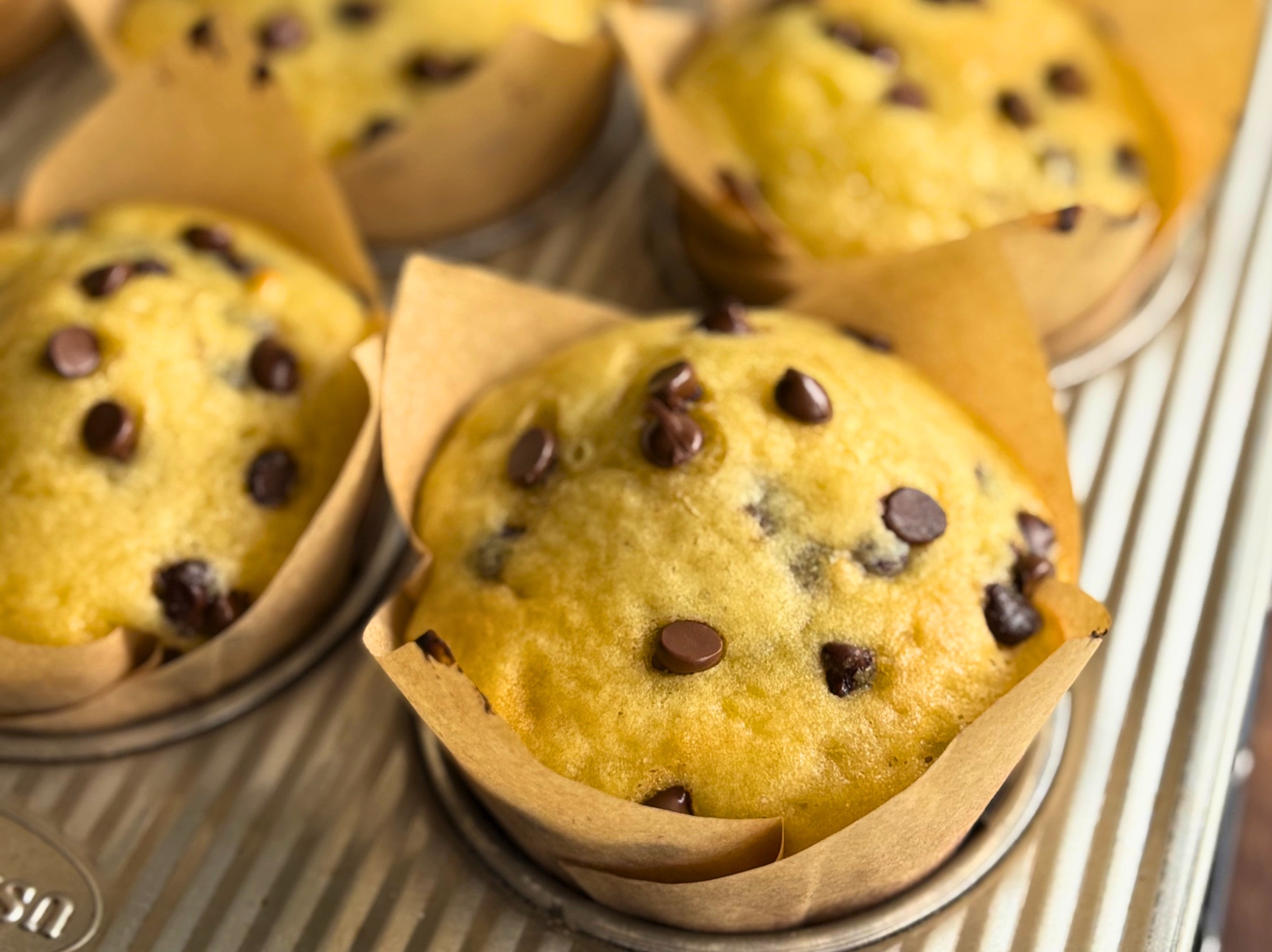
I have a confession. I did not set out to make the healthiest muffin you can make. I set out to have something other than my High Protein Chocolate Chip Scones I have to make twice a week because my boys eat them faster than I can bake them. I needed a high protein Greek yogurt chocolate chip muffin that could do the same job, filling, genuinely good, and actually built to fuel a morning, not just fill a stomach. Something I could batch bake on Sunday and feel good handing them on a Tuesday without a second thought.
Eight grams of protein per muffin. No protein powder. No compromise on texture or flavor. Just nonfat Greek yogurt doing what Greek yogurt does best when it is baked into something worth eating. Less fat than a standard muffin, less sugar than a standard muffin, and nearly double the protein. Not because I was trying to make something super healthy. Because I wanted more mileage out of something my kids would actually eat.
And here is the thing. I knew these would be loved not only by my sourdough community, but people who don’t use sourdough, because not everyone keeps a starter on the counter. So this is that recipe, reworked from the ground up for everyone else. Same protein, same dome, same crumb. Zero starter required.
Table of Contents
- Why These Muffins Actually Deliver on Protein
- Ingredient Notes
- How to Make High Protein Greek Yogurt Chocolate Chip Muffins
- Recipe
- Tips for Success
- Choosing the Right Greek Yogurt
- Storage and Freezing
- More High Protein Recipes from H3art of the Home
- Frequently Asked Questions
Why These Muffins Actually Deliver on Protein
Most Greek yogurt muffin recipes on the internet clock in at 4 to 6 grams of protein per muffin. Some advertising high protein are sneaking in a scoop of protein powder to get there. These high protein Greek yogurt chocolate chip muffins hit 8 grams from real, whole ingredients only, primarily a generous amount of nonfat Greek yogurt and two eggs.
Nonfat Greek yogurt is one of the most efficient sources of protein you can bake with. A single cup contains roughly 17 to 20 grams of protein depending on the brand, and this recipe uses considerably more than that. The nonfat version is ideal here because the higher protein-to-fat ratio means you are getting more protein per gram of yogurt than you would from a full fat version. The butter in the recipe handles the fat and richness, so nothing is sacrificed in texture.
Two eggs contribute another 12 grams of protein to the total batch, and the combination of these two ingredients working together is what pushes each muffin well above what a standard recipe can achieve without powders or supplements.
Here is why that matters beyond just a number on a label. Muffins are naturally carbohydrate heavy, and carbohydrates alone digest quickly, which means a standard muffin can leave kids hungry again within an hour. Pairing those carbohydrates with a meaningful amount of protein slows digestion, stabilizes blood sugar, and actually keeps them full until the next meal. That is the whole point of this recipe. It is not diet food. It is a muffin that does its job better than most.
A standard bakery style chocolate chip muffin averages around 25 grams of sugar and 15 grams of fat per muffin. This recipe comes in 10 to 15% less sugar than a standard recipe and about half the fat, while delivering double the protein. You are not sacrificing the muffin. You are just building it smarter.

Ingredient Notes
Nonfat Plain Greek Yogurt: This is the foundation of the recipe. Use plain, unsweetened nonfat Greek yogurt. The yogurt does triple duty here. It provides protein, contributes acidity that activates the baking soda, and keeps the crumb moist and tender without needing a heavy hand with fat. Avoid Greek style yogurts that are simply thickened with cream or additives. You want the real thing, strained milk and live cultures.
All Purpose Flour: Standard unbleached all purpose flour. All purpose gives you the right balance of structure and tenderness for a muffin that domes without being tough.
Butter: Unsalted, melted and cooled to slightly warm before mixing. The butter adds richness that complements the lean yogurt and rounds out the flavor. Butter gives these muffins a bakery quality flavor that oil cannot replicate.
Whole Milk: A small amount thins the batter just enough for proper mixing and even baking. Room temperature is important. Cold milk can cause the melted butter to seize and leave you with a lumpy batter before you even add the dry ingredients.
Chocolate Chips: Semi sweet is the right call here. The slight bitterness of semi sweet chips balances the sweetness of the muffin perfectly. Reserve a small handful to press onto the tops before baking so every muffin looks exactly the way a bakery muffin should.
Leavening: Both baking powder and baking soda are used. The baking powder provides steady lift throughout the bake. The baking soda reacts with the acid in the Greek yogurt to give an additional boost of rise and contributes to that golden color on top. Both are necessary.

How to Make High Protein Greek Yogurt Chocolate Chip Muffins
Start by whisking your dry ingredients together thoroughly so the leavening is evenly distributed before anything wet touches it. In a separate bowl, whisk the melted butter and sugars together until glossy, about two minutes by hand. This step builds a little structure even without a mixer.
Warm your Greek yogurt slightly before adding it to the butter and sugar. About 30 seconds in the microwave is enough. Cold yogurt straight from the refrigerator can cause the butter to solidify and leave you with a broken batter. A slightly warmed yogurt incorporates smoothly and gives you a cohesive base before the eggs go in.
Add the eggs one at a time, then the milk and vanilla. Pour the wet ingredients into the dry and fold gently with a rubber spatula until just combined. Stop the moment you no longer see dry flour. Overmixing develops gluten and turns a tender muffin into a rubbery one.
Let the batter rest for five minutes before scooping. This gives the leavening a moment to start working and helps the muffins dome evenly during baking. Fill each liner nearly to the top and press a few reserved chocolate chips onto each one before they go in the oven.
Bake at a steady 375 degrees for 20 to 23 minutes. Do not rely on the toothpick alone to check for doneness. Press the top of a muffin gently with your finger. It should spring back completely with zero give. If it leaves any indent at all, give it another minute or two. High moisture batters can feel and look done before the structure has fully set, and pulling them too early leads to that slight deflating on the counter as they cool.

Recipe

High Protein Greek Yogurt Chocolate Chip Muffins
Equipment
- Large mixing bowl
- medium mixing bowl
- Whisk
- Rubber spatula
- Standard 12 cup muffin tin
- Tulip liners or standard paper liners
- kitchen scale
- Ice cream scoop or large spoon
Ingredients
DRY INGREDIENTS
- 300 g all purpose flour 2 1/2 cups
- 10 g baking powder 2 1/2 teaspoons
- 3 g baking soda 1/2 teaspoon
- 4 g fine sea salt 3/4 teaspoon
WET INGREDIENTS
- 56 g unsalted butter melted and cooled to slightly warm (4 tablespoons)
- 130 g granulated sugar 2/3 cup
- 50 g light brown sugar packed (1/4 cup packed)
- 375 g nonfat plain Greek yogurt room temperature (1 1/2 cups)
- 60 g whole milk room temperature (1/4 cup)
- 2 large eggs room temperature
- 10 g pure vanilla extract 2 teaspoons
MIX-IN
- 150 g semi sweet chocolate chips plus a small handful reserved for topping (scant 1 cup)
Instructions
- Preheat your oven to 375 degrees Fahrenheit. Line a standard 12 cup muffin tin with tulip liners or paper liners and lightly spray with nonstick spray.
- In a large bowl, whisk together the flour, baking powder, baking soda, and salt until evenly combined. Set aside.
- In a medium bowl, whisk the melted butter with the granulated sugar and brown sugar for about 2 minutes until well combined and slightly glossy.
- Microwave the Greek yogurt for 30 seconds and stir well. It should feel slightly warm, not hot. Add the warmed yogurt and the milk to the butter and sugar mixture. Whisk until fully combined with no streaks.
- Add the eggs one at a time, whisking well after each addition.
- Add the vanilla extract and whisk until smooth.
- Pour the wet ingredients into the dry ingredients. Fold gently with a rubber spatula until just combined. Stop as soon as no dry flour streaks remain. Do not overmix.
- Fold in the chocolate chips, reserving a small handful for topping.
- Let the batter rest for 5 minutes. This allows the leavening to activate and helps the muffins dome evenly.
- Scoop the batter into the prepared liners, filling each nearly to the top. Press a few reserved chocolate chips onto the top of each muffin.
- Bake at 375 degrees Fahrenheit for 20 to 25 minutes, until the tops are set and golden. Do not rely on the toothpick alone. Press the top of a muffin gently with your finger. It should spring back completely with zero give. If it leaves any indent, bake for another 1 to 2 minutes.
- Cool in the pan for 5 minutes, then transfer to a wire rack to cool completely.
Notes
Tips for Success
Room temperature ingredients matter. Cold eggs and cold milk slow down batter emulsification. Pull everything out of the refrigerator 30 minutes before you start, or do the quick warm up method for the yogurt as described above.
Do not overmix. Once the wet and dry ingredients meet, fold only until the flour disappears. A few small lumps in the batter are fine and actually preferable to a smooth, overworked batter.
Fill the liners full. Unlike cupcakes, muffins benefit from a full liner. Filling each cup nearly to the top is what gives you that tall bakery dome rather than a flat topped muffin that barely clears the liner.
Use the finger press test. Press the top gently at the 20 minute mark. It must spring back completely. This test is more reliable than the toothpick for a high moisture batter like this one.
Tulip liners give the best results. Standard liners work fine, but tulip liners allow the muffin to dome above the liner without restriction. Lightly spray whichever liner you use with nonstick spray before filling.

Choosing the Right Greek Yogurt
The yogurt you use in this recipe matters more than almost any other ingredient. It is doing the heavy lifting on protein, moisture, and structure all at once, so grabbing the wrong container off the shelf will affect both the texture of your muffins and the protein count you are baking toward.
True Greek Yogurt vs Greek Style
This is the most important distinction. True Greek yogurt is made by straining regular yogurt to remove the whey, which concentrates the protein and creates that thick, spoonable texture. Greek style yogurt is regular yogurt thickened with additives like cream or starch to mimic the texture without the straining process. It looks similar on the shelf but has significantly less protein and more water content. More water in the batter means a looser consistency, a harder set, and a muffin that does not hold together the way it should. Always check the ingredient list. True Greek yogurt should list only milk and live cultures.
Nonfat vs Full Fat
This recipe was developed and tested with nonfat Greek yogurt. Nonfat gives you the highest protein per gram, which is what pushes these muffins to 8 grams of protein each. Full fat Greek yogurt will work and produces a slightly richer, more tender crumb, but the protein per muffin will be slightly lower. Either works. Nonfat is what gets you to that 8 gram number.
Plain vs Flavored
Plain unsweetened only. Flavored yogurts add extra sugar which throws off the sweetness balance of the recipe, and many are thickened differently than plain which affects the batter consistency. Vanilla yogurt is the most common swap people try and it is the one most likely to cause problems. Stick with plain.
My Recommendations
My first choice is the Kirkland Organic Nonfat Plain Greek Yogurt from Costco. It is consistently thick, reliably high in protein, and the value per gram of protein is unbeatable. If you have a Costco membership this is what I recommend you use and what this recipe was tested with.
If you do not have a Costco membership, Stonyfield Organic Nonfat Plain Greek Yogurt is an excellent second choice. It has a similar protein profile and holds up beautifully in baked goods.
Fage Total 0% is another reliable option you will find at most grocery stores. It is one of the thickest nonfat Greek yogurts widely available and performs consistently well in baking. If Kirkland or Stonyfield are not accessible to you, Fage is an easy reach.
If you want to squeeze a little more protein out of each muffin, Siggi’s Plain Nonfat Skyr is worth reaching for. Skyr is technically an Icelandic cultured dairy product rather than true Greek yogurt, but it behaves almost identically in baking and has a higher protein content per gram than most Greek yogurts. It replaces the yogurt in this recipe one to one with no other adjustments needed.
Storage and Freezing
Store muffins in an airtight container at room temperature for up to two days. After that, move them to the refrigerator where they will keep for up to five days. To serve from the refrigerator, microwave for 15 to 20 seconds to take the chill off and restore that soft, fresh texture.
These freeze beautifully. Let them cool completely, then wrap individually in plastic wrap and store in a freezer bag for up to three months. Thaw overnight in the refrigerator or microwave from frozen for 30 to 45 seconds. They come out of the freezer tasting exactly as they did on day one.

More High Protein Recipes from H3art of the Home
If you are building out a higher protein breakfast rotation without sacrificing what makes the food worth eating, these are the recipes worth bookmarking. The High Protein Sourdough Chocolate Chip Muffins are the sourdough discard version of this very recipe if you do keep a starter going. The High Protein Honey Whole Wheat Sandwich Bread and the High Protein Classic Sandwich Bread have become weekly staples around here, and the High Protein Cinnamon Rolls have a yeasted version that requires no starter at all. Every one of these recipes follows the same philosophy: real ingredients, no powders, no compromise on the food being genuinely good.
These muffins are also one of my favorite make ahead breakfast recipes. Bake a batch on Sunday and you have grab and go breakfasts ready for the whole week, if they last that long.
They hold up beautifully in the refrigerator for five days and reheat in seconds, which means busy mornings are handled before they even start.

Frequently Asked Questions
How much protein is in these muffins?
Each muffin contains approximately 8 grams of protein, coming entirely from nonfat Greek yogurt and eggs. No protein powder, no supplements. That is nearly double what a standard chocolate chip muffin delivers.
Are these Greek yogurt muffins healthy?
That depends on your definition. These were not designed to be a health food. They were designed to be a muffin worth eating that also happens to be built better than most. Compared to a standard chocolate chip muffin, they have significantly more protein, less fat, and slightly less sugar. The protein and carbohydrate combination means they digest more slowly and keep us fuller longer than a standard muffin would. Whether that makes them healthy is up to you. What I can tell you is that they taste like a real muffin and I feel good handing them to my boys.
Can I use full fat Greek yogurt instead of nonfat?
Yes. Full fat Greek yogurt will work and produce a slightly richer, more tender crumb. The protein per muffin will be slightly lower since full fat yogurt contains less protein per gram than nonfat, but the muffins will still be well above average in protein content.
Can I use vanilla Greek yogurt?
Plain unsweetened is strongly recommended. Vanilla yogurt adds extra sugar and can make the muffins sweeter than intended. It can also affect the texture depending on how the brand is thickened.
Why did my muffins deflate after baking?
This is almost always a sign of slight underbaking. High moisture batters hold a lot of steam and can appear done before the interior structure has fully set. Use the finger press test and add one to two minutes to the bake time if needed.
Can I make these into mini muffins?
Yes. Fill a mini muffin tin about three quarters full and bake at 375 degrees for 12 to 14 minutes, checking with the finger press test at the 12 minute mark.
Can I substitute the chocolate chips?
Absolutely. Blueberries, diced strawberries, or chopped dark chocolate all work well in this batter. Keep the add-in quantity at around 150 grams total.
Do these need to be refrigerated?
Because of the high Greek yogurt content, refrigerating after day two is recommended. They keep well for up to five days in the refrigerator and a quick 15 second microwave brings them right back to soft and fresh.
Can I add protein powder to boost the protein further?
It is possible but requires additional testing to get the texture right. Protein powder absorbs liquid differently than flour and adding it without adjusting other ingredients typically results in a dense, dry muffin. The recipe as written already delivers 8 grams of protein per muffin from whole ingredients, which is nearly double what most comparable recipes achieve without powder.

If you make these, I want to see them. Tag me on Instagram or drop a comment below and let me know how they turned out. And if you are not signed up for the H3art of the Home newsletter yet, that is where new recipes go first before they ever hit social media.





Leave a Reply