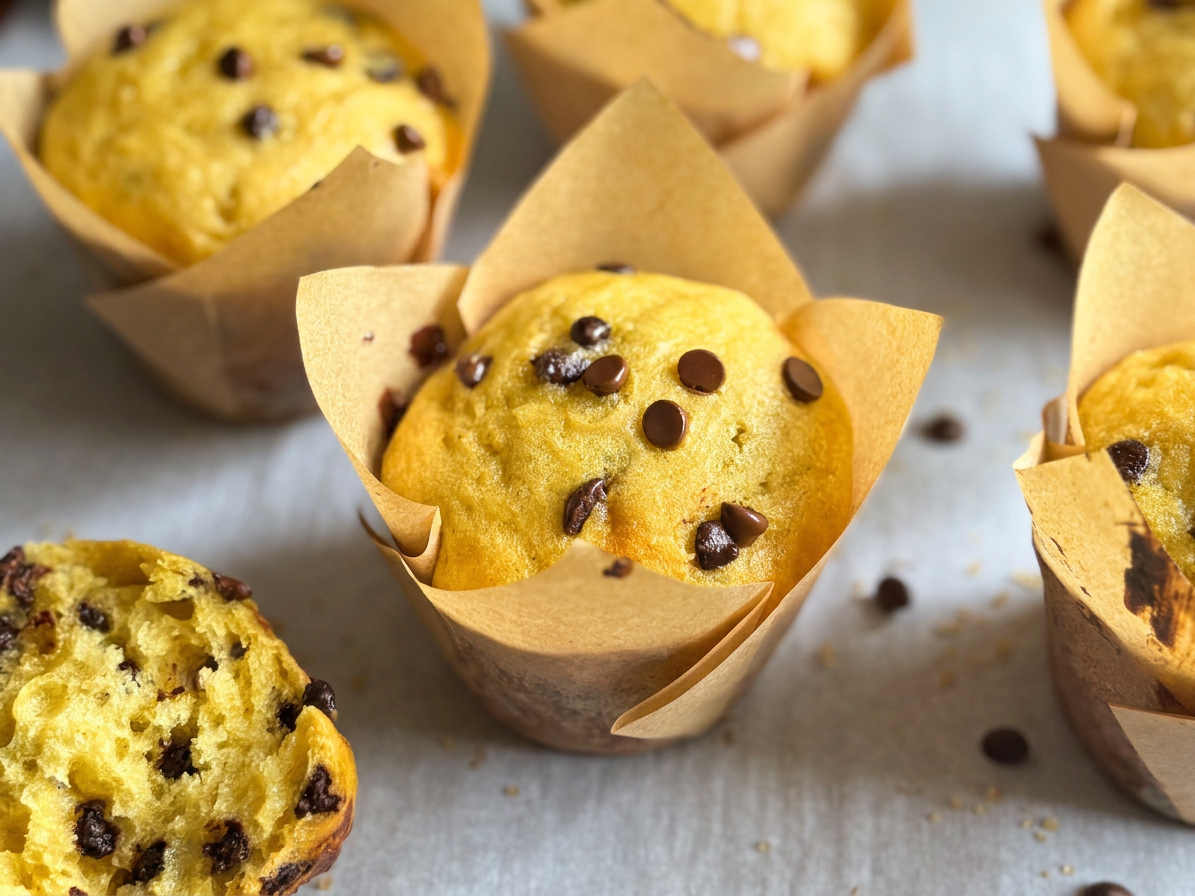
Most high protein muffin recipes ask you to compromise. Either the texture goes dense and rubbery from too much protein powder, or the flavor gets buried under it, or you end up with something that technically hits the protein numbers but does not actually taste like a muffin you want to eat. I was not interested in any of that.
What I wanted was a real chocolate chip muffin. But simple ingredients everyone would have on hand. Tall domed top, soft open crumb, generous chocolate chips, the kind of muffin you would happily pay 5 dollars for at a coffee shop. But built with double the protein of a standard chocolate chip muffin and made entirely from real whole ingredients. No protein powder. Just nonfat Greek yogurt and sourdough discard doing the heavy lifting.
These muffins deliver 8 grams of protein each, roughly double what a typical bakery muffin gives you, 10-15% less sugar and half the fat. And every gram comes from ingredients you can pronounce. The crumb is soft and airy, the dome is tall, and they hold up beautifully for days. My boys have already put in their vote, and I think yours will too.
Table of Contents
- Why This Recipe Works
- Ingredients and What They Do
- Same Day vs Overnight Fermentation
- Recipe
- Tips for the Best Muffins
- Storage and Freezing
- Choosing the Right Greek Yogurt
- More from the High Protein Series
- Don’t Have a Sourdough Starter?
- Frequently Asked Questions
Why This Recipe Works
Most high protein muffin recipes rely on protein powder. It works, but they also come with a texture compromise that I was not willing to make. This recipe takes a different approach entirely. Creating a muffin with 10-15% less sugar than a standard muffin recipe and about half the fat, while delivering double the protein without affecting taste of texture.
The Greek yogurt here is doing three jobs at once. It is the primary protein source. It is also the moisture engine, keeping the crumb soft for days without any oil. And the natural acidity in the yogurt activates the baking soda, which is part of why these muffins rise so well.
The sourdough discard or starter adds depth of flavor and a second source of acid that works alongside the yogurt. It also contributes a small amount of additional protein through the flour in the starter. Together, they create a muffin that tastes far more complex than the ingredient list would suggest.
The baking method is the other piece. These muffins start in a 425 degree oven for five minutes, then drop to 350 degrees for the remainder of the bake. That initial blast of high heat creates a rapid burst of steam inside the batter, which forces the top of the muffin upward before the structure sets. The result is that tall, domed bakery top that most home muffins never quite achieve.

Ingredients and What They Do
There are no filler ingredients in this recipe. Every component is earning its place.
All purpose flour gives the muffins structure. King Arthur AP flour was used for testing and works beautifully here. Its slightly higher protein content compared to standard AP flour contributes to both structure and the overall protein count.
Nonfat Greek yogurt is the backbone of the recipe. Use a thick, authentic Greek yogurt rather than a Greek style product. Kirkland nonfat Greek yogurt from Costco was used in development and is an excellent choice. The thick texture keeps the batter from becoming too loose, and the protein content is exceptional at 18 grams per 170 grams of yogurt.
Sourdough adds flavor and acidity. Active or discard both work. The discard is not acting as the primary leavener here, so whether it is fresh or several days old will mainly affect depth of flavor rather than rise.
Pasture raised eggs provide structure, richness, and additional protein. Two large eggs contribute about 12 grams of protein to the batch.
Unsalted butter adds flavor and tenderness. Unlike oil, butter gets absorbed into the crumb structure rather than sitting on the surface, which keeps the finished muffin from having a greasy finish.
Both granulated and brown sugar are used here. The granulated sugar provides straightforward sweetness, while the brown sugar adds moisture retention and a subtle depth that rounds out the chocolate flavor.
Semi sweet chocolate chips are the classic choice, but bittersweet chips are excellent here too and photograph beautifully against the golden crumb. Reserve a small handful to press onto the tops just before baking.

Same Day vs Overnight Fermentation
This recipe works two ways, and the method you choose will slightly change the result.
Same day method: If you want muffins on the table within the hour, this is the way. Mix your batter, let it rest at room temperature for 30 minutes, scoop, and bake. The 30 minute rest is not optional. It gives the baking powder time to start doing its work, allows the flour to fully hydrate, and thickens the batter so it scoops cleanly and rises into a tall dome rather than spreading flat.
Overnight fermentation method: This is where the recipe really shines. Mix your batter the night before, cover it tightly, and refrigerate for up to 12 hours. When you are ready to bake, pull the batter from the fridge and let it rest at room temperature for a full two hours before scooping. Do not skip that two hour rest. It is the most important step in the entire overnight method. The two hour window is what allows the cold batter to relax and the leaveners to prime before hitting the oven. The result is an even more open, airy crumb with a deeper flavor from the extended fermentation.
If you are baking in the morning, mix the batter before bed and pull it out when you wake up.

Recipe

High Protein Sourdough Chocolate Chip Muffins
Equipment
- Standard 12 cup muffin tin
- Tulip muffin liners or paper liners
- Large mixing bowl
- medium mixing bowl
- Whisk or stand mixer
- Rubber spatula
- Large cookie scoop or 1/3 cup measuring cup
- Wire cooling rack
- – Microwave-safe bowl
- Digital Kitchen Scale
Ingredients
- 250 g all purpose flour 2 cups
- 8 g double acting baking powder 2 teaspoons
- 3 g baking soda 1/2 teaspoon
- 4 g fine sea salt 3/4 teaspoon
- 56 g unsalted butter melted and cooled to slightly warm (4 tablespoons)
- 130 g granulated sugar 2/3 cup
- 50 g light brown sugar packed (1/4 cup)
- 300 g nonfat Greek yogurt 1 1/4 cups
- 100 g sourdough discard or active sourdough starter 1/2 cup
- 2 large eggs
- 10 g pure vanilla extract 2 teaspoons
- 150 g semi sweet chocolate chips 1 cup, plus a small handful for topping
Instructions
- In a large bowl, whisk together the flour, baking powder, baking soda, and salt until evenly combined. Set aside.
- Melt the butter in the microwave and let it cool to slightly warm. Do not use it hot.
- In a separate medium bowl, add the granulated sugar and brown sugar. Pour the slightly warm melted butter over the sugars and beat by hand for about 2 minutes, or use a stand mixer or hand mixer for about 1 minute, until well combined.
- Microwave the Greek yogurt for 30 seconds and stir well to distribute the heat evenly. The yogurt should feel slightly warm, not hot. This step takes the chill off and helps the batter come together smoothly.
- Add the warmed Greek yogurt to the butter and sugar mixture. Whisk by hand for 1 to 2 minutes, or mix in a stand mixer for about 1 minute, until fully combined with no streaks.
- Add the eggs one at a time, whisking well after each addition.
- Add the sourdough discard or active starter and vanilla extract. Whisk until smooth.
- Pour the wet ingredients into the dry ingredients. Fold gently with a rubber spatula until just combined. Stop the moment you no longer see dry flour streaks. The batter will be thick. Do not overmix.
- Fold in the chocolate chips, reserving a small handful to press onto the tops of the muffins before baking.
CHOOSE YOUR METHOD: At this point, decide whether you are baking same day or fermenting overnight. The instructions diverge below.
SAME DAY METHOD:
- Cover the bowl and let the batter rest at room temperature for 30 minutes. This rest is not optional. It gives the baking powder time to activate, allows the flour to fully hydrate, and produces a taller dome.
- While the batter rests, line a standard 12 cup muffin tin with tulip liners or paper liners. Preheat the oven to 425 degrees F during the last 15 minutes of the rest. Once the rest is complete, proceed to the scooping and baking steps below.
OVERNIGHT FERMENTATION METHOD:
- Cover the bowl tightly with plastic wrap and refrigerate for up to 12 hours. The next day, pull the batter from the refrigerator and let it rest at room temperature for a full 2 hours before baking. Do not skip this 2 hour rest.
- During the last 15 to 20 minutes of the rest, line a standard 12 cup muffin tin with tulip liners or paper liners, lightly spray with nonstick spray, and preheat the oven to 425 degrees F. Once the 2 hour rest is complete, proceed to the scooping and baking steps below.
SCOOPING AND BAKING (both methods):
- Scoop the batter into the prepared muffin tin, filling each cup all the way to the brim. Press a few reserved chocolate chips onto the top of each muffin.
- Bake at 425 degrees F for 5 minutes. Without opening the oven door, reduce the temperature to 375 degrees F and continue baking for an additional 14 to 16 minutes, or until a toothpick inserted into the center comes out with just a few moist crumbs.
- Allow the muffins to cool in the pan for 5 minutes, then transfer to a wire rack to finish cooling.
Notes
Tips for the Best Muffins
A few things that make a real difference with this recipe.
Whisk the sugars into the butter and yogurt first. Adding both sugars directly to the cooled melted butter, then Greek yogurt and letting them sit for two to three minutes before adding the remaining wet ingredients gives the sugar a head start on dissolving. This produces a smoother, more uniform crumb and eliminates any graininess in the finished muffin.
Fill the cups to the brim. Unlike cupcakes where you fill cups two thirds full, bakery muffins need to be filled all the way to the top. The thick batter will hold its shape and rise upward rather than spreading sideways.
Do not open the oven during the first five minutes. That initial high heat window is where the dome forms. Opening the door releases the steam and the dome collapses before it sets.
Warm the yogurt and use slightly warm butter. Microwave the Greek yogurt for 30 seconds and give it a good stir before adding it to the batter. Cold yogurt hitting warm butter and sugar will cause the fats to seize and create a lumpy batter. The melted butter should be cooled to slightly warm, never hot. Beat the slightly warm butter with both sugars first for about a minute, then add the warmed yogurt and whisk until smooth before continuing with the eggs and discard.
Batter thickness is your guide. After mixing, the batter should hold a mounded shape on a spoon without dripping. If it feels too stiff, your discard may be on the thicker side. Add a tablespoon of milk. If it drips easily, add flour 10 grams at a time until it firms up.

Storage and Freezing
Store muffins in an airtight container at room temperature for up to three days, or in the refrigerator for up to one week. If refrigerating, a quick 15 to 20 seconds in the microwave brings them back to fresh baked texture.
These muffins freeze exceptionally well. Let them cool completely, then wrap individually in plastic wrap and transfer to a freezer bag. They will keep for up to three months. Thaw overnight in the fridge or microwave from frozen for 45 to 60 seconds.

Choosing the Right Greek Yogurt
The yogurt you use in this recipe matters more than almost any other ingredient. It is doing the heavy lifting on protein, moisture, and structure all at once, so grabbing the wrong container off the shelf will affect both the texture of your muffins and the protein count you are baking toward.
True Greek Yogurt vs Greek Style
This is the most important distinction. True Greek yogurt is made by straining regular yogurt to remove the whey, which concentrates the protein and creates that thick, spoonable texture. Greek style yogurt is regular yogurt thickened with additives like cream or starch to mimic the texture without the straining process. It looks similar on the shelf but has significantly less protein and more water content. More water in the batter means a looser consistency, a harder set, and a muffin that does not hold together the way it should. Always check the ingredient list. True Greek yogurt should list only milk and live cultures.
Nonfat vs Full Fat
This recipe was developed and tested with nonfat Greek yogurt. Nonfat gives you the highest protein per gram, which is what pushes these muffins to 8 grams of protein each. Full fat Greek yogurt will work and produces a slightly richer, more tender crumb, but the protein per muffin will be slightly lower. Either works. Nonfat is what gets you to that 8 gram number.
Plain vs Flavored
Plain unsweetened only. Flavored yogurts add extra sugar which throws off the sweetness balance of the recipe, and many are thickened differently than plain which affects the batter consistency. Vanilla yogurt is the most common swap people try and it is the one most likely to cause problems. Stick with plain.
My Recommendations
My first choice is the Kirkland Organic Nonfat Plain Greek Yogurt from Costco. It is consistently thick, reliably high in protein, and the value per gram of protein is unbeatable. If you have a Costco membership this is what I recommend you use and what this recipe was tested with.
If you do not have a Costco membership, Stonyfield Organic Nonfat Plain Greek Yogurt is an excellent second choice. It has a similar protein profile and holds up beautifully in baked goods.
Fage Total 0% is another reliable option you will find at most grocery stores. It is one of the thickest nonfat Greek yogurts widely available and performs consistently well in baking. If Kirkland or Stonyfield are not accessible to you, Fage is an easy reach.
If you want to squeeze a little more protein out of each muffin, Siggi’s Plain Nonfat Skyr is worth reaching for. Skyr is technically an Icelandic cultured dairy product rather than true Greek yogurt, but it behaves almost identically in baking and has a higher protein content per gram than most Greek yogurts. It replaces the yogurt in this recipe one to one with no other adjustments needed.
More from the High Protein Series
If you are building out a high protein breakfast rotation, these muffins fit right alongside the rest of the series. Here is what else is in the lineup.
The High Protein Classic Sourdough Sandwich Bread is the one that started it all and became the most viewed recipe on the blog. If you have not made it yet, that is where to start.
The High Protein Honey Wheat Sourdough Sandwich Loaf and High Protein Chocolate Sourdough Sandwich Bread are both built on the same Greek yogurt foundation and round out the bread side of the series beautifully.
For something a little more focused on snacking, the High Protein Sourdough Pretzel Bites are endlessly snackable, and the High Protein Sourdough Chocolate Chip Scones are what inspired this very recipe when my boys kept requesting them twice a week.
And if you are a cinnamon roll person, the High Protein Sourdough Cinnamon Rolls and High Protein Yeasted Cinnamon Rolls are both worth bookmarking.
Don’t Have a Sourdough Starter?
If you do not keep a sourdough starter, do not worry. I created a non sourdough version of these muffins specifically for you. It uses the same Greek yogurt base and delivers the same soft, fluffy crumb and tall bakery dome, just without the discard. Same protein content, same method, same result.
Find the non sourdough version here: High Protein Greek Yogurt Chocolate Chip Muffins
Frequently Asked Questions
Can I use full fat Greek yogurt instead of nonfat?
Yes. Full fat Greek yogurt will produce a slightly richer, more tender muffin. The protein content will be marginally lower per gram compared to nonfat, but the difference is small. Avoid Greek style yogurt, which contains additives and a thinner consistency that will affect the batter.
Can I use active starter instead of discard?
Yes. Active starter and sourdough discard are interchangeable here in equal amounts by weight. Because the discard is not acting as the primary leavener, the activity level of your starter will mainly affect flavor depth rather than rise.
Why do my muffins not have a big dome?
A few common causes. The batter was too thin, the cups were not filled to the brim, or the oven temperature was not high enough for the initial blast. Make sure the batter holds a mounded shape on the spoon before scooping, fill each cup all the way to the top, and verify your oven temperature with an oven thermometer. Dark nonstick pans also run hotter than light aluminum, so if you are using a dark pan, drop the initial temperature to 415 degrees.
Can I bake these at a straight 375 degrees instead of starting at 425?
Yes, you can. The 425 degree blast for the first 5 minutes is what creates the tall bakery style dome by forcing a rapid burst of steam before the structure sets. If you skip the high heat start and bake at a straight 375 degrees the entire time, the muffins will still bake through perfectly and taste exactly the same, but the tops will be flatter and more rounded rather than tall and domed. Bake at 375 degrees for 18 to 20 minutes total, checking with a toothpick at 18 minutes.
Why are my muffins gummy in the middle?
The two most common causes are underbaking and overmixing. Make sure your toothpick comes out with just a few moist crumbs, not wet batter, before pulling them from the oven. If your tester is clean, the muffins are likely overbaked and dry. If you stirred the batter too aggressively when combining wet and dry ingredients, the gluten developed too much, which creates a gummy texture. Fold gently and stop the moment the dry streaks disappear.
How much protein is actually in each muffin?
Each muffin contains approximately 8 grams of protein, derived entirely from the Greek yogurt, flour, eggs, discard, and chocolate chips. No protein powder is used in this recipe.
Can I add other things besides chocolate chips?
Absolutely. Blueberries, diced strawberries, or a combination of chocolate chips and dried fruit all work well. Keep the total weight of additions around 150 grams to maintain the right ratio in the batter.
Can I make these as mini muffins?
Yes. Fill a mini muffin tin to the brim, bake at 425 degrees for three minutes, then drop to 375 degrees and bake an additional eight to ten minutes. Start checking at eight minutes.

If you make these muffins, I want to see them. Tag me on Instagram or leave a comment below and let me know how they turned out. And if you have not signed up for the H3art of the Home newsletter yet, that is where new recipes land first before they ever hit social media.





Leave a Reply