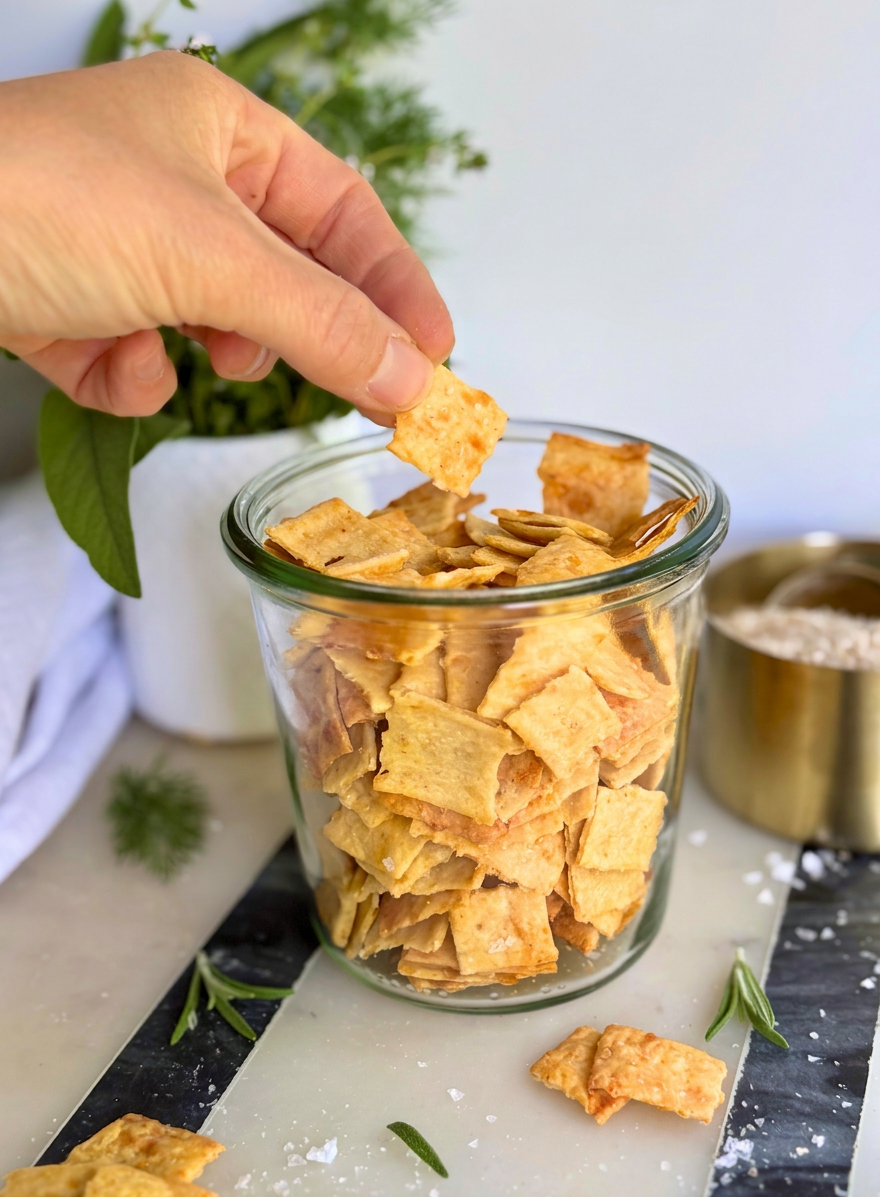
Crispy, cheesy, and completely snackable, these cottage cheese crackers are the homemade Cheez-It you never knew you needed. Blended cottage cheese and extra sharp cheddar come together in a dough that rolls thin, bakes golden, and snaps with every bite. Make them with sourdough for a little fermented depth or keep it classic with no sourdough at all. Either way you get nearly double the protein of a standard cracker, no protein powder, no additives, and no compromise on crunch.
Table of Contents
- Why I Made These
- What Makes These Different
- Ingredients
- Cheese Variations
- Fermentation Options
- How to Make Cottage Cheese Crackers
- Sourdough Recipe
- Classic Version, No Sourdough
- Tips for the Crispiest Crackers
- Storage
- FAQ
- Macros and Nutrition
- Shop This Recipe
- More Recipes You Will Love
- Subscribe
Why I Made These

My family snacks constantly. Three boys, a kitchen that never fully closes, and a snack drawer that empties faster than I can restock it. I have been on a quiet mission lately to take the snacks we already love and make them work a little harder. Not in a way that changes what they are, not in a way that feels like a compromise. Just real food swaps that keep everyone fuller a little longer and add something meaningful to the ingredient list.
Crackers felt like the obvious next target. We go through them fast, and the box stuff is mostly flour, oil, and salt with not much else to show for it. I started thinking about what I could swap in that would actually do something, and cottage cheese kept coming back as the answer. It is high in protein, it blends completely smooth, and it works as a binder in doughs in a way that butter cannot fully replicate.
I had sourdough in the fridge so my first batch went that route, but I wanted these to work for everyone, so I tested a classic version with no sourdough too. Both are excellent. My boys demolished the first batch before I even finished photographing them, which is the only review that matters in this house.
What Makes These Different
Most homemade cheese cracker recipes follow the same formula: butter, cheddar, flour, salt. That is a great cracker. But cottage cheese changes the game in a few meaningful ways.
It replaces most of the butter. Traditional crackers lean heavily on butter. Here, full fat cottage cheese takes over as the primary fat and moisture source. The result is a cracker with real substance and a satisfying snap that holds up whether you eat them straight, pile them with something, or toss them into a bowl and walk away with it.
It nearly doubles the protein of a standard cracker. A traditional cracker made with butter comes in around 2 to 3 grams of protein per 28g serving. These land at 5 grams with fewer calories and fewer carbs. No protein powder, no supplements, just cottage cheese and cheddar doing what they do. For reference on what a truly high protein bake looks like, check out my High Protein Sourdough Cinnamon Rolls or High Protein Yeasted Cinnamon Rolls. These crackers are not in that category, but for a snack cracker the difference is real and it shows up in how long a handful actually keeps you going.
The flavor is clean. No weird aftertaste, no compromise on the cheesy, salty, addictive quality you want from a homemade Cheez-It. The cottage cheese is invisible in the finished cracker. Nobody will know it is in there unless you tell them.
Ingredients
Full fat cottage cheese (4%): Blended completely smooth before it goes into the dough. Full fat is important here. Low fat cottage cheese contains more added water, which makes the dough stickier and harder to crisp up. I use Good Foods 4% cottage cheese.
Extra sharp cheddar: Grated from a block, never the pre shredded kind. Bagged shredded cheese contains anti caking agents that interfere with the dough texture and how the cheese melts into the cracker. I use Kirkland grass fed sharp cheddar from Costco.
Unsalted butter: A small amount, just enough to support the fat structure alongside the cottage cheese and help with the final crispiness.
All-purpose flour: The base. Bread flour is an equal 1 to 1 substitute and will give you a marginally sturdier, crispier cracker thanks to its higher protein content.
Sourdough (optional): Discard or active peak starter both work here and are interchangeable, so use whatever you have on hand. Sourdough adds a subtle fermented depth and helps the dough come together. It is completely optional. If you want to skip it entirely, see the classic version section below. If you want to build and maintain a starter, my Complete Sourdough Starter Guide walks you through everything from scratch.
Seasonings: Kosher salt, garlic powder, dry mustard powder, and smoked paprika. The mustard powder in particular adds a depth that makes these taste like they came from a box, in the best way.
Flaky sea salt for topping: Do not skip this. It is the finishing touch that makes every cracker look intentional and taste complete.

Cheese Variations
Extra sharp cheddar is the classic choice and gives you the most Cheez-It like result, but this dough is a great base for experimenting. A few combinations worth trying:
Gruyere: Nutty, slightly sweet, melts beautifully into the dough. Pairs really well with the mustard powder already in the recipe.
Pepper jack: Adds heat and a little smokiness. Great if your family likes a spicier snack.
Smoked gouda: Smoky, rich, and a little different. Cut back on the smoked paprika if you go this route since the cheese brings that flavor on its own.
Parmesan: A harder, saltier option. Works well either as the sole cheese or mixed in equal parts with cheddar.
Colby jack: Milder than extra sharp cheddar, good for kids or anyone who wants a less intense cheese flavor.
Whatever cheese you use, grate it yourself from a block for the best result.
Fermentation Options

If you are making the sourdough version, you have two solid options depending on how much time you have.
Quick chill: Make the dough, divide it into four portions, wrap tightly, and refrigerate for a minimum of 45 minutes to 1 hour. The dough will be firm enough to roll and the flavors will be good. This is a great same day option when a cracker craving strikes and you want to move fast.
Overnight long ferment: Refrigerate the wrapped dough for 12 to 48 hours. This is where the magic happens. The longer the dough ferments, the deeper the flavor gets, and the fermentation benefits from the sourdough culture have more time to develop. If you have the patience, the overnight version is noticeably better.
Discard and active peak starter are interchangeable here, so reach for whichever you have. Active starter adds a slightly more pronounced flavor and a little extra lift, which in a thin cracker translates to a barely there airiness at the center. Both work beautifully.
How to Make Cottage Cheese Crackers
Step 1: Blend the cottage cheese
Add the cottage cheese to a small blender or personal blender and blend for about 60 seconds until completely smooth with no visible curds. It should look like thick sour cream. This step is non negotiable. If the curds stay intact they will create inconsistencies in the dough and affect the final texture of the crackers.
Step 2: Make the dough
Add the blended cottage cheese, finely grated cheddar, softened butter, and sourdough if using to a food processor. Pulse 8 to 10 times until everything comes together. Add the flour, salt, garlic powder, mustard powder, and smoked paprika. Pulse until the dough just comes together into a shaggy ball. Do not overmix. Overworked dough develops too much gluten and produces a tough cracker instead of a crispy one.
Step 3: Divide and chill
Turn the dough out onto a lightly floured surface and divide it in half, then cut each half in half again so you have four equal portions. Working in four smaller portions gives you much better control, especially if you are using a pasta machine. Press each portion into a flat disc, wrap tightly in plastic wrap, and refrigerate for at least 45 minutes or up to 48 hours.
Step 4: Preheat
Standard oven: 375 degrees F. Convection oven: 350 degrees F. The convection fan circulates heat actively, so you do not need the extra temperature on top of it. Line two quarter sheet pans with parchment paper.

Step 5: Rest and roll
Remove one dough portion from the refrigerator and let it rest at room temperature for 15 minutes before rolling. This relaxes the gluten and makes the dough cooperative. Keep the remaining portions cold until you are ready for them.
Make sure your surface and the dough are well floured.
If you are using a pasta machine: start at setting 1, then 3, then 5. Lightly flour the dough before each pass to prevent sticking. The dough comes out in long narrow sheets that you can layer onto your parchment lined pan.
If you are rolling by hand: roll between two sheets of parchment paper with plastic wrap on top so it peels off cleanly. Roll as thin as you possibly can. 1/16 inch is the goal. Thinner means crispier. If the dough springs back while you are rolling, cover it and let it rest for another 5 minutes before continuing.

Step 6: Cut and dock
Transfer the rolled dough, still on the parchment, to your quarter sheet pan. Use a pizza cutter or pastry wheel to score the dough into 1 inch squares. Separate each cracker slightly for crispier edges. Dock every cracker with a fork, 2 to 3 pokes per square, to prevent puffing during baking. Sprinkle with flaky sea salt.
Step 7: Bake
Bake for 15 to 20 minutes until golden and the edges are just starting to deepen in color. Start checking at 15 minutes. Ovens that run hot will finish closer to 15, while cooler ovens may need the full 20. Edge crackers always finish before center ones. Pull any that are done and return the rest to finish baking. Repeat with the remaining dough portions.

Step 8: The oven off trick
Turn the oven off and leave the crackers inside for an additional 5 minutes as the oven cools down. This pulls out any remaining moisture without letting them brown too much. Watch closely if you are using convection. The retained heat is more intense and 5 minutes is all you need.
Step 9: Cool completely
Transfer to a wire rack and cool for at least 15 minutes before eating or storing. The crackers continue to crisp as they cool. Do not store them warm or they will steam themselves soft in the container.
Recipe

Crispy Cottage Cheese Crackers
Equipment
- Food processor pastry cutter
- Small blender
- Rolling Pin Pasta machine
- Quarter sheet pans
- Parchment paper
- Pizza cutter or pastry wheel
- fork
- Wire cooling rack
Ingredients
- 113 grams full fat cottage cheese blended smooth (1/2 cup)
- 113 grams extra sharp cheddar finely grated (1 cup)
- 28 grams unsalted butter softened (2 tablespoons)
- 120 grams all-purpose flour 1 cup
- 100 grams sourdough discard or active starter scant 1/2 cup
- 1.5 grams kosher salt 1/2 teaspoon
- garlic powder 1/2 teaspoon
- dry mustard powder 1/4 teaspoon
- smoked paprika 1/4 teaspoon
- flaky sea salt for topping 1 teaspoon
Instructions
- Add the cottage cheese to a small blender and blend for about 60 seconds until completely smooth with no visible curds. It should look like thick sour cream. Smooth cottage cheese keeps the dough consistent and the texture even.
- Add the blended cottage cheese, grated cheddar, softened butter, and sourdough to a food processor. Pulse 8 to 10 times until combined. Add the flour, kosher salt, garlic powder, mustard powder, and smoked paprika. Pulse just until the dough comes together into a shaggy ball. Do not overmix or the crackers will be tough.
- Turn the dough out and divide it in half, then cut each half in half again so you have four equal portions. Working in smaller portions gives you better control when rolling. Press each into a flat disc, wrap tightly, and refrigerate for at least 45 minutes or up to 48 hours.
- For a standard oven, preheat to 375 degrees F. For a convection oven, preheat to 350 degrees F since the fan circulates heat. Line two quarter sheet pans with parchment paper.
- Remove one dough portion and let it rest at room temperature for 15 minutes before rolling. This relaxes the gluten and makes the dough easier to work with. Keep the other portions cold.
- You have two options to roll out your dough. Use a pasta machine or use a rolling pin by hand. Both are simple it just depends on your preference.
To Use a Pasta Machine for Rolling
- Flour the dough well. Using a pasta machine, start at setting 1, then 3, then 5, flouring lightly before each pass. To roll by hand, roll between two sheets of parchment as thin as possible, about 1/16 inch. Thinner dough makes crispier crackers.
To Roll By Hand
- Flour the dough and place the dough between two sheets of parchment paper and roll it out as thin as you possibly can, about 1/16 inch. Thinner dough makes crispier crackers, so do not be afraid to really work it out.
Continue for both methods
- Transfer the rolled dough on the parchment to a sheet pan. Score into 1 inch squares with a pizza cutter or pastry wheel and separate each cracker slightly for crispier edges. Dock each cracker with a fork 2 to 3 times to prevent puffing. Sprinkle with flaky sea salt.
- Bake for 15 to 20 minutes until golden and the edges begin to deepen in color. Start checking at 15 minutes. Pull any crackers that finish early and return the rest to the oven. Repeat with the remaining dough.
- Turn the oven off and leave the crackers inside for 5 more minutes to pull out the last of the moisture. Watch closely on convection since the retained heat is more intense.
- Transfer to a wire rack and cool completely. The crackers continue to crisp as they cool. Do not store them warm or they will steam soft.
Notes
Classic Version, No Sourdough
No sourdough? No problem. These crackers are just as crispy and delicious without it. Here is exactly what changes:
- Omit the sourdough entirely
- Increase the cottage cheese by 50g, blended smooth as always
- Increase the all-purpose flour by 50g
That is the only adjustment. The extra cottage cheese and flour replace the moisture and structure the sourdough would have provided, so your dough comes together the same way and rolls out beautifully.
When you mix the dough in the food processor, simply add the blended cottage cheese, cheddar, and butter, then pulse and continue with the dry ingredients exactly as written. There is no sourdough to add.
The one thing you can skip is the long ferment. Since there is no sourdough culture to develop, you do not need the overnight rest. Just chill the wrapped dough for 45 minutes to 1 hour to firm it up and make it easy to roll, then pick right back up at the rest and roll step. Everything from there is identical.
The flavor will be slightly milder without the fermented note, but the crackers will be every bit as crispy, cheesy, and snackable.
Tips for the Crispiest Crackers

Roll thin. This is the single most important factor. Aim for 1/16 inch. The pasta machine makes this easy and consistent. If you are rolling by hand, go thinner than you think you need to.
Use full fat cottage cheese. Low fat versions have more added water and fight against crispiness at every step.
Chill the dough. Do not try to rush this step. Cold dough is manageable dough. Warm dough sticks, tears, and does not roll evenly.
Rest before rolling. After the dough comes out of the refrigerator, give it 15 minutes before you start rolling. Cold dough straight from the fridge is too stiff and will spring back on you.
Dock every cracker. Those fork holes are doing real work. Skip them and you will have puffy, uneven crackers instead of flat crispy ones.
Separate the crackers before baking. Leaving a little space between each square helps the edges crisp up all the way around.
Use convection if you have it. Drop the temperature to 350 degrees F and let the fan do the work. The circulating air pulls moisture out of the crackers and produces a more even bake.
Do not skip the cool. Crackers finish crisping on the wire rack after they come out of the oven. Give them time.
Storage

Store completely cooled crackers in an airtight container at room temperature for up to 5 days. A Weck jar or any glass container with a tight seal works beautifully and looks great on the counter. I kept a jar out specifically to test how they held up, and even on day three they were still perfectly crisp.
If they do soften slightly over time, and humidity is the enemy of crackers, spread them on a baking sheet and warm at 350 degrees F for 5 minutes, then cool completely on a wire rack. They will come right back to crispy.
The unbaked dough keeps in the refrigerator for up to 48 hours, which means you can make a batch of dough on Sunday and bake fresh crackers throughout the week in small portions. This is genuinely one of the best things about this recipe.
FAQ
Do I need sourdough to make these?
No. The sourdough is completely optional. To make the classic version, omit it and add an extra 50g of blended cottage cheese and 50g of all-purpose flour. See the classic version section above for the full adjustment.
Can I use discard or active starter?
Either one. Discard and active peak starter are interchangeable in this recipe, so use whatever you have. Active starter adds a slightly more pronounced fermented flavor.
Can I make these gluten free?
Yes. A 1 to 1 gluten free flour blend is an equal substitute for the all-purpose flour in this recipe. Bob’s Red Mill 1 to 1 Baking Flour works well.
Can I use a different cheese?
Yes. Gruyere, pepper jack, smoked gouda, parmesan, and colby jack all work. See the cheese variations section above for more detail. Always grate from a block.
My dough is too sticky to roll. What do I do?
Add flour one tablespoon at a time until the dough is manageable. Different brands of cottage cheese have different moisture levels and your sourdough hydration can vary too. A slightly drier dough is easier to work with and still produces a great cracker.
How long do they stay crisp?
Stored in an airtight container at room temperature, they stay crisp for days. I tested a jar and they were still crisp on day three. If they ever soften, a quick 5 minute warm up in a 350 degree oven brings them right back.
Can I freeze the baked crackers?
The baked crackers are best kept at room temperature. Freezing can affect the texture and crispiness when they thaw.
Macros and Nutrition
Here is how these crackers stack up against a standard store bought cheese cracker, measured per 28 gram serving, which is about one ounce or a generous handful.
These cottage cheese crackers, per 28 grams: around 105 calories, 5 grams of protein, 5 grams of fat, and 10 grams of carbohydrates.
A standard store bought cheese cracker, per 28 grams: around 150 calories, 2-3 grams of protein, 8 grams of fat, and 17 grams of carbohydrates.
That works out to roughly 60-67 percent more protein, about 30 percent fewer calories, and close to 40 percent fewer carbs, all from real food with no protein powder and no additives. The cottage cheese and cheddar do the heavy lifting, which is exactly why a handful of these holds you over better than the box version.
These numbers are calculated estimates based on the specific brands I use, so your exact macros will shift a little depending on the cottage cheese, cheese, and flour you choose. If you track closely, run your ingredients through your favorite nutrition calculator for numbers tailored to your kitchen.
Shop This Recipe
These are the tools I reach for every time I make a batch. A few of them do real work toward getting that crispy, even result.
Food processor makes the dough come together in seconds and blends everything evenly without overworking it. I also use it to get the cottage cheese completely smooth. Budget Friendly Model or Higher End Model I’ve used both in the past and haven’t had problems with either!
Pasta roller is my secret weapon for thin, even crackers and it is surprisingly inexpensive at around $30. It gives you consistent thickness every time, which is the key to even crisping. You do not need it since you can hand roll, but it makes the job faster and more uniform.
Rolling pin is all you need if you are skipping the pasta roller. Roll between parchment for the easiest handling.
Parchment paper keeps the crackers from sticking and makes transferring the rolled dough to the pan simple.
Quarter sheet pans are the right size for this recipe and bake the crackers evenly.
Pastry wheel gives you those clean scored squares, though a pizza cutter works just as well.
Wire cooling rack lets air circulate underneath so the crackers finish crisping as they cool.
Flaky sea salt is the finishing touch on top that makes every cracker taste complete.
Weck jars are my favorite way to store them. They keep the crackers crisp and look beautiful on the counter.
More Recipes You Will Love
If you love a snack that puts simple ingredients to good use, here are a few more worth bookmarking:
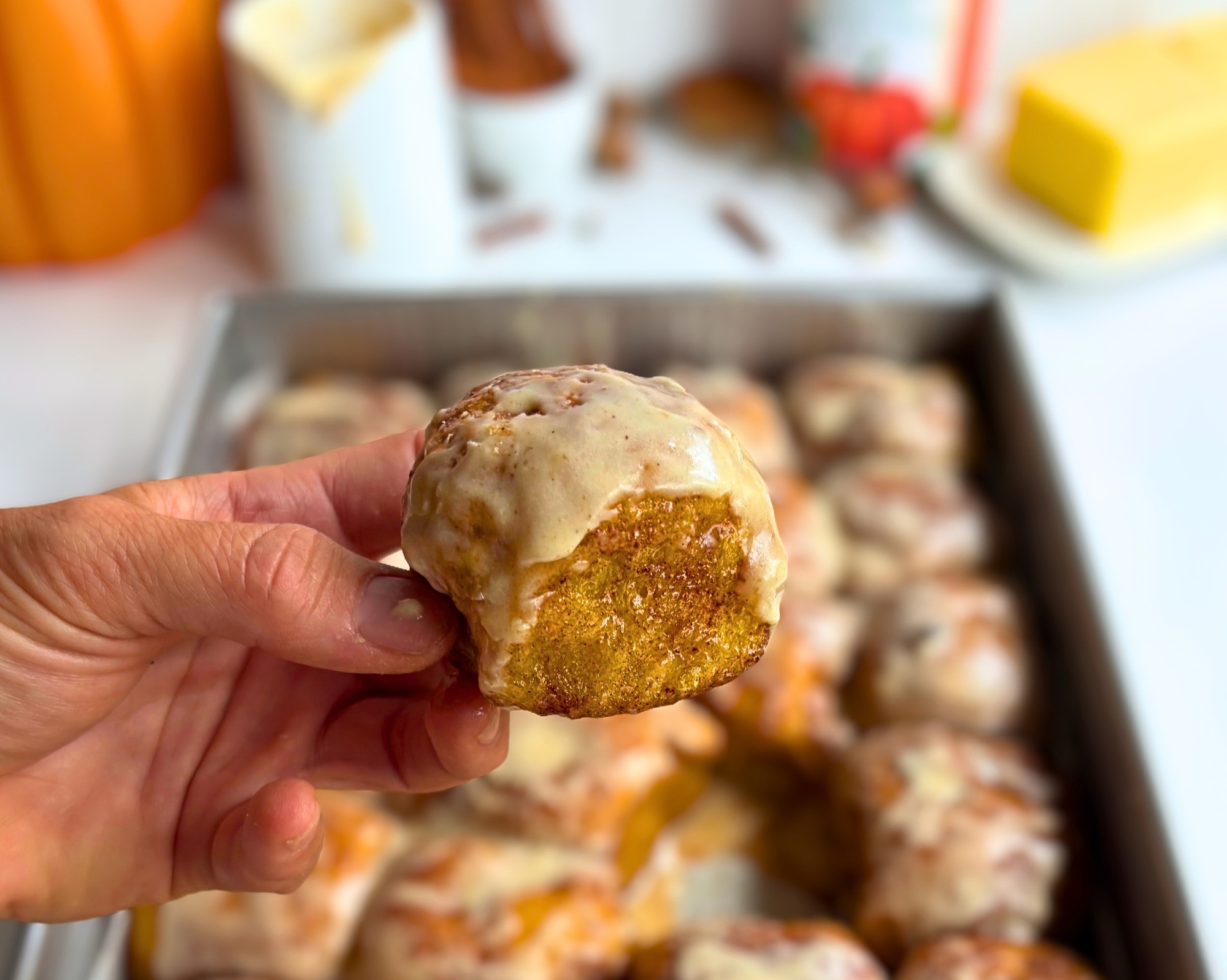
High Protein Sourdough Cinnamon Rolls are long fermented, pillowy and gooey with a silky cream cheese glaze, and pack 12 grams of protein per roll.
The High Protein Yeasted Cinnamon Rolls are the same concept with a same day timeline and no starter required.
If you are new to sourdough, How to Create a Thriving Sourdough Starter walks you through everything from scratch with minimal waste and maximum flavor.
Subscribe
Want new recipes straight to your inbox every week? From high protein bakes to sweet treats to hearty meals, I share something new every week. No spam, ever, and I will never sell your information. Just good food delivered straight to you.


This post contains affiliate links. If you click through and make a purchase, it costs you nothing extra, but it does help support the recipes I create here at H3art of the Home. Thank you for being here.




Leave a Reply