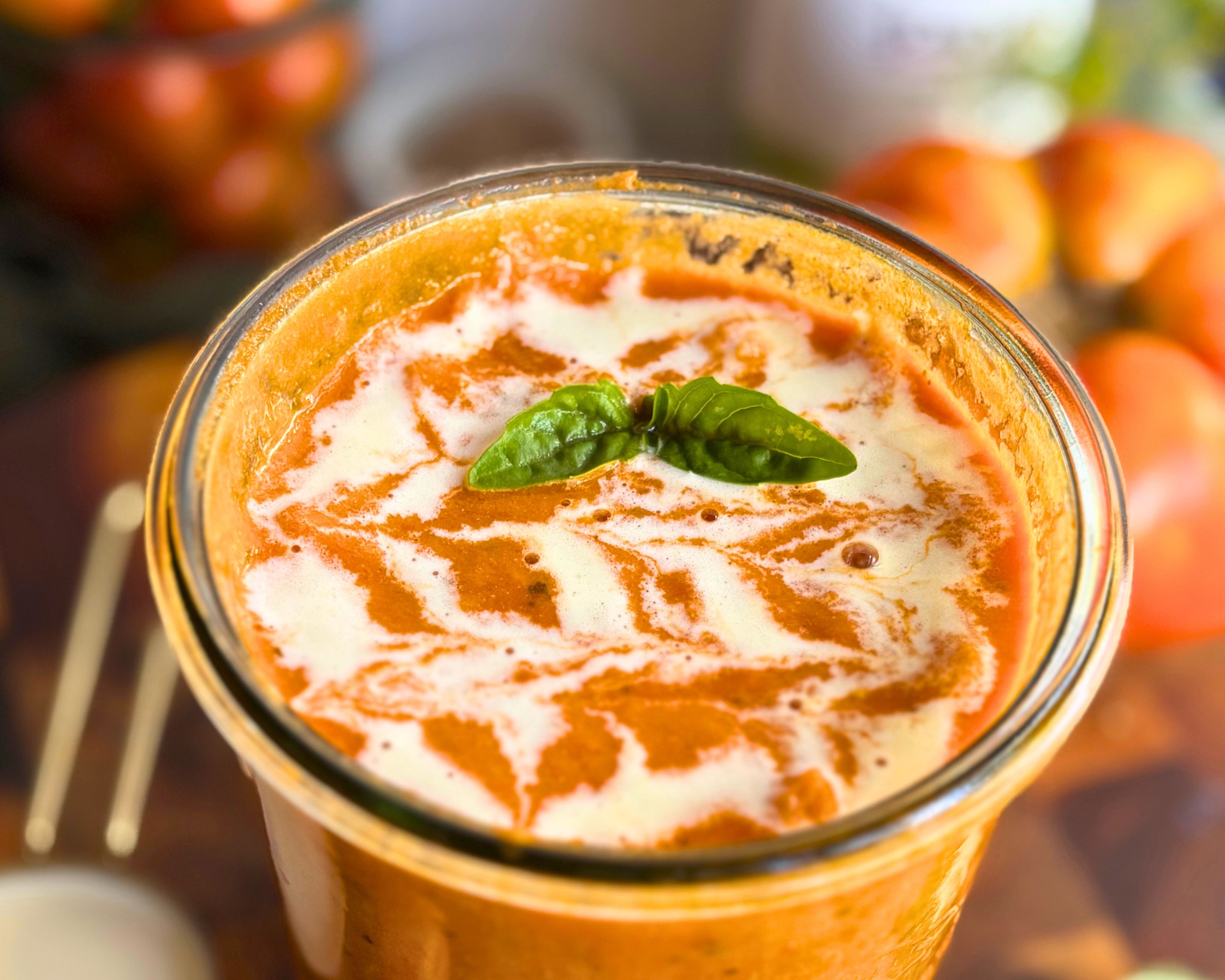
I like a thick soup. Not a bowl of hot tomato water with a swirl of cream on top pretending to be dinner, but something with actual body, something that coats the back of the spoon and holds a drizzle without swallowing it. And for years the only ways I knew to get there were a roux, a handful of torn bread, a spoonful of cornstarch, or so much heavy cream that the tomatoes stopped tasting like tomatoes.
None of that is happening here.
The oven does it instead. When you roast tomatoes in a hot oven, an enormous amount of water evaporates right out of them, and what stays behind is concentrated, sweet, and thick on its own. You are not thickening anything. You are just removing what you did not want in the first place. By the time the pan comes out, the sauce is already the consistency most recipes are fighting to reach after twenty minutes of simmering with broth.
Then a splash of half and half turns it into soup, and it is the best tomato soup I make. No broth, no pot, no thickener, and no second cooking step.
Table of Contents
- Thick Tomato Soup Without a Thickener
- The Best Tomatoes to Use
- Why an 8×8 Pan
- Why You Keep the Skins and the Seeds
- Why Roast Hot and Fast
- Blending in the Jar
- How Much Cream to Add
- The Whipped Cream Topping
- Variations and Substitutions
- What to Serve With It
- Storage and Freezing
- Frequently Asked Questions
- Recipe
Thick Tomato Soup Without a Thickener
Almost every roasted tomato soup recipe you will find sends you to the stove with two cups of broth and tells you to simmer for twenty minutes. Think about what that actually is. You add a large volume of water, and then you spend twenty minutes trying to boil that same water back off.
Skipping the broth entirely means skipping both halves of that problem. The tomatoes come out of the oven already reduced, so there is nothing to cook down, and the flavor stays purely tomato instead of turning into tomato and chicken stock.
It also means the soup is thick because of the tomatoes, not in spite of them. Roux thickens by coating your tongue in fat and flour. Torn bread thickens by adding starch that dulls the brightness. Cornstarch thickens by turning things faintly gluey. Evaporation thickens by taking away water and leaving flavor behind, which is the only method that makes the soup taste more like itself instead of less.
The half and half is doing a different job. It is not there for body, it is there to round the acidity and give the soup that velvety mouthfeel. A quarter cup is plenty.
The Best Tomatoes to Use
Whatever ripened this week.
This soup is not fussy about varieties. The batch in these photos is a mix of cherry tomatoes, little yellow and orange ones, a couple of dark heirlooms, and larger slicers cut into wedges. The mix is an advantage. Cherry tomatoes bring concentrated sweetness, big slicers bring body, and the dark varieties bring a savory depth underneath all of it.

Paste tomatoes like Roma and San Marzano give you the thickest result, since they have more flesh and less water to begin with. If you are growing them, use them here.
Slicing tomatoes and heirlooms are juicier and will give you a slightly looser soup. The oven handles most of that.
Cherry and grape tomatoes are excellent and their skins are so thin you will never find them once the soup is blended.
Do not peel and do not seed. The skins soften completely and carry a lot of the color and flavor, and the seeds vanish under the blender. Peeling is a canning habit and it has no business here.
Ripeness is the only thing that actually matters. Roasting concentrates whatever flavor is already in the fruit, so a pale winter tomato just gives you concentrated pale. In the off season, skip fresh entirely and reach for canned. There is a note in the FAQ on how to adjust.
Why an 8×8 Pan
A sheet pan is the standard call for roasted tomato soup, and it is the wrong tool for a batch this size.
Sheet pans spread a small amount of fruit into a thin layer. The tomatoes at the edges dry out and go leathery, the juices run thin across all that surface area and scorch onto the metal, and the exact liquid you are trying to concentrate is the thing you lose.

The 8×8 keeps everything close and deep. The tomatoes on top steam gently while the ones underneath sit in their own juice and reduce, and the onion softens rather than burning. What comes out is a pan of collapsed fruit sitting in a shallow pool of thick orange juice, and that pool is your soup. Nothing is lost to the pan.
It also removes the math. Fill the pan, stop. No scale, no measuring, no wondering whether you have enough.
Why You Keep the Skins and the Seeds
This soup has no broth in it and no thickener, which means every bit of body in the bowl has to come from the tomatoes themselves. That is the first reason nothing gets peeled or seeded here. The second reason is that the parts most recipes tell you to throw away are the parts carrying the flavor.
The savory depth in a tomato comes mostly from glutamic acid and a group of compounds called ribonucleotides, the same family of compounds behind the savory pull of parmesan and mushrooms. Food scientists at the University of Reading measured where they sit inside the fruit, across thirteen different varieties, and found they are not distributed evenly. The inner pulp, meaning the seeds and the gel around them, held about 4.56 grams of glutamic acid per kilogram against 1.26 in the outer flesh. That is roughly three times as much sitting in the part that usually goes into the sink, and in some varieties the difference ran past six fold. One of the researchers put the gap between the seeds themselves and the flesh at closer to eight fold.
This matters more in soup than it does in sauce. A sauce goes onto pizza or pasta where cheese, crust, and salt are all contributing. A bowl of tomato soup has nowhere to hide, and since there is no stock here doing the savory work for you, that concentrated pulp is most of what stands between a soup that tastes deep and a soup that tastes like warm tomato juice with cream stirred through it.
The skins are doing a different job. They carry pectin and most of the color, so they are the reason the finished soup is thick enough to coat a spoon and holds a deep red instead of turning a thin pale pink once the cream goes in. Peeling tomatoes is a canning habit, carried over from long processing times where skins can toughen and separate. Nothing here cooks long enough for that to be a concern.
The hot oven and the immersion blender are what let you get away with keeping all of it. Thirty five minutes at 425 softens the skins until they collapse instead of tearing, and the blender takes them the rest of the way. For soup I blend longer than I do for sauce, closer to a full minute, because a velvety texture is the whole point of the bowl and the extra time leaves you with something completely smooth.
You can strain it through a fine mesh sieve if you want, and it will still be good. It will also be thinner, paler, and noticeably less savory, and you will have given away the body you were counting on the tomatoes to provide.
Why Roast Hot and Fast
Plenty of recipes call for 250 or 300 degrees over three or four hours. That produces a lovely jammy result and if you have the afternoon, enjoy it.
At 425 degrees you get two things you cannot get low and slow. The first is browning. High heat caramelizes the edges of the tomatoes and the cut faces of the onion, and that browning is where the savory backbone of the soup comes from. The second is speed of evaporation. You drive off the water in thirty five minutes rather than half a day, which matters when this is a weeknight dinner and not a project.

You want collapsed tomatoes, skins that have split and pulled back, and genuinely dark spots on the onion and around the edges of the pan. Do not pull it early trying to keep things pretty. Those dark spots are the flavor.
Blending in the Jar
Scrape the whole pan into a half gallon jar, juices and all, and blend it right there with an immersion blender.

The jar becomes the pot, the blender carafe, and the storage container all at once. One thing to wash. It just needs to be tall enough that the blender head sits under the surface and wide enough for the shaft to fit, and a half gallon Ball jar is ideal.
For soup I blend longer than I would for sauce. Thirty seconds to a minute plus, gets you smooth and velvety, which is what you want in a bowl. If you like a rustic soup with visible texture, stop sooner.
No immersion blender is not a dealbreaker. A countertop blender or food processor works, just let things cool a little first so you are not trapping steam under a sealed lid.
How Much Cream to Add
Start with a quarter cup of half and half and taste from there.

A quarter cup gives you a soup that still tastes assertively of tomato with the sharp edge of the acidity smoothed off. A half cup gives you something rounder, milder, and closer to the creamy tomato soup most people picture. Both are good and it depends entirely on what you want that day.
For something lighter, cut the half and half with whole milk, half of each. You lose a little richness and none of the body, because remember the body was never coming from the dairy in the first place.
Stir the cream in off the heat once the soup is blended. It does not need to cook.
The Whipped Cream Topping
This is the part that makes it look like it came out of a restaurant kitchen, and it takes about a minute with no equipment whatsoever.
Pour a little heavy whipping cream into a Ziploc bag. Twist the bag so the cream gathers into a small ball at one corner, then shake it back and forth for about a minute. That is it. The cream comes out lightly whipped, thick enough to hold a line but still loose enough to drizzle.

Snip a tiny corner off the bag and you have a piping bag. Drizzle it in a spiral, then drag a toothpick or the tip of a knife through it from the center outward to feather it, or leave the spiral as it is.

The reason to do it this way rather than pouring straight cream is that lightly whipped cream sits on the surface instead of sinking and disappearing. It stays where you put it long enough to actually eat it.
Variations and Substitutions
Thin it with bone broth. If you want a looser soup, chicken or beef bone broth is the way to do it. You can add a splash alongside the cream, or use bone broth in place of the cream entirely for a lighter soup that still has real depth. Add it slowly, since you cannot take it back out.
White balsamic instead of regular. Same brightness, none of the darkening, so the soup stays a vivid orange red rather than deepening toward brown. Worth it if you are serving this to people.
Crushed red pepper flake. Add it before roasting so it blooms in the oil and spreads evenly, or stir it in at the end for a sharper hit.
More oregano. Double it if you want the soup to lean more classic Italian.
Fresh herb swaps. Thyme and rosemary both roast well with tomatoes. Rosemary is loud, so use less than feels right.
What to Serve With It
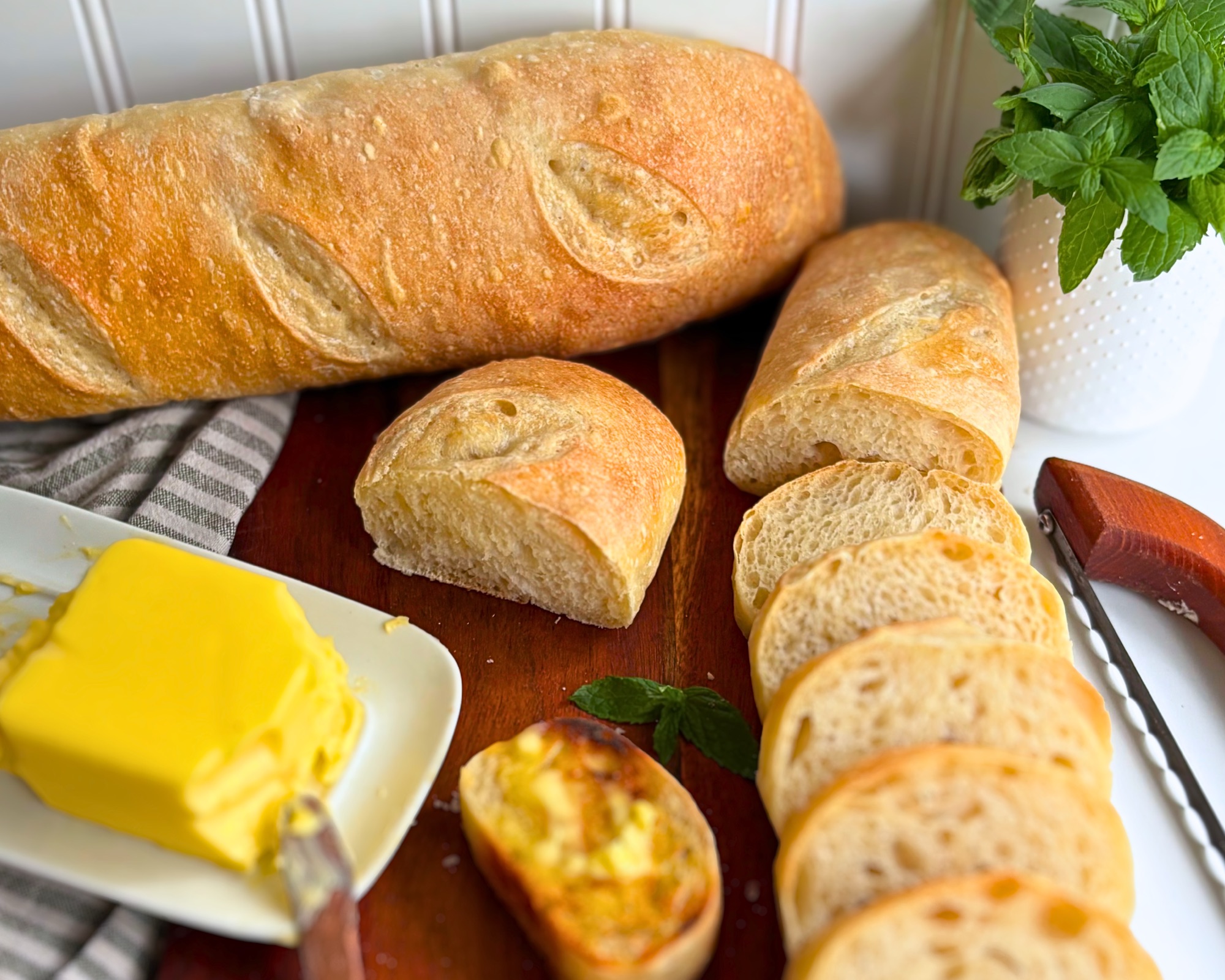
Bread, obviously. I use my regular sourdough, sliced thick and toasted with a little olive oil, and the possibilities really do run out only when you get bored.

Sourdough. A thick slice, toasted, brushed with olive oil. It holds up to dunking without collapsing. Get my recipe HERE!
Focaccia. Torn straight off the pan and dipped is one of the better dinners available to a person. My Same Day Focaccia is ready in about four hours with no starter required, and the Sourdough Focaccia is the overnight version if you have one going.
Grilled cheese. The classic pairing for a reason, and this soup is thick enough to stand up to it.
Croutons or parmesan. Both give you texture against all that velvet.
If you want the sauce this soup is built on, without the cream, that is written up separately in my SMALL BATCH ROASTED GARDEN TOMATO SAUCE It is the same pan of roasted tomatoes headed toward pizza and pasta instead of a bowl.
Storage and Freezing
Refrigerator. Four to five days in a sealed jar. It thickens as it chills, so thin it with a splash of milk or broth when you reheat.
Reheating. Low and slow on the stove, stirring now and then. Dairy splits if you blast it, so keep it well under a boil.
Freezer. Freeze the sauce base without the cream, then add the cream fresh when you reheat. Dairy can go grainy after freezing and thawing, and the base freezes perfectly for up to three months. Leave an inch of headspace at the top of the jar and use a straight sided jar so the glass is not fighting a shoulder.
Not for canning. This has not been tested for water bath canning and should not be canned. Safe tomato canning requires added acid in tested amounts to bring the pH into a safe range, and the onion, oil and dairy here all change that equation. Fridge or freezer only.
Frequently Asked Questions
Can I make tomato soup without broth?
Yes, and this recipe is built that way on purpose. Roasting removes enough water from the tomatoes that they blend into soup on their own, so there is nothing to thin and nothing to cook back down. Skipping the broth also keeps the flavor purely tomato instead of tomato and stock.
Why is my tomato soup thin?
Either the tomatoes were very juicy varieties or they did not roast long enough. Give the pan another ten minutes next time and look for genuinely collapsed fruit with dark edges. To fix a batch you have already blended, simmer it uncovered in a saucepan for ten to fifteen minutes before adding the cream.
Do I have to peel the tomatoes?
No. The skins soften completely in the oven and disappear under the blender. Peeling is a step borrowed from canning and it is not needed here.
Can I use heavy cream instead of half and half?
Yes, and it will be richer. Start with less, about two tablespoons, and work up, because heavy cream mutes the tomato faster than half and half does.
Can I make this dairy free?
Yes. Use bone broth or a splash of full fat coconut milk in place of the cream, or leave the dairy out entirely. The soup is already thick without it, which is the whole point.
Can I use canned tomatoes?
Yes, and out of season it is the better choice. Use a 28 ounce can of whole San Marzano tomatoes, drain off some of the packing liquid, and roast them with the onion, garlic and herbs for about 20 minutes to brown the edges. Then blend and add the cream the same way.
Why is my soup orange instead of deep red?
Yellow and orange tomato varieties lighten the whole batch, and the immersion blender whips air into the soup, which lifts the color further. Both are normal. It settles and deepens as it sits.
Recipe

Small Batch Roasted Tomato Soup
Equipment
- 8×8 glass baking dish
- Half gallon wide mouth jar
- Immersion blender
- Quart size zip top bag
- Cutting board and sharp knife
Ingredients
- 1000 grams mixed ripe tomatoes enough to fill an 8×8 pan (about 2 to 2.5 pounds)
- 150 grams sweet onion 1 medium onion, cut into wedges
- 16 grams garlic 4 cloves, peeled and left whole
- 40 grams extra virgin olive oil 3 tablespoons
- 6 grams fresh basil leaves left whole (1/4 cup)
- 8 grams fresh parsley chopped (2 tablespoons)
- 1 gram dried oregano 1 teaspoon
- 16 grams balsamic vinegar 1 tablespoon
- 13 grams granulated sugar 1 tablespoon
- 6 grams fine sea salt 1 teaspoon
- freshly ground black pepper to taste
- 60 grams half and half 1/4 cup
- 30 grams heavy whipping cream for topping 2 tablespoons
Instructions
- Preheat your oven to 425 degrees Fahrenheit.
- Cut the larger tomatoes into thick wedges and halve the cherry tomatoes, leaving the smallest ones whole. Do not peel or seed anything, since the skins soften completely and the seeds disappear under the blender.
- Fill the 8×8 dish with the tomatoes, packing them in snugly and slightly mounded, because everything collapses as it roasts.
- Tuck the onion wedges and whole garlic cloves in among the tomatoes, then scatter the basil leaves and chopped parsley over the top.
- Drizzle the olive oil evenly over everything and sprinkle with the dried oregano. Dried herbs go in before roasting because they hold up to high heat and bloom in the oil.
- Roast for 35 minutes, until the tomatoes have collapsed, the skins have split and pulled back, and the onion edges have darkened. Those browned edges are where the savory depth comes from, so let them happen.
- Scrape the entire contents of the pan into a half gallon jar, juices and all. That liquid has already reduced in the oven, which is what makes this soup thick without any thickener.
- Blend with an immersion blender for 30 seconds to a minute, until smooth and velvety. Blend less if you want a rustic soup with visible texture.
- Stir in the balsamic vinegar, sugar, salt and black pepper. Taste and adjust, since tomato acidity swings widely depending on variety and ripeness.
- Stir in the half and half off the heat. Start with the full quarter cup, then taste and add more if you want a milder, rounder soup.
- Pour the heavy whipping cream into a zip top bag, twist the bag so the cream gathers into a small ball in one corner, and shake it back and forth for about a minute until it thickens into a light whip.
- Snip a small corner off the bag and drizzle the whipped cream over the soup in a spiral. Drag a toothpick through it from the center outward to feather the pattern, or leave the spiral as it is.
- Serve warm with thick sliced sourdough for dipping.
Notes
If you make this soup I want to hear how thick you got it and what tomatoes you used, because every garden hands you a different mix. Leave a comment below and tell me.
Tag me on Instagram at @h3artofthehome when you make it. I share them.
Subscribe
Sign up for my newsletter and new recipes come straight to your inbox, including the rest of my summer garden series.





Leave a Reply