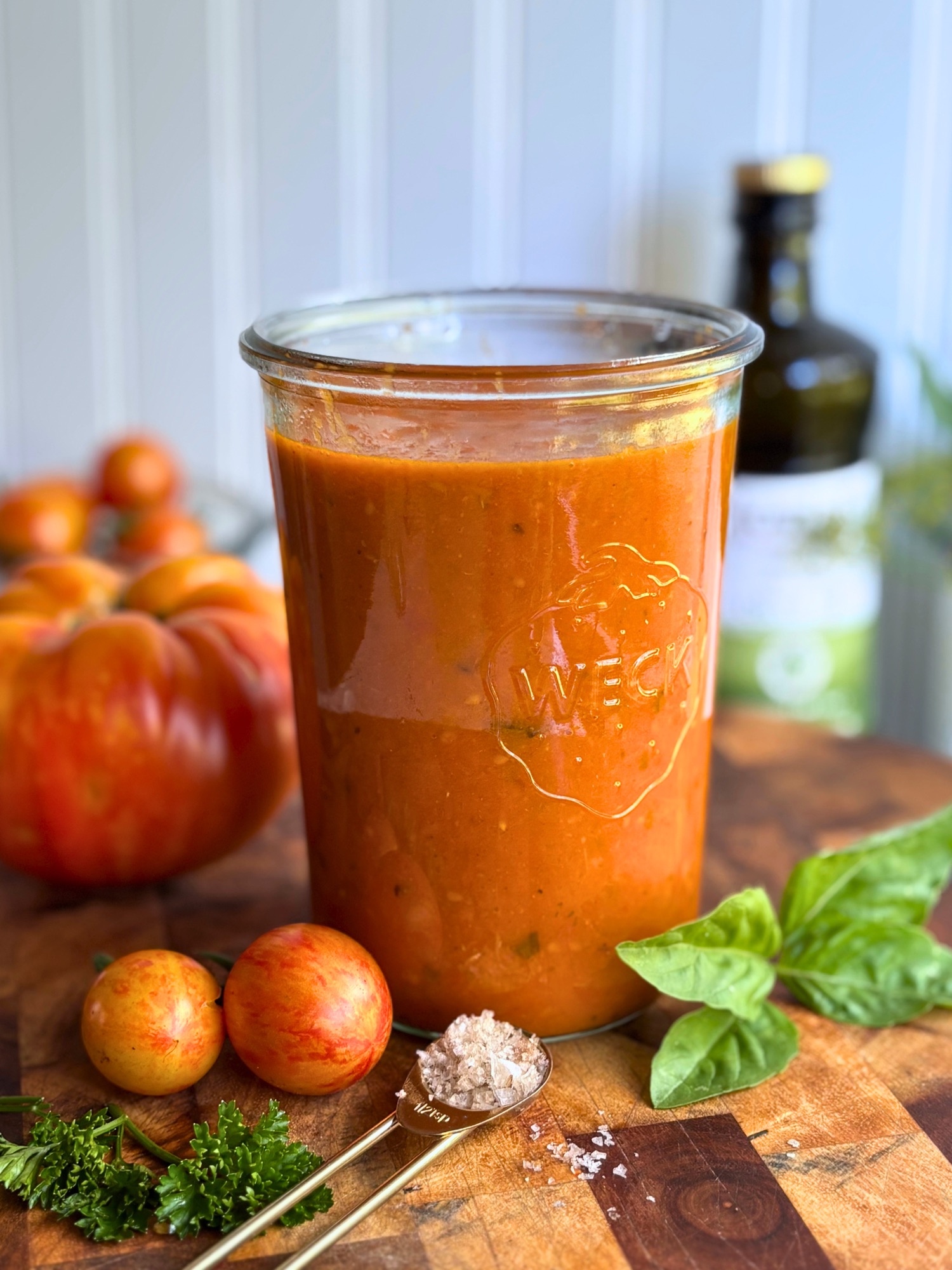
My tomatoes never come in all at once. Every single year it is the same thing. A few plants decide they are the stars of the show and start throwing fruit at me in July while the rest of the garden stands around doing absolutely nothing. So I end up with these little sparse handfuls. Not enough to can. Not enough to justify hauling out the big pot and the water bath and the whole production. Just a bowl of really good tomatoes sitting on the counter getting softer by the day.
And then last week I went to make dinner and realized I was completely out of tomato sauce. No jar in the pantry, nothing in the freezer, nothing.
Which is how I ended up doing what I have been doing for a few years now whenever the tomatoes start trickling in. I cut up everything I had, filled one 8×8 pan, and roasted it. No stovetop. No simmering for an hour. No peeling, no seeding, no straining. Thirty five minutes in a hot oven, then straight into a jar with the immersion blender.
This is honestly my favorite way to make tomato sauce, and I have tried plenty of other ways. It tastes like the garden actually tastes, which is something a jar of store sauce has never once managed, and it asks almost nothing of you in return.
This is the recipe for the in between weeks. When you have some tomatoes but not a harvest.
Table of Contents
Why This Sauce Works
Most roasted tomato sauce recipes are written for people drowning in tomatoes. They call for four or five pounds, a full sheet pan, sometimes a four hour roast at 250 degrees, and then they send you to the stove to simmer it down for another hour. That is a wonderful recipe in September when you are up to your elbows in Romas. It is a ridiculous recipe in July when you have two pounds of mixed heirlooms and a dinner problem.
This one is built the other direction. One pan, one oven, one jar. The roasting does every job at once. It softens the tomatoes so you never have to peel them, it drives off the excess water so you never have to reduce anything on the stove, and it caramelizes the sugars in the tomatoes and the onion so the finished sauce tastes deep instead of thin and raw.
There is no canning here and no canning equipment. This is a fresh sauce for the fridge or the freezer, made to be eaten.
The Best Tomatoes to Use
Whatever ripened this week.
I mean that. This is the least fussy thing I make. The batch in these photos is a mix of cherry tomatoes, little yellow and orange ones, a couple of dark heirlooms, and some larger slicers cut into wedges. That variety is actually an advantage. The cherry tomatoes bring sweetness and concentrated flavor, the big slicers bring body and juice, and the dark varieties bring that deep savory note underneath.

A few things worth knowing:
Paste tomatoes like Roma and San Marzano give you the thickest sauce because they have more flesh and fewer seeds. If you are growing them, use them.
Slicing tomatoes and heirlooms are juicier, so your sauce will be a little looser. Roasting handles most of that, and I actually like the lighter body for pizza.
Cherry and grape tomatoes work beautifully and the skins are thin enough that you will never notice them once blended. Leave them whole or halve them.
Do not peel anything. The skins break down completely under the blender and they carry a lot of the color and flavor. Peeling tomatoes is a canning habit and it has no place here.
The only real rule is ripeness. Roasting concentrates whatever flavor is already there. A pale grocery store tomato in February will give you pale February sauce. A sun ripened one in August will give you something you want to eat with a spoon.
Which is exactly why this is a summer recipe. In the off season I would not bother with fresh tomatoes at all. A can of good San Marzano tomatoes will make you a better sauce in February than anything sitting in the produce section, and there is no shame in it. See the FAQ for how to adjust the method.
Why an 8×8 Pan
This is the part I would not change.
A sheet pan spreads everything into a single thin layer, which is what you want when you are roasting four pounds and trying to evaporate a lot of liquid fast. In a small batch it works against you. The tomatoes dry out at the edges, the juices spread thin and scorch, and you lose the very thing you are trying to make.

The 8×8 keeps everything close together. The tomatoes on top steam a little while the ones on the bottom sit in their own juice and concentrate. The onion softens instead of burning. When it comes out of the oven you have a pan of collapsed tomatoes sitting in a shallow pool of thick, sweet, orange juice, and that juice is the sauce. Nothing gets sacrificed to the pan.
It also means you fill the pan and stop thinking about it. No scale, no measuring cups, no math. Cut up tomatoes until the pan is full.
Why Roast Hot and Fast
You will see a lot of roasted tomato recipes calling for 250 or 300 degrees for two to four hours. Low and slow does produce a gorgeous jammy result, and if you have all afternoon it is a lovely way to spend it.
At 425 degrees you get something different and, for sauce, better. High heat browns the edges of the tomatoes and the onion, and that browning is where the savory depth comes from. It is the same reason a roasted vegetable tastes nothing like a steamed one. You also lose the water you want to lose in half an hour instead of half a day.
Thirty five minutes is the window I keep landing on. You are looking for collapsed tomatoes, skins that have split and lifted, and dark caramelized spots on the onion and around the edges of the pan. Those dark spots are flavor. Do not pull it early trying to avoid them.

Blending in the Jar
Here is the trick that makes this recipe genuinely easy instead of just fast.
Scrape the entire contents of the pan, juice included, straight into a half gallon jar. Drop the immersion blender in and blend it right there. You store the sauce in the same vessel you made it in, which means one thing to wash instead of a blender carafe, a lid, a gasket, and a funnel.

The jar just has to be tall enough that the blender head sits fully under the surface and wide enough for the shaft to fit. A half gallon Ball jar is perfect. A large measuring pitcher works too. If you do not have an immersion blender, a countertop blender or a food processor will do the job, just let everything cool a bit first so you are not fighting steam pressure under a sealed lid.
How long you blend is entirely your call. Ten seconds leaves you a rustic sauce with real texture and visible flecks of herb and skin. A full minute gives you something smooth and pourable. I stop somewhere in the middle.
The Finishing Ingredients
Everything else goes in after the blending, and there is a reason for that.
Balsamic vinegar is doing the heavy lifting. Tomatoes lose some of their brightness in a hot oven, and a splash of balsamic at the end puts the top note back while adding a little sweetness and complexity underneath. Stir it in off the heat so it stays sharp.

Sugar is not there to make the sauce sweet. It is there to soften acidity. Tomato acidity swings wildly depending on the variety and how ripe the fruit was, and a small amount of sugar rounds off the sharp edge without changing the flavor. Taste before you add it. Some batches barely need it.
Salt and pepper go in last for the same reason. The sauce reduced in the oven, which means whatever salt you added at the start got concentrated. Seasoning at the end is the only way to know where you actually are.
Variations and Substitutions
White balsamic instead of regular. This is my favorite swap and the one I would try first. White balsamic gives you the same brightness and gentle sweetness without the dark color, so the sauce stays a vivid red orange instead of deepening toward brown. If you are making this for a pizza night or anything where the color is on display, use white.
Crushed red pepper flake. Add it before roasting so the heat blooms in the oil and distributes evenly, or stir it in at the end if you want a sharper bite. Either works.
More oregano. The teaspoon in the recipe is a baseline. If you want this to lean more classic Italian, double it. Dried oregano holds up to high heat far better than fresh, which is why it goes in before roasting while the basil and parsley stay softer.
Fresh herb swaps. Thyme and rosemary both roast beautifully with tomatoes. Rosemary is assertive, so use less than you think.
No onion or no garlic. Both can come out. The sauce will be simpler and more purely tomato, which is not a bad thing if you plan to build on it later.
How to Use This Sauce
This makes roughly enough for one pound of pasta, or two to three pizzas.

Pizza. This is where it shines. It is looser than a thick canned pizza sauce, so spread it thin and do not overload the crust. Try it on my SOURDOUGH PIZZA CRUST or YEAST PIZZA CRUST. There is also SOURDOUGH PIZZA SCONES or PIZZA PULL-APART FOCACCIA
Pasta. Toss it with hot pasta and a ladle of the starchy cooking water to help it cling. Finish with parmesan and torn basil.
Dipping. A pan of YEASTED FOCACCIA or SOURDOUGH FOCACCIA and a bowl of this is a dinner in my house more often than I would admit.
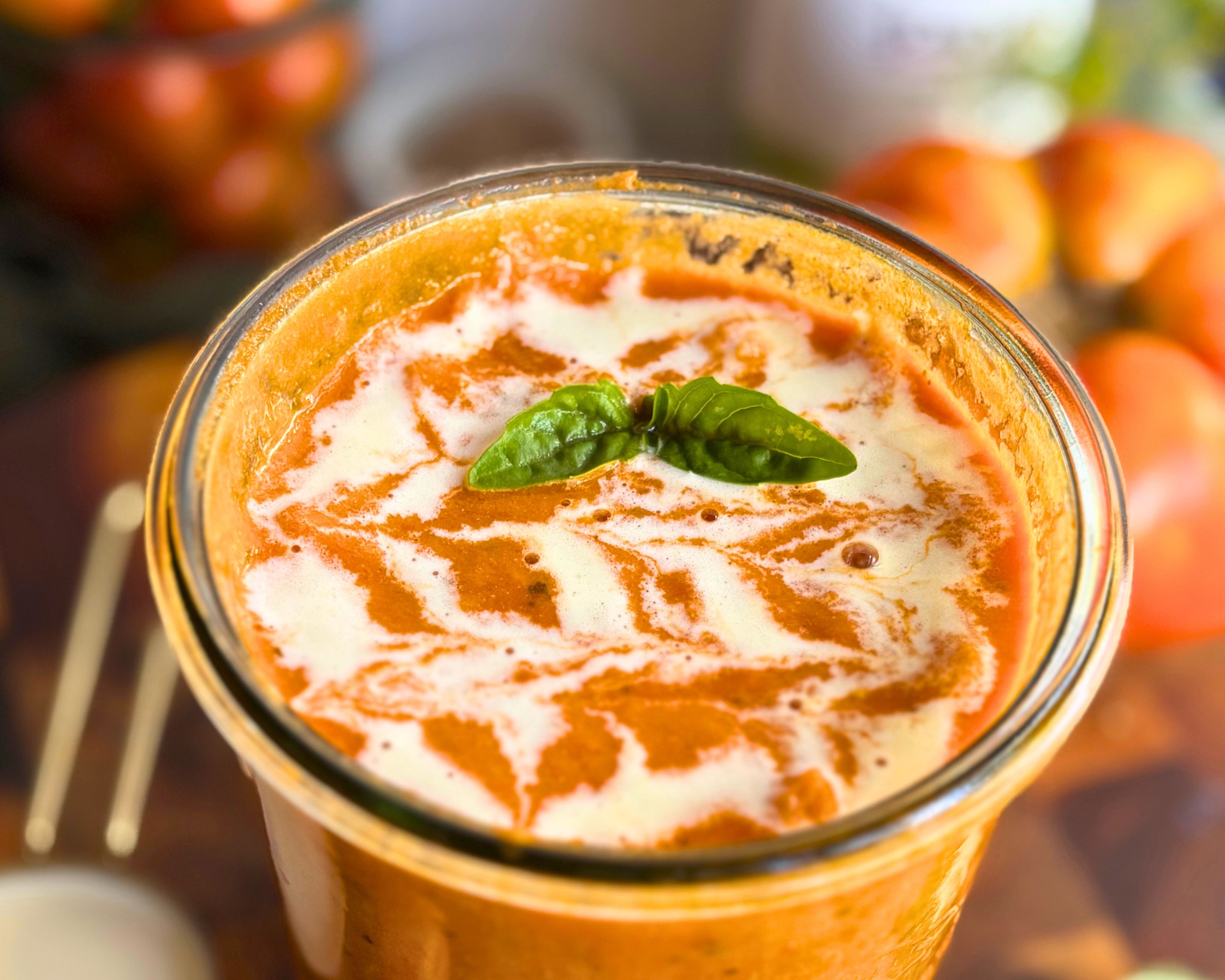
As a base. Add cream and it becomes roasted tomato soup, which I have written up separately in ROASTED TOMATO SOUP
Storage and Freezing
Refrigerator. Five to seven days in a sealed jar. The flavor is noticeably better on day two once the garlic and oregano have settled in.
Freezer. Up to three months. Leave at least an inch of headspace at the top of the jar because the sauce expands as it freezes, and use a straight sided jar so the glass is not fighting a shoulder. Freezing in a silicone cube tray and then bagging the cubes is my preferred method when I want single servings for a weeknight.
Not for canning. This recipe has not been tested for water bath canning and it should not be canned. Safe tomato canning requires added acid in tested amounts to bring the pH into a safe range, and the onion and oil here change the equation. Fridge or freezer only.
Frequently Asked Questions
Do I have to peel the tomatoes?
No. The skins soften completely during roasting and disappear entirely under the blender. Peeling is an option if you want to but it is not needed here.
Do I need to remove the seeds?
No. Actually the seeds are where majority of the flavor is and they blend in. If you want a completely smooth sauce with no seeds at all, run the blended sauce through a food mill or a fine mesh sieve, but you will lose some volume and body doing it.
Can I use store bought tomatoes instead of garden tomatoes?
In summer, absolutely. Buy the ripest ones you can find, let them sit on the counter for a few days, and the oven will handle the rest. Out of season I would skip fresh entirely. Roasting concentrates the flavor that is already in the fruit, and a pale winter tomato does not have any for it to work with. Reach for canned instead.
Can I make this with canned tomatoes?
Yes, and from about October through June it is honestly the better call. Canned tomatoes are picked at peak ripeness and packed the same day, so a can of San Marzano carries far more real tomato flavor than a fresh tomato that was shipped green in January. Use a 28 ounce can of whole tomatoes, drain off some of the packing liquid, and roast them with the onion, garlic and herbs for about 20 minutes just to brown the edges and cook the onion through. Then blend and finish exactly the same way. You will not get quite the same caramelization since the tomatoes are already cooked, but you will get a very good sauce in the dead of winter.
Why is my sauce thin?
Juicy tomato varieties give you a looser sauce. If you want it thicker, roast it ten minutes longer, or pour the blended sauce back into a saucepan and simmer it uncovered for ten to fifteen minutes.
Why is my sauce a light orange color instead of deep red?
That is the tomato varieties you used and the air whipped in by the blender, and both are completely normal. Yellow and orange tomatoes lighten the whole batch, and blending aerates the sauce. The color deepens as it sits.
Can I double this?
Yes. Use a 9×13 for a double batch and add about ten minutes of roasting time. Beyond that, move to a sheet pan and expect the flavor to be a little less concentrated.
Recipe

Small Batch Roasted Garden Tomato Sauce
Equipment
- 8×8 glass baking dish
- Half gallon wide mouth jar
- Immersion blender
- Cutting board and sharp knife
Ingredients
- 1000 grams mixed ripe tomatoes enough to fill an 8×8 pan (about 2 to 2.5 pounds)
- 150 grams sweet onion 1 medium onion, cut into wedges
- 16 grams garlic 4 cloves, peeled and left whole
- 40 grams extra virgin olive oil 3 tablespoons
- 6 grams fresh basil leaves left whole (1/4 cup)
- 8 grams fresh parsley chopped (2 tablespoons)
- 1 gram dried oregano 1 teaspoon
- 16 grams balsamic vinegar 1 tablespoon
- 13 grams granulated sugar 1 tablespoon
- 6 grams fine sea salt 1 teaspoon
- freshly ground black pepper to taste
Instructions
- Preheat your oven to 425 degrees Fahrenheit.
- Cut the larger tomatoes into thick wedges and halve the cherry tomatoes, leaving the smallest ones whole. Do not peel or seed anything, since the skins soften completely and carry a lot of the color and flavor.
- Fill the 8×8 dish with the tomatoes, packing them in snugly. The pan should be full and slightly mounded, because everything collapses as it roasts.
- Tuck the onion wedges and whole garlic cloves in among the tomatoes, then scatter the basil leaves and chopped parsley over the top.
- Drizzle the olive oil evenly over everything and sprinkle with the dried oregano. The oregano goes in before roasting because dried herbs hold up to high heat and bloom in the oil.
- Roast for 35 minutes, until the tomatoes have collapsed, the skins have split and lifted, and the onion edges have darkened. Those browned spots are where the savory depth comes from, so do not pull the pan early trying to avoid them.
- Scrape the entire contents of the pan into a half gallon jar, juices and all. Every bit of that liquid is sauce.
- Blend with an immersion blender until the sauce reaches the texture you want. Ten seconds leaves it rustic with visible flecks of herb and skin, while a full minute gives you something smooth and pourable.
- Stir in the balsamic vinegar, sugar, salt and black pepper. Taste and adjust, since tomato acidity swings widely depending on variety and ripeness.
- Use right away or cool completely before storing.
Notes
If you make this sauce I want to hear about it. Leave a comment below and tell me what tomatoes you used, because everybody’s garden gives them something different and I am genuinely curious what combinations people land on.
Tag me on Instagram at @h3artofthehome when you make it. I share them.
Subscribe
Sign up for my newsletter and new recipes come straight to your inbox, including the rest of my summer garden series.





Leave a Reply