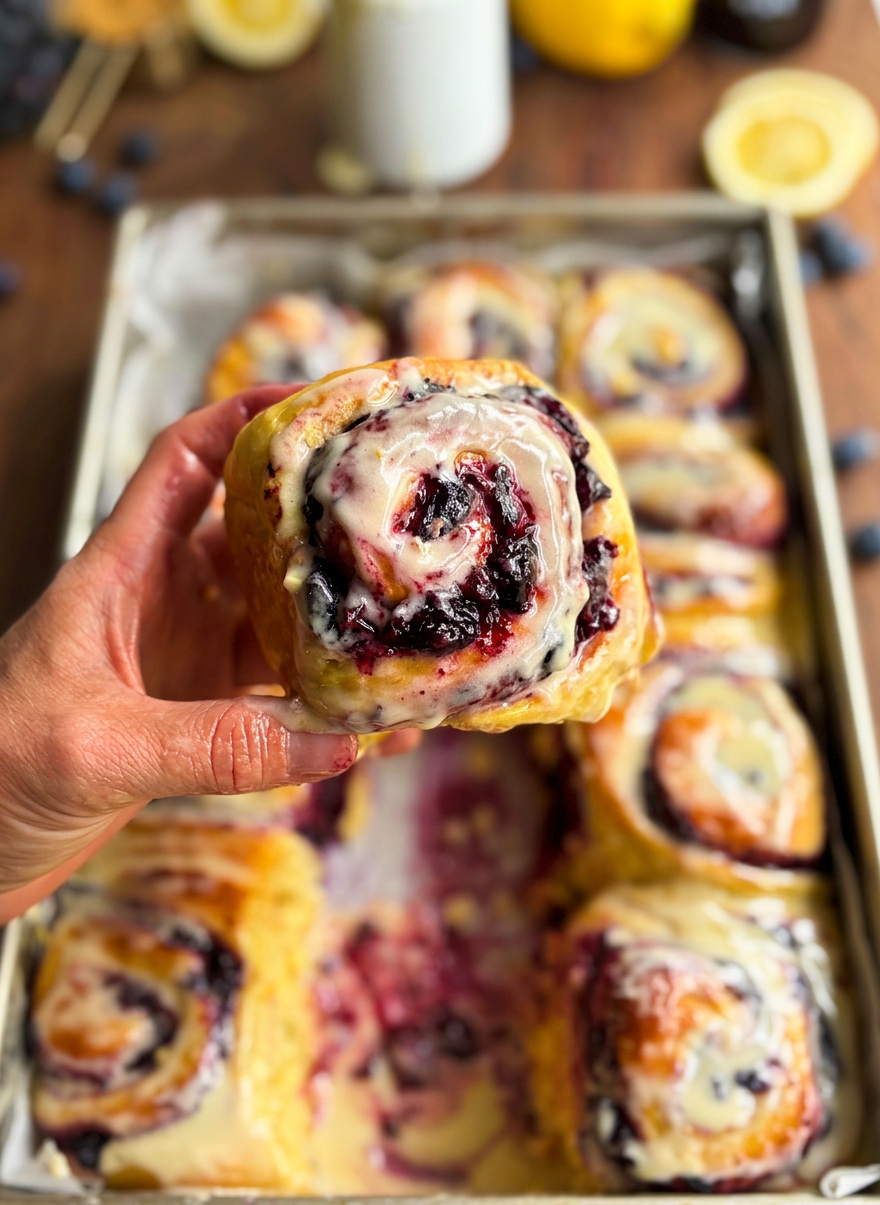
When I think of a burst of flavor, these High Protein Sourdough Blueberry Lemon Rolls are it. A vivid purple blueberry lemon compote is swirled through every layer and most importantly, stays put. That was as important to me as the protein content, no filling leaking out, gaps in the rolls and having a messy bottom. My three tier system delivers that. Plus a lemon cream cheese glaze drizzles into every crevice. and Bonus, each roll delivers 12 grams of protein from real whole food ingredients with no protein powder in sight and no compromise on taste or texture! These are the high protein sourdough rolls you make when you need something bright and cheery, but also balanced.
Table of Contents
- Why This Recipe Works
- Why Siggi’s Skyr or Greek Yogurt
- Ingredients You Need
- How to Make the Blueberry Lemon Compote
- The Three Layer Filling Method
- How to Make the Rolls
- Frosting Variations (High Protein/Thicker)
- Overnight and Make Ahead Options
- Substitutions and Variations
- The Yeasted Version
- Frequently Asked Questions
- Recipe
Why This Recipe Works
This recipe is built on the same dough base as my High Protein Sourdough Cinnamon Rolls, which means it has already been tested, refined, and locked in. The only change to the dough is fresh lemon zest, which works itself into every layer and gives the roll the brightness you want alongside a fruit filling.
The part that required the most thought was the filling. In my High Protein Sourdough Cinnamon Rolls, the method is whipped butter spread directly on the dough, then a dry brown sugar and cinnamon mixture sprinkled on top. That works beautifully because the dry filling absorbs into the butter and the layers stay put. A fruit compote cannot work the same way. It has moisture, it moves, and if you do not handle it correctly it will push out of your layers during baking. You end up with gaps between the dough and the filling, pooled compote at the bottom of the pan, and rolls that look beautiful on the outside but fall apart the moment you pull one. So we built a three layer system that solves the problem. Whipped butter goes down first as the grip layer, a lemon zest cornstarch sugar goes on top as a moisture barrier, and the cold firm compote goes on last. Every layer has a job. Together they keep your swirl exactly where it belongs.

Why Siggi’s Skyr or Greek Yogurt Is the Secret to 12 Grams of Protein Per Roll
The protein in these rolls does not come from protein powder. It does not come from any additives or tricks. It comes from real whole food ingredients, and the most important one is the thick strained dairy you use as the primary liquid in the dough. This recipe was developed and tested using both Siggi’s nonfat plain skyr and Kirkland Signature organic nonfat Greek yogurt from Costco, and both work beautifully. What matters most is thickness. The thicker your yogurt or skyr, the better your dough will come together and the more protein you get per roll.
Skyr is an Icelandic style cultured dairy product that sits right next to Greek yogurt at most grocery stores. It tends to be thicker and higher in protein than most Greek yogurts, which is why it is a great option if you can find it. But a thick nonfat Greek yogurt gets you to the same place. This is not a recipe that requires a specific brand. It is a recipe that requires a thick, high protein dairy and you have options.
My top picks
Siggi’s Nonfat Plain Skyr and Kirkland Signature Organic Nonfat Greek Yogurt from Costco are both what this recipe was built and tested on. Either one is a great starting point.
Other options that work
FAGE Total 0% Plain Greek Yogurt is widely available and thick enough to work in this dough. Stonyfield Organic Nonfat Plain Greek Yogurt is a solid backup with a slightly softer texture.
What to avoid
Skip anything flavored, anything labeled 2% or whole milk, and anything thin or runny. Flip the container and check the ingredients. You want nothing more than milk and live active cultures. The thicker the better.

Ingredients You Need
You will need bread flour, active sourdough starter, Siggi’s nonfat plain skyr/yogurt, whole milk, unsalted butter, granulated sugar, fresh lemons, fine salt, baking powder, eggs, and vanilla extract for the dough.
For the blueberry lemon compote you will need frozen blueberries, sugar, fresh lemon juice and zest, cornstarch, and salt.
The three layer filling uses whipped butter, a lemon zest cornstarch sugar mixture, and the finished compote.
The lemon cream cheese glaze uses full fat cream cheese, butter, powdered sugar, fresh lemon juice and zest, vanilla extract, salt, and a splash of whole milk if needed to thin.
Full measurements are in the recipe card below.

How to Make the Blueberry Lemon Compote for Sweet Rolls
Make the compote first. It needs to be fully cold and firm before you spread it onto the dough, so plan to make it at least 2 hours ahead, or the night before if you are doing an overnight bulk ferment. When you are ready to start assembling, pull the compote out of the refrigerator while you whip your butter, mix your lemon cornstarch sugar, and roll out your dough. By the time everything else is ready, the compote will still be cold and firm but slightly easier to spread.
I use frozen blueberries here for two reasons. They are accessible year round and significantly less expensive than fresh. The moisture issue that frozen blueberries are known for is completely controlled by the cooking process. You are cooking out that extra liquid during the compote step, which means frozen blueberries actually give you more consistency and control than fresh ones would.
The thickening method matters a lot here. Rather than whisking the cornstarch into cold water, you whisk it directly into the cold lemon juice. The acid in the lemon juice produces a slightly smoother set than a plain water slurry, which gives you a compote that is firm and spreadable but never gluey or gummy. You then temper the slurry by adding a tablespoon of hot blueberry liquid before pouring it into the pot. This prevents the cornstarch from seizing in clumps when it hits the heat. It is a small step that makes a meaningful difference in the final texture.
The finished compote should be firm enough that when you drag a spoon through it, the line holds for a few seconds before slowly settling. If it is still loose after 2 hours in the refrigerator, give it more time. It will continue to firm up as it cools. You want it cold and stiff, almost like a thick jam, before it goes anywhere near your dough.

The Three Layer Filling Method and Why It Keeps Your Compote Where It Belongs
This is the part of the recipe I want you to understand before you start, because it is what separates a roll with beautiful tight swirls from one where the filling has gapped between the layers or pooled at the bottom of the pan during baking.
A fruit compote has moisture. Even after cooking it down to a thick jam consistency, it still behaves differently than a dry filling. If you spread compote directly onto the dough and roll it up immediately, the weight and warmth will start shifting the filling as you roll. By the time the rolls go into the pan and start their final proof, you have already lost control of where that filling sits.
The three layer system solves this completely.
Layer one: whipped butter
The butter goes down first. It creates a fat barrier between the dough and the filling that slows moisture migration during baking. It also acts as a grip surface that gives the dry layer something to adhere to. The butter must be whipped until light and almost frosting-like. This is not the same as spreading softened butter with a spatula. Whipped butter covers more evenly, thinner, and clings to the dough in a way that melts gradually rather than all at once when the oven heat hits it.
Layer two: lemon cornstarch sugar
The lemon zest rubbed into granulated sugar goes on top of the butter with cornstarch whisked in. This layer adds lemon flavor throughout every bite of the roll. It also gives the compote a textured surface to grip rather than sliding on a slick butter layer. And the cornstarch acts as an additional moisture absorber, pulling any liquid that tries to migrate down from the compote before it can reach the dough and cause separation.
Layer three: cold compote spread thin
The compote goes on last and it goes on cold, straight from the refrigerator. Cold compote is stiff enough to spread in a controlled layer without migrating. Thin is the key word. You do not need every last bit of compote on the dough. A thin even layer gives you a beautiful swirl in every roll. Too much creates the steam pressure during baking that pushes layers apart.
Once the compote is spread, you are ready to roll.

How to Make High Protein Sourdough Lemon Blueberry Rolls Step by Step

Step one: make the compote ahead of time
The compote needs at least 2 hours in the refrigerator before use. If you are doing an overnight bulk ferment, make the compote the same evening you mix the dough and refrigerate both overnight.
Step two: mix the dough
Combine your dry ingredients including the lemon zest in the bowl of your stand mixer. Add the warmed skyr/yogurt, warmed milk, eggs, vanilla, and sourdough starter. Mix on low until a shaggy dough forms, then add the softened butter in pieces and mix on medium until the dough is smooth, elastic, and pulls cleanly away from the sides of the bowl, about 8 to 10 minutes.
Step three: bulk fermentation
Cover the bowl and allow the dough to bulk ferment at room temperature until it has grown noticeably, feels airy and light when pressed gently, and bubbles are visible on the surface and sides. Because this is an enriched dough with butter, eggs, skyr/yogurt, and sugar, it ferments more slowly than a lean sourdough. At a kitchen temperature of 68 to 72 degrees Fahrenheit this will take approximately 8 to 10 hours, which makes it a natural overnight dough. If your kitchen runs warmer than 72 degrees, watch the dough rather than the clock.
Step four: roll and fill
Turn the dough out onto a lightly floured surface and roll to a 12 by 18 inch rectangle with the 12 inch edge parallel to your body. Spread the whipped butter evenly across the entire surface all the way to the edges. Sprinkle the lemon cornstarch sugar over the butter and press lightly with your palm to adhere. Working quickly with an offset spatula, spread the cold compote in a thin even layer, leaving a 1 inch border clean along the top edge. Place the filled dough in the refrigerator for 15 to 20 minutes to firm the layers before rolling.
Step five: roll, cut, and arrange
Remove the dough from the refrigerator. Starting from the edge closest to you, roll the dough upward away from you into a tight log, pulling back gently as you go to create tension. Trim the uneven ends and cut into 12 rolls at 1 inch intervals using unflavored dental floss. Arrange cut side up in a parchment lined 9 by 13 pan.
Step six: final proof
Cover and proof at room temperature for 3 to 4 hours, using the poke test rather than the clock. The rolls should feel puffy and spring back slowly when poked. Under proofed rolls will force the filling out during baking.
Step seven: bake
Bake at 375 degrees Fahrenheit for 22 to 26 minutes. Pull when an instant read thermometer reads 190 degrees internal temperature.
Step eight: glaze and serve
If you forgot to pull your cream cheese out ahead of time, place it on a microwave safe plate and microwave for 20 seconds. It should be soft enough to beat smoothly without being warm. Do not skip this step. Cold cream cheese will not beat smooth and you will end up with lumps in your glaze.
Beat the cream cheese and butter together until completely smooth. Then add the lemon juice slowly, one teaspoon at a time, beating between each addition. Adding the lemon juice into the fat first before anything else is what prevents curdling. The acid gets coated in the butter and cream cheese fats so it cannot shock the proteins and turn the glaze grainy. Once all the lemon juice is incorporated, add the powdered sugar, lemon zest, vanilla, and salt and beat until glossy and pourable. Add milk one tablespoon at a time only if the glaze needs thinning. Drizzle over warm rolls so the glaze runs into the swirls and lets the blueberry color show through. Serve immediately.
If you prefer a thicker frosting that covers the rolls completely rather than a drizzle, head to the Want a Thicker Frosting Instead section above for that variation.
Frosting Variations
The drizzle glaze is my choice for this recipe because it lets the blueberry swirl stay visible in the pan, which is the whole visual point of these rolls. But if you want something closer to a classic cream cheese frosting that covers the rolls completely, here is how to adjust.
Use the same ingredients but reduce the lemon juice to 10 grams and skip the milk entirely. Follow the same method: beat the cream cheese and butter together first until smooth, then add the lemon juice slowly one teaspoon at a time into the fat before adding anything else. This order is what keeps the glaze from curdling. Once the lemon juice is fully incorporated, add the powdered sugar, lemon zest, vanilla, and salt and beat until thick and spreadable. Dollop generously over warm rolls and spread with an offset spatula.
Higher Protein Greek Yogurt Glaze
If you want a modest protein boost without changing the flavor or drizzle consistency, this variation swaps the butter entirely for nonfat plain Greek yogurt and adds a small amount of heavy cream for richness. The result is nearly identical in taste and texture to the standard glaze. The order of operations is the same: lemon juice goes into the cream cheese and Greek yogurt base before the powdered sugar to prevent curdling.
113 grams full fat cream cheese, room temperature (4 oz)
60 grams nonfat plain Greek yogurt, room temperature (1/4 cup)
120 grams powdered sugar, sifted (1 cup)
zest of 1 lemon
15 grams fresh lemon juice (1 tablespoon)
5 grams vanilla extract (1 teaspoon)
1 gram fine sea salt (small pinch)
15 to 30 grams heavy cream, to consistency (1 to 2 tablespoons)
Beat the cream cheese and Greek yogurt together until completely smooth, about 2 minutes. Add the lemon juice one teaspoon at a time, beating between each addition. Once all the lemon juice is incorporated, add the sifted powdered sugar, lemon zest, vanilla, and salt. Beat until glossy and pourable. Add heavy cream one tablespoon at a time until the glaze reaches a drizzleable consistency. It should run slowly off a spoon but not be watery. Drizzle immediately over warm rolls.

Overnight and Make Ahead Options for Sourdough Sweet Rolls

This dough was designed for the overnight baker. The enrichment in the dough, the butter, eggs, skyr/yogurt, and sugar, naturally slows fermentation. That means an overnight room temperature bulk ferment is not only possible, it is ideal for this recipe. The dough develops beautifully over a long slow bulk and is easy to work with in the morning when the kitchen has cooled overnight.
Overnight bulk ferment
Mix your dough in the evening. Cover and leave at room temperature overnight. In the morning the dough should be noticeably risen, feel airy and light, and have visible bubbles on the surface. Roll it out, fill it, cut your rolls, and proceed with the final proof before baking. This is exactly how the first test batch of these rolls was made.
Make ahead after shaping
If you want to prep your rolls the day before baking, shape and cut them, arrange them in the pan, cover tightly, and refrigerate for up to 8 to 10 hours. When you are ready to bake, remove the pan from the refrigerator and allow the rolls to sit at room temperature until they are no longer cold to the touch, about 1 hour. Then allow them to complete the full 3 to 4 hour final proof before baking. Do not put cold rolls directly into the oven. The cold dough will not rise properly and your rolls will be dense.
Substitutions and Variations
Flour
Bread flour is strongly recommended for this recipe because the higher protein content gives the dough the strength and structure it needs to hold its swirl and rise properly. If bread flour is not available, all purpose flour can work but you will need to reduce the skyr/yogurt by about 20 to 30 grams since all purpose absorbs less liquid. King Arthur all purpose is the best backup choice because it runs higher in protein than most other brands. The rolls will be slightly softer and more tender but may not hold their layers quite as cleanly.
Eggs
In this dough the eggs contribute binding, moisture, and richness from the yolk fat alongside the butter. The bread flour and sourdough starter handle the majority of the structural work, which means egg substitutions are workable here.
- Extra skyr/yogurt is the most seamless swap. Add an additional 60 to 80 grams in place of the 2 eggs. It keeps the protein content up, stays completely flavor neutral, and you already have it on hand since it is the primary ingredient in the dough.
- Aquafaba is the best vegan option. Use 3 tablespoons per egg, so 6 tablespoons total. It is the liquid from a can of chickpeas and is completely flavor neutral.
- Flax egg works but makes the crumb slightly denser. Combine 1 tablespoon ground flax with 3 tablespoons water per egg and rest for 5 minutes before using. You will need a double batch to replace 2 eggs.
- Unsweetened applesauce is a last resort for this specific dough. Use 60 grams per egg, 120 grams total. The volume is significant enough to add a subtle flavor note and can affect the dough balance slightly.
Fruit filling
The three layer filling method works with other fruits. Raspberries, blackberries, and strawberries all follow the same compote process and ratios. Stone fruits like peach work as well but need to be diced small and cooked down a little longer. Avoid very watery fruits that cannot hold structure when cooked.
Glaze
The drizzle glaze is the primary choice for this recipe because it lets the blueberry swirl stay visible. If you prefer a thicker cream cheese frosting that covers the rolls completely, visit the Want a Thicker Frosting Instead section above for the adjusted method.

Looking for the Yeasted Version?
If you do not have an active sourdough starter or you want a faster same day version, I have you covered.
High Protein Lemon Blueberry Rolls with Greek Yogurt
Same bright lemon blueberry flavor, same three layer filling method, same lemon cream cheese glaze, made with instant yeast instead of a sourdough starter and ready in a fraction of the time.
Frequently Asked Questions
Can I use fresh blueberries instead of frozen?
Yes. Cook them the same way using the same compote method and ratios. Fresh blueberries release slightly less liquid than frozen so your compote may firm up a little faster on the stovetop. The rest of the process is identical.
Can I use a different pan size?
A 9 by 13 pan is what this recipe was tested in and is strongly recommended. A smaller pan will crowd the rolls and force them to push upward rather than proof evenly. A larger pan gives the rolls too much room to spread outward and they may bake flatter. Stick with 9 by 13.
Can I halve this recipe?
Yes. Cut every ingredient exactly in half. You will get 6 rolls. Use an 8 by 8 or 9 by 9 pan. Baking time stays roughly the same so start checking with your thermometer at 20 minutes.
How do I store leftover rolls?
Cover the pan tightly with plastic wrap or transfer rolls to an airtight container and store at room temperature for up to 3 days. Do not refrigerate. Cold temperatures accelerate staling in enriched doughs and will dry them out faster than leaving them at room temperature.
Can I freeze these?
Yes. Allow the rolls to cool completely, then wrap individually in plastic wrap and place in a freezer safe bag for up to 3 months. Freeze without the glaze. To serve, thaw at room temperature overnight, then warm covered with foil at 350 degrees Fahrenheit for about 10 minutes. Make the glaze fresh.
How do I reheat leftover rolls?
Cover with foil and warm in a 350 degree oven for 8 to 10 minutes. If the rolls have been sitting a day or two, add a small pat of butter on top before covering. The microwave works in a pinch at 20 to 30 seconds per roll but the oven gives you a better result.
How do I know when my starter is ready to use?
Your starter should be active, bubbly, domed at the top, and at or just past peak. A reliable test is to drop a small spoonful into a glass of water. If it floats it is ready. If it sinks, give it more time. Do not use discard for this recipe. You need a fully active peaked starter.
Why does my dough feel sticky?
This is normal for an enriched dough with this much moisture from the skyr/yogurt. Resist adding more flour. A slightly tacky dough is correct. If it is genuinely unworkable, refrigerate it for 30 minutes to firm it up before rolling.
My rolls are not rising during the final proof. What should I do?
The two most likely reasons are a starter that was not at peak when you mixed the dough, or a kitchen that is too cold. Make sure your starter was bubbly, domed, and active before you used it. For temperature, find a warm spot in your home. The oven with just the light on runs about 75 to 80 degrees Fahrenheit which is ideal for proofing. Always use the poke test rather than the clock. If the roll springs back slowly it is ready. If it springs back immediately it needs more time.
Can I make these without a stand mixer?
Yes. This is an enriched dough with butter, eggs, and a thick dairy so it is heavier than a lean dough. Knead by hand for 12 to 15 minutes until the dough is smooth, elastic, and passes the windowpane test. The windowpane test means stretching a small piece of dough thin enough to see light through without it tearing.
Can these be made gluten free?
I have not tried it and would not want to guess. This recipe relies heavily on the gluten structure from bread flour and a gluten free conversion would be a completely different recipe development project. But using the filling layering method should work well!

More High Protein Sourdough Recipes You Will Love
If these High Protein Sourdough Lemon Blueberry Rolls hit the way I think they will, here is where to go next in the high protein series. Every recipe uses real whole food ingredients and no protein powder.
High Protein Sourdough Cinnamon Rolls with Greek Yogurt
High Protein Cinnamon Rolls with Greek Yogurt
High Protein Sourdough Sandwich Bread
High Protein Honey Whole Wheat Sandwich Bread
High Protein Sourdough Dinner Rolls
Cottage Cheese Sourdough Pretzels
High Protein Cottage Cheese Chocolate Chip Scones
Did You Make These?
If you made these High Protein Sourdough Lemon Blueberry Rolls, I want to see them. Drop a comment below and let me know how they turned out, and leave a star rating if you loved them. It genuinely helps other bakers find this recipe. And if you are not already following along, subscribe so you never miss a new recipe from the high protein series. New recipes go up every week.
Recipe

Blueberry Lemon Sourdough Sweet Rolls with Greek Yogurt
Equipment
- – Stand mixer with dough hook your hands
- 9 by 13 inch baking pan
- Parchment paper
- Medium saucepan
- kitchen scale
- Offset spatula
- Unflavored dental floss a knife
- Instant read thermometer
- Hand mixer or stand mixer for glaze
- Small bowl for cornstarch slurry
- plastic wrap
Ingredients
For the Blueberry Lemon Compote (make first)
- 315 grams frozen blueberries approximately 2 cups
- 85 grams granulated sugar 6 tablespoons + 2 teaspoons
- 15 grams fresh lemon juice 1 tablespoon
- 16 grams cornstarch 2 tablespoons
- 1 gram fine salt small pinch
For the Dough
- 560 grams bread flour 4 2/3 cups
- 140 grams active peaked sourdough starter 2/3 cup
- 265 grams nonfat plain skyr or Greek yogurt slightly warmed (1 cup + 1 tablespoon + 1 teaspoon)
- 40 grams whole milk slightly warmed (2 tablespoons + 2 teaspoons)
- 75 grams unsalted butter softened (5 tablespoons)
- 45 grams granulated sugar 3 tablespoons + 2 teaspoons
- zest of 2 lemons
- 9 grams fine salt 1 1/2 teaspoons
- 4 grams baking powder 1 teaspoon
- 2 large pasture raised eggs room temperature
- 1 teaspoon vanilla extract
For the Whipped Butter Layer
- 85 grams unsalted butter room temperature (6 tablespoons)
For the Lemon Cornstarch Sugar Layer
- 60 grams granulated sugar 4 tablespoons + 2 teaspoons
- zest of 2 lemons
- 10 grams cornstarch 1 tablespoon + 1 teaspoon
For the Lemon Cream Cheese Glaze
- 113 grams full fat cream cheese room temperature (4 oz)
- 60 grams unsalted butter softened (4 tablespoons)
- 120 grams powdered sugar sifted (1 cup)
- zest of 1 lemon
- 20 grams fresh lemon juice 1 tablespoon + 1 teaspoon
- 1 teaspoon vanilla extract
- pinch of fine salt
- 1 to 2 tablespoons whole milk only if needed to thin
For the Higher Protein Greek Yogurt Glaze (variation)
- 113 grams full fat cream cheese room temperature (4 oz)
- 60 grams nonfat plain Greek yogurt room temperature (1/4 cup)
- 120 grams powdered sugar sifted (1 cup)
- zest of 1 lemon
- 15 grams fresh lemon juice 1 tablespoon
- 5 grams vanilla extract 1 teaspoon
- 1 gram fine sea salt small pinch
- 15 grams heavy cream to consistency (1 tablespoons)
Instructions
Make the Blueberry Lemon Compote (needs 2 hours in the refrigerator before use)
- Combine the frozen blueberries and sugar in a medium saucepan over medium heat. Cook, stirring occasionally, until the berries break down completely and the mixture is bubbling and deep purple, about 8 minutes.
- While the blueberries cook, whisk the cornstarch into the lemon juice in a small bowl until completely smooth with no dry streaks.
- Once the compote is bubbling and the berries have fully broken down, slowly drizzle the slurry into the pot while whisking constantly. Cook for 2 more minutes until the compote thickens and a line drawn through it with a spoon holds for at least 3 seconds. Remove from heat, stir in the salt, and transfer to a bowl. Press plastic wrap directly against the surface. Cool to room temperature, then refrigerate until completely cold and firm, at least 2 hours.
Make the Dough
- Warm the skyr or Greek yogurt and milk together in the microwave for 30 to 45 seconds until slightly warm but not hot. If the mixture is too hot it can affect your starter.
- In the bowl of your stand mixer, whisk together the starter, warmed skyr or yogurt and milk mixture, vanilla extract, and eggs until smooth, then mix in the softened butter. In a separate bowl whisk together the bread flour, baking powder, salt, sugar, and lemon zest.
- Add the dry ingredients to the wet mixture and mix until the dough just comes together and there are no dry bits remaining. Cover the bowl with a towel and let it rest for 15 to 30 minutes. This rest gives the Greek yogurt time to hydrate the flour fully before the final knead, which is important because yogurt hydrates flour differently than regular liquid.
- After the rest, knead the dough with the dough hook on medium speed for 5 to 6 minutes until smooth and elastic. The dough will feel softer than a lean sourdough, which is correct for an enriched dough.
- Place the dough in a lightly oiled bowl and cover. Bulk ferment at room temperature for 8 to 10 hours until the dough has increased noticeably in volume, looks domed, and feels airy and jiggly when you shake the bowl. Watch the dough rather than the clock.
Assemble and Bake
- When the dough is finished proofing, whip the room temperature butter with a hand mixer until light and fluffy. Set aside.
- Rub the lemon zest into the granulated sugar with your fingertips for about 60 seconds until it clumps and smells fragrant. Whisk in the cornstarch until evenly distributed. Set aside.
- Turn the dough out onto a lightly floured surface and gently roll into a 12 by 18 inch rectangle with the 12 inch edge parallel to your body. If the dough springs back, let it rest 5 minutes and try again.
- Spread the whipped butter evenly across the entire surface all the way to the edges.
- Sprinkle the lemon cornstarch sugar evenly over the butter and press lightly with your palm so it adheres.
- Pull the cold compote from the refrigerator. Working quickly with an offset spatula, spread it in a thin even layer over the sugar, leaving a 1 inch border clean along the top edge.
- Starting from the edge closest to you, roll the dough upward and away from you into a tight log, pulling back gently as you go to create tension. The log will be approximately 12 inches long.
- Using unflavored dental floss, trim any uneven ends, then cut into 12 equal rolls at 1 inch each.
- Arrange the rolls cut side up in a parchment lined 9 by 13 pan. Cover and proof at room temperature for 3 to 4 hours until puffed and passing the poke test. Press gently with one finger and the dough should spring back slowly. Under proofed rolls will force the filling out during baking.
- Preheat oven to 375 degrees Fahrenheit. Bake for 22 to 26 minutes until golden. The center of a middle roll should read 190 degrees Fahrenheit on an instant read thermometer.
Make the Glaze
- While the rolls bake, beat the cream cheese and butter together until completely smooth. If your cream cheese was cold, microwave it on a microwave safe plate for 20 seconds first.
- Add the lemon juice slowly, one teaspoon at a time, beating between each addition. Adding the lemon juice into the fat before anything else prevents the acid from curdling the cream cheese.
- Once all the lemon juice is incorporated, add the powdered sugar, lemon zest, vanilla, and salt and beat until glossy and pourable. Add milk one tablespoon at a time only if the glaze needs thinning.
- Drizzle over warm rolls so it runs into the swirls and lets the blueberry color show through. Serve immediately.
For the Greek yogurt glaze variation:
- Beat the cream cheese and Greek yogurt together until completely smooth, about 2 minutes
- Add the lemon juice one teaspoon at a time, beating between each addition.
- Once all lemon juice is incorporated, add the sifted powdered sugar, lemon zest, vanilla, and salt. Beat until glossy and pourable.
- Add heavy cream one tablespoon at a time until the glaze reaches a drizzleable consistency. Drizzle immediately over warm rolls.



Leave a Reply