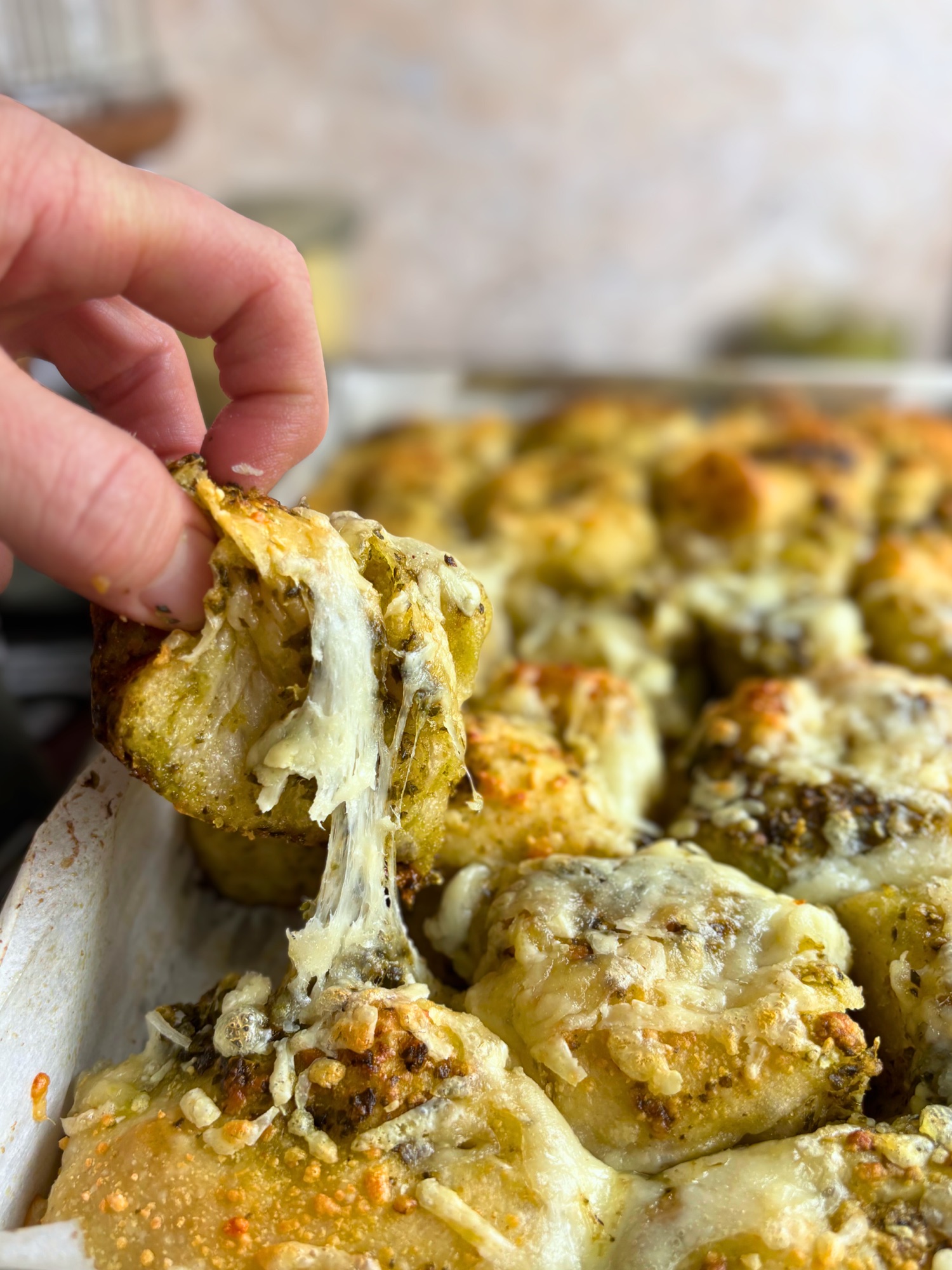
I’ve made a lot of pull apart focaccia at this point, and this pesto version is one of my favorite savory recipes yet. When thinking about more savory recipes to create, this popped into my mind. Pesto is pretty much universally loved, so it was an obvious choice.
This sourdough pesto focaccia takes tender sourdough chunks and dips them directly into homemade basil pesto, rolls them in a crispy parmesan coating, then finishes everything with melted mozzarella (optional) and a drizzle of fresh, bright green pesto. The result is golden, herbaceous, cheesy, and absolutely perfect for tearing apart and sharing.
The best part? No complicated shaping or lamination. Just tear, dip, roll, and bake.
Table of Contents

What is Pull Apart Focaccia?
Pull apart focaccia is a fun twist on traditional Italian focaccia bread. Instead of baking one large flat bread, the dough is torn into individual chunks, coated in flavorful ingredients, then arranged in a pan where they bake together. The result is a bread you can literally pull apart with your hands, with each piece having a crispy coated exterior and soft fluffy interior.
This method creates more surface area for flavor and texture, plus it’s incredibly fun to eat. No knife needed, just grab a piece and pull!
↑ Back to Table of ContentsWhy You’ll Love This Recipe
The pesto is baked into every bite. Instead of just drizzling pesto on top like most recipes, we’re coating each individual chunk before baking. This means the pesto flavor gets into every crevice and pull-apart piece. It’s not a garnish, it’s integral to the bread.
Double pesto for maximum flavor and color. Basil oxidizes when baked and turns dark green. So we add pesto twice, once before baking for deep caramelized flavor, and again optionally with fresh pesto after baking for that bright green color and fresh taste.
No shaping skills required. You literally just tear the dough into chunks with your hands. No rolling, no fancy techniques, no stress. If you can dip things and arrange them in a pan, you can make this.
Perfect for gatherings. This is the kind of recipe that makes you look like a baking genius but doesn’t actually require much skill. Serve it as an appetizer, a side dish, or the star of the meal. People will be pulling it apart and going back for more.
Works with store-bought pesto. I’m sharing the tree nut free pesto recipe below because I’m allergic to pine nuts, but you can absolutely use your favorite store bought pesto if that’s easier. No judgment.
Better digestion. The long sourdough fermentation breaks down gluten and starches, making this easier on your digestive system than regular yeasted bread. Plus, that slow fermentation develops more complex flavors.
↑ Back to Table of ContentsSourdough Recipe

Pesto Pull-Apart Focaccia
Equipment
- Large mixing bowl
- kitchen scale l(recommended for accuracy)
- 9×13 inch baking pan
- Parchment paper
- Food processor or blender (for pesto)
- Box grater or microplane
- Shallow bowls or plates (for dipping and coating)
- Plastic wrap or clean bag
Ingredients
FOR THE SOURDOUGH FOCACCIA DOUGH:
- 500 g bread flour about 4 cups
- 400 g water about 1⅔ cups, see notes section about hydration
- 75 g active sourdough starter about ⅓ cup
- 10 g salt about 2 teaspoons
FOR THE PESTO:
- 60 g fresh basil leaves 2½ cups, packed
- 135 g olive oil ½ cup plus 2 Tablespoons
- 40 g parmesan cheese ⅓ cup plus 2 Tablespoons, freshly grated
- 15 g romano cheese 3 tablespoons
- 57 g butter 4 tablespoons, softened
- 1.5 g salt ¼ teaspoon
- 0.3 g crushed red pepper flakes optional, for warmth, ⅛ teaspoon
- 2-4 cloves garlic adjust based on your love of garlic, I like 3
FOR THE PARMESAN COATING:
- 90 g parmesan cheese finely grated, about 1 cup
- 25 g cornstarch 2-3 tablespoons
- 3 g garlic powder optional, 1 teaspoon
FOR FINISHING:
- 115-225 g low moisture mozzarella cheese shredded (1-2 cups, optional)
- Fresh basil leaves for garnish
- Flaky sea salt optional
- 55 g reserved pesto for drizzling ¼ cup
Instructions
- Make the sourdough dough. In a large bowl, combine the bread flour, water, active sourdough starter, and salt. Mix with a wooden spoon, spatula, or your hands until no dry flour remains. (2-3 minutes) The dough will be very sticky. Cover the bowl with a lid or plastic wrap. Let rest for one hour.
- After one hour, do a series of stretch and folds. Grab one edge of the dough, stretch it upward, and folding over itself. Rotate the bowl 90 degrees and repeat 3-4 times about the entire dough mass. Place the lid or plastic wrap back over top and continue the bulk fermentation.
- Bulk ferment the dough. Let the dough sit at room temperature for 8 to 12 hours. The timing depends on your kitchen temperature. In a warmer kitchen (75 to 78°F), check around 8 hours. In a cooler kitchen (68 to 70°F), it may need the full 12 hours. The dough is ready when it’s puffy, doubled in size, and full of visible bubbles. When you shake the bowl, the dough should jiggle.
- Make the pesto. While the dough is fermenting, add the basil leaves, olive oil, parmesan, romano, butter, garlic, and optional RPF to a food processor or blender. Blend until completely smooth, stopping to scrape down the sides as needed. If making ahead, let the pesto come to room temperature before using (1 to 2 hours out of the fridge). It should be soft and fluid, not thick like solidified butter. Reserve about ¼ cup of pesto for finishing.
- Prepare the parmesan coating. Grate a block of parmesan on a box grater. For the finest coating, add the grated parmesan and cornstarch to a food processor and pulse until super fine and powdery. Transfer to a shallow bowl or plate and add the garlic powder if using. Whisk to combine evenly. (or you can purchase finely grated parmesan at the store)
- Set up your workspace. Line a 9×13 inch baking pan with parchment paper. Have your room temperature pesto, parmesan coating mixture, and lined pan all within reach.

- Portion the dough. Once bulk fermentation is complete, lightly grease your hands with oil. Turn the dough out onto a lightly greased work surface or work directly from the bowl. Using greased hands or a bench scraper, tear the dough into 2 to 3 inch chunks. You should get about 24-30 pieces. They don’t need to be uniform. and you can make them larger or smaller. I usually like golf ball size.
- Coat the chunks. Take each dough chunk and dip it into the pesto, turning to coat all sides generously. Let excess drip off briefly but keep them well saturated. Immediately roll the pesto coated chunk in the parmesan coating mixture, turning until all sides are coated. The pesto acts as glue for the coating to stick.
- Arrange in the pan. Place each coated chunk into the prepared pan as you work. Nestle them close together but don’t pack them too tight. They should be touching. This creates the pull apart effect as they proof and bake together. I like to do 5 rows or 4 across. But you can alter how big or small you'd like the balls to be.
- Second proof. Loosely cover the pan with plastic wrap or a lid. Let it sit at room temperature for 1 to 2 hours. The chunks should puff up noticeably and look airy. They’ll expand and touch each other more firmly. Don’t over proof. The dough should be puffy but not completely doubled.
- Preheat the oven. While the dough is proofing, preheat your oven to 425°F (220°C). Make sure it’s fully preheated before baking.
- Dimple the dough. Once the second proof is complete and right before baking, use your fingertips to dimple the entire surface. Press down gently all over, creating small indentations everywhere. This pushes the pesto and coating down into the dough, creating marbled swirls throughout. It also helps the focaccia maintain its texture during baking.

- Bake. Uncover the pan and place it in the preheated oven. Bake for 20 minutes. The focaccia should be starting to turn golden brown.
- Add the cheese. Pull the pan out of the oven and quickly sprinkle the shredded mozzarella evenly over the top if using. Work quickly to avoid losing too much heat. Return to the oven immediately.
- Finish baking. Bake for another 5 to 10 minutes. The cheese should be fully melted and bubbly, and the focaccia should be deeply golden brown with some darker caramelized spots.
- Add fresh pesto and serve. As soon as you remove the focaccia from the oven, drizzle the reserved fresh pesto all over the top (optional). The heat will help it settle into the nooks and crannies while keeping the bright green color. Scatter fresh basil leaves over the top and sprinkle with flaky sea salt if desired. Let cool for about 5 minutes, then serve warm.
Notes
Yeast Recipe

Yeasted Pesto Pull-Apart Focaccia
Equipment
- Large mixing bowl
- Kitchen scale (recommended for accuracy)
- 9×13 inch baking pan
- Parchment paper
- Food processor or blender (for pesto)
- Box grater or microplane
- Shallow bowls or plates (for dipping and coating)
- Plastic wrap or clean bag
Ingredients
FOR THE YEASTED FOCACCIA DOUGH:
- 540 g bread flour about 4¼ cups
- 440 g water about 1⅔ cups plus 2½ tablespoons, see note section about hydration
- 7 g instant yeast about 2¼ teaspoons OR 9 g active dry yeast (about 2¾ teaspoons) see directions below
- 10 g salt about 2 teaspoons
- 1 g sugar only if using active dry yeast, for activation, ¼ teaspoon
FOR THE PESTO:
- 60 g fresh basil leaves 2½ cups, packed
- 135 g olive oil ½ cup plus 2 Tablespoons
- 40 g parmesan cheese freshly grated, ⅓ cup plus 2 tablespoons
- 15 g grated romano cheese 3 tablespoons
- 57 g butter 4 tablespoons, softened
- 2-4 cloves garlic I like 3
- 1.5 g salt ¼ teaspoon
- 0.3 g crushed red pepper flake optional, for warmth, 1/8 teaspoon
FOR THE PARMESAN COATING:
- 90 g parmesan cheese finely grated, 1 cup
- 25 g cornstarch about 2 to 3 tablespoons
- 3 g garlic powder optional, 1 teaspoon
FOR FINISHING:
- 115-225 g low moisture mozzarella cheese shredded (about 1 to 2 cups, optional)
- Fresh basil leaves for garnish
- Flaky sea salt optional
- 55 g reserved pesto for drizzling, ¼ cup
Instructions
Mix the dough.
- There are two ways to do this depending on your yeast. Follow only the method that matches your yeast, then continue with the rest of the recipe.
METHOD A: INSTANT YEAST (no proofing needed)
- In a large bowl, whisk together the 540 g bread flour, 7 g instant yeast, and 10 g salt. Add the 440 g warm water and mix with a wooden spoon, spatula, or your hands until no dry flour remains, about 2 to 3 minutes. The dough will be very sticky. Water temperature depends on your brand, so check the packet. Red Star Platinum instant calls for about 120°F, while many other instant yeasts prefer 100 to 110°F.
METHOD B: ACTIVE DRY YEAST (proof the yeast first)
- In a large bowl, stir together 40 g of the water warmed to 100 to 110°F, the 9 g active dry yeast, and ¼ teaspoon sugar. Let it sit for 5 to 10 minutes until foamy and bubbly. If it does not foam, the yeast is dead and you need to start over with fresh yeast. Add the 540 g bread flour, 10 g salt, and the remaining 400 g water. Mix until no dry flour remains. The dough will be very sticky.
Stretch and fold, three sets.
- Thirty minutes after mixing, do the first set. With a lightly damp or oiled hand, grab one edge of the dough, stretch it up, and fold it over to the opposite side. Rotate the bowl 90 degrees and repeat all the way around, about 4 folds. Cover and rest 30 minutes, then do the second set the same way. Rest 30 more minutes and do the third set. Stay on the top surface, keep your movements quick and gentle, and do not knead.

Bulk ferment.
- After the last set of folds, cover and let the dough rise at room temperature until doubled in size, puffy, and jiggly, usually 2 to 3 hours total from mixing. A warmer kitchen moves faster.
Make the pesto.
- While the dough ferments, add the basil, olive oil, parmesan, romano, butter, garlic, and optional RPF to a food processor or blender. Blend until completely smooth, scraping down the sides as needed. Reserve about ¼ cup for finishing. If made ahead and refrigerated, let it come to room temperature so it is soft and fluid before dipping.
Prepare the parmesan coating.
- Add the finely grated parmesan and cornstarch to a food processor and pulse until fine and powdery. Transfer to a shallow bowl and stir in the garlic powder if using. Or use store bought finely grated parmesan and mix with the cornstarch and optional garlic powder.
Set up your workspace.
- Line a 9×13 inch baking pan with parchment paper. Have the room temperature pesto, parmesan coating, and lined pan within reach.
Portion the dough.
- Lightly grease your hands with oil. Working from the bowl or a lightly greased surface, tear the dough into 2 to 3 inch chunks. You should get about 24-30 pieces. They do not need to be uniform. About the size of a golf ball, but this is customizable for how large or small you want to make them.
Coat the chunks.
- Dip each chunk into the pesto, turning to coat all sides generously. Let the excess drip off, then immediately roll it in the parmesan coating until covered. The pesto acts as glue for the coating.
Arrange in the pan.
- Nestle the coated chunks close together in the pan so they are just touching. This creates the pull-apart effect as they proof and bake together.
Second proof.
- Loosely cover the pan and let it sit at room temperature for 1 to 2 hours, until the chunks look puffy and airy and press together more firmly. Do not over proof. The dough should be puffy but not completely doubled.
Preheat the oven.
- While the dough proofs, preheat your oven to 425°F (220°C). Make sure it is fully preheated before baking.
Dimple the dough.
- Right before baking, use your fingertips to dimple the entire surface, pressing gently all over. This pushes the pesto and coating down into the dough and creates marbled swirls throughout.
Bake.
- Uncover and bake for 20 minutes, until the focaccia is starting to turn golden brown.
Add the cheese.
- Pull the pan out and quickly sprinkle the shredded mozzarella evenly over the top if using. Work fast to keep the heat, then return it to the oven immediately.
Finish baking.
- Bake for another 5 to 10 minutes, until the cheese is melted and bubbly and the focaccia is deeply golden with some caramelized spots.
- Add fresh pesto and serve. As soon as it comes out of the oven, drizzle the reserved pesto over the top if using. Scatter fresh basil leaves and sprinkle with flaky sea salt if desired. Let cool about 5 minutes, then serve warm.
Notes
Why Dimple Focaccia?
If you’ve made traditional focaccia before, you know that dimpling is a signature step. But why do we do it, and what does it do for this pesto version?
It creates the classic focaccia texture. Dimpling helps the dough maintain its airy, pillowy texture while baking. Those indentations prevent the dough from puffing up too much in the oven, keeping it tender instead of turning into a dense loaf. The dimples create varied texture in every bite, from soft and fluffy to slightly crispy edges.
It pushes flavor into the dough. In traditional focaccia, dimpling pools olive oil and herbs into the surface. In this pesto version, it does something even better. It pushes that pesto and parmesan coating down into the dough, creating beautiful green swirls throughout each chunk. When you pull the focaccia apart, you’ll see ribbons of pesto running through the bread, making every bite perfectly balanced.
It looks authentic. Those rustic dimples make focaccia look more artisanal and homemade. The textured surface catches the light, shows off caramelized spots, and gives your pull-apart focaccia that from-scratch appearance.
↑ Back to Table of Contents
Tips for Success
Line your pan with parchment paper. This is essential for easy removal. The pesto and cheese can stick, so parchment saves you from a messy cleanup.
Room temperature pesto is crucial. If your pesto has been refrigerated, let it sit out for 1 to 2 hours before using. Cold pesto with solidified butter won’t coat the dough chunks evenly. It should be fluid and pourable.
Use the food processor for your parmesan coating. Grate a block of parmesan on a box grater, then throw it in the food processor with 2 to 3 tablespoons (about 25g) cornstarch and pulse until it’s super fine and powdery. The garlic powder is optional but adds nice flavor. This creates the most even coating and the crispiest crust.
Shred your own mozzarella. Pre-shredded cheese has anti-caking agents that prevent it from melting and stretching properly. Buy a block of low-moisture mozzarella and shred it yourself for the best cheese pulls. I use about 1 to 2 cups (or about 115g to 225g) depending on how cheesy you want it. You can even skip the cheese entirely if you prefer.
Don’t skip the dimpling. This step pushes the pesto into the dough and creates that signature focaccia texture. Don’t rush through it.
Reserve pesto for finishing. Set aside about ¼ cup of pesto to drizzle on after baking. This keeps the color bright green and adds fresh basil flavor. This is optional but adds that pop of color.
Temperature matters. If your kitchen is cold (below 68°F), bulk fermentation and proofing will take longer. If it’s warm (above 75°F), it’ll go faster. Watch the dough, not the clock.
↑ Back to Table of Contents
Troubleshooting
My pesto turned brown when I baked it. This is completely normal. Basil oxidizes when exposed to heat. That’s why we add fresh pesto after baking to get that bright green color back.
The dough is too sticky to work with. High-hydration sourdough is supposed to be very sticky. Grease your hands generously with oil and work quickly. Don’t add more flour or the bread will be dense.
The parmesan coating is falling off. Make sure your pesto is room temperature and fluid. The pesto acts as glue for the coating. If it’s too cold and thick, the coating won’t stick well.
My chunks are spreading too much in the pan. You might have over-proofed. The dough should be puffy but not completely doubled during the second rise.
The cheese is burning. Add the mozzarella in the last 5 to 10 minutes of baking, not at the beginning. If your oven runs hot, you can lower the temperature to 400°F.
It didn’t get crispy. Make sure you’re using enough cornstarch in the coating and that your oven is fully preheated to 425°F. I like keeping my oven rack on the lowest setting to help that bottom get crisp.
↑ Back to Table of Contents
Storage
Room temperature. Store in an airtight container for up to 2 days. This is best served the day it’s made while the crust is still crispy.
Refrigerator. Store covered for up to 3 days. The pesto will darken more, but the flavor remains great. Reheat before serving.
Freezer. Let it cool completely, wrap tightly in plastic wrap and then foil, and freeze for up to 2 months. Thaw overnight in the fridge.
Reheating. Reheat in a 350°F oven for 10 to 15 minutes to restore some of the crispiness. Microwave works but makes everything softer.
↑ Back to Table of Contents
Nutrition Information
Per serving (based on 20 servings):
- Calories: 180-220 (depending on cheese amount)
- Total Fat: 9-12g
- Saturated Fat: 3-5g
- Carbohydrates: 20-22g
- Fiber: 1g
- Protein: 6-8g
- Sodium: 280-320mg
Note: Nutrition information is a rough estimate and will vary based on the specific ingredients you use, how much pesto you add, and whether you include the optional mozzarella. This calculation is based on using homemade pesto with the full amount of cheese. For a lower calorie option, reduce or omit the mozzarella.
↑ Back to Table of ContentsFAQs
Can I use store-bought pesto?
Absolutely. Use about 1¼ cups of your favorite pesto. Just make sure to let it come to room temperature before using, and reserve some for drizzling after baking.
Can I use fresh mozzarella?
No, fresh mozzarella has too much moisture and will make the focaccia soggy. Use low-moisture mozzarella and shred it yourself from a block for the best results.
Do I have to use sourdough starter?
Nope. Check the yeast conversion instructions above to make this with instant yeast instead.
Can I prep this the night before?
You can prep this the night before. Mix your dough in the morning and let it proof all day (8 to 12 hours). Once bulk fermentation is complete, tear the dough into chunks, dip in pesto, roll in the parmesan coating, and arrange in your parchment lined 9×13 pan. Cover the pan really well with plastic wrap and refrigerate overnight. The next morning, pull it out and let it come to room temperature and proof until puffy. Once it looks ready, dimple the surface right before baking and bake as directed.
What if I don’t have a 9×13 pan?
You can use a different size, but results will vary. An 8×8 will make it taller and more densely packed. A larger pan will make it flatter. Adjust baking time as needed.
Why is your pesto recipe different from traditional pesto?
I’m allergic to tree nuts, so my pesto uses butter instead of pine nuts. You can use your own favorite pesto recipe or store bought if you prefer.
Can I add other ingredients?
Yes! Sun dried tomatoes, roasted red peppers, or artichoke hearts would be delicious. Add them when you’re arranging the chunks in the pan.
How much mozzarella should I use?
I use about 1 to 2 cups (115g to 225g) depending on how much cheese people like. You can use less for a lighter touch or skip it entirely. The focaccia is delicious with just the pesto and parmesan coating.
How do I know when bulk fermentation is done?
The dough should be puffy, doubled, and full of visible bubbles. When you shake the bowl, it should jiggle. If you’re unsure, let it go longer rather than under fermenting.

More Pull-Apart Focaccia Recipes
If you loved this pesto version, you have to try my other pull-apart focaccia flavors:
- Garlic Parmesan Pull-Apart Focaccia. The OG that started it all with over 4 million views. Herb butter, parmesan coating, and melty mozzarella on top.
- Cinnamon Roll Pull-Apart Focaccia. Dipped in vanilla butter, rolled in cinnamon sugar, and topped with cream cheese icing.
- Caramel Apple Pull-Apart Focaccia. My most viral recipe with over 10 million views! Chunks dipped in homemade apple pie filling and drizzled with caramel.
- Jelly Donut Pull-Apart Focaccia. Vanilla butter, sugar coating, filled with jelly, and topped with donut icing.
- Pizza Pull-Apart Focaccia. Dipped in pizza sauce and loaded with cheese. All the pizza flavors in pull-apart form.
- Gingerbread Pull-Apart Focaccia. Perfect for the holidays with warm spices, molasses, and vanilla icing.
Comment and Subscribe
This pesto pull-apart focaccia is everything I love about the savory versions in my series. Bold flavor, gorgeous presentation, and that irresistible pull-apart factor that makes people audibly react when you tear into it. The combination of garlicky pesto, crispy parmesan crust, and gooey mozzarella just works.
Whether you’re making this for a dinner party, holiday gathering, or just because you have basil to use up, it’s guaranteed to impress. And if you’re worried about the sourdough commitment, the yeast version is just as delicious and comes together much faster.
Made this recipe? I’d love to see your pesto pull-apart focaccia! Tag @h3artofthehome on Instagram, Facebook or TikTok. If you have questions or tips to share, drop them in the comments below.
Want more fun recipes sent directly to you? No spam, just a direct way to recieve new weekly creations. Subscribe below at no cost to you!



Leave a Reply