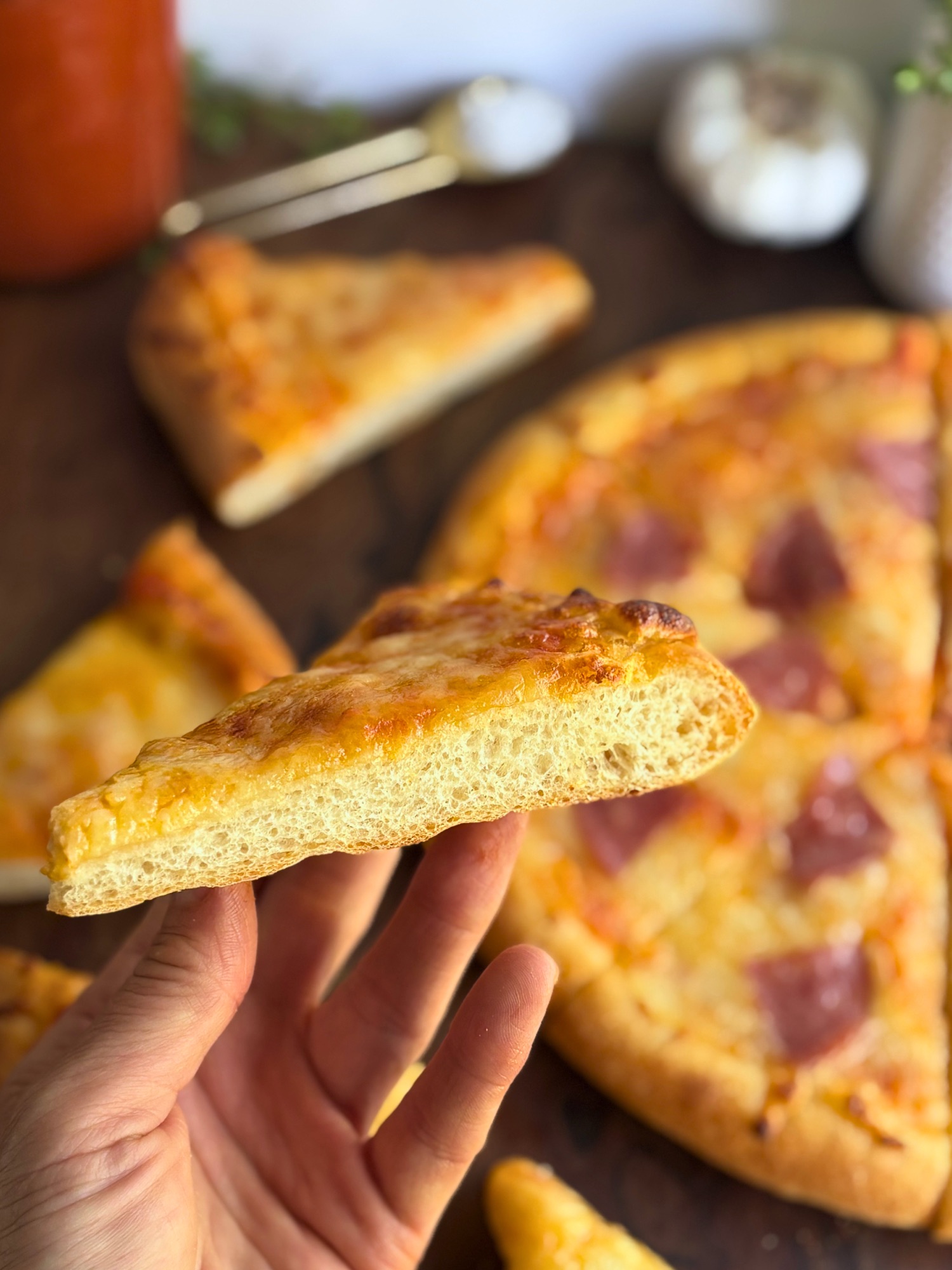
Pizza night does not have to require a two day commitment. And it should not require you to choose between convenience and a crust that actually has flavor, chew, and something worth writing home about nutritionally.
This High Protein Pizza Crust uses instant yeast and is ready to bake in about 90 minutes from start to finish. It is enriched with nonfat Greek yogurt or blended cottage cheese, which bumps the protein content 70% above a standard pizza dough made with nothing but flour and water. No protein powder. No sourdough no starter sitting on your counter. Just a real yeasted dough that rises, stretches, and bakes into a soft, chewy, golden crust that holds up under toppings without going soggy.
If you have been reaching for baking powder pizza doughs on busy weeknights, this is the upgrade you did not know you needed.

Table of Contents
- Why You Will Love This Recipe
- This Is Not a Lean Pizza Dough and That Is the Point
- Greek Yogurt or Cottage Cheese: What You Need to Know
- How to Make High Protein Pizza Crust
- Recipe
- How to Par Bake and Freeze
- Baking Tips
- Substitutions and Variations
- Frequently Asked Questions
- More High Protein Recipes You Will Love
- Never Miss a Recipe
Why You Will Love This Recipe

Ready in about 90 minutes. Mix the dough, let it bulk ferment for 1 to 1.5 hours, shape, and bake. That is it. No overnight planning, no sourdough starter, no complicated process.
70% more protein than regular pizza dough. The Greek yogurt or cottage cheese in this dough boosts the protein content significantly compared to a standard yeast dough made with just flour and water. You are getting more nutrition from the crust itself before a single topping goes on.
A real yeasted dough. Unlike baking powder pizza crusts that come together in minutes and taste like it, this dough actually rises. You get real chew, real structure, and a crust that behaves like pizza dough should when you stretch it.
Par bake and freeze friendly. This crust par bakes beautifully and freezes for up to 3 months. Pull it out, top it, and bake. Weeknight dinner is handled.
No sourdough starter required. If you love the idea of a long fermented version, check out my High Protein Sourdough Pizza Crust. But if you want pizza tonight without any planning, this is your recipe.
This Is Not a Lean Pizza Dough and That Is the Point

Before you dive in, a few things worth knowing so you know exactly what to expect from this crust.
This is an enriched dough. The Greek yogurt or cottage cheese adds fat, protein, and moisture that changes how the dough behaves and how the finished crust tastes and feels. You are not getting a thin, cracker crisp Neapolitan style crust with leopard spot charring. What you get is a soft, tender crumb with a satisfying chew and a golden exterior that browns beautifully because of the dairy’s natural sugars. It is closer to a hearty artisan style crust than a traditional pizza crust, and it holds up under toppings without going soggy or floppy.
The windowpane test also looks different here. Because the fat and protein in the dairy interfere with gluten development, you will not achieve a full translucent windowpane the way you would with a lean bread dough. You are looking for a partial windowpane where the dough stretches without immediately tearing. That is the correct target. Do not over knead chasing a full windowpane or you will end up with a tight, tough result.
The dough will also feel tackier than a standard pizza dough. That is normal and expected. The dairy adds hydration and the dough is working correctly.
Once you know what to expect this crust is incredibly forgiving and produces a result that a baking powder pizza dough simply cannot match for flavor and texture.
Greek Yogurt or Cottage Cheese: What You Need to Know

Both nonfat Greek yogurt and blended cottage cheese work beautifully in this recipe and swap 1:1 with no other adjustments needed. Here is what makes each one work.
Nonfat Greek yogurt is the simplest option. Measure it straight from the container and add it directly to the dough. Use a thick strained Greek yogurt that holds its shape when you spoon it. Thin or regular yogurt will add too much free liquid and throw off your hydration.
Cottage cheese delivers a slightly more neutral flavor and a marginally higher protein content per serving. To use it, blend 200g of cottage cheese with 15g of milk until completely smooth before measuring. The milk brings it to the right consistency. Good Culture is a great option because it is particularly thick and dry. Once blended, measure and use it exactly the same way as the yogurt with no other adjustments needed.
Either way you are boosting the protein content of this crust 70% above a standard pizza dough made with flour and water alone. That number comes entirely from real food, not from protein powders or supplements, which makes it an easy addition to any meal without overthinking it.
How to Make High Protein Pizza Crust

This recipe is straightforward and the active hands on time is minimal. Here is a quick overview before you get into the recipe card.
Combine your dry ingredients in the stand mixer, whisk your wet ingredients together separately, then mix and knead on medium speed for 6 to 8 minutes until smooth and passing a partial windowpane test. Transfer to an oiled bowl and bulk ferment at room temperature for 1 to 1.5 hours until visibly puffy. Divide into two equal pieces, rest for 20 to 30 minutes, and shape.
For shaping, lay a sheet of parchment paper on your surface and give it a light spritz of water. This keeps the dough from sticking without adding any extra flour. Place your dough ball in the center and start pressing from the middle outward with your fingertips, working around the dough in a circle and stretching evenly as you go. Once the dough gets larger, switch to using just your fingertips to push outward around the circle toward the edges, building up your crust rim as you work your way out to a full round. No rolling pin needed and no throwing it in the air required.
The rest before stretching is important. Skipping it means the dough will spring back every time you try to shape it. Twenty to thirty minutes of rest is all it takes for the gluten to relax and the dough to stretch easily and cooperatively.

The full recipe with all measurements and detailed instructions is in the recipe card below.
Recipe

High Protein Pizza Crust
Equipment
- – Stand mixer with dough hook
- kitchen scale
- Pizza stone, steel, or heavy rimmed baking sheet flipped upside down
- Parchment paper
- Small spray bottle with water
- Fork for docking
- Pizza peel or sheet pan
Ingredients
For the Dough
- 380 grams bread flour 3 and 1/4 cups
- 200 grams nonfat Greek yogurt OR 200 grams cottage cheese blended smooth with 15 grams milk, warmed scant 1 cup
- 120 grams water warm 100 to 110 degrees F (1/2 cup)
- 20 grams olive oil 1 and 1/2 tablespoons
- 4 grams instant yeast 1 and 1/4 teaspoons
- 7 grams salt 1 and 1/4 teaspoons
- 5 grams sugar 1 teaspoon
For Baking
- Your favorite pizza sauce
- Low moisture shredded mozzarella
- Toppings of choice
- Water for the parchment
Instructions
- If using cottage cheese, blend 200 grams with 15 grams of milk until completely smooth before measuring. If using Greek yogurt, measure straight from the container. Both should have a thick smooth consistency.
- Warm the yogurt or cottage cheese in the microwave for 30 seconds.
- In the bowl of your stand mixer fitted with the dough hook, combine the bread flour, instant yeast, salt, and sugar and mix briefly on low to distribute. In a separate bowl whisk together the Greek yogurt or blended cottage cheese, warm water, and olive oil until smooth. Pour the wet ingredients into the flour.
- Mix on low speed until a shaggy dough forms, about 2 minutes, then increase to medium speed and knead for 6 to 8 minutes until the dough is smooth, pulls away cleanly from the sides of the bowl, and passes a partial windowpane test. The dough should be tacky but not sticky. If it severely sticks to the bowl after 3 minutes add flour one tablespoon at a time. If it looks too stiff add water one tablespoon at a time.
- Transfer the dough to a lightly oiled bowl, cover, and bulk ferment at room temperature for 1 to 1.5 hours until visibly puffy and increased in size. You do not need it to double, just to look noticeably puffed and airy. Check at the 1 hour mark as instant yeast moves quickly.
- Place your pizza stone, steel, or upside down heavy baking sheet on the top rack and preheat your oven to 475 degrees F for at least 30 minutes. If using the upside down baking sheet shoot for about 10 minutes. A fully preheated surface is the most important factor in getting a crispy bottom crust at home.
- Divide the dough into 2 equal pieces. Shape each into a ball, cover, and rest for 20 to 30 minutes before shaping. The rest period lets the gluten relax so the dough stretches cooperatively.
- Lay a sheet of parchment paper on your work surface and give it a light spritz of water. This keeps the dough from sticking without adding extra flour. Place one dough ball in the center and press from the middle outward with your fingertips, working around the dough in a circle and stretching evenly as you go. Once the dough gets larger switch to pushing outward around the edges with your fingertips to build the crust rim. Work to a 10 to 12 inch round. If the dough springs back cover and rest another 10 minutes before trying again.

- Use a fork to dock the crust all over before baking. This prevents large air bubbles from forming and gives you a flat even surface for toppings.

- For a par bake, slide the docked crust on parchment onto the preheated stone and bake at 475 degrees F for 6 to 8 minutes until just set and lightly golden with no raw patches. Remove, cool completely, wrap tightly, and freeze for up to 3 months. To finish from frozen, add toppings and bake at 475 degrees F for 10 to 12 minutes.
- To bake right away, slide the docked crust on parchment onto the preheated stone and bake at 475 degrees F for 6 to 8 minutes until just set and lightly golden with no raw patches. Remove, add sauce, cheese, and toppings directly to the shaped crust and bake again on the preheated stone at 475 degrees F for an additional 12 to 15 minutes until the cheese is deeply golden and the crust rim is dark brown. Watch closely after 10 minutes as the dairy in this dough accelerates browning.

Notes
How to Par Bake and Freeze

Par baking and freezing this crust is one of the best meal prep moves you can make. It reheats beautifully and tastes almost identical to fresh.
Par bake the shaped crust at 475F on a preheated pizza stone for 6 to 8 minutes until just set and lightly golden with no raw patches. Pull it out and let it cool completely before adding any toppings. A warm crust will steam under the sauce and make the bottom soft before it ever hits the freezer.
Once fully cooled, wrap tightly in plastic wrap then foil and freeze flat. It keeps for up to 3 months.
To bake from frozen, add your sauce, cheese, and toppings straight from the freezer and bake on a preheated stone at 475F for 10 to 12 minutes until the cheese is golden and bubbling. No thawing needed.
Making two crusts and freezing one every time you make this recipe means you always have a high protein pizza crust ready to go on a night when cooking from scratch is not happening.

Baking Tips
Preheat your stone for a full 45 minutes to 1 hour. This is the single most important tip for a crispy bottom crust at home. A stone that has not fully preheated will give you a pale, soft bottom no matter how good your dough is.
Rest the dough before stretching. After dividing, cover the balls and let them rest for 20 to 30 minutes before you try to shape them. If the dough springs back when you press it, cover it and give it another 10 minutes. Forcing it will just tear the dough.
Dock the crust before par baking. Use a fork to poke holes all over the surface before the par bake. This prevents large air bubbles from forming during the initial bake and gives you a flatter, more even surface for toppings.
The crust will brown faster than a lean dough. The dairy sugars in the yogurt or cottage cheese accelerate browning. Keep an eye on the crust around the 7 minute mark and pull it when it looks right rather than going strictly by time.
Spritz the parchment with water before shaping. A light mist of water on your parchment paper prevents the dough from sticking without adding any extra flour that could tighten the dough. It takes two seconds and makes a noticeable difference.
Use your hands not a rolling pin. Start from the center and press outward with your fingertips in a circular motion, rotating as you go. Once the dough is larger switch to pushing outward around the edges with your fingertips to build the rim. A rolling pin degasses the dough and gives you a denser, tougher result.

Substitutions and Variations
Greek yogurt or cottage cheese. Both work at a 1:1 measured swap. Nonfat Greek yogurt goes in straight from the container. Cottage cheese gets blended smooth with 15g of milk first. Use whichever you have on hand.
Active dry yeast instead of instant. If you only have active dry yeast, bloom 5g in the warm water with a pinch of sugar for 5 to 10 minutes until foamy before adding to the recipe. Do not add active dry yeast directly to the dry ingredients the way you would instant yeast.
Long ferment sourdough version. If you want deeper flavor and more complexity, check out my High Protein Sourdough Pizza Crust for the overnight version of this recipe.
Pull apart pizza bites. Use this same dough to make High Protein Pizza Bites (Pull Apart) divide into 24 small balls, arrange in an oiled 13×9 pan, top, and bake at 450F for 15 to 20 minutes.
Different toppings. Try a white sauce base with garlic and fresh mozzarella, pesto with cherry tomatoes, or a classic margherita. The crust is neutral enough to support almost anything.
Frequently Asked Questions
Can I make this without a stand mixer?
Yes. Mix and knead by hand for 10 to 12 minutes until smooth and passing a partial windowpane test. Wet your hands periodically to manage stickiness rather than adding extra flour.
Why is my dough sticky?
This is a higher hydration enriched dough and some stickiness is normal. Use wet hands rather than floured hands when handling. If the dough is sticking to the bottom of the mixer bowl after 3 minutes of kneading, add flour one tablespoon at a time until it clears the bowl.
Why does my dough not windowpane like regular pizza dough?
Because this is an enriched dough the fat and protein from the dairy interfere with gluten development. A partial windowpane where the dough stretches without immediately tearing is the correct target. Do not over knead chasing a full translucent window.
Can I refrigerate the dough overnight?
Yes. After the bulk ferment, cover tightly and refrigerate overnight or up to 24 hours. Cold fermented dough has more flavor and is easier to stretch. Let it come fully to room temperature before shaping.
What if I do not have a pizza stone or steel?
No pizza stone or steel? No problem. Flip a heavy rimmed baking sheet or cookie sheet upside down and place it on the top rack of your oven. Preheat it at 450 degrees F for at least 10 minutes before baking. The flat bottom of the upside down pan acts just like a pizza stone and gives you a much crispier bottom than baking on a cold pan. Slide your pizza on parchment paper directly onto the preheated surface and bake as directed.
How do I know when the crust is done?
For a topped fresh bake you are looking for deeply golden cheese with dark spots, caramelized edges on any meat toppings, and a crust rim that is golden brown. For a par bake, pull it when it looks set and dry but has minimal color.
Can I make this gluten free?
This recipe has not been tested with gluten free flour. The bread flour is essential for the gluten development that gives this crust its structure and chew. However the yeast version would be the one to experiement with!
More High Protein Recipes You Will Love
If you loved this High Protein Pizza Crust, here are a few more recipes from the blog worth trying next.
High Protein Pizza Bites (Pull Apart)
High Protein Sourdough Pizza Crust
High Protein Sourdough Pizza Bites (Pull Apart)
Pull-Apart Pizza Focaccia
High Protein Hamburger Buns
Sourdough Pizza Scones
High Protein Chocolate Chip Muffins

If you make this High Protein Pizza Crust I want to see it. Tag me on Instagram and leave a comment below letting me know how it went and whether you used Greek yogurt or cottage cheese.
Never Miss a Recipe
Sign up for the H3art of the Home newsletter so you never miss a new recipe sent straight to your inbox.






Leave a Reply