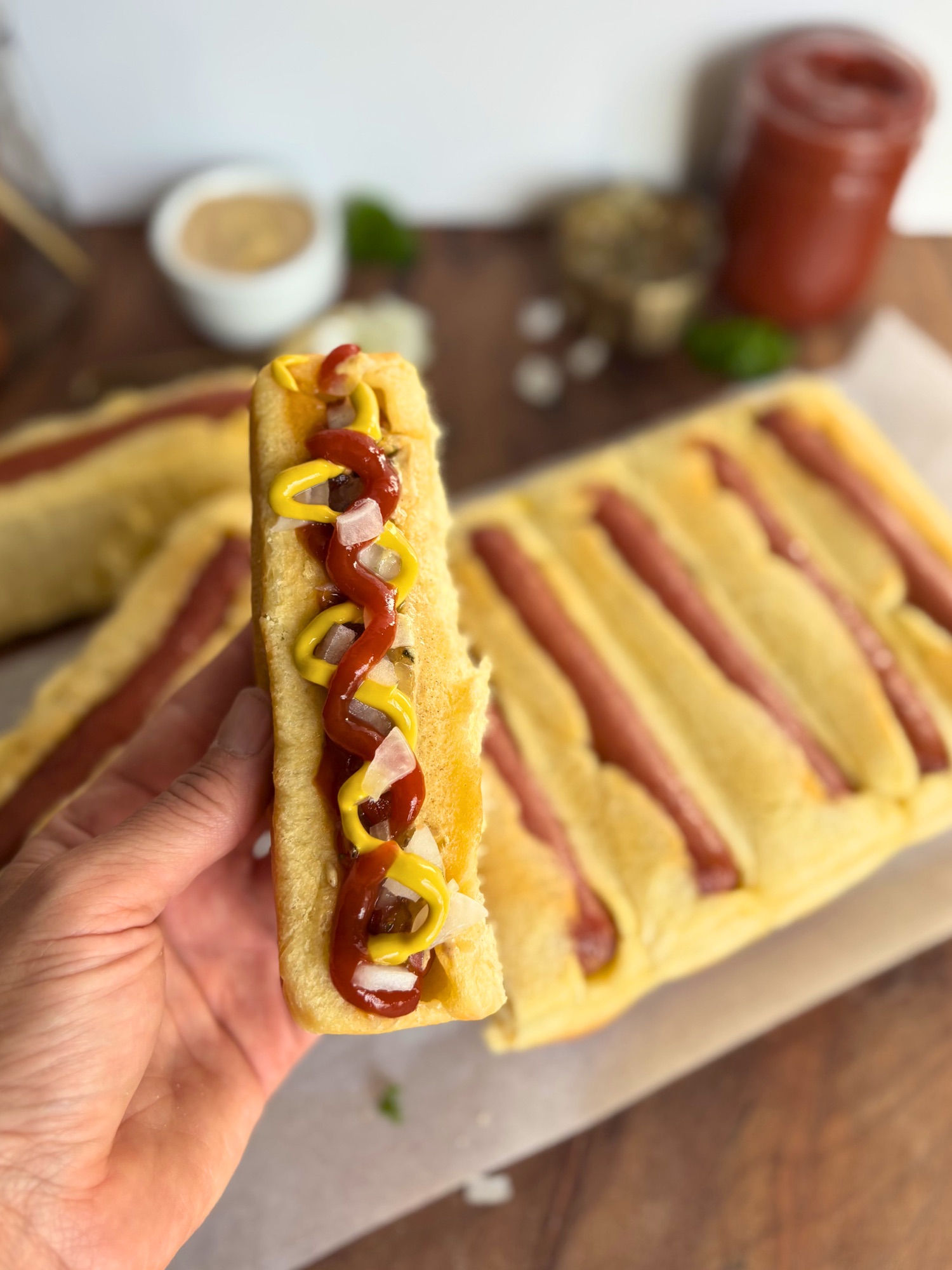
I have made a lot of hot dog buns. I have shaped them, split them, top loaded them, and lined them up in my New England pan like little soldiers. And every single time I thought the same thing. This is a lot of work for something that is going to disappear in four bites at a cookout. Plus a homemade hotdog bun never seemed to fit the same as store bought…until now.
This time I skipped the part where you make a bun and then go find a hot dog to put in it. I laid the hot dog straight into the pan and baked the dough right over the top of it. The dog bakes into the bun. One piece. No slicing a pocket, no dog sliding out the back, no dry store bun soaking up all the mustard before you get to the good part.
These are built on my High Protein Sourdough Hamburger Bun dough, so you already know the crumb is soft, sturdy, and quietly doing more for you than a hot dog bun has any right to do. With nonfat Greek yogurt in the dough and a good beef dog baked in, each one lands right around 15g of protein. No protein powder. Just real food pulling double duty.
Everything you loved about a pig in a blanket, all grown up and taking itself a little more seriously.

Table of Contents
- Why You Will Love These
- What Makes Them High Protein
- The Pan I Use
- Ingredients
- How the Baked In Method Works
- Tips for the Best Baked In Hot Dog Buns
- The Hot Dog Matters
- Recipe
- Want to Make These with Yeast
- Storage and Reheating
- Frequently Asked Questions
Why You Will Love These
There is no bun shaping. That is the whole pitch and it is a good one. You portion the dough, give each piece a quick roll to hot dog length, and drape it over the dog. The pan does the shaping for you.

The dog bakes fully into the bread, so the bread and the dog become one handheld thing. No gap, no slide, no sad split down the middle. The bottom of the well gives the top of the bun those clean flat New England sides once you flip it out, and the crumb underneath stays soft and pillowy.
And because this is the Greek yogurt dough, you get a genuinely high protein result out of something that is usually just empty bread. Around 15g of protein in a hot dog bun is not something the store is offering you.
What Makes Them High Protein
The protein comes from two places and neither one is a scoop of powder.
The dough uses nonfat Greek yogurt, which is the same trick running through my whole high protein series. It brings protein and a soft, tender crumb at the same time, and it keeps the finished bun fresher longer than a plain bun. The dough portion of each bun carries about 6-7g of protein on its own.

Then the hot dog adds its own protein on top. A good beef dog brings roughly 9g per link, so the finished baked in bun lands around 15g of protein each. A standard store bought bun barely moves that number at all.
The Pan I Use
This recipe is built for a USA Pan New England Hot Dog Bun Pan. It has 10 long narrow wells, and those wells are exactly what makes the baked in method work. The dog sits down in the channel, the dough goes over the top, and the walls keep everything upright and snug while it proofs and bakes.

You need the divided pan for this one. A flat sheet pan will not hold the shape, and the dogs will not stay tucked. If you have the pan already because you went down the homemade bun road like I did, this is its moment.
Ingredients
This is a half batch of my sourdough hamburger bun dough, sized to fill all 10 wells without overfilling them. Full amounts, weights, and volume conversions are in the recipe card below, but here is what you are working with and why.
Bread flour gives the dough the structure to wrap around a dog and hold. I add a touch more flour here than a straight half batch, because a slightly firmer dough rolls and drapes better than a wet one.
Active peaked sourdough starter does the leavening and the flavor. Use it at peak, bubbly and risen, not straight discard.
Nonfat Greek yogurt is the protein and the softness. Do not swap it for full fat or regular yogurt without adjusting, or the hydration goes sideways.
Butter, one egg, a little sugar, salt, and a small amount of baking powder round it out. The baking powder is a backup leavener so you get a reliable rise even on a busy day.
You will also need 10 hot dogs, an egg wash, and a little melted butter for brushing after they bake.

How the Baked In Method Works
The dough itself is made exactly like my sourdough hamburger buns. Nothing about the mixing or the bulk ferment changes. The only new part is what happens at shaping, so that is what I want to walk you through here. The full step by step is in the recipe card.
Once the dough has finished its bulk ferment, you divide it into 10 even pieces. Each piece gets a quick roll across the counter to stretch it out to roughly the length of a hot dog. Start in the middle and pull outward as you roll back and forth. A short rest lets the gluten relax so the dough stops fighting you.

Then you pat each piece flat, lay it over a dog, and press the sides of the dough all the way down to the bottom edge of the dog so it wraps rather than just sitting on top like a lid. Be sure to leave a little of the hot dog peeking out. That almost full wrap is what seals the dog into the bread. You place each one dog side down in the well, so the smooth dough is on the bottom and the dog ends up on top once it bakes and you flip it out.


From there it is a final proof until puffy, an egg wash, and into the oven. The dog is precooked, so you are really baking the bread to golden and heating the dog through.

Tips for the Best Baked In Hot Dog Buns
Pat the dogs dry before they go in. They release fat and moisture as they heat, and a dry dog gives you a cleaner seal and a less soggy bottom.
Grease the wells even if your pan is nonstick. Dough wrapped around a dog grabs more than a plain bun does, and you want these to release in one piece.
Do not overload each well. The dog is already taking up most of the space, so a piece around 65g is plenty. Too much dough and it mushrooms up over the ridges and merges with its neighbor.
Press the dough all the way down the sides. If you just lay it on top, you get a lid, not a wrapped bun. Seal it to the bottom edge of the dog.
Let them cool before you separate them. They bake as one connected slab, and if you pull them apart hot they tear. Give them time to set and they come apart clean.

The Hot Dog Matters
Since the dog is baked in and there is no swapping it out later, pick one you actually like. I used the Applegate Organics The Great Organic Uncured Beef Hot Dog. It is 100 percent grass fed beef, no added sugar, no fillers, and about 9g of protein per link, which is what carries the finished bun to around 15g.

Any standard length hot dog works. If you use a longer or thicker dog, just know it will fill more of the well, so you may want to trim your dough portions down a few grams so nothing overflows.
Recipe
The full sourdough recipe card with weights, volume conversions, and step by step instructions is below. Looking for the yeasted version? Jump to Want to Make These with Yeast.

High Protein Sourdough Hot Dog Buns (Hot Dogs Baked In)
Equipment
- USA Pan New England Hot Dog Bun Pan (10 wells)
- kitchen scale
- Large mixing bowl
- bench scraper
- Paper Towel Pastry Brush
- Instant read thermometer
Ingredients
- 285 g bread flour 2 and 1/4 cups
- 108 g active peaked sourdough starter scant 1/2 cup
- 155 g nonfat Greek yogurt room temperature (2/3 cup)
- 32 g unsalted butter softened (2 tablespoons plus 1 teaspoon)
- 1 large egg room temperature
- 13 g granulated sugar 1 tablespoon
- 4 g fine sea salt 3/4 teaspoon
- 2 g baking powder 1/2 teaspoon
To Assemble
- 10 hot dogs patted dry
- Butter or oil for greasing the pan
Egg Wash/Finish
- 1 large egg
- 15 g water 1 tablespoon
- 28 g unsalted butter melted, for brushing after baking (2 tablespoons)
Instructions
- If the Greek yogurt is coming straight from the fridge, microwave it for about 30 seconds and stir well before using. You want it warm to the touch but not hot. Yogurt that is too hot can kill your starter.
- In a medium bowl, whisk together the bread flour, baking powder, salt, and sugar until evenly combined.
Mix (Two Ways)
Stand Mixer
- In a separate bowl, whisk the active starter, warmed Greek yogurt, and egg until smooth. Pour the dry mixture into the wet ingredients and mix until a rough dough is formed. Then mix in the softened butter until a soft, slightly tacky dough forms. If the dough feels sticky, work in a little more flour, 10 grams at a time, but don't add too much as it can make your rolls dense. The dough will naturally be tackier because the yogurt hydrates differently.
- Knead for about 3-4 minutes. Place in an oil bowl and cover.
By Hand
- In a separate bowl, whisk the active starter, warmed Greek yogurt, and egg until smooth. Pour the dry mixture into the wet ingredients and mix until a rough dough is formed. Then mix in the softened butter until a soft, slightly tacky dough forms. If the dough feels sticky, work in a little more flour, 10 grams at a time, but don't add too much as it can make your rolls dense. The dough will naturally be tackier because the yogurt hydrates differently.
- Knead the dough on a floured clean surface for about 5 minutes, just until it comes together and smooths out. Place in oiled bowl and cover.
One Hour Rest
- Perform a few rounds of stretch and folds after an hour rest.
Bulk Ferment
- Cover the dough and let it bulk ferment at room temperature for about 6 to 8 hours, or until noticeably risen and airy. Timing depends on the temperature of your kitchen and the strength of your starter.
Shaping
- Grease all 10 wells of the pan well, even if it is nonstick. Pat each hot dog dry and set aside.
- Turn the dough out onto a lightly floured surface and weigh the total dough. Divide into 10 equal pieces of approximately 65 grams each using a bench scraper.
- Roll each piece across the counter into a log roughly the length of a hot dog. Start in the middle and pull outward as you roll back and forth. Let the pieces rest 5 to 6 minutes so the gluten relaxes.

- Pat a piece of dough flat into an oval. Lay a hot dog in the center and press the sides of the dough all the way down to the bottom of the dog so it wraps around, not just over the top. Leaving the bottom open. Place it dog side down into a well of the pan, smooth dough on the bottom. Repeat with the remaining dogs and dough.

Second Proof
- Cover and proof for about 1 1/2 hours, until puffy. Preheat the oven to 375 degrees F during the last 20 minutes of proofing.
Baking
- Whisk the egg with the water until smooth. Gently brush the tops with the egg wash.
- Bake at 375 degrees F for about 30 minutes, until deep golden brown. The buns are done when the bread reads 190 to 195 degrees F internal and the hot dogs are heated through.
- Remove from the oven and flip so the hotdog is now visable.
- Brush the hot buns immediately with melted butter.
- Let the buns cool before separating them, since they bake as one connected slab and need to set before you pull them apart cleanly.
Notes
Want to Make These with Yeast
Not everyone has an active starter ready to go, and a cookout does not always give you an 8 hour heads up. So this post carries both versions. The sourdough recipe card is above, and the same day yeasted version is right here in its own recipe card below.
The yeasted dough is a half batch of my High Protein Yeasted Hamburger Buns, built on the same Greek yogurt base with active dry yeast doing the leavening instead of starter. Everything about the assembly is identical. Portion the dough, roll each piece to hot dog length, wrap it around a dog, and place it dog side down in the pan. The only differences are the yeast bloom at the start and the shorter timeline, since you go from mixing to baking in a few hours instead of waiting on a bulk ferment.
High Protein Yeasted Hot Dog Buns (Hot Dogs Baked In)
Equipment
- USA Pan New England Hot Dog Bun Pan (10 wells)
- – Stand mixer with dough hook or Hands
- kitchen scale
- Small bowl for blooming yeast
- bench scraper
- Paper Towel Pastry brush
- Instant read thermometer
Ingredients
INGREDIENTS
- 325 g bread flour 2 and 2/3 cups
- 7 g active dry yeast 2 and 1/4 teaspoons, one standard packet
- 30 g warm water 105 to 110 degrees F (2 tablespoons)
- 16 g granulated sugar divided (1 tablespoon plus 1 teaspoon)
- 212 g nonfat Greek yogurt room temperature (3/4 cup plus 2 tablespoons)
- 37 g unsalted butter softened (2 and 1/2 tablespoons)
- 5 g fine sea salt scant 1 teaspoon
- 1 large egg room temperature
To Assemble
- 10 hot dogs patted dry
- Butter or oil for greasing the pan
Egg Wash/Finish
- 1 large egg
- 15 g water 1 tablespoon
- 28 g unsalted butter melted, for brushing after baking (2 tablespoons)
Instructions
- In a small bowl, combine the warm water, active dry yeast, and 1g of the sugar. Stir gently and let sit for 5 to 10 minutes until foamy. If the mixture does not foam, your yeast is no longer active and you should start with a fresh packet before continuing.
- In a medium bowl, whisk together the bread flour, salt, and remaining 15g of sugar until evenly combined.
- If the Greek yogurt is coming straight from the fridge, microwave it for about 30 seconds and stir well before using. You want it warm to the touch but not hot. Add the warmed Greek yogurt, egg, and bloomed yeast mixture to the bowl of a stand mixer fitted with the dough hook. Mix briefly on low speed to combine.
- Add the dry ingredients to the wet ingredients and mix on low speed until a shaggy dough forms, about 1 minute.
- With the mixer running on low, add the softened butter one tablespoon at a time, waiting for each addition to be fully incorporated before adding the next. This slow addition prevents the dough from becoming greasy and allows the flour to absorb the fat properly.
- Once all the butter is incorporated, increase the mixer to medium speed and knead for 6 minutes until the dough is smooth, elastic, and pulls away cleanly from the sides of the bowl. The dough should be tacky but not sticky.
- Shape the dough into a smooth ball and place it in a lightly oiled bowl. Cover with plastic wrap or a damp towel and let it rise at room temperature for 1 to 1.5 hours, or until doubled in size.
- While the dough rises, grease all 10 wells of the pan well, even if it is nonstick. Pat each hot dog dry and set aside.
- Turn the dough out onto a lightly floured surface and weigh the total dough. Divide into 10 equal pieces of approximately 65 grams each using a bench scraper.
- Roll each piece across the counter into a log roughly the length of a hot dog. Start in the middle and pull outward as you roll back and forth. Let the pieces rest 5 to 6 minutes so the gluten relaxes.
- Pat a piece of dough flat into an oval. Lay a hot dog in the center and press the sides of the dough all the way down to the bottom of the dog so it wraps around, leaving the bottom part of the hotdog open (which will be the top after baking and flipping). Place it dog side down into a well of the pan, smooth dough on the bottom. Repeat with the remaining dogs and dough.
- Cover loosely and proof for 45 minutes to 1 hour, until noticeably puffy. Preheat the oven to 375 degrees F during the last 20 minutes of proofing.
- Whisk the egg with the water until smooth. Gently brush the tops with the egg wash with a piece of paper towel or pastry brush.

- Bake at 375 degrees F for 25 to 30 minutes, until deep golden brown. The buns are done when the bread reads 190 to 195 degrees F internal and the hot dogs are heated through.
- Let the pan rest for five minutes
- Flip the buns out of the tray.
- Brush the hot buns immediately with melted butter.
- Let the buns cool about 15 minutes before separating them, since they bake as one connected slab and need to set before you pull them apart cleanly.
Notes
Storage and Reheating
Store cooled buns in an airtight container in the fridge for up to 5 days. To reheat, warm them in a 300 degree oven for a few minutes until the bread is soft and the dog is hot through. You can freeze them too. Wrap individually, freeze, and reheat from frozen in a low oven until warmed all the way through.
Because these already have the dog baked in, they reheat into a full handheld meal. No assembly, no second pan.

Frequently Asked Questions
Can I use a regular loaf pan or sheet pan instead of the New England pan?
I haven’t tested it. The divided wells are what hold the dog and dough upright and give you separate buns.
Do I need to cook the hot dogs first?
No. Hot dogs are precooked, so they only need to heat through while the bread bakes. Just pat them dry before wrapping.
Why bake them dog side down?
So the smooth dough forms the bottom of the bun and the dog ends up on top when you flip it out. It gives you that clean look with the dog visible in the bread.
My dough felt wet and hard to roll. What happened?
Sourdough hydration shifts with your starter and your yogurt. If the dough is too slack to roll, work in a small amount of extra flour, 10 to 20g at a time, until it is firm enough to shape but still soft.
How much protein is in each one?
About 15g per bun, roughly 6-7g from the Greek yogurt dough and about 9g from a beef hot dog. Your exact number will depend on the dog you choose.
Subscribe
If you make these, I want to hear about it. Tag me so I can see your baked in hot dog buns, and subscribe to get every new high protein recipe sent straight to your inbox before it hits the feed. There is a whole series of these Greek yogurt recipes waiting for you, and none of them involve a scoop of anything.




Leave a Reply