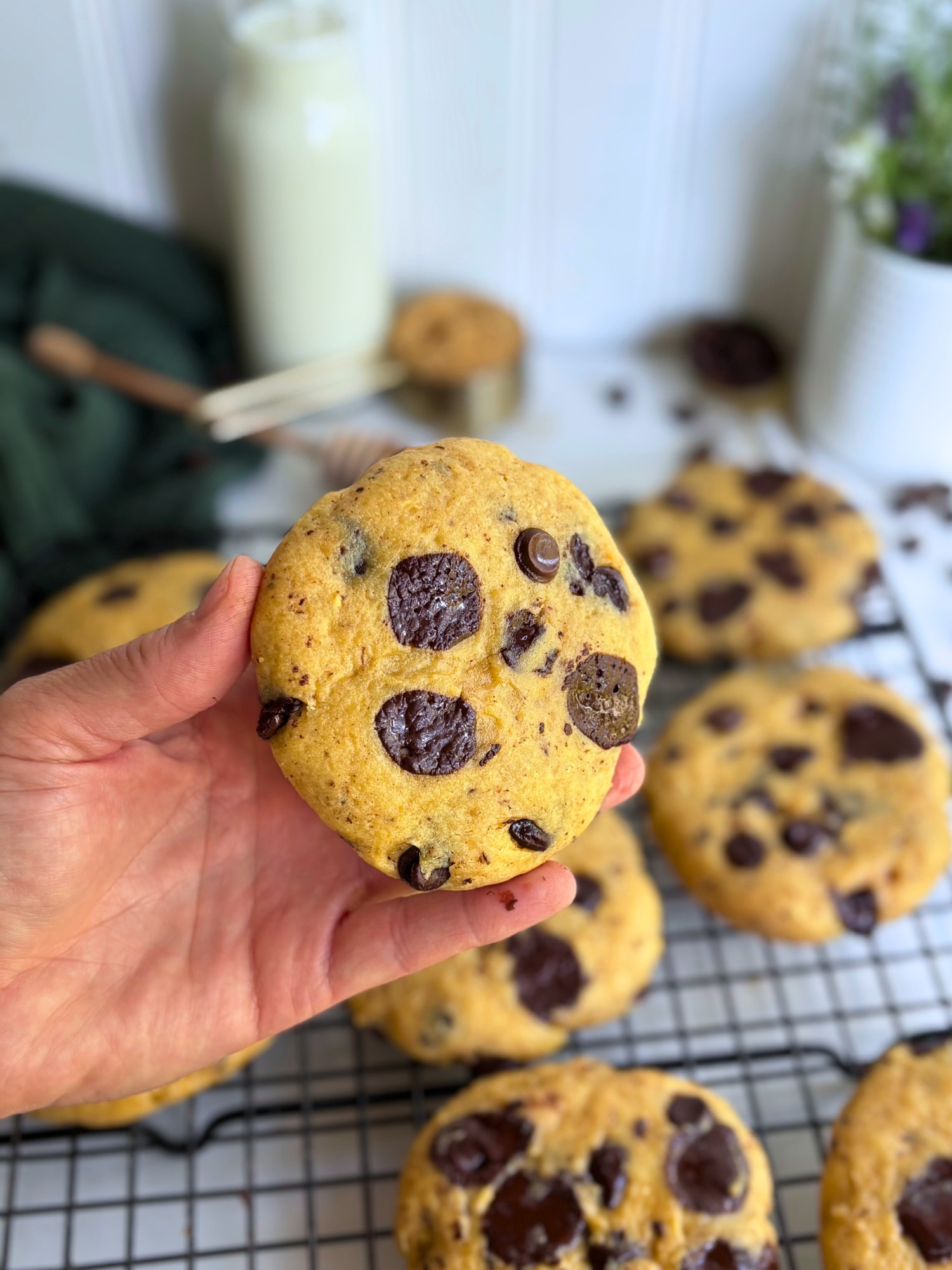
I was not trying to make a protein cookie. I want to say that up front, because the internet is full of them and most of them taste like the compromise they are.
What I wanted was a chocolate chip cookie. A real one, thick and soft with pools of dark chocolate and browned butter you can smell from the next room, that also happened to bring a little more to the table than the version I would otherwise be eating three of. Something I could hand my kids after school without doing math in my head about it.
So this is a chocolate chip cookie first. The cottage cheese goes in blended smooth, where it carries moisture and richness that would otherwise have to come from a lot more butter, and it brings the protein along with it as a bonus rather than as the whole point. The sourdough discard goes in because I always have it and because a long cold rest in the refrigerator turns it into flavor rather than waste. There is no protein powder anywhere in this recipe, and there never will be.
It is worth knowing what that trade actually buys you before you preheat anything. There is less butter here and less sugar than a standard bakery cookie, and cottage cheese is carrying moisture that butter normally would. A cookie built that way behaves a little differently in the oven and eats a little differently in the hand. It is softer and more tender than a chewy bakery cookie, and it browns more gently because there is less sugar to caramelize. That is the design, not a shortcoming, and once you know to expect it you will stop waiting for it to look like something it was never going to look like.
What you get instead is a thick, soft cookie with real chew, deep browned butter flavor, and melted dark chocolate running through it, carrying about a third less sugar and 70 percent more protein than a classic homemade chocolate chip cookie the same size, with no protein powder anywhere in it.

Table of Contents
Why These Work
Blended cottage cheese is the whole trick. Left in curds it would be a texture problem. Blended completely smooth it becomes a thick cream that carries water, fat, and protein into the dough all at once, which is how this cookie stays soft for days on far less butter than it looks like it should need.
Browned butter does double duty. Browning drives the water out of the butter, which matters more here than usual because the cottage cheese is already bringing plenty of its own. It also gives you the nutty, almost caramel flavor that makes a lower sugar cookie taste finished instead of restrained.
The discard earns its place. A 12 hour rest in the refrigerator is not just about chilling the dough. It gives the flour time to fully hydrate and gives the discard time to do what fermentation does to flavor, which is turn it deeper and more complex than anything you can get from a same day cookie.
Dark chocolate over semi sweet. At 69 percent cacao you get more chocolate flavor per chip and quite a bit less sugar, which lets the sugar in the dough come down without the whole cookie tasting flat. I used Hu Chocolate Dark Chocolate Gems and Enjoy Life Dark Chocolate Chips.
Ingredient Notes
Cottage cheese. I use Good Culture 4 percent. Full fat matters here since the fat is doing structural work, and it has to be blended until there is not a single curd left. If you can see texture in the blender, keep going.
Bread flour. King Arthur organic unbleached bread flour, the same flour I use for everything else including my starter. The extra protein in bread flour gives these cookies the chew that keeps them from going cakey, which is a real risk in any dough carrying this much moisture.
Sourdough discard. Straight from the refrigerator at 100 percent hydration, and younger is better here. Discard that has been sitting for a week will push the flavor further than you want in a chocolate chip cookie, since there is no cocoa standing in front of it. A day or two past feeding is the sweet spot.
Brown sugar and honey. The honey replaces the white sugar you would normally see. It is sweeter per gram than granulated sugar and holds onto moisture better, so it does more work with less weight, which is how the total sugar came down without the cookie going dry.
Egg yolks only. Yolks bring the emulsifying power that keeps all that cottage cheese water bound to the fat instead of running loose. Whites would add water and lift, and lift is the last thing this dough needs.
Enjoy Life dark chocolate morsels. These are dairy free and free from fourteen allergens, so they open the recipe up to more people, and at 69 percent cacao they carry about 40 percent less sugar than a standard semi sweet chip. Any good dark chocolate works if you prefer something else. I also used Hu Dark Chocolate Gems in this! If you want to go further in that direction, my Double Chocolate High Protein Cookies are built on the same idea with cocoa worked into the dough, also with no protein powder.

Shop This Recipe
- Digital kitchen scale. Every measurement in this recipe is in grams first, and with a dough this sensitive to moisture the scale is not optional.
- Light bottomed saucepan. You cannot judge browned butter in a dark pan, and the difference between nutty and burned is about thirty seconds.
- Food Processor. For getting the cottage cheese completely smooth. A blender works, but this gets there faster and cleaner.
- Half sheet pans. Heavy aluminum, not dark nonstick, which browns the bottoms too fast.
- Cooling rack. These need to set on the pan and then finish cooling on a rack so the bottoms do not steam.
I earn a small commission from these affiliate links at no cost to you, which helps support the blog and keep the recipes coming.
How to Make Them
Full amounts, temperatures, and timing are in the recipe card at the bottom of this post. Here is what is happening at each stage and why it matters.

Brown the butter properly. Keep it moving over medium high heat until the bubbling changes in sound and slows down, then drop the heat and keep stirring until it smells nutty and turns deep amber. Scrape every bit of the toasted milk solids from the bottom of the pan into your bowl, because that is where all of that flavor actually lives, and leaving it behind is the most common way people end up wondering why their browned butter cookies do not taste like anything.
Rest the butter and sugars together. Once the sugar and honey go into the hot butter, let the mixture sit before you whisk it. That short rest lets the residual heat start dissolving the sugar, which is where the chew comes from.
Whisk, do not cream. This is the step that decides whether you get a cookie or a dome. Creaming beats air into the dough, and air is a leavening system you did not ask for. Whisk only until the mixture pulls together and looks like wet sand, then stop.
Cool before the yolks. Warm is fine, hot will scramble them. There are no whites in this dough to buffer the yolks, so they are more vulnerable than usual.
Fold the dry ingredients in by hand. The mixer has done its job. Once flour meets liquid you are developing gluten, and a few extra turns is the difference between chew and tough.
Chill for 12 hours, and mean it. The dough will feel loose and slack when you cover it, and every instinct will tell you to add flour. Do not. Bread flour keeps absorbing water for hours, and what feels wet at midnight will be scoopable and firm by morning.

Flatten the dough into discs before baking. Do not put round balls on the pan. Press each portion into a thick disc, which gives the spread a head start and is one of the main reasons these bake wide instead of tall. Press a few extra chunks of chocolate onto the tops while you are there, since that is what makes them look like the cookies in the pictures.
Pull them looking underdone. The edges should be golden and set while the centers still look soft but not shiny. They finish on the hot pan. If you wait until the middle looks done in the oven, you have already gone too far. On the other end of it, if you want a cakier cookie, that is puffier and light, bake an additional 3-4 minutes.

Tips for the Best Cookies
Weigh everything. This dough sits in a narrow window between soft and cakey, and a heavy hand with a measuring cup can put an extra 30 grams of flour into the bowl without you noticing. That is enough to change the cookie entirely.
Do not add flour to fix a loose dough. I know I already said it. I am saying it again because it is the single most likely way this recipe goes wrong. The refrigerator is the fix, not the flour canister.
Use young discard. There is no cocoa in this cookie to stand in front of the fermentation flavor, so discard that has been sitting a long time will come through more than you want.
If they dome anyway, bang the pan. Pull the sheet at about five minutes, drop it firmly onto the counter two or three times until the centers collapse, then return it to the oven to finish. It works, and it is much easier than reworking the dough.

Why These Do Not Brown Like a Regular Cookie
I want to tell you this before you bake them rather than after, because most of us judge a cookie with our eyes and these do not look the way a bakery chocolate chip cookie looks coming out of the oven.
These bake up golden. Set golden edges, a slightly paler center, and nothing like the deep bronze you get from a standard recipe. The first time you make them your instinct will be to leave them in longer, which is fine if you want a cakier, lighter cookie.
Here is what is happening. Browning in a cookie comes from two reactions, caramelization of sugar and the Maillard reaction between sugars and proteins, and both of them need a hot dry surface to get going. This dough gives them neither.
There is less sugar to caramelize. Sugar is the primary browning agent in any cookie, and this recipe runs about a third less of it than a classic homemade chocolate chip cookie the same size. Less sugar means less color and that is a trade I made on purpose.
The cottage cheese brings a lot of water. As long as a surface is evaporating water it cannot climb past 212 degrees, and the Maillard reaction does not get moving until well above that. So the surface of these cookies spends much of the bake busy steaming rather than browning. It is the same reason a piece of chicken that goes into a pan wet will never get a crust.
The oven is gentle on purpose. These bake at 350, which is not a browning temperature so much as a setting temperature. A hotter oven would give you more color and a puffier cookie and after testing that tradeoff I would rather have the cookie than the picture of it.
So watch the edges instead of the middle. Pull them when the outer rim is golden and set and the center still looks soft and matte. They finish on the hot pan over the next ten minutes. If you wait until the whole surface looks done in the oven, you have gone several minutes too far and you will have that fluffy cakey cookie.
Storage and Freezing
On the counter. In an airtight container these stay soft for four days, which is longer than a standard chocolate chip cookie holds up. The cottage cheese and the honey are both doing that work, since both hold onto moisture.
Freezing baked cookies. Cool them completely, then freeze in a single layer before transferring to a bag. They thaw on the counter in about an hour, or you can warm one in a 300°F oven for five minutes and get the melted chocolate back. This is actually my favorite way to enjoy them. Once they freeze the resistant starch increases, meaning it digests differently and helps stabilize blood sugar even more.
Freezing the dough. This is how I usually do it. Portion the chilled dough, flatten the discs, and freeze them on a sheet pan until solid, then bag them. Bake straight from frozen and add two or three minutes. Having these in the freezer means a warm cookie is fifteen minutes away whenever somebody needs one.

Frequently Asked Questions
Can you taste the cottage cheese?
No. Blended completely smooth and surrounded by browned butter, brown sugar, vanilla, and dark chocolate, it disappears entirely. Nobody who has eaten these has guessed it was in there.
Do I have to use bread flour?
I would. All purpose will work, but you will get a softer, more delicate cookie, because the extra protein in bread flour is a large part of what gives these their chew and keeps a dough this moist.
Can I skip the 12 hour chill?
Not really. This dough is much wetter than a standard cookie dough, and the chill is what lets the flour finish absorbing that water. Baking it warm gives you a cookie that spreads into a thin puddle. If you are truly out of time, six hours is the shortest I would go.
Why is my dough so loose?
Because it is supposed to be. Cottage cheese brings a great deal of water with it, and bread flour needs hours to take that water up. It will be firm and scoopable after the chill.
Can I use regular chocolate chips?
Yes. You will get a sweeter cookie, since a standard semi sweet chip carries close to 40 percent more sugar than the 69 percent dark I use. If you make that swap and it reads too sweet, that is why.
How much protein is in one cookie?
Close to 7 grams, which is about 70 percent more than a classic homemade chocolate chip cookie the same size, and there is no protein powder anywhere in this recipe.
How do these compare to a regular chocolate chip cookie?
Measured against a classic homemade chocolate chip cookie at the same 85 grams, these run about 35 percent less sugar, about 35 percent less fat, and about 25 percent fewer calories, with roughly 70 percent more protein. They are still a cookie, and there is still real sugar and real butter in them. They just bring more along for the ride.
Can I make these smaller?
You can, and you will get about 18 cookies at 55 grams instead of 12 at 85 grams. Drop the bake time by two or three minutes and start checking early.
Does the sourdough discard make them sour?
Not if the discard is young. A day or two past feeding gives you depth and complexity without anything sharp. Discard that has been sitting in the refrigerator for a week or more will come through much more strongly.
What are the macros?
- Calories 285 kcal
- Carbohydrates 41g
- Protein 7g
- Fat 13g
- Saturated Fat 7g
- Cholesterol 49mg
- Sodium 316mg
- Potassium 165mg
- Fiber 2g
- Sugar 21g
- Calcium 45mg
- Iron 2mg
Sourdough Recipe

Brown Butter Cottage Cheese Chocolate Chip Cookies (Sourdough or Classic)
Equipment
- Digital Kitchen Scale
- Light bottomed saucepan
- food processor for the cottage cheese High speed blender
- Large mixing bowl
- Whisk
- Cooling rack
- Half sheet pans
Ingredients
- 230 g Good Culture/Nancy’s 4% cottage cheese blended completely smooth (1 cup)
- 260 g King Arthur organic unbleached bread flour 2 cups plus 3 tablespoons
- 160 g brown sugar packed (3/4 cup)
- 40 g honey 2 tablespoons
- 85 g unsalted butter weighed before browning (6 tablespoons)
- 2 large egg yolks room temprature
- 60 g fresh sourdough discard at 100% hydration 1/4 cup
- 3 g baking soda 1/2 teaspoon
- 6 g fine sea salt 1 teaspoon
- 12 g vanilla extract 1 tablespoon
- 150 g dark chocolate chips (scant 1 cup)
- Extra dark chocolate chunks for pressing on top
- Flaky sea salt for finishing
Instructions
- Blend the cottage cheese with the vanilla in a high speed blender until completely smooth with no curds visible at all. Doing this first takes the chill off before adding to the dough.
- Melt the butter in a light bottomed saucepan over medium high heat, stirring constantly. When the bubbling slows and changes in sound, lower the heat to medium low and keep stirring until the butter smells nutty and turns deep amber, about 5 to 7 minutes total. Pour it into a large mixing bowl and scrape every bit of the toasted milk solids from the bottom of the pan in with it. It should weigh close to 70g now.
- Add the brown sugar and honey to the hot butter, stir briefly to combine, and let the mixture sit for 5 minutes so the sugar begins to dissolve.
- Whisk for about 1 minute, until the mixture looks like very wet sand and has pulled together. Stop there and do not whip air into it. If using a stand mixer the paddle attchment is fine for this.
- Let the mixture cool to warm before continuing, since hot butter will scramble the yolks.
- Mix the egg yolks into the butter and sugar for about 2 minutes, until creamy and lightened but not fluffy.
- Add the blended cottage cheese and whisk until smooth, then add the sourdough discard and stir gently just until incorporated.
- Whisk the flour, baking soda, and fine sea salt together in a separate bowl, then fold them into the wet mixture by hand with a rubber spatula. Fold in the chocolate chips.
- Cover the bowl and refrigerate for 8-12 hours. The dough will feel loose when you cover it. Do not add flour, it firms up as the flour hydrates.
- Preheat the oven to 350°F and line two half sheet pans with parchment paper.
- Portion the cold dough at 80-85g each for 12 cookies. Press each portion into a thick disc rather than leaving it as a ball, spacing them well apart on the pans. Press extra chocolate chunks if you want onto the tops and finish with flaky sea salt.
- Bake for about 14 minutes, until the edges are golden and set and the centers still look soft and slightly underdone. Every oven is different and that time is a guide.
- Cool on the pan for 10 minutes, then transfer to a cooling rack to finish.
Notes
More Recipes You Will Love
- Double Chocolate High Protein Cookies (No Protein Powder)
- High Protein Sourdough Chocolate Chip Muffins
- High Protein Greek Yogurt Chocolate Chip Muffins
- High Protein Sourdough Bagels
- High Protein Bagels
- How to Create a Sourdough Starter
No Sourdough Version
You do not need a starter to make these. The discard is here for flavor and for using up what I already have, not for leavening, so it comes out cleanly.
The result is a slightly milder cookie. You lose the depth the discard brings, and you gain a cleaner browned butter and chocolate flavor, which some people in my house actually prefer.
If you have been thinking about starting a starter, I walk through the whole process here: How to Create a Sourdough Starter

Brown Butter Cottage Cheese Chocolate Chip Cookies
Equipment
- Digital Kitchen Scale
- Light bottomed saucepan
- Food processor High speed blender
- Large mixing bowl
- Half sheet pans
- Parchment paper
- Cooling rack
Ingredients
- 230 g Good Culture/ Nancy’s 4% cottage cheese blended completely smooth (1 cup)
- 285 g King Arthur organic unbleached bread flour 2 cups plus 6 tablespoons
- 160 g brown sugar packed (3/4 cup)
- 40 g honey 2 tablespoons
- 1/4 teaspoon dark roast instant coffee
- 85 g unsalted butter weighed before browning (6 tablespoons)
- 2 large egg yolks
- 30 g whole milk 2 tablespoons
- 3 g baking soda 1/2 teaspoon
- 6 g fine sea salt 1 teaspoon
- 12 g vanilla extract 1 tablespoon
- 150 g dark chocolate chips 69% cacao (scant 1 cup)
- Extra dark chocolate chunks for pressing on top
- Flaky sea salt for finishing
Instructions
- Blend the cottage cheese with the vanilla in a high speed blender until completely smooth with no curds visible at all. Doing this first will take the chill off before adding it into the dough.
- Melt the butter in a light bottomed saucepan over medium high heat, stirring constantly. When the bubbling slows and changes in sound, lower the heat to medium low and keep stirring until the butter smells nutty and turns deep amber, about 5 to 7 minutes total. Pour it into a large mixing bowl and scrape every bit of the toasted milk solids from the bottom of the pan in with it. It should weigh close to 70g now.
- Add the brown sugar, honey, and instant coffee to the hot butter, stir briefly to combine, and let the mixture sit for 5 minutes. The coffee needs the hot liquid to dissolve, which is why it goes in here rather than with the dry ingredients.
- Whisk for about 1 minute, until the mixture looks like very wet sand and has pulled together. Stop there and do not whip air into it. If using a stand mixer, the paddle attchment is fine for this.
- Let the mixture cool to warm before continuing, since hot butter will scramble the yolks.
- Whisk the egg yolks into the butter and sugar for about 2 minutes, until creamy and lighter but not fluffy.
- Add the blended cottage cheese and whisk until smooth, then add the milk and stir gently just until incorporated.
- Whisk the flour, baking soda, and fine sea salt together in a separate bowl, then fold them into the wet mixture by hand with a rubber spatula. Fold in the chocolate chips. If using a stand mixer, go slow here as to not over mix.
- Cover the bowl and refrigerate for 8-12 hours. The dough will feel loose when you cover it. Do not add flour, it firms up as the flour hydrates.
- Preheat the oven to 350°F and line two half sheet pans with parchment paper.
- Portion the cold dough at 80-85g each for 12 cookies. Press each portion into a thick disc rather than leaving it as a ball, spacing them well apart on the pans. Press extra chocolate chunks onto the tops and finish with flaky sea salt.
- Bake for 14 minutes, until the edges are golden and set and the centers still look soft and matte. If they seem to be domeing, pull the pan at five minutes a tap the tray onto the counter a few times, then continue to bake.
- Cool on the pan for 10 minutes, then transfer to a cooling rack to finish.
Notes
Subscribe
If you made these, I would love to know how they turned out. Leave a star rating and a comment below, and tag me when you share them.
Subscribe to get new recipes straight to your inbox, and come find me on Instagram, Facebook, and Pinterest for everything that does not make it to the blog.






Leave a Reply