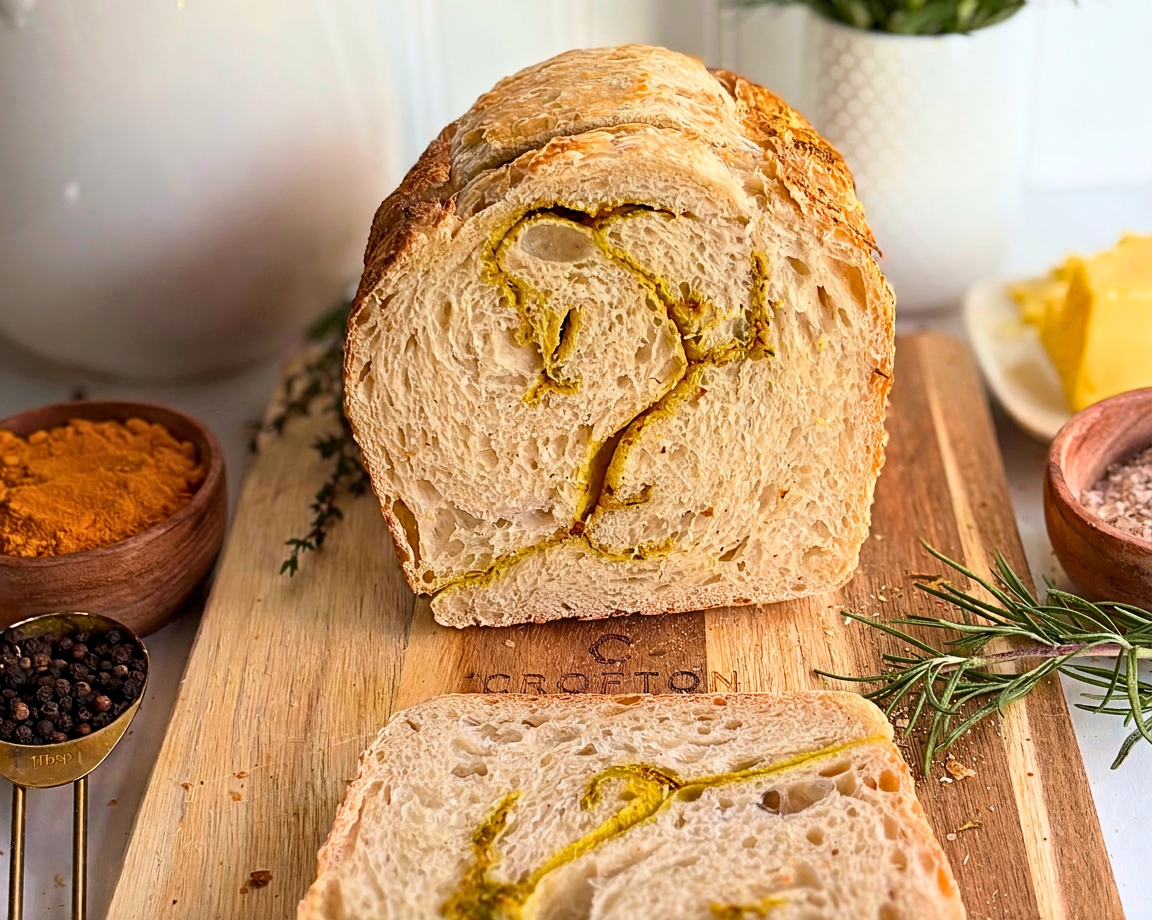
This garlic Parmesan sourdough bread came from wanting a loaf that looked as special as it tasted, the kind you set on the table at Thanksgiving or Christmas dinner and everyone asks about before they have even had a bite. Plain sourdough is wonderful, but for the holidays, or any night I want dinner to feel a little more special, I wanted a bread with something beautiful hiding inside, so that every slice showed off a golden swirl of Parmesan, garlic, onion, and herbs.

Savory swirl breads are notoriously hard to get right, because cheese melts into hollow tunnels and the layers slide apart as the loaf bakes, so I built this one on my Cold Swirl Method. The loaf starts as a plain sourdough and only becomes a swirl bread minutes before it goes into the oven, which is the reason the filling bakes into a clean golden line instead of a greasy gap. It did take me a few loaves to get here, and I am sharing exactly what went wrong along the way so yours comes out right the first time, whether you are baking it for a holiday table or just because.
Table of Contents
- What Is the Cold Swirl Method
- Why You Will Love This Bread
- Ingredient Notes
- How I Tested This Loaf
- How to Make Garlic Parmesan Sourdough Bread
- How to Get a Clean Swirl
- Can You Make This With Yeast
- Expert Tips
- How to Serve It
- Storing and Freezing
- Shop This Recipe
- Frequently Asked Questions
- Recipe
- More Swirl Sourdough Recipes
- Subscribe for Free
What Is the Cold Swirl Method
The Cold Swirl Method is the technique I use for every swirl loaf in this series, and it breaks one of the most basic rules in sourdough baking. Once a loaf has finished its cold proof, you are supposed to score it and bake it, and you are not supposed to cut it open, fill it, and handle it all over again.

It started on a day when I had a plain loaf sitting in the refrigerator, fully bulk fermented, shaped, and cold proofed, and I changed my mind right before it was time to bake. I wanted a swirl loaf instead, and rather than starting a whole new dough, I wondered what would happen if I added the filling now, after the bulk ferment and after the cold proof, when the dough was already finished.
It was not a lucky accident, because I had a reason to think it would work. The problems people run into with swirl bread almost all come from time. When a filling goes in during shaping, it sits against the dough through the entire proof, and over those hours sugar pulls water out of the dough and turns syrupy, fruit releases its juice, and cheese and butter soften the layers around them. By the time the loaf bakes, the swirl has turned gummy, the layers have slid apart, or there is a big hollow gap where the filling used to be.
With the Cold Swirl Method, the filling only touches the dough for the few minutes it takes to cut, fill, and roll the loaf, which takes me about five minutes from turning it out to sliding it into the oven. The dough is cold and firm, so it cuts cleanly and holds its shape while you work, and the filling goes into the oven still dry. There is simply no time for anything to weep, melt, or slacken the dough before the heat sets the crumb around it.
That one change opened up swirls that are normally a headache, from fresh apple to cheese, and it is the method I reach for whenever a filling is known for being difficult. You can see it in my cinnamon swirl sourdough bread, which is where it all began.
Why You Will Love This Bread
This garlic Parmesan sourdough is the loaf I make when I want a bread that can carry a whole meal, and it has a few things going for it that a plain loaf does not.

- Pretty enough for the holiday table. Slice it in front of your guests and the swirl does all the talking, which makes it a bread that feels special without any extra fuss.
- A real swirl in every slice. The golden line of Parmesan and herbs runs from the center of the loaf all the way out, so every slice looks as good as the first one.
- No gummy filling and no tunnels. Because the filling goes in after the cold proof and stays dry, it bakes into a clean line instead of a greasy pocket.
- Big savory flavor without fresh cheese. Parmesan cheese powder, garlic, onion, and herbs give you that garlic bread flavor without any melting cheese to fight with.
- It starts as a plain loaf. You make your usual sourdough dough, and you do not have to decide on the flavor until the morning you bake.
- Assembly takes about five minutes. The cutting, filling, and rolling happen right before the loaf goes into the oven.
- The leftovers are just as good. Toast it, make garlic bread with it, or turn the last few slices into croutons.
Back to Table of Contents | Jump to Recipe
Ingredient Notes
The dough is a simple, classic sourdough made with bread flour, water, an active starter, and salt, so all of the personality in this loaf comes from the filling. The exact amounts for everything are in the recipe card, and here is why each part of the filling is there.

- Parmesan cheese powder. This is the key to the whole loaf. A fine, dry cheese powder settles into the cuts and bakes into a clean swirl line the same way the cheddar powder does in my cheddar everything bagel swirl sourdough. I use Hoosier Hill Farm Parmesan cheese powder, and a small amount goes a long way, because it is concentrated Parmesan flavor with nothing diluting it.
- Finely grated store bought Parmesan. If you do not have the powder, the dry, finely grated Parmesan from the store works too, and I have made this loaf successfully with it. You use less of it and toss it with a little cornstarch, and the swap is written out in the notes of the recipe card.
- Garlic powder and onion powder. These give the loaf its garlic bread flavor without adding any moisture. Fresh garlic would add water right where the swirl needs to stay dry.
- Dried oregano, basil, and parsley. Dried herbs keep the filling dry, and the parsley adds those little green flecks you see in the swirl. I do not use an Italian seasoning blend for this one, because oregano and basil on their own give you the same flavor with more control.
- Turmeric and smoked paprika. These are here for color. Together they turn the Parmesan a warm golden orange so the swirl stands out against the crumb, and the smoked paprika adds a gentle smoky note behind the garlic. I first tried a pinch of turmeric for color in an earlier savory roll, and it worked so well that I brought it into this loaf.
- Black pepper. This is optional, but a little freshly ground pepper sharpens the Parmesan.
One thing to know before you start is that the herbs and spices in this filling are so light that most kitchen scales will not register them, and mine did not either. Measure those with measuring spoons, and weigh the Parmesan powder, since that is the amount that matters most.
Back to Table of Contents | Jump to Recipe
How I Tested This Loaf
This loaf did not work on the first try, and every change in the final recipe comes from something I watched happen in my own kitchen.

My first loaf used freshly grated Parmesan from a wedge, and it did not turn out the way I wanted, so it became a batch of Parmesan croutons with a crispy golden cheese crust instead, which honestly were not a bad consolation prize. Fresh Parmesan carries more moisture and fat than a dry cheese, so for the next round I switched to a dry Parmesan, cut the amount of cheese way back because I felt less was more for this loaf, and rolled the log tighter.
I tested the filling with a little cornstarch, the way I use it in my sweet swirls, but once I switched to the Parmesan powder the loaf did better without it, so the powder version has no cornstarch at all. The cornstarch only stays in when you use grated Parmesan, which carries more fat than the powder. I also settled on 1/2 teaspoon of turmeric with 1/4 teaspoon of smoked paprika for the color, and bumped the garlic up and added onion powder for a fuller garlic bread flavor.
The last two test loaves taught me the most. On one, I used far too much filling, and the thick bands of seasoning kept the dough from sealing to itself, so the slices pulled apart into separate rings. On the other, the swirl amount was exactly right, a thin, even ribbon all the way through, but my dough overproofed, which was a timing problem with the dough rather than anything in the filling.

That second loaf is the line to aim for, and it is why the recipe now tells you to spread the filling evenly with no clumps and to sprinkle whatever is left over across the top of the loaf instead of forcing it into the cuts.
Back to Table of Contents | Jump to Recipe
How to Make Garlic Parmesan Sourdough Bread
The dough itself is a straightforward sourdough loaf, and the full schedule with every amount, time, and temperature is in the recipe card. Here is what happens at each stage and why it matters.

Make and cold proof a plain loaf. Mix, stretch and fold, bulk ferment, shape, and cold proof your dough exactly as you would for a plain sourdough loaf. Keep an eye on the bulk ferment, since an overproofed dough is softer and harder to cut cleanly, which is exactly what happened on one of my test loaves.
Mix the filling. Stir the Parmesan powder, garlic, onion, herbs, and spices together in a small bowl, breaking up any clumps as you go, until the mixture is evenly golden and loose.
Firm and open the loaf. A short rest in the freezer firms the cold dough so it cuts cleanly. Turn the loaf out top side down onto parchment, slice down through it with a knife, then cut it into sections with kitchen scissors.

Fill the cuts. Sprinkle the filling down into all of the cuts and spread it evenly between the sections, so there are no piles or pockets of powder anywhere. Set aside whatever does not fit.

Roll it tight. Starting at one end, roll the loaf into a snug log, gently tugging back against the roll and pressing each cut section flat as the dough comes over it. Tuck the ends, press the seam closed all the way across, then flip the log so the seam faces down.

Into the pan, top it, and bake. Brush any loose filling off the sides and ends so it does not scorch against the pan, lower the log into a 9×5 loaf pan, and sprinkle the leftover filling over the top. It bakes in my double pan method, with a second loaf pan turned upside down over the top as a lid, so the loaf steams like it would in a Dutch oven, then finishes uncovered for a deep golden crust.

Cool it completely. It is hard to wait, but slicing too early lets steam escape from the crumb before it sets, and the swirl needs that time to hold together.
Back to Table of Contents | Jump to Recipe
How to Get a Clean Swirl
The swirl is the whole point of this loaf, and it comes down to three things: how much filling goes in, how evenly it is spread, and how tightly the loaf is rolled.

Keep the knife cuts deeper than the scissor cuts. That difference puts the filling at different levels inside the loaf, and it is what gives you a true swirl instead of one flat layer of seasoning.
Spread the filling evenly. Anywhere the filling piles up, the dough cannot seal to itself, and that spot turns into a gap in the slice. A thin, even layer bakes into a clean ribbon, while a thick one pushes the layers apart, which is exactly what happened on my overfilled test loaf.
Do not force the extra into the cuts. The filling batch is generous on purpose, and anything that does not fit goes over the top of the loaf, where it bakes into those golden, herby streaks on the crust.
Roll it snug and seal the seam. A loose roll and a loose seam let the layers drift apart as the loaf bakes and cools. Pressing each section flat as you roll keeps the pieces from flopping sideways and gives you a tighter spiral.
Back to Table of Contents | Jump to Recipe
Can You Make This With Yeast
This loaf is made with sourdough, but I know not everyone keeps a starter, so I am working on an artisan style yeast loaf that copies the crust and crumb of my classic sourdough. Once it is finished and tested, I will link it right here, along with how to use it as the base for this garlic Parmesan swirl.
ARTISAN YEAST LOAF
In the meantime, if you want to start baking with sourdough, my guide on how to create a sourdough starter walks you through making your own with very little waste.
Back to Table of Contents | Jump to Recipe
Expert Tips
These are the small details that make the biggest difference between a good swirl loaf and a great one.

- Use cheese powder or dry grated Parmesan, not fresh. Freshly grated Parmesan from a wedge and bagged shredded Parmesan carry more moisture and fat and can melt into pockets.
- Weigh the cheese and spoon the spices. Your scale will likely not register the small herb and spice amounts, so use measuring spoons for those.
- Watch the bulk ferment. A warm spot in the kitchen can overproof the dough quickly, and an overproofed loaf is soft and harder to cut and roll.
- Use the freezer rest. A short time in the freezer firms the dough so the knife and scissors cut cleanly.
- Brush the sides, not the top. Loose filling on the sides and ends scorches against the pan, while filling on the top bakes onto the crust.
- Bake to temperature. Pull the loaf when the center of the crumb reaches the internal temperature in the recipe card, checking the bread rather than the filling seam.
- Wait to slice. Let the loaf cool completely so the crumb and swirl set before you cut into it.
Back to Table of Contents | Jump to Recipe
How to Serve It
My favorite way to eat garlic Parmesan sourdough is toasted with a little butter, which melts right into the swirl and turns each slice into instant garlic bread.

It is also the bread I want next to a bowl of soup, especially one made with my homemade chicken bone broth, and it is wonderful with pasta, a big salad, or as the base for a grilled cheese. If you have a few slices left at the end of the week, cube them and turn them into Parmesan croutons, since this loaf already has the garlic and herbs built right in.
Back to Table of Contents | Jump to Recipe
Storing and Freezing
This loaf keeps just like a plain sourdough loaf, and the swirl holds up well as it sits.

Once it has cooled completely, store it wrapped at room temperature for up to 3 days. For longer storage, slice the whole loaf, freeze the slices in a freezer bag, and toast them straight from frozen, which is the easiest way to have garlic bread ready any night of the week.
Back to Table of Contents | Jump to Recipe
Shop This Recipe
These are the tools I use to make this loaf. As an Amazon Associate I earn a small commission from qualifying purchases made through these links, at no extra cost to you, and it helps support the blog so I can keep sharing recipes like this one.
- USA Pan 9×5 Loaf Pans: I bake every loaf in this series in two of these, one for the bread and one turned upside down on top as a lid for my double pan method.
- Hoosier Hill Farm Parmesan Cheese Powder: The dry Parmesan that makes this swirl bake into a clean golden line instead of a greasy pocket.
- Banneton: For the overnight cold proof, so the loaf holds its shape before you cut into it.
- Kitchen Scissors: I use a sharp pair of kitchen scissors to cut the loaf into sections after the knife cuts.
- Digital Kitchen Scale: For weighing the dough ingredients and the Parmesan powder so the loaf comes out the same every time.
- Measuring Spoons: For the herbs and spices, which are too light for most kitchen scales to read.
- Parchment Paper: For turning the loaf out, filling it, and lowering it into the pan without it falling apart.
- Instant Read Thermometer: The easiest way to know your loaf is fully baked in the center.
Frequently Asked Questions
These are the questions I expect to hear most about making garlic Parmesan sourdough bread at home.

Can I use fresh Parmesan cheese in this swirl bread?
I do not recommend freshly grated Parmesan from a wedge or bagged shredded Parmesan, because both carry more moisture and fat and can melt into pockets inside the loaf. My first loaf used fresh Parmesan and did not turn out. Parmesan cheese powder works best, and the dry, finely grated Parmesan from the store works too when you toss it with a little cornstarch.
Can I use grated Parmesan instead of Parmesan cheese powder?
Yes. I have made this loaf successfully with dry, finely grated store bought Parmesan. Use a smaller amount and toss it with a little cornstarch, which soaks up the extra fat so the swirl stays clean. The exact swap is in the notes of the recipe card.
Why is there no cornstarch in the main recipe?
I tested the filling with and without cornstarch, and the Parmesan powder version did better without it. Cornstarch only goes in when you use grated Parmesan, since it carries more fat than the powder.
What is the Cold Swirl Method?
It is my technique for adding a swirl filling to a sourdough loaf after the bulk ferment and the cold proof, right before baking, instead of during shaping. Because the filling only touches the dough for a few minutes, it does not have time to turn gummy, melt, or soften the layers before the oven sets the crumb.
Why did my swirl separate or leave gaps?
The most common reason is too much filling or filling that piled up in one spot, since the dough cannot seal to itself where the filling is thick. A loose roll or a seam that was not pressed closed can also let the layers drift apart. Spread the filling thin and even, put any extra on top of the loaf, and roll the log snug.
Can I add the filling when I shape the loaf instead?
You can, but you lose the advantage of the Cold Swirl Method. A filling that sits in the dough through the whole cold proof has hours to soften the layers around it, which is exactly what this method avoids.
Do I need the turmeric and smoked paprika?
No, they are there for color. Together they turn the swirl a warm golden orange so it stands out in every slice, and the smoked paprika adds a little smoky flavor. Leave either one out if you prefer a paler swirl.
Can I use fresh garlic or fresh herbs?
I would not. Fresh garlic and fresh herbs add moisture right where the swirl needs to stay dry, so garlic powder, onion powder, and dried herbs work much better here.
Can I bake this in a Dutch oven?
The swirl loaf is rolled into a log, so it bakes best in a 9×5 loaf pan that supports it on the sides. I use the double pan method, with a second loaf pan turned upside down over the top as a lid, which gives you the same steam a Dutch oven would.
How do I know when the loaf is done?
Use an instant read thermometer in the center of the crumb rather than in the filling seam, and pull the loaf when it reaches the internal temperature in the recipe card. The crust should be a deep golden color.
Do I need a sourdough starter to make this bread?
This recipe is made with an active sourdough starter. If you do not have one yet, my guide on how to create a sourdough starter walks you through making your own with very little waste.
How long does garlic Parmesan sourdough bread stay fresh?
Wrapped at room temperature, it keeps for up to 3 days. For longer storage, slice and freeze it, then toast the slices straight from frozen.
Recipe

The Easiest Garlic Parmesan Herb Swirl Sourdough Bread
Equipment
- Digital Kitchen Scale
- Large mixing bowl
- Banneton
- Two 9×5 loaf pans
- Parchment paper
- Sharp knife
- Kitchen scissors
- Small Bowl
- Instant read thermometer
Ingredients
Dough
- 75 g active sourdough starter 1/3 cup
- 350 g room temperature filtered water 1 1/2 cups
- 500 g bread flour 4 cups
- 10 g salt 1 3/4 teaspoons
Garlic Parmesan Herb Filling
- 10 g Parmesan cheese powder 1 tablespoon plus 2 teaspoons (See notes for alternative)
- 4.5 g garlic powder 1 1/2 teaspoons
- 1.2 g onion powder 1/2 teaspoon
- 1 g dried oregano 1 teaspoon
- 1 g dried basil 1 1/2 teaspoons
- 1 g dried parsley flakes 2 teaspoons
- 1.5 g ground turmeric 1/2 teaspoon
- 0.6 g smoked paprika 1/4 teaspoon
- 0.5 g ground black pepper optional (a scant 1/4 teaspoon)
Instructions
Make the Dough
- In a large bowl, mix the starter, water, and bread flour until no dry flour remains and you have a shaggy dough, then cover and rest for 1 hour.
- Add the salt and work it in with wet hands until it disappears into the dough.
- Perform a set of stretch and folds every hour for 3 hours, keeping the bowl covered between sets.
- Let the dough bulk ferment until it has increased 50 to 70 percent and looks jiggly when you move the bowl, which usually takes 6 to 12 hours depending on the temperature of your kitchen.
- Turn the dough out, pre shape it into a round, and let it rest seam side down for 20 to 30 minutes.
- Shape the dough into a batard and place it seam side up in a floured banneton, then cover and cold proof in the refrigerator for 8 to 12 hours.
Make the Filling
- In a small bowl, stir together the Parmesan cheese powder, garlic powder, onion powder, oregano, basil, parsley, turmeric, smoked paprika, and pepper, breaking up any clumps, until the mixture is evenly golden and loose.
Swirl the Loaf
- Preheat the oven to 450F.
- Place the cold proofed loaf in the freezer for 15 to 20 minutes to firm it for cutting.
- Turn the loaf out onto a sheet of parchment top side down.
- Using a sharp knife, slice down through the loaf lengthwise, then use kitchen scissors to cut it into sections to open up the interior, keeping the knife cuts deeper than the scissor cuts.
- Sprinkle the filling down into all of the cuts, spreading it evenly between the sections so there are no clumps or pockets of powder, and set aside any filling that is left over.
- Starting at one end, roll the loaf up snugly into a tight log, gently tugging back against the roll and pressing each cut section flat as the dough comes over it, so the top of the loaf ends up on the bottom and the seam faces up.
- Tuck in the ends and press the seam tightly closed all the way across.
- Flip the log so the seam faces down and the smooth top faces up, brush away any loose filling from the sides and ends, and use the parchment to lower it into a 9×5 loaf pan.
- Sprinkle the leftover filling evenly over the top of the loaf.
Bake
- Invert the second loaf pan over the top as a lid and bake for 9 minutes.
- Remove the lid, score the loaf down the center, replace the lid, and bake for 30 minutes more.
- Remove the lid and bake for 10 minutes, or until the crust is deep golden and the internal temperature reaches 205F.
- Lift the loaf out of the pan and let it cool completely on a wire rack before slicing so the crumb and swirl can set.
Notes
More Swirl Sourdough Recipes
If you love this loaf, the rest of the Cold Swirl Method series is waiting for you, sweet and savory.
- The Easiest Cheddar Everything Bagel Swirl Sourdough Bread: The savory loaf that started me down the cheese powder path, with cheddar and everything bagel seasoning.
- The Easiest Cinnamon Swirl Sourdough Bread: The loaf where the Cold Swirl Method began.
- The Easiest Apple Cinnamon Swirl Sourdough Bread: Fresh apple in a swirl loaf, which only works because of this method.
- Chocolate Swirl Sourdough Bread: A thin, elegant cocoa swirl through a classic sourdough loaf.
- The Easiest Pumpkin Swirl Sourdough Bread: A pumpkin and molasses dough with a pumpkin spice swirl.
- Parmesan Croutons with a Crispy Golden Cheese Crust: The perfect way to use up the last few slices of this loaf.
Subscribe for Free
If you want more sourdough swirl loaves like this one, along with the high protein bakes I am working on in my kitchen, join my email list. It is completely free, and you will get every new recipe delivered straight to your inbox so you never miss one.



Leave a Reply