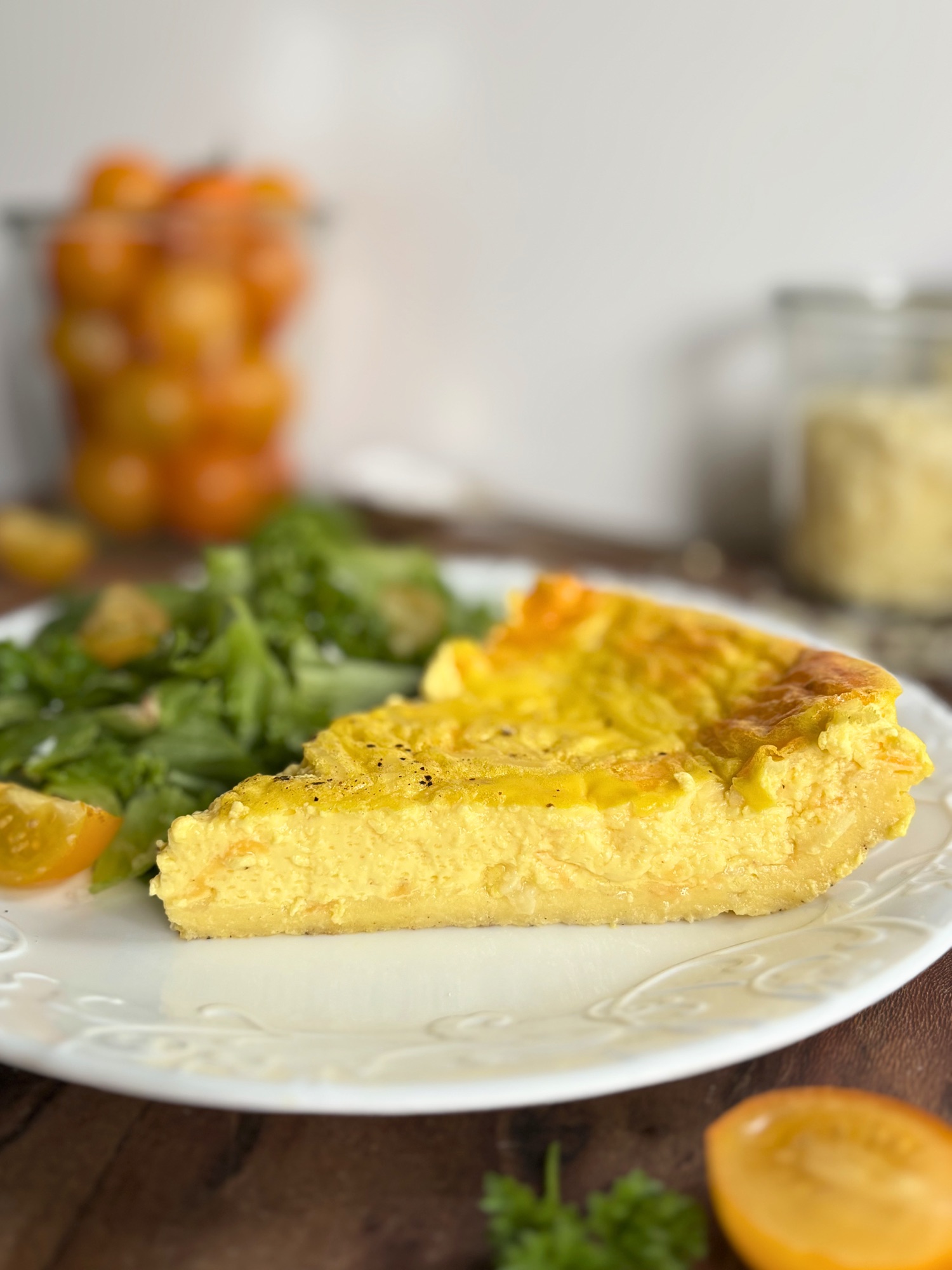
My mom has chickens. Living their best lives on her farm. Every spring when they start laying again, I end up with a big basket of fresh eggs and more than I know what to do with. This quiche became my answer to that problem, and honestly it has turned into one of my favorite easy meals. Serve it with a simple salad and it is a perfect lunch. Bring it to brunch and watch it disappear. Eat it for dinner, for breakfast, as a snack straight from the fridge. It works every single time.
I wanted something I could pull together quickly for my family without rolling out pie dough or blind baking anything. I had sourdough discard sitting in the fridge waiting to be used, I had a block of sharp cheddar, and I had more eggs than I needed and the thought to create something new. What came out of the oven was a perfectly set, silky, golden quiche that tasted like I had put in way more effort than I actually did.
The discard is the secret here. It blends into the custard, quietly sinks toward the bottom as the quiche bakes, and gives you a slightly more structured base layer without any extra steps. No separate crust. No pastry work. Just a real, sliceable, satisfying quiche that holds its shape and tastes exactly like it should. And if you do not keep a sourdough starter, I have you covered too. There is a no-starter version in the post that works just as well.
Table of Contents
- What Is a Self-Crusting Quiche?
- Why Sourdough Discard Works Here
- Key Ingredients and What They Do
- Tips for the Best Quiche
- Recipe
- No Sourdough Starter? Make It Without
- What to Serve With It
- Storage and Reheating
- More Savory Sourdough Recipes
- Frequently Asked Questions
- Subscribe
What Is a Self-Crusting Quiche?

A self-crusting quiche skips the pastry entirely. Instead of a separate pie crust, a small amount of starch or flour gets mixed directly into the egg custard. As it bakes, that heavier ingredient naturally sinks toward the bottom of the pan and sets against the heat, forming a thin, slightly more structured base layer that holds everything together when you slice.
The classic version of this is sometimes called an impossible quiche, a style that has been a staple in home kitchens for decades. The idea is the same: let the batter do the work so you do not have to.
This version uses sourdough discard in place of the traditional flour addition, which means you get the same self crusting effect with the added depth of flavor that comes from fermented grains. The result is somewhere between a crustless quiche and a traditional pastry quiche. You get the clean slice ability and the structure without the extra work.
Why Sourdough Discard Works Here

Sourdough discard at 100% hydration is equal parts flour and water. When you blend it into your egg custard, the flour portion behaves exactly the way it does in a traditional self crusting recipe. It is denser than the liquid custard, so it naturally migrates toward the bottom of the pan as the quiche bakes. As the heat sets everything from the outside in, that flour layer gelatinizes and firms up, giving you a base that is noticeably more structured than the custardy top.
The fermentation in the discard also adds something that plain flour cannot. The acids produced during fermentation help tenderize the proteins in the eggs, which contributes to that silky, smooth texture in every bite. You will not taste it as a distinct flavor. It just makes the whole thing taste more complete.
Both sourdough discard and active starter work in this recipe. Discard straight from the fridge is perfectly fine. Active starter will give a slightly milder result since it has not had as much time to develop acidity. Either one produces the same self-crusting effect.
Key Ingredients and What They Do

Eggs are the foundation of any quiche. They provide the protein structure that sets the custard as it bakes. Using whole eggs gives you both richness from the yolks and structure from the whites.
Whole milk thins the custard to a pourable consistency and contributes to a tender, smooth set. Whole milk works best here because the fat content helps the custard stay silky rather than rubbery. You can use 2% in a pinch but the texture will be slightly less rich.
Heavy cream adds a small amount of extra fat that rounds out the custard and gives it that luscious quality you expect from a proper quiche. A little goes a long way.
Sourdough discard or active starter is doing double duty. It adds the flour component that creates the self crusting effect and contributes fermented flavor depth to the overall custard. Use discard that has been fed within the last week for the best results. You can also use active starter that is at its peak, which will give a slightly milder, less acidic flavor in the finished quiche.
Cornstarch is the ingredient that ties everything together. It binds the extra moisture from the discard, prevents weeping after slicing, and gives the custard a clean, silky set. It is optional but highly recommended. Tapioca starch or arrowroot work as substitutes in equal amounts.
Cheese gets split between the bottom and the top of the quiche. The layer on the bottom melts into the base and fuses with the self-crusting layer. The cheese on top browns beautifully during the initial high-heat blast and gives you that golden, bubbling surface that makes this recipe so photogenic.
Nutmeg is a classic quiche seasoning. Just a pinch is enough to add warmth and depth without being identifiable as a distinct flavor.

Tips for the Best Quiche
Use room temperature discard. Cold discard can cause the custard to blend unevenly. Let it sit out for about 30 minutes before you start, or give it an extra few seconds with the immersion blender.
Shred your own cheese. Pre-shredded cheese is coated in anti-caking agents that affect how it melts. Block cheese freshly grated gives you better melt, better flavor, and better coverage.
Use an immersion blender. An immersion blender gives you a smooth, uniform custard in about 15 seconds and is honestly the best tool for this job. I will link mine here. A high speed blender or a NutriBullet also works well. If you are whisking by hand, whisk vigorously until everything is fully combined with no streaks. Whatever method you use, remember you are not trying to incorporate air. You are just mixing everything together evenly. Overblending will introduce bubbles that affect the surface texture of the finished quiche.
Watch your pan material. Metal pans conduct heat faster than glass or ceramic. If you are using a glass or ceramic dish, add 5 to 10 minutes to the lower temperature bake and consider starting at 375 degrees F instead of 400 to avoid over-browning the edges before the center sets. Love using my USA pie pans for this, zero sticking.
Do not rush the rest. Let the quiche cool for at least 20 minutes before slicing. This is not optional. The custard continues to set as it cools, and cutting into it too soon will give you a sliding, messy slice no matter how well it baked. Once it has fully cooled, the slices are honestly sturdy enough to pick up and eat by hand.
The puff is normal. Your quiche will rise during baking and settle as it cools. That is the eggs doing their job. It does not mean anything went wrong. A quiche that stays puffed after cooling is a soufflé, not a quiche.

Recipe

SOURDOUGH DISCARD CRUSTLESS QUICHE (IMPOSSIBLE QUICHE)
Equipment
- 9 or 10 inch deep dish pie pan
- Immersion blender blender, nutribullet, whisk
- Wide mouth quart jar or large bowl
- Kitchen scale (highly recommeded) measuring cups
Ingredients
- 200 g eggs 4 large eggs
- 320 g whole milk 1 cup + 5 tablespoons
- 65 g heavy cream just under 1/4 cup
- 100 g sourdough discard/peaked starter 100% hydration, room temperature (scant 1/2 cup)
- 8 g cornstarch 1 tablespoon
- 3/4 teaspoon kosher salt
- 1/4 teaspoon black pepper
- pinch of nutmeg
- 57 g sharp cheddar freshly shredded (1/2 cup loosely packed)
- 57 g low moisture mozzarella freshly shredded (1/2 cup loosely packed)
- butter for greasing the pan
Instructions
- Preheat your oven to 400 degrees F and generously butter your pie pan.
- Add all custard ingredients to a wide mouth quart jar or large bowl, the eggs, milk, cream, sourdough discard, cornstarch, salt, pepper, and nutmeg. A wide mouth quart jar works especially well here as it minimizes splashing and makes pouring easy. Blend with an immersion blender for about 10 to 15 seconds until completely smooth. You are not trying to add air, just combine everything evenly. Alternatively, use a blender, nutribullet or hand whisk.
- Scatter half of the shredded cheddar and mozzarella evenly across the bottom of the buttered pan. This layer melts into the base as the quiche bakes and gives the bottom extra structure.
- Slowly pour the custard over the cheese. Do not stir. Scatter the remaining cheese evenly over the top of the custard.
- Transfer the pan to the center rack of your oven and bake at 400 degrees F for 10 minutes. This initial high heat sets the edges and gives the top a beautiful golden color.
- Reduce the oven temperature to 350 degrees F and continue baking for 25 to 35 minutes, checking for doneness starting at the 20 minute mark. Every oven is different and metal pans will bake faster than glass or ceramic.
- The quiche is done when the edges are fully set and the very center has a slight jiggle as one unified mass. It should not ripple like liquid.
- Remove from the oven and let rest uncovered for at least 20 minutes before slicing. The custard continues to set as it cools and the slices will hold their shape much better once fully rested. If cutting before the rest, no matter how well baked it will not hold shape.
Notes
No Sourdough Starter? Make It Without
You do not need a sourdough starter to make this quiche. The discard is doing one job here: contributing flour to the custard so it can sink and self-crust during baking. Plain all-purpose flour does the same thing, which is exactly how the classic impossible quiche has been made in home kitchens for decades.
For the no-starter version, you will use:
4 large eggs (200g)
366g whole milk (1 and 1/2 cups)
65g heavy cream (just under 1/4 cup)
50g all-purpose flour (6 to 7 tablespoons)
8g cornstarch (1 tablespoon)
3/4 teaspoon kosher salt
1/4 teaspoon black pepper
Pinch of nutmeg
57g sharp cheddar, freshly shredded (1/2 cup)
57g low moisture mozzarella, freshly shredded (1/2 cup)
To bring it together, whisk the flour with a small splash of the milk until completely smooth and lump free. Add the milk, cream, eggs, cornstarch, salt, pepper, and nutmeg and blend with an immersion blender until uniform. From here, continue with the recipe as written.
The self crusting effect works just as well with flour as it does with discard. You will not get the same depth of flavor that fermented starter brings, but you will still get a beautiful, sliceable quiche with a naturally formed base layer.
What to Serve With It

This quiche is a complete meal on its own but pairs really well with a simple green salad and fresh fruit for a full brunch spread. The brightness of cherry tomatoes or a lightly dressed arugula salad cuts through the richness of the custard beautifully.
It is just as good for dinner as it is for breakfast. Serve it alongside roasted vegetables or a bowl of soup and nobody will question it.
If you love savory baked egg dishes, my Sourdough Discard Savory Dutch Baby has a similar any-time-of-day quality and comes together even faster.
Storage and Reheating

Store leftover quiche in an airtight container in the refrigerator for up to 3 days.
To reheat, place slices in a 300 degree F oven covered loosely with foil for 15 to 20 minutes until warmed through. Individual slices can also be microwaved in 30 second intervals, though the oven method keeps the texture noticeably better.
To freeze, let the quiche cool completely, then wrap tightly in plastic wrap followed by a layer of foil. Freeze for up to 3 months. Thaw overnight in the refrigerator before reheating.
More Savory Sourdough Recipes
If this is your kind of recipe, here are a few more savory sourdough dishes worth making:
- Sourdough Discard Savory Dutch Baby
- High Protein Pretzel Bites
- High Protein Sourdough Dinner Rolls
- Meatball Stuffed Pull-Apart Focaccia
- HIgh Protein Smoked Cheddar and Onion Scones

Frequently Asked Questions
Do I have to use heavy cream?
No. You can make this quiche with all whole milk if that is what you have. Simply replace the cream with the same amount of whole milk and proceed as written. The texture will be slightly less rich since you are losing some of the fat that cream contributes, but the quiche will still set properly and taste great.
Can I use a different cheese?
Yes, use whatever melting cheese you like. Gruyere is a classic quiche choice, Swiss works beautifully, and pepper jack adds a little heat if that is your thing. The one thing to avoid is preshredded cheese. The anti caking coating on bagged shredded cheese affects how it melts and can make the texture grainy. Always shred your own from a block for the best result.
Can I use active sourdough starter instead of discard?
Yes. Active starter and discard both work in this recipe. Active starter will give a slightly milder flavor since it has less acidity built up. Discard that has been in the fridge for up to a week is ideal for the most developed flavor.
Why does my quiche puff up and then deflate?
This is completely normal and expected. The eggs expand in the oven heat and settle as the quiche cools. A quiche that holds its puff after cooling would be over-baked. The slight deflation means the custard is set correctly.
Can I make this ahead of time?
The baked quiche reheats beautifully, so making it a day ahead and reheating for brunch is a great option. Store it covered in the refrigerator and reheat in a 300 degree F oven covered loosely with foil until warmed through.
My quiche is weeping liquid after I slice it. What went wrong?
This usually means one of two things: the quiche was under-baked, or the custard had too much liquid relative to the eggs. Make sure the center has that very slight jiggle as one mass before pulling it from the oven, and do not skip the cornstarch. It is there specifically to bind excess moisture and prevent weeping.
Can I add vegetables or meat to this quiche?
Absolutely. This cheese-only version is the base recipe. You can add cooked and cooled vegetables, crumbled cooked bacon, diced ham, or cooked sausage. The key is making sure any vegetables are pre-cooked so they do not release moisture into the custard during baking.
Does this recipe work in a glass or ceramic dish?
Yes, with a small adjustment. Glass and ceramic conduct heat more slowly than metal, so you may need to add 5 to 10 extra minutes to the lower temperature portion of the bake. Starting at 375 degrees F instead of 400 is also a good idea to prevent the edges from over-browning before the center sets.
Can I use non-dairy milk?
You can, though the texture will vary depending on what you use. Full-fat oat milk or unsweetened coconut milk will give you the closest result to whole milk. Thinner plant milks like almond or rice milk have less fat and protein, which can result in a less firm set. If you go the non-dairy route, do not skip the cornstarch.
Subscribe
If you make this quiche, I would love to hear how it turned out. Leave a comment below and let me know what fillings you used or any tweaks you made. If you share it on Instagram, tag me so I can see it. And if you want new recipes sent straight to your inbox, sign up for the H3art of the Home newsletter so you never miss one.



Leave a Reply