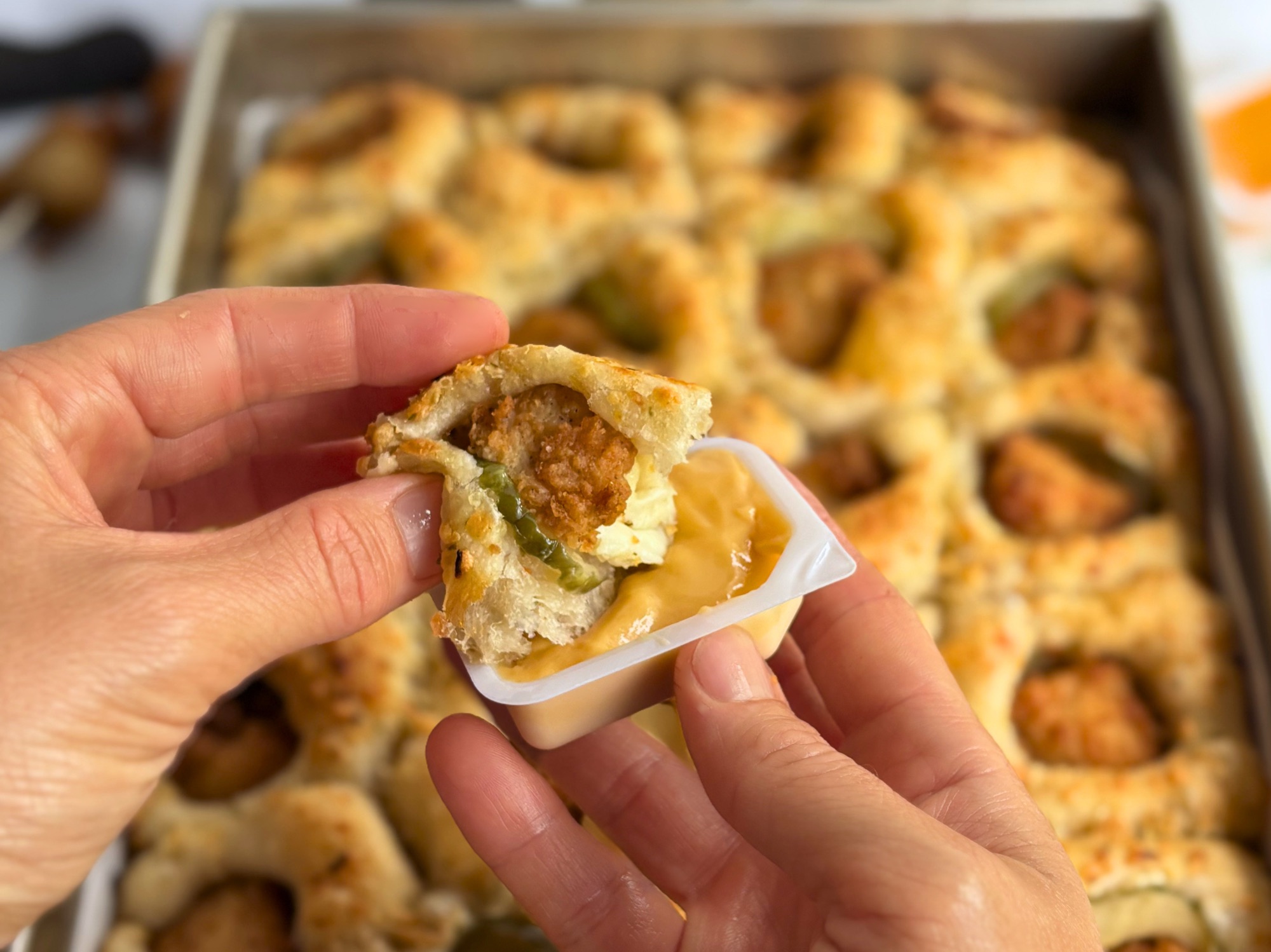
It is Sunday. You want Chick-fil-A BUT they are closed. This is the recipe that fixes that. The ultimate we’ve got Chick-fil-A at home.
Soft sourdough or yeast focaccia balls, dunked in seasoned butter and rolled in a sandy sharp white cheddar crust, each one topped with a breaded chicken nugget and a dill pickle chip and baked until deeply golden. Cheese is optional, and if you want it, you lay slices right on top for the last ten minutes of baking rather than working it into every ball. Chick-fil-A uses American, Colby Jack, and Pepper Jack on their Deluxe sandwiches, so any of those three will get you close. Honestly, use whatever cheese you like and whatever is in your fridge. You pull one off the pan, dip it in my copycat Chick-fil-A sauce, and the whole thing tastes exactly like the drive thru order.
You can use actual Chick-fil-A nuggets if you have a bag in the fridge, or grab any frozen breaded chicken nugget from the freezer aisle. Both work. The one rule that is not negotiable: the chicken nuggets have to be fully cooked before they go on the dough. Raw or frozen nuggets will not cook through in the oven and you will end up with soggy bread and undercooked chicken. Cook them first, cool them slightly, then build.
The copycat sauce is in the recipe card below and it is the part people will lose their minds over.
Table of Contents
- Why This Recipe Works
- What Makes This Different
- Ingredient Notes
- Choosing Your Hydration
- Which Chicken Should You Use
- The Cheese Question
- Copycat Chick-fil-A Sauce
- Why These Steps Matter
- Sourdough Recipe Card
- Yeast Version and Recipe Card
- Tips for the Best Pull-Apart Focaccia
- Substitutions and Variations
- Make Ahead and Storage
- Frequently Asked Questions
- More Pull-Apart Focaccia Recipes
- Subscribe
Why This Recipe Works

Every pull-apart focaccia I make runs on the same three part structure, and it is the reason this format works every single time.
The dunk. Each ball of dough gets rolled through something fatty before it ever hits the pan. Here it is melted butter cut with avocado oil. The butter carries the flavor and the browning, and the oil keeps the mixture from seizing up and turning solid on you while you work through two dozen dough balls. A splash of pickle brine whisked in is optional but it is the move. It puts that unmistakable tang under everything, which is what makes a chicken sandwich taste like a chicken sandwich instead of just chicken and bread.
The coating. Sharp white cheddar and cornstarch and dried parsley, run through the food processor until the whole thing looks like sand. The cornstarch keeps the cheese dry and powdery so it acts as a barrier between the balls. Without it, they proof back into one solid slab and you lose the pull entirely. With it, every piece stays its own piece and the edges go crackly and golden where they touch. Sharp white cheddar is not a random pick either. It has less moisture than a mild cheddar and more punch, so it crisps instead of greasing out, and white rather than orange keeps the baked crust golden instead of turning it orange.
The topper. Right before baking, a dill pickle chip and a fully cooked chicken nugget get pressed into the top of each ball, exactly like the Pigs in a Blanket version. The nugget crisps in the oven, the pickle steams into the dough, and every single piece comes out of the pan already assembled. If you want cheese, that comes later, laid on top in slices for the last ten minutes of baking. It is optional, it melts into the crust rather than getting lost inside the bread, and you can cover as much or as little of the pan as you want.
The sourdough base is the same one behind all of my pull-apart recipes, from Garlic Parmesan to Cinnamon Roll. Flour, water, starter, salt. It ferments overnight while you sleep and it takes about twenty minutes of actual hands on time.
What Makes This Different
Most focaccia recipes have you spread the dough into a pan, dimple it, and bake it as one slab. That is a beautiful bread and I have a recipe for it. This is not that.
This is the ball method. The dough gets torn into individual pieces, coated, and packed into the pan so each piece bakes as its own roll with a crust on every side. It is closer to monkey bread than it is to traditional focaccia, and that is the entire point. You are not slicing this. You are pulling it apart with your hands and dipping it.
That structure is also what lets a copycat like this actually work. A slab of focaccia with nuggets on top is just bread with chicken on it. A pan of individual coated balls, each one topped with a nugget and a pickle, is a tray of twenty four little chicken sandwiches that happen to be attached to each other.
Ingredient Notes

The full amounts are in the recipe cards. This section is the part a recipe card cannot tell you: why each of these is what it is, and what happens if you swap it.
Bread flour. Bread flour has the protein content to handle this hydration and still give you a chewy, open crumb. All purpose will work, but the dough will be slacker and the balls will spread more in the pan. If you go that route, take the water down.
Water. This is the one real decision to make before you start, so it gets its own section below.
Active sourdough starter. Use it at peak, when it has doubled and is domed and bubbly. A sluggish starter is the reason most overnight ferments disappoint.
Butter and avocado oil. The butter carries the flavor and the browning. The avocado oil is there so the dunk stays liquid and pourable instead of stiffening into a paste while you work through two dozen dough balls. Any neutral oil does the same job.
Dill pickle brine. Optional in the dunk, and the thing that makes this taste like the restaurant instead of like cheese bread with chicken on it. It is a small splash and it matters.
Sharp white cheddar. Sharp white cheddar has less moisture and more flavor than a mild or medium cheddar, so it crisps into a real crust instead of going greasy and soft. White rather than orange because orange cheddar bakes into a crust that reads as nacho, and you want this one to look like a golden parmesan style crust. Buy it in a block and run it through the food processor with the cornstarch and parsley until the mixture looks like damp sand. Shreds will not coat a wet dough ball. Sand will.
The no food processor shortcut. Buy the finely grated parmesan from the refrigerated section of the store, not the shelf stable shaker can. Whisk the cornstarch and parsley right into it and use it exactly the same way. Saltier and nuttier than the cheddar, equally good, zero equipment.
Cornstarch. A structural ingredient, not a flavor one. Anyone who has made the Pizza version or the Pesto version already knows this drill. It keeps the cheese dry so it acts as a barrier between the balls. Skip it and they fuse into one solid slab and the whole pull-apart disappears.
Chicken nuggets. Fully cooked and cooled before they touch the dough. Not negotiable. See the section below.
Dill pickle chips. Blotted dry on both sides. Wet pickles are the number one cause of a soggy top.
Cheese on top. Optional, and there is a whole section on it below.
Choosing Your Hydration
This is the same guidance I added to the cinnamon roll focaccia, because it is the thing that trips people up more than anything else.
400 grams of water is 80 percent hydration. This is the standard version. It gives you the lightest, most open, most custardy interior. It is also wet, sticky, and a little alarming to handle if you have not worked with a dough like this before. That is normal. That is what it is supposed to feel like.
375 grams of water is 75 percent hydration. This is where I would point you if you are newer to sourdough, if you are nervous about sticky dough, or if your kitchen runs warm and your doughs tend to go slack. The bread is still excellent. The crumb is a touch tighter, the balls hold their shape better in the pan, and the dough is dramatically more cooperative in your hands.
There is no wrong answer here. Make it once at 375, get comfortable with the process, and go up to 400 next time if you want to.

Handling either one
Wet your hands, not your counter. Flour on the outside of the dough fights the coating later. Water on your hands does the same job without changing the dough.
Use a bench scraper. Cutting the dough into pieces with a scraper is far easier than pulling at it with your fingers.
Let the bulk ferment do the work. Well fermented dough is much easier to handle than underfermented dough. If it is still soupy and slack with no life in it, it is not done.
Remember this recipe is customizeable. Make the balls as big or small as you want. Just make sure there is enough dough surrounding your inclusions to have the walls hold up.
Which Chicken Should You Use
You have three good options and none of them are wrong.
Actual Chick-fil-A nuggets. If you have leftovers, this is the most accurate version by a mile. An 8 count is not enough for a full pan, so plan on a 30 count. Chop any oversized nuggets in half so they sit down into the dough instead of perching on top.
Frozen breaded chicken nuggets. The freezer aisle version is what most people will use and it is genuinely great. Bake them according to the package until they are fully cooked and crisp, then let them cool slightly before you press them into the dough.
Homemade fried chicken bites. If you want to go all the way, cut boneless chicken breast into one inch pieces, brine them in pickle juice for thirty minutes, dredge in seasoned flour, and fry until golden. This tastes the most like the real thing, because pickle brine is doing the same work in the chicken that it is doing in your dunk.

Read this part twice. Whatever chicken you choose, it must be fully cooked before it goes on the focaccia. Not raw. Not frozen. Not partially baked. The bake time on this recipe is set by the bread, not the chicken, and a raw nugget will not cook through in that window. Frozen nuggets release water as they thaw, which soaks the dough underneath and leaves you with a gummy bottom. Cook the nuggets first, let them cool slightly so they are not steaming, then press them in.
And yes, this bake runs longer than my other pull-aparts. That is because there is a chicken nugget sitting on top of every single ball, and the bread underneath it needs the extra time to catch up. Thirty to thirty five minutes at 425 degrees F is correct.
The Cheese Question
Chick-fil-A does not put cheese on their nuggets. Cheese shows up on the Deluxe sandwiches, where the options are American, Colby Jack, and Pepper Jack. So if you want cheese here, those three are the accurate choices, and American is the closest to the classic Deluxe. Pepper Jack is my pick if you want a little heat behind it.
Lay it on top for the last ten minutes. This is what I would do. Bake the pan as written, pull it out with about ten minutes left, lay slices right across the top, and return it to the oven until melted and bubbly. Better melt, better photo, less work, and the bread stays the star.
You can absolutely tuck it into the dough instead. I have done it. Just use a small thin square, not a full slice folded up. A big piece of cheese inside every ball is a lot of cheese, it competes with the cheddar coating, and it makes the pan heavier than it needs to be. Keep it small and it works beautifully.
This also solves the picky eater problem. Cheese only lands where you lay the slices. I have a kid who does not want it, so half my pan gets slices and half does not, and nobody has to negotiate. You cannot do that when the cheese is buried inside the dough.
Or skip it entirely. The cheddar coating is already doing real work here. This recipe does not need added cheese to be good.
Copycat Chick-fil-A Sauce

This is what ties the whole thing together, and it takes five minutes. The amounts are in the recipe card. What is worth understanding is the balance, because you will want to adjust it to your taste.
It is mayonnaise as the base, yellow mustard for sharpness, honey for sweetness, a smoky BBQ sauce for depth, and a little lemon juice to lift the whole thing. That is the entire sauce.
Yellow mustard, not Dijon. Dijon is too sharp and too wine forward and it pulls the sauce somewhere else entirely.
The BBQ sauce is doing more work than you think. It needs to be smoky and slightly sweet, not thin and vinegary. A vinegar heavy Carolina style sauce will turn the whole thing sour.
Let it sit. Cover it and refrigerate for at least thirty minutes before serving. The flavors meld and it gets noticeably closer to the real thing. It is better on day two than it is on day one.
No lemon juice? Swap in white wine vinegar, apple cider vinegar, or a splash of pickle brine at the same amount. Or skip it. The mustard and BBQ carry plenty of tang on their own.
It keeps in an airtight container in the fridge for up to two weeks, so make a double batch.
Why These Steps Matter

The step by step lives in the recipe card. These are the four places people go wrong, and why.
Process the cheese until it looks like sand. Not shreds. Sand. A wet dough ball rolled in shreds comes out patchy, and patchy coating means the balls fuse where they touch. A fine, sandy coating clings to every surface and bakes into a shell.
Keep the dunk warm. Melted butter starts firming up the second it leaves the heat, and by ball number fifteen you are dragging dough through paste. The avocado oil buys you time, but if it starts to thicken, warm it for a few seconds and keep going.
Give the balls room, then actually let them proof. Let them get genuinely puffy, one to two+ hours, especially for the sourdough. This is the step everybody rushes. Underproofed dough bakes dense, the balls never merge into a pan, and the tear lines never form. Times are always a guide, read your dough.
Top right before it goes in, never before. The pickle and the nugget go on the moment before the pan hits the oven. Sitting on proofed dough, a wet pickle starts soaking in and a nugget starts sweating. Press both in firmly enough that they anchor, because anything perched on the surface will slide off when the dough springs in the oven.
Then bake it longer than you think. Thirty to thirty five minutes at 425 degrees F in a light colored metal pan. Pale focaccia balls are gummy in the middle. You want deeply golden.

Sourdough Recipe Card

Chick-fil-A Pull-Apart Focaccia (Sourdough)
Equipment
- Large mixing bowl
- Digital Kitchen Scale
- bench scraper
- Food processor
- 13×9 inch light colored metal baking pan (USA Pan)
- Small saucepan or microwave safe bowl
- Small mixing bowls
Ingredients
Dough
- 500 g bread flour about 4 cups
- 400 g water room temperature (1 and 2/3 cups). For an easier dough to handle, use 375 g (1 and 1/2 cups plus 2 tablespoons). See notes.
- 75 g active sourdough starter at peak (about 1/3 cup)
- 10 g fine sea salt 2 teaspoons
Butter Dunk
- 85 g unsalted butter melted (6 tablespoons)
- 30 g avocado oil 2 tablespoons
- 15 g dill pickle brine optional (1 tablespoon)
- 1 g dried parsley 1 teaspoon
- 1 g garlic powder optional (1/4 teaspoon)
- 1 g onion powder optional (1/4 teaspoon)
Cheddar Coating
- 150 g sharp white cheddar cut from a block into cubes (about 1 and 1/2 cups shredded). See notes for the parmesan shortcut.
- 16 g cornstarch 2 tablespoons
- 3 g dried parsley 1 tablespoon
Topping
- 24-30 breaded chicken nuggets(depending on ball size) FULLY COOKED AND COOLED before use (Chick-fil-A nuggets or frozen nuggets cooked per the package). Raw or frozen nuggets will not cook through on the dough.
- dill pickle chips patted dry
- American Colby Jack, or Pepper Jack cheese slices, optional, for laying on top during the last 10 minutes of baking. See notes.
Copycat Chick-fil-A Sauce
- 115 g mayonnaise 1/2 cup
- 30 g yellow mustard 2 tablespoons
- 42 g honey 2 tablespoons
- 40 g smoky BBQ sauce 2 tablespoons
- 5 g lemon juice 1 teaspoon
Instructions
- Mix the dough. In a large bowl, combine the bread flour, water, active sourdough starter, and salt. Mix with wet hands until no dry flour remains. The dough will be sticky and shaggy. Cover and rest for 30 minutes.
- Stretch and fold. With wet hands, grab one edge of the dough, stretch it up, and fold it over to the opposite side. Rotate the bowl 90 degrees and repeat four times total around the bowl.
- Bulk ferment. Cover and let the dough ferment at room temperature overnight, about 8 to 12 hours, until it has roughly doubled and feels airy and jiggly when you shake the bowl.
- Make the sauce. Whisk together the mayonnaise, yellow mustard, honey, BBQ sauce, and lemon juice until completely smooth. Cover and refrigerate for at least 30 minutes. It can be made up to a week ahead.
- Make the coating. Add the cubed sharp white cheddar, cornstarch, and dried parsley to a food processor. Pulse until the mixture is fine and sandy. Do not stop at shreds. Transfer to a shallow bowl.
- Make the dunk. Melt the butter, then whisk in the avocado oil, pickle brine, dried parsley, and the garlic and onion powder if using. Keep it warm and liquid while you work.
- Prep the pan. Grease a 13×9 inch light colored metal pan generously, including up the sides.
- Shape. With wet hands, pull off pieces of dough about 2 tablespoons each and gently roll each one into a ball. You should have about 24-30 balls.
- Dunk and coat. Roll each ball through the butter mixture, then through the cheddar and cornstarch mixture until fully coated. Place in the prepared pan.
- Second proof. Cover and let proof at room temperature for 1 to 2 hours, until the balls are visibly puffy and have grown into each other slightly.
- Preheat. Preheat the oven to 425 degrees F.
- Top the balls. Pat the pickle chips dry. Press one pickle chip and one fully cooked, cooled chicken nugget firmly into the top of each ball so they anchor into the dough. The nuggets must already be cooked. Raw or frozen nuggets will not cook through in the oven. If you prefer cheese inside rather than on top, tuck a small thin square into the ball now.
- Bake. Bake at 425 degrees F for 30 to 35 minutes, until the tops are deeply golden and the crust is crisp at the edges. This bake runs longer than a plain pull-apart because the chicken nugget on top slows the dough underneath.
- Add the cheese, optional. With about 10 minutes of bake time left, pull the pan out, lay a cheese slices across the top, and return it to the oven until melted and bubbly. Cover the whole pan or only part of it.
- Serve. Serve hot, straight from the pan, with the copycat sauce for dipping.
Notes
400 g of water is 80 percent hydration. It gives the lightest, most open crumb, and it is a wet, sticky dough. 375 g of water is 75 percent hydration and it is far easier to handle, especially if you are newer to sourdough. The bread is excellent either way. Use wet hands and a bench scraper, and let the bulk ferment finish properly, because underfermented dough is always the hardest to work with. The coating shortcut
No food processor, or no time? Buy the finely grated parmesan from the refrigerated section of the store, not the shelf stable shaker can. Whisk the cornstarch and dried parsley straight into it and coat exactly the same way. Saltier and nuttier than the cheddar, equally good. THE CHICKEN MUST BE FULLY COOKED AND COOLED BEFORE IT GOES ON THE DOUGH Pat the pickles dry
Blot both sides on a paper towel. This is the single most common cause of a soggy top. Make ahead
After coating and arranging the balls in the pan, cover and refrigerate overnight instead of proofing on the counter. Pull the pan out 2 to 3 hours before baking to come to room temperature and finish proofing. Add the nuggets and pickles right before baking, never before refrigerating. Storage
Refrigerate leftovers in an airtight container for up to 3 days. Reheat at 350 degrees F for 8 to 10 minutes or in an air fryer. Do not microwave, it softens the crust. Freeze baked and cooled focaccia for up to 2 months. Sauce swaps
Use yellow mustard, not Dijon. The BBQ sauce should be smoky and slightly sweet. No lemon juice? Use white wine vinegar, apple cider vinegar, or pickle brine at the same amount. The sauce keeps for 2 weeks in the fridge and tastes better on day two. No sourdough starter?
Use the same day yeast version. See the separate yeast recipe card on this post. Questions? Head back to the full post for troubleshooting, tips, and the FAQ.
No sourdough starter? The yeast version is right below this card.
Yeast Version and Recipe Card
No sourdough starter? You are not left out. The full printable yeast recipe card is at the bottom of this section, with its own ingredients and its own instructions. It is not an afterthought paragraph. It is a same day method that gets you from mixing bowl to hot pan in about five hours.
Here is what is actually different about it.
The dough gets three sets of stretch and folds instead of one. This is the part that matters most. The sourdough version builds its gluten strength during the long overnight ferment, which is time the yeast dough simply does not have. So you build that strength with your hands instead, three sets spaced about thirty minutes apart. Skip them and you get a tight, bready crumb instead of an open, airy one.
The timeline collapses. Bulk fermentation is two to three hours instead of overnight, and the second proof moves faster too, so start checking it early.
Instant yeast and active dry are not interchangeable in method. Instant goes in dry with the flour and needs no proofing at all. Active dry has to be dissolved in the warm water first and left five to ten minutes until it is foamy. If it does not foam, the yeast is dead and no amount of waiting will fix it. Both paths are written out step by step in the yeast card, so follow the one that matches what is in your pantry.
Everything after the dough is identical. The dunk, the coating, the nugget and the pickle, the pan, the temperature, the bake time. No changes.
Timing comparison. Sourdough: mix in the evening, bake the next day. Yeast: mix in the morning, eat by dinner.
The full yeast recipe is right here.
Chick-fil-A Pull-Apart Focaccia (Yeast Version)
Equipment
- Large mixing bowl
- Digital Kitchen Scale
- bench scraper
- Food processor
- 13×9 inch light colored metal baking pan (USA Pan)
- Small saucepan or microwave safe bowl
- Small mixing bowls
Ingredients
Dough
- 537 g bread flour about 4 and 1/2 cups
- 437 g warm water 100 to 110 degrees F (1 and 3/4 cups plus 1 and 1/2 tablespoons). For an easier dough to handle, use 412 g (1 and 3/4 cups). See notes.
- Yeast choose one: 7 g instant yeast (2 and 1/4 teaspoons) OR 9 g active dry yeast (2 and 3/4 teaspoons). See Step 1 for the matching method.
- 10 g fine sea salt 2 teaspoons
Butter Dunk
- 85 g unsalted butter melted (6 tablespoons)
- 30 g avocado oil 2 tablespoons
- 15 g dill pickle brine optional (1 tablespoon)
- 1 g dried parsley 1 teaspoon
- 1 g garlic powder optional (1/4 teaspoon)
- 1 g onion powder optional (1/4 teaspoon)
Cheddar Coating
- 150 g sharp white cheddar cut from a block into cubes (about 1 and 1/2 cups shredded). See notes for the parmesan shortcut.
- 16 g cornstarch 2 tablespoons
- 3 g dried parsley 1 tablespoon
Topping
- 24-30 breaded chicken nuggets depending on ball size, FULLY COOKED AND COOLED before use (Chick-fil-A nuggets or frozen nuggets cooked per the package). Raw or frozen nuggets will not cook through on the dough.
- dill pickle chips patted dry
- American Colby Jack, or Pepper Jack cheese slices, optional, for laying on top during the last 10 minutes of baking. See notes.
Copycat Chick-fil-A Sauce
- 115 g mayonnaise 1/2 cup
- 30 g yellow mustard 2 tablespoons
- 42 g honey 2 tablespoons
- 40 g smoky BBQ sauce 2 tablespoons
- 5 g lemon juice 1 teaspoon
Instructions
- Mix the dough. There are two ways to do this depending on which yeast you use. Follow only the method that matches your yeast, then continue to the next step.
- METHOD A: INSTANT YEAST (no proofing needed)
- In a large bowl, whisk together the bread flour, salt, and instant yeast. Add the warm water and mix until no dry flour remains. The dough will be sticky and shaggy.
- METHOD B: ACTIVE DRY YEAST (proof the yeast first)
- In a large bowl, combine the warm water and active dry yeast. Let it sit for 5 to 10 minutes until foamy and bubbly. If it does not foam, your yeast is dead, so start over with fresh yeast. Then add the bread flour and salt and mix until no dry flour remains. The dough will be sticky and shaggy.
- Rest. Cover the bowl and rest the dough for 30 minutes.
- Stretch and fold, set one. With wet hands, grab one edge of the dough, stretch it up, and fold it over to the opposite side. Rotate the bowl 90 degrees and repeat four times total around the bowl. Cover and rest 30 minutes.
- Stretch and fold, set two. Repeat the same four folds around the bowl. Cover and rest 30 minutes.
- Stretch and fold, set three. Repeat the same four folds around the bowl. The dough should feel noticeably smoother, stronger, and more elastic than when you started.
- Bulk ferment. Cover and let the dough rise at room temperature for 2 to 3 hours, until it has roughly doubled and feels airy and jiggly when you shake the bowl.
- Make the sauce. Whisk together the mayonnaise, yellow mustard, honey, BBQ sauce, and lemon juice until completely smooth. Cover and refrigerate for at least 30 minutes.
- Make the coating. Add the cubed sharp white cheddar, cornstarch, and dried parsley to a food processor. Pulse until the mixture is fine and sandy. Do not stop at shreds. Transfer to a shallow bowl.
- Make the dunk. Melt the butter, then whisk in the avocado oil, pickle brine, dried parsley, and the garlic and onion powder if using. Keep it warm and liquid while you work.
- Prep the pan. Grease a 13×9 inch light colored metal pan generously, including up the sides.
- Shape. With wet hands, pull off pieces of dough about 2 tablespoons (golf ball size) each and gently roll each one into a ball.
- Dunk and coat. Roll each ball through the butter mixture, then through the cheddar and cornstarch mixture until fully coated. Place in the prepared pan. Makes about 24-30 depending on how big you make them.
- Second proof. Cover and let proof at room temperature for 45 minutes to 1 hour, until the balls are visibly puffy and have grown into each other slightly. Yeast dough proofs faster than sourdough, so start checking early.
- Preheat. Preheat the oven to 425 degrees F.
- Top the balls. Pat the pickle chips dry. Press one pickle chip and one fully cooked, cooled chicken nugget firmly into the top of each ball so they anchor into the dough. The nuggets must already be cooked. Raw or frozen nuggets will not cook through in the oven. If you prefer cheese inside rather than on top, tuck a small thin square into the ball now.
- Bake. Bake at 425 degrees F for 30 to 35 minutes, until the tops are deeply golden and the crust is crisp at the edges. This bake runs longer than a plain pull-apart because the chicken nugget on top slows the dough underneath.
- Add the cheese, optional. With about 10 minutes of bake time left, pull the pan out, lay cheese slices across the top, and return it to the oven until melted and bubbly. Cover the whole pan or only part of it.
- Serve. Serve hot, straight from the pan, with the copycat sauce for dipping.
Notes
437 g of water is roughly 80 percent hydration and gives the lightest, most open crumb. It is a wet, sticky dough. 412 g is roughly 75 percent and it is far easier to handle if you are newer to this. The bread is excellent either way. Use wet hands and a bench scraper. Water temperature matters
Use warm water at 100 to 110 degrees F for both methods. Water that is too hot will kill the yeast. Check your yeast packet, as some brands recommend slightly warmer water when instant yeast is added dry with the flour rather than proofed first. Instant versus active dry
Instant yeast is more forgiving and requires no proofing. If you are newer to baking, choose instant. The coating shortcut
No food processor, or no time? Buy the finely grated parmesan from the refrigerated section of the store, not the shelf stable shaker can. Whisk the cornstarch and dried parsley straight into it and coat exactly the same way. THE CHICKEN MUST BE FULLY COOKED AND COOLED BEFORE IT GOES ON THE DOUGH
Do not use raw or frozen nuggets. Pan
A 13×9 light colored metal pan, greased generously including up the sides. I use a USA Pan. Dark pans run hotter and the cheese crust on the bottom can scorch over a longer bake. Pat the pickles dry
Blot both sides on a paper towel. This is the single most common cause of a soggy top. Make ahead
After coating and arranging the balls in the pan, cover and refrigerate for up to 8 hours instead of proofing on the counter. Pull the pan out 1 to 2 hours before baking to come to room temperature and finish proofing. Add the nuggets and pickles right before baking. Storage
Refrigerate leftovers in an airtight container for up to 3 days. Reheat at 350 degrees F for 8 to 10 minutes or in an air fryer. Do not microwave. Freeze baked and cooled focaccia for up to 2 months. Questions? Head back to the full post for troubleshooting, tips, and the FAQ.
Tips for the Best Pull-Apart Focaccia
Cook the chicken first. I will keep saying it. Fully cooked and cooled nuggets only.
Pat the pickles dry. Every time. Lay them on a paper towel and blot both sides. This is the single most common cause of a soggy top.
Process the cheese until it looks like sand. Shreds will not coat properly.
Do not skip the cornstarch. It is what keeps the balls from fusing into one loaf.
Keep the dunk warm and liquid. That is what the avocado oil is for. If it stiffens as you work, warm it for a few seconds.
Use a light colored metal pan. I use a 13×9 USA Pan. Dark pans run hotter and the cheese crust on the bottom can go from golden to burnt fast, especially over a 30 to 35 minute bake.
Grease the pan generously. Butter or oil, and get up the sides. We know cheese sticks. Parchment is an excellent option for easy clean up.
Watch the color, not the clock. Every oven runs differently. You want deeply golden, not pale.

Substitutions and Variations
Parmesan instead of cheddar. Use the finely grated parmesan from the refrigerated section, whisk in the cornstarch and parsley, and coat exactly the same way. Saltier and nuttier, equally good.
Spicy version. Whisk a tablespoon of hot sauce into the dunk, swap in spicy pickle chips, and add a pinch of cayenne to the coating. Pepper Jack slices on top for the last ten minutes.
Buffalo chicken version. Toss the cooked nuggets in buffalo sauce before pressing them in, and serve with ranch instead of the copycat sauce.
Different oil. Any neutral high heat oil works in place of avocado oil. Olive oil works too, it just brings its own flavor.
All purpose flour. Works. Expect a slightly slacker dough and a slightly less chewy crumb. I would use the lower hydration option if you go this route.
Gluten free. I have not tested this recipe with a gluten free flour blend. I would try the yeast version first! If you try it, tell me how it goes.
Make Ahead and Storage
Make ahead. After you coat the balls and set them in the pan, cover the pan and refrigerate it overnight instead of doing the second proof on the counter. Pull it out two to three hours before you want to bake, let it come to room temperature and finish proofing, then top with the nuggets and pickles and bake. The toppings go on right before baking, never before the fridge.
Storage. Store leftovers in an airtight container in the refrigerator for up to three days. The chicken means this one does not live on the counter.
Reheating. The oven or an air fryer, not the microwave. A microwave turns the cheese crust soft and the nugget rubbery. Reheat at 350 degrees F for eight to ten minutes until warmed through and the crust crisps back up.
Freezing. Freeze the baked and cooled focaccia in a sealed container for up to two months. Thaw overnight in the fridge and reheat in the oven. Make the sauce fresh.
Frequently Asked Questions
Do I have to cook the chicken first?
Yes, always. You cannot put raw or frozen nuggets on the dough and expect them to cook through while the bread bakes. The bake time is set by the bread, not the chicken, so raw chicken will still be undercooked when the focaccia is golden. That is a food safety problem, not a texture preference. Cook the nuggets fully, let them cool slightly, then press them in.
Can I use real Chick-fil-A nuggets?
Yes, and it is the most accurate version. You will need about 24 for a full pan, so order a 30 count. Chop any oversized nuggets in half so they sit into the dough rather than balancing on top.
Can I use frozen chicken nuggets instead?
Yes. Cook them fully according to the package directions first, then let them cool slightly before pressing them into the proofed dough. Never place frozen nuggets on the dough. They release water as they thaw and the bread underneath goes gummy.
Why does this bake longer than your other pull-apart focaccias?
Because every ball has a chicken nugget sitting on top of it. That extra mass slows down the bread underneath, so the pan needs 30 to 35 minutes at 425 degrees F. Bake until the tops are deeply golden, not pale.
What pan do you use?
A 13×9 USA Pan. Light colored metal, greased generously including up the sides. Dark pans run hotter and the cheese crust on the bottom can scorch over a longer bake.
Does Chick-fil-A put cheese on their nuggets?
No. Cheese shows up on their Deluxe sandwiches, where the options are American, Colby Jack, and Pepper Jack. If you want cheese on this focaccia, those are the accurate picks, and American is closest to the classic Deluxe.
Should I put the cheese inside the dough or on top?
Either works. On top is what I recommend: lay slices across the pan with about ten minutes of bake time left and return it to the oven until melted and bubbly. You get a better melt, and you can cover only part of the pan if someone at your table does not want cheese. If you would rather tuck it into the dough, do it, just use a small thin square. A big piece inside every ball is a lot of cheese and it competes with the cheddar coating.
Can I make this without a sourdough starter?
Absolutely. There is a full standalone yeast recipe card on this post with a same day method. It uses instant or active dry yeast and takes about five hours start to finish.
Can I just use my regular focaccia dough?
Yes. Follow my Sourdough Focaccia or Same Day Focaccia recipe through the end of bulk fermentation, then come back here and pick up at the shaping and coating step.
My dough is really wet and I am nervous. What do I do?
Use the lower hydration option, 375 grams of water instead of 400. That is 75 percent instead of 80, the bread is still excellent, and the dough is far easier to handle. Wet hands, a bench scraper, and let the bulk ferment finish properly, because underfermented dough is always the hardest to work with.
Why is my focaccia one solid slab instead of pulling apart?
Two likely causes. Either you skipped the cornstarch in the coating, or you packed the balls too tightly in the pan. The cornstarch creates a dry barrier so the pieces cannot fuse. The spacing gives them room to rise into each other and form clean tear lines rather than merging.
Can I use pre shredded cheese for the coating?
Not the bagged shreds, they are too coarse and will not form a shell. Either process a block of sharp white cheddar with the cornstarch and parsley until it looks like sand, or buy the finely grated parmesan from the refrigerated section and whisk the cornstarch and parsley into that. Both work.
Why sharp white cheddar and not mild?
Sharp cheddar has less moisture and more flavor than mild, so it crisps into a proper crust instead of going greasy and soft. Go with white rather than orange, since orange cheddar bakes into an orange crust and you want this one golden.
Do I have to use avocado oil in the dunk?
No, any neutral oil works. It is there to keep the melted butter from stiffening while you coat two dozen dough balls. If you use all butter, just rewarm it as you go.
Do I have to add the pickle brine?
You do not have to, but it is the ingredient that makes this taste like the restaurant instead of like cheese bread with chicken on it. It is a small splash and it matters.
Why are my pickles making the bread soggy?
They were not dried. Blot pickle chips on a paper towel on both sides before pressing them into the dough. That one step fixes it.
Can I use all purpose flour instead of bread flour?
Yes, though the crumb will be a little less chewy and the dough will be slacker. If you use all purpose, go with the lower hydration option to help the balls hold their shape.
Can I assemble this the night before?
Yes. Coat the balls, arrange them in the pan, cover, and refrigerate overnight. Bring the pan back to room temperature and let it finish proofing before you top and bake. Add the nuggets and pickles right before baking.
Can I halve the recipe?
Yes. Halve every dough ingredient and bake in an 8×8 pan. Keep the temperature the same and start checking around 25 minutes.
What do I serve with this?
Waffle fries, obviously. A crunchy slaw or a simple green salad cuts the richness. And more sauce than you think you need, because you will run out.
How long does the copycat sauce keep?
Up to two weeks in an airtight container in the refrigerator. It gets better after the first day.

More Pull-Apart Focaccia Recipes
If this is your first one, welcome. There are a lot of them.
Savory
- Garlic Parmesan Pull-Apart Focaccia – the savory one that started the whole series
- Pigs in a Blanket Pull-Apart Focaccia – the mini hot dog version this recipe borrows its topping trick from
- Meatball Stuffed Pull-Apart Focaccia
- Pulled Pork Pull-Apart Focaccia
- Pizza Pull-Apart Focaccia
- Pesto Pull-Apart Focaccia
Sweet
- Cinnamon Roll Pull-Apart Sourdough Focaccia – the most viewed recipe on this site
- Caramel Apple Pie Pull-Apart Focaccia
- S’mores Pull-Apart Focaccia
- Strawberry Shortcake Pull-Apart Focaccia
- Carrot Cake Pull-Apart Focaccia
- Banana Bread Pull-Apart Focaccia
- Jelly Donut Pull-Apart Focaccia
- Gingerbread Pull-Apart Focaccia
The base recipes
Subscribe
If you make this, come back and leave a star rating and a comment. It genuinely helps other people find the recipe, and I read every single one.
Tag me when you post it. I want to see the pan.
Subscribe to the newsletter so the next pull-apart lands in your inbox before it lands on your feed.



Leave a Reply