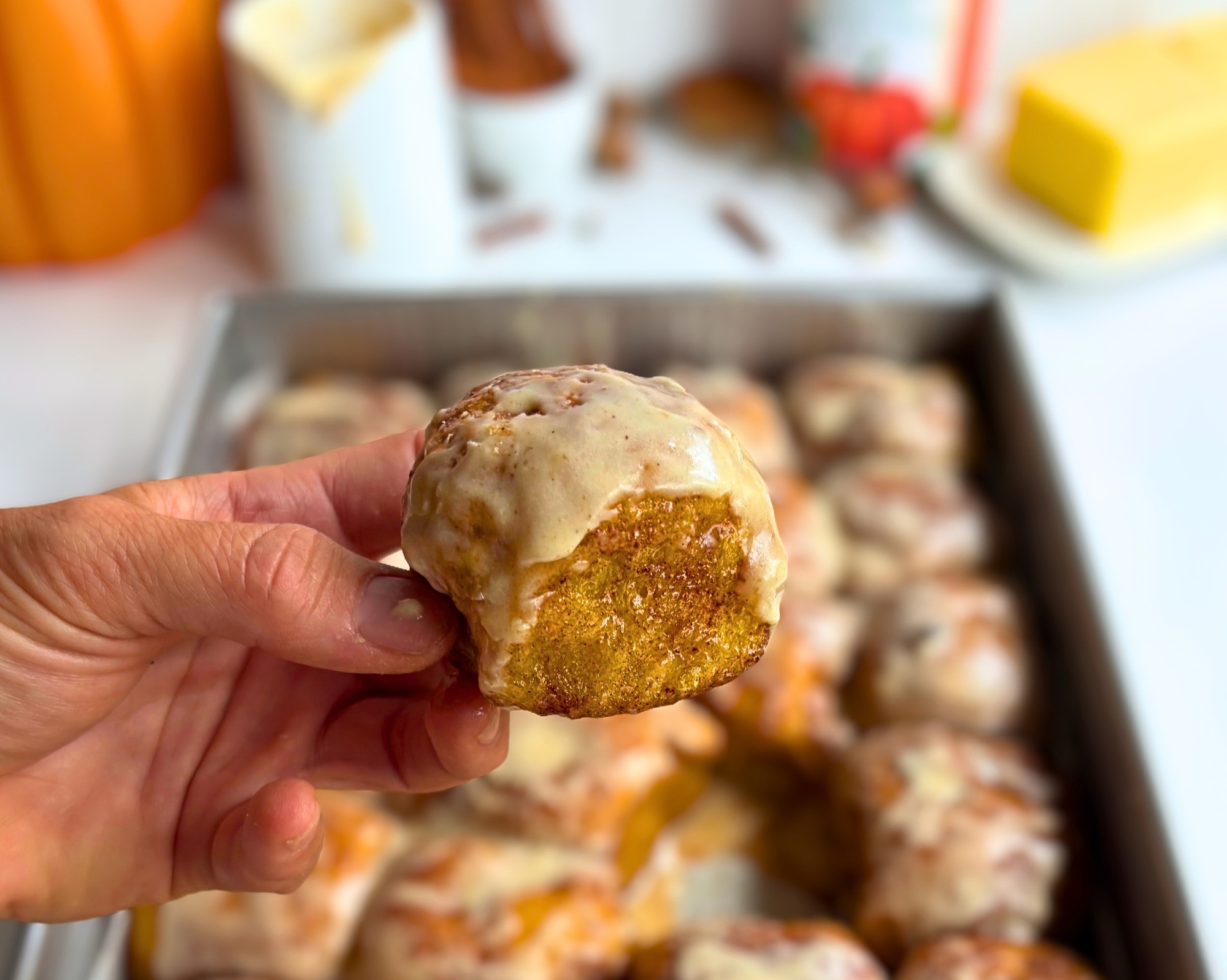
Every fall I want pumpkin in everything, but what I really wanted this year was a pull-apart focaccia where the pumpkin actually lives inside the dough instead of just showing up as a spice on the outside. So I worked real pumpkin puree straight into my focaccia dough, kept the dough itself only lightly sweet with a little brown sugar, and let the coating and the glaze do the heavy lifting. Each soft orange ball gets dunked in vanilla butter, rolled in a brown sugar pumpkin pie spice coating, baked together until the bottom caramelizes, and finished with a warm brown butter maple glaze that tastes like the coziest part of the season.
If you have made my Cinnamon Roll Pull-Apart Focaccia, the recipe whose reels have passed 50 million views across social media, you already know the method, and this is its fall counterpart. If you are brand new to the series, I walk you through everything below, including why this dough behaves a little differently than my other focaccias, and there is a same day yeast version for anyone without a sourdough starter.
Table of Contents
- Why You Will Love This Recipe
- What Makes This Pumpkin Spice Focaccia Different
- Ingredient Notes
- How to Make Pumpkin Spice Pull-Apart Focaccia
- Working With Pumpkin Dough
- How to Make the Brown Butter Maple Glaze
- The Sourdough Recipe
- The Yeast Recipe
- Tips for the Best Pumpkin Spice Pull-Apart Focaccia
- Ingredient Substitutions
- Storage and Make Ahead Instructions
- Shop This Recipe
- Frequently Asked Questions
- More Pull-Apart Focaccia and Pumpkin Recipes
- Subscribe (Free & No spam)
Why You Will Love This Recipe
This is the pan I want on the counter from the first cool morning of September straight through Thanksgiving, and here is why it earns that spot.

There is real pumpkin in the dough, not just pumpkin spice on the outside. The puree gives every piece a soft, tender, golden orange crumb and a gentle pumpkin flavor that comes through underneath the spice.
It is sweet without being too much. The dough itself is only lightly sweetened, so the brown sugar spice coating and the glaze can shine without the whole pan tipping over into cloying.
The brown butter maple glaze is the finish this flavor deserves. Toasty, nutty brown butter and pure maple syrup belong with pumpkin, and drizzling it over the warm pan is the best part of the whole bake.
The pull-apart format makes it a crowd favorite. Every ball separates cleanly with a soft middle and a caramelized, spiced shell, which makes it perfect for brunch, holiday mornings, or setting out for a fall get together.
It fits your schedule and your pantry. Mix it the night before and bake in the morning, or use the same day yeast version if you do not keep a sourdough starter.
What Makes This Pumpkin Spice Focaccia Different
The biggest difference is where the pumpkin goes. Instead of spreading a spiced topping over a plain dough, I built the pumpkin right into the focaccia itself, so the bread tastes like pumpkin from the inside out and has that beautiful orange color when you pull a piece apart.

Adding pumpkin to a dough is not as simple as stirring it in, though. Canned pumpkin is roughly 90 percent water, so a cup of it is really a cup of water hiding inside some fiber, and if you add it on top of a full amount of water you end up with a dough that is far too slack to pinch into balls. I pulled the added water back to account for everything the pumpkin brings, which keeps this dough a little lower in hydration than my other pull-apart focaccias and makes it easier to shape while still baking up soft and tender.
Then the spice goes where it can do the most good. Rather than mixing spice into the dough, every ball is rolled in a brown sugar coating built with cinnamon, ginger, nutmeg, cloves, allspice, and a touch of cardamom, so you get that warm pumpkin pie flavor in every caramelized bite.
Ingredient Notes
Full measurements are in the recipe cards below. Here is what matters most about the key ingredients.

Canned pumpkin puree is the star, and it needs to be plain 100 percent pumpkin, not pumpkin pie filling, which is already sweetened and spiced and will throw off the whole dough. I use canned rather than homemade because canned pumpkin is consistent from can to can, while homemade puree usually holds a lot more water and changes how the dough behaves.
Bread flour gives you the soft, chewy, pillowy structure this dough needs, and it handles the extra weight of the pumpkin well. All purpose flour works in a pinch, and there is a note on that in the substitutions section.
Active sourdough starter should be fed, bubbly, and at its peak when you mix. That is what gives you a strong rise and a good depth of flavor. No starter yet? Use the yeast version below.
Brown sugar is the only sweetener in the dough, and only a little of it. Its molasses brings a warm, deep flavor that pairs naturally with pumpkin and ties into the brown sugar coating, while keeping the dough lightly sweet.
Butter shows up three ways: a puddle in the pan for a caramelized bottom, a vanilla butter dip that coats every ball, and browned in the glaze. There is no butter in the dough itself, since the pumpkin brings plenty of tenderness on its own. Salted butter tastes best here because the salt balances the sweetness.
The spices for the coating are cinnamon, ginger, nutmeg, cloves, allspice, and cardamom. Cinnamon does most of the work so it tastes warm and familiar, while the others are what make it taste like pumpkin pie instead of a cinnamon roll. The small amount of cardamom is a nod to my Homemade Pumpkin Pie Spice, which uses it too. A little cornstarch in the coating helps it cling to the dough and set into a crackly shell.
Pure maple syrup goes in the glaze, where you can actually taste it. Use real maple syrup, not pancake syrup, which is mostly corn syrup and flavoring.
How to Make Pumpkin Spice Pull-Apart Focaccia
Here is the process at a glance, and the full step by step is in the recipe cards below.

First, you make the dough by whisking the water, pumpkin puree, starter, brown sugar, and vanilla together until the pumpkin is fully blended in, then adding the flour and salt and mixing until no dry flour remains. It will be shaggy and sticky, and that is right.
Next, you build strength and ferment. After an hour of rest you do one set of stretch and folds around the bowl, then let the dough bulk ferment at room temperature until it has tripled, which usually takes 8 to 12 hours depending on your kitchen and your starter. For the yeast version, you do three sets of stretch and folds spaced about thirty minutes apart, followed by a much shorter rise.
Then you shape and coat. Pinch off golf ball size pieces one at a time, dunk each one in vanilla butter, roll it in the pumpkin pie spice coating, and set it in the buttered pan, with the balls touching in rows.

After that, the balls rise again until they puff up and grow together into one cohesive pull-apart loaf, and then you dimple the tops and bake until deep golden and caramelized.
Finally, you let it cool for a few minutes while you brown the butter, whisk up the maple glaze, and pour it over the warm pan.
Working With Pumpkin Dough
If you have made my other pull-apart focaccias, this dough will feel a little different in your hands, and that is completely normal. Because I lowered the hydration to account for the pumpkin, it is a touch firmer and easier to pinch into balls than my vanilla or cinnamon roll dough, but the pumpkin also makes it feel tacky in a way plain flour and water do not.

Work with damp or lightly oiled hands and keep your movements quick and gentle. During the stretch and fold, keep your hand on the top surface of the dough as you lift and fold, since you are not kneading this dough at all. When it is time to shape, a light spray of avocado or olive oil on your work surface makes pinching off the balls much easier.
Resist the urge to add extra flour. The water in pumpkin is partly held in its fiber, so the dough often firms up as it rests and ferments, and extra flour at the mixing stage will leave you with a tighter, drier crumb than you want.
The most important thing to watch is how far the dough rises, because you want this one to triple during bulk fermentation rather than just double. With all that pumpkin weighing it down, it needs the full rise to bake up light, and in most kitchens that takes somewhere between 8 and 12 hours. A straight sided container with measurement marks makes it easy to see exactly where you started and when you have hit that mark.
How to Make the Brown Butter Maple Glaze
Brown butter sounds fancy, but it is just butter cooked a few minutes past melted until the milk solids toast and turn nutty, and it takes this glaze from sweet to something really special.

Use a light colored saucepan so you can actually see the color change. Melt the butter over medium heat and keep swirling the pan as it foams. Within a few minutes the foam settles, the bits on the bottom turn a toasty golden brown, and the whole kitchen smells nutty. Pour it into a bowl right away, scraping in every browned bit, since those bits are where the flavor lives and the butter will keep cooking if you leave it in the hot pan.
Here is the step that makes this glaze come together smoothly. Let the brown butter sit off the heat for about a minute so it does not spatter, then whisk the maple syrup and a pinch of salt directly into the butter before it ever touches the powdered sugar. Adding warm fat and thick syrup to dry sugar separately tends to leave clumps and stiff patches, but starting with one warm, loose liquid makes it easy to whisk smooth. The butter and maple will not fully blend together, so give it a quick whisk right before you pour it over the powdered sugar, then add the milk a little at a time until the glaze is thick but pourable.
Glaze while it is still warm. Brown butter glaze firms up as it cools, so if it starts to thicken before you are finished, a few seconds in the microwave will loosen it right back up.
The Sourdough Recipe
This is the original version and it comes first for a reason, since the long room temperature fermentation gives this pumpkin dough its flavor and its soft, open structure. Use an active, bubbly starter at its peak for the best rise. If you do not have a starter yet, my Minimal Waste Sourdough Starter guide walks you through making one from scratch.

Pumpkin Spice Pull-Apart Sourdough Focaccia
Equipment
- Large bowl or straight sided dough container
- spatula
- 9×13 baking pan
- Parchment paper
- 2 small bowls for dipping
- Small light colored saucepan
- Whisk
- Instant read thermometer
Ingredients
For the Pumpkin Sourdough Dough
- 500 g bread flour 4 cups
- 200 g water room temperature (3/4 cup plus 1 1/2 tablespoons)
- 200 g canned pumpkin puree for the dough not pumpkin pie filling (3/4 cup plus 1 tablespoon)
- 75 g active sourdough starter fed and bubbly (1/3 cup)
- 20 g brown sugar for the dough 1 1/2 tablespoons packed
- 8 g salt 1 1/2 teaspoons
- 10 g vanilla extract for the dough 2 teaspoons
For the Vanilla Butter Dip
- 85 g butter melted, for the vanilla dip (6 tablespoons)
- 5 g vanilla extract for the vanilla dip 1 teaspoon
For the Pumpkin Pie Spice Coating
- 150 g brown sugar for the coating 3/4 cup packed
- 7 g cornstarch for the coating 1 tablespoon
- 6.5 g ground cinnamon for the coating 2 1/2 teaspoons
- 1.8 g ground ginger for the coating 1 teaspoon
- 1.1 g ground nutmeg for the coating 1/2 teaspoon
- 0.5 g ground cloves for the coating 1/4 teaspoon
- 0.5 g ground allspice for the coating 1/4 teaspoon
- 0.25 g ground cardamom for the coating 1/8 teaspoon
For the Brown Butter Maple Glaze
- 28 g butter for the glaze weighed before browning (2 tablespoons)
- 40 g pure maple syrup for the glaze 2 tablespoons
- 180 g powdered sugar for the glaze 1 1/2 cups
- 15 to 30 g milk or cream for the glaze 1 to 2 tablespoons
- Pinch of salt for the glaze
Instructions
Day 1: Make the Pumpkin Sourdough Dough
- Mix the dough. In a large bowl, whisk together the water, pumpkin puree, active sourdough starter, brown sugar, and vanilla until the starter is dissolved and the pumpkin is completely blended in. Add the flour and salt, then mix until no dry flour remains. The dough will be sticky and shaggy.
- Rest. Cover the bowl and let the dough rest for 1 hour at room temperature.
- Stretch and fold. Perform one set of stretch and folds. With wet hands, grab one side of the dough, stretch it up, and fold it over itself, then rotate the bowl and repeat, working your way around the entire dough 4 to 6 times.
- Bulk fermentation. Cover and let the dough proof at room temperature for 8 to 12 hours, until it has tripled in size, the top is domed and bubbly, and it is pulling away from the sides of the bowl. Cooler kitchens may need longer, so follow the rise rather than the clock.
Day 2: Shape, Rise, and Bake
- Prepare the pan. Line a 9×13 inch pan with parchment paper, pour in the 28g of melted butter, and spread it evenly across the bottom.
- Prepare the vanilla butter. Melt the 85g of butter, stir in the 5g of vanilla extract, and set it aside in a small bowl for dipping.
- Prepare the coating. Whisk together the brown sugar, cornstarch, cinnamon, ginger, nutmeg, cloves, allspice, and cardamom in a shallow bowl until the spices are evenly mixed with no clumps.
- Shape, dip, and coat. Turn the dough out onto a surface lightly sprayed with oil. Working one ball at a time, pinch off a golf ball size piece of dough, dip it in the vanilla butter, roll it generously in the pumpkin pie spice coating, and place it in the pan. Arrange the balls touching with very little space between them, in rows. You should end up with roughly 24 to 30 balls depending on size.
- Drizzle. Pour any remaining vanilla butter over the arranged balls.
- Second rise. Cover and let rise at room temperature for 1 to 2 hours, until the balls are puffy and have grown together into one cohesive pull-apart loaf.
- Bake. Preheat the oven to 375°F (190°C). Gently dimple the tops of the balls with your fingers, then bake on the lower rack for 25 to 30 minutes, until deep golden brown and the internal temperature reads 190 to 200°F.
- Cool. Let the focaccia cool in the pan for 10 to 15 minutes before glazing.
Make the Brown Butter Maple Glaze
- Brown the butter. Melt the 28g of butter in a small light colored saucepan over medium heat, swirling often, until it foams, the milk solids turn toasty golden brown, and it smells nutty, about 4 to 6 minutes. Pour it right away into a bowl, scraping in all the browned bits.
- Add the maple. Let the brown butter sit for about 1 minute so it does not spatter, then whisk in the maple syrup and a pinch of salt. Give it a good whisk right before using, since the butter and maple will not fully blend.
- Mix the glaze. Whisk the brown butter maple mixture into the powdered sugar, then add the milk or cream a little at a time, starting with 15g, until the glaze is thick but pourable.
- Glaze and serve. Drizzle the warm glaze over the warm focaccia. If the glaze thickens before you finish, warm it in the microwave for a few seconds to loosen it. Serve warm and pull apart to enjoy.
Notes
The Yeast Recipe
No sourdough starter? You can make this exact pumpkin spice pull-apart focaccia with instant or active dry yeast and have it ready the same day. The pumpkin dough, the vanilla butter, the spice coating, the shaping, the bake, and the brown butter maple glaze all stay the same, and the only real changes are the leavener and the timeline.
The yeast version follows the same rhythm as my Same Day Focaccia, with three sets of stretch and folds spaced about thirty minutes apart. Those folds build the gluten strength that the long overnight sourdough fermentation would otherwise develop on its own. The pumpkin makes this a heavier dough, so let it rise until it is fully doubled and puffy before you shape it rather than going by the clock. The full method, ingredients, and timing are in the printable card below.

Pumpkin Spice Pull-Apart Focaccia (Yeast Version)
Equipment
- Large bowl
- spatula
- 9×13 baking pan
- Parchment paper
- 2 small bowls for dipping
- Small light colored saucepan
- Whisk
- Instant read thermometer
Ingredients
For the Pumpkin Yeast Dough
- 535 g bread flour 4 1/4 cups
- 236 g warm water about 100 to 110°F (1 cup)
- 200 g canned pumpkin puree for the dough room temperature, not pumpkin pie filling (3/4 cup plus 1 tablespoon)
- Yeast choose one: 7g instant yeast (2 1/4 teaspoons) OR 9g active dry yeast (2 3/4 teaspoons). See the mixing step for the matching method.
- 20 g brown sugar for the dough 1 1/2 tablespoons packed
- 8 g salt 1 1/2 teaspoons
- 10 g vanilla extract for the dough 2 teaspoons
For the Vanilla Butter Dip
- 85 g butter melted, for the vanilla dip (6 tablespoons)
- 5 g vanilla extract for the vanilla dip 1 teaspoon
For the Pumpkin Pie Spice Coating
- 150 g brown sugar for the coating 3/4 cup packed
- 7 g cornstarch for the coating 1 tablespoon
- 6.5 g ground cinnamon for the coating 2 1/2 teaspoons
- 1.8 g ground ginger for the coating 1 teaspoon
- 1.1 g ground nutmeg for the coating 1/2 teaspoon
- 0.5 g ground cloves for the coating 1/4 teaspoon
- 0.5 g ground allspice for the coating 1/4 teaspoon
- 0.25 g ground cardamom for the coating 1/8 teaspoon
For the Brown Butter Maple Glaze
- 28 g butter for the glaze weighed before browning (2 tablespoons)
- 40 g pure maple syrup for the glaze 2 tablespoons
- 180 g powdered sugar for the glaze 1 1/2 cups
- 15 to 30 g milk or cream for the glaze 1 to 2 tablespoons
- Pinch of salt for the glaze
Instructions
Make the Pumpkin Yeast Dough
- Mix the dough. There are two ways to do this depending on which yeast you use. Follow only the method that matches your yeast, then continue with the rest of the recipe.
- METHOD A: INSTANT YEAST (no pre proofing needed)
- In a large bowl, whisk together the bread flour, salt, and instant yeast. In a separate bowl, whisk the warm water, room temperature pumpkin puree, brown sugar, and vanilla until smooth, then pour it into the flour and mix until no dry flour remains. The dough will be sticky and shaggy.
- METHOD B: ACTIVE DRY YEAST (proof the yeast first)
- In a large bowl, combine the warm water, active dry yeast, and a pinch of the brown sugar. Let it sit for 5 to 10 minutes until foamy and bubbly. If it does not foam, your yeast is dead, so start over with fresh yeast. Whisk in the room temperature pumpkin puree, the remaining brown sugar, and the vanilla until smooth, then add the flour and salt and mix until no dry flour remains. The dough will be sticky and shaggy.
- Rest. Cover the bowl and let the dough rest for 30 minutes at room temperature.
- Stretch and fold, set 1. With wet hands, grab one side of the dough, stretch it up, and fold it over itself. Rotate the bowl and repeat, going all the way around the dough 4 to 6 times. Cover and rest 30 minutes.
- Stretch and fold, set 2. Repeat the same stretch and fold around the bowl. Cover and rest 30 minutes.
- Stretch and fold, set 3. Repeat the stretch and fold one more time. The dough will feel noticeably smoother and stronger.
- Bulk fermentation. Cover and let the dough rise at room temperature until fully doubled, puffy, and domed with bubbles, about 1 to 2 more hours. The pumpkin makes this a heavier dough, so go by the rise rather than the clock.
Shape, Rise, and Bake
- Prepare the pan. Line a 9×13 inch pan with parchment paper.
- Prepare the vanilla butter. Melt the 85g of butter, stir in the 5g of vanilla extract, and set it aside in a small bowl for dipping.
- Prepare the coating. Whisk together the brown sugar, cornstarch, cinnamon, ginger, nutmeg, cloves, allspice, and cardamom in a shallow bowl until the spices are evenly mixed with no clumps.
- Shape, dip, and coat. Turn the dough out onto a surface lightly sprayed with oil. Working one ball at a time, pinch off a golf ball size piece of dough, dip it in the vanilla butter, roll it generously in the pumpkin pie spice coating, and place it in the pan. Arrange the balls touching with very little space between them, in rows. You should end up with roughly 24 to 30 balls depending on size.
- Drizzle. Pour any remaining vanilla butter over the arranged balls.
- Second rise. Cover and let rise at room temperature for 1 to 2 hours, until the balls are puffy and have grown together into one cohesive pull-apart loaf.
- Bake. Preheat the oven to 375°F (190°C). Gently dimple the tops of the balls with your fingers, then bake on the lower rack for 25 to 30 minutes, until deep golden brown and the internal temperature reads 190 to 200°F.
- Cool. Let the focaccia cool in the pan for 10 to 15 minutes before glazing.
Make the Brown Butter Maple Glaze
- Brown the butter. Melt the 28g of butter in a small light colored saucepan over medium heat, swirling often, until it foams, the milk solids turn toasty golden brown, and it smells nutty, about 4 to 6 minutes. Pour it right away into a bowl, scraping in all the browned bits.
- Add the maple. Let the brown butter sit for about 1 minute so it does not spatter, then whisk in the maple syrup and a pinch of salt. Give it a good whisk right before using, since the butter and maple will not fully blend.
- Mix the glaze. Whisk the brown butter maple mixture into the powdered sugar, then add the milk or cream a little at a time, starting with 15g, until the glaze is thick but pourable.
- Glaze and serve. Drizzle the warm glaze over the warm focaccia. If the glaze thickens before you finish, warm it in the microwave for a few seconds to loosen it. Serve warm and pull apart to enjoy.
Notes
Tips for the Best Pumpkin Spice Pull-Apart Focaccia
A few small things make a big difference with this one.

Use canned pumpkin. Plain canned pumpkin puree keeps the dough consistent every time, while homemade puree and pumpkin pie filling will both change how the dough behaves.
Whisk the pumpkin in first. Fully blending the pumpkin with the water and starter before the flour goes in keeps you from ending up with orange streaks and pockets of puree in the dough.
Let it triple. This pumpkin dough needs to triple in bulk fermentation, which usually takes 8 to 12 hours. Under proofed pumpkin dough bakes up dense, so give it the full rise and look for a domed, bubbly top that is pulling away from the sides.
Whisk the coating well. Make sure the spices are evenly mixed through the brown sugar with no clumps, especially the cloves, so no single ball gets a mouthful of one spice.
Do not skimp on the butter dip. It is what helps the coating stick and caramelize, and it keeps every ball soft and moist.
Do not rush the second rise. The balls need time to puff and grow together into one cohesive loaf, and they should jiggle a little when you shake the pan.
Bake on the lower rack. This helps the bottom caramelize while keeping the sugary top from browning too quickly.
Glaze while it is warm. Both the focaccia and the brown butter glaze should be warm when they meet, which helps the glaze settle into every crack between the balls.
Ingredient Substitutions
Not every pantry looks the same, so here are the swaps that work well.
Pumpkin pie spice blend. If you would rather not measure out each spice, use the same total weight of my Homemade Pumpkin Pie Spice or your favorite store bought blend in place of the individual spices.
Homemade pumpkin puree. Homemade works, but it usually holds a lot more water than canned. Cook it down in a pan, stirring often, until it is thick enough to hold a spoon upright, and let it cool before mixing, or the dough will be much wetter than intended.
Glaze without maple. If you want a simpler finish, leave out the maple syrup and add a teaspoon of vanilla instead for a plain brown butter glaze, adding a splash more milk to reach a pourable consistency.
Flour. All purpose flour can be used in place of bread flour, though the crumb will be a little less structured, and you may want to hold back a small amount of the water since it absorbs differently. Fresh milled flour will also change your hydration and proofing times, so watch the dough closely.
Butter. Salted or unsalted both work. If you only have unsalted, add a pinch of salt to the vanilla butter dip. A plant based butter works for the pan and dip, though it will not brown the same way for the glaze.
Glaze liquid. Milk or cream gives the richest glaze, but any plant based milk works too.
Gluten free. I have not tested this recipe with gluten free flour, and if you try it I would love to hear how it goes in the comments.
Storage and Make Ahead Instructions
Store leftovers covered at room temperature for up to 2 days. Reheat individual pieces in the microwave for 15 to 20 seconds, or warm the whole pan in a 300°F oven until heated through.
This recipe is easy to make ahead, and there are two ways to do it.
Option 1, night before. In the evening, mix the dough and let it bulk ferment overnight at room temperature. In the morning, shape, dip, coat, and arrange the balls, let them rise, then bake and glaze. Mixing around dinnertime usually lines the 8 to 12 hour bulk up nicely with breakfast.
Option 2, day before. In the morning, mix the dough and let it ferment during the day. In the evening, shape, dip, coat, and arrange the balls, cover the pan well, and refrigerate overnight. The next morning, let the pan come to room temperature and finish rising for 1 to 2 hours, then bake and glaze.
To freeze, bake the focaccia, let it cool completely, and freeze it without the glaze. Defrost at room temperature, warm it in the oven, and make a fresh batch of brown butter maple glaze right before serving so it tastes just baked.
Shop This Recipe
These are the tools that make this pumpkin spice pull-apart focaccia easier. I earn a small commission from these affiliate links at no extra cost to you, which helps support the blog and keeps the recipes coming.

- 9×13 Baking Pan, the size this recipe is built for, so the balls rise into each other and bake into one cohesive pull-apart loaf.
- Digital Kitchen Scale, which makes measuring the flour, pumpkin, and starter accurate every time, since grams are far more reliable than cups for bread.
- Instant Read Thermometer, the easiest way to know the center is baked through without tearing into the pan to check.
- Light Colored Saucepan, which lets you see the butter change color so you can pull it at the perfect toasty brown for the glaze.
- Parchment Paper, which lines the pan so the caramelized bottom releases cleanly.
Frequently Asked Questions
Here are the questions I expect to get most about this pumpkin version.

Can I use pumpkin pie filling instead of pumpkin puree?
No. Pumpkin pie filling is already sweetened and spiced, and it has a different texture, so it will make the dough too sweet and throw off the balance with the coating and glaze. Use plain canned pumpkin puree.
Can I use homemade pumpkin puree?
Yes, but cook it down first. Homemade puree holds much more water than canned, so simmer it, stirring often, until it is thick enough to hold a spoon upright, then let it cool before adding it to the dough.
Does it taste like pumpkin pie?
It tastes like a soft pumpkin bread wrapped in a warm pumpkin pie spice shell. The pumpkin in the dough gives a gentle pumpkin flavor and a golden crumb, the coating brings the classic spice, and the brown butter maple glaze adds a toasty sweetness on top.
How do I know when bulk fermentation is done?
You want the dough to triple in size, with a domed top, bubbles on the surface and sides, and a light, airy feel when you jiggle the bowl. For the sourdough version that usually takes 8 to 12 hours at room temperature, though a cool kitchen can push it longer, so go by the rise rather than the clock.
Why is there less water in this dough than your other focaccias?
Canned pumpkin is roughly 90 percent water, so it brings a lot of liquid into the dough on its own. I lowered the added water to account for it, which keeps the dough soft but firm enough to pinch into balls that hold their shape.
Why is there no spice in the dough?
The spice lives in the coating so it can caramelize against the butter and brown sugar, where you taste it most. Keeping the dough plain lets the pumpkin flavor come through underneath instead of getting covered up.
Why do you add the maple syrup to the brown butter first?
Whisking the maple into the warm brown butter first gives you one loose liquid to mix into the powdered sugar, which whisks up smoothly instead of leaving clumps and stiff spots. Let the butter cool for about a minute off the heat first so the maple does not spatter.
Can I use my regular focaccia dough for this?
You can, though you will lose the pumpkin in the dough, which is a big part of what makes this version special. If you want to go that route, make my Sourdough Focaccia or Same Day Focaccia through the bulk rise, then come back here and pick up at the shaping step with the vanilla butter, spice coating, and glaze.
Can I make it ahead?
Yes. You can shape, dip, coat, and arrange the balls, cover the pan well, and refrigerate it overnight, then let it come to room temperature and finish rising in the morning before baking. See the make ahead section above for both options.
Can I freeze it?
Yes. Bake it, cool it completely, and freeze it without the glaze. Defrost at room temperature, warm it in the oven, and glaze it fresh right before serving.
How do I know when it is done baking?
The top should be deep golden brown and the internal temperature should read between 190 and 200°F on an instant read thermometer.
Why does my sourdough version taste sour?
A sour flavor usually comes from a starter on the acidic side or a dough that fermented too long. Use your starter at its peak, and once the dough has tripled, move on to shaping rather than letting it sit much longer.
More Pull-Apart Focaccia and Pumpkin Recipes
Once you have the pull-apart method down, you can take it in any direction, sweet or savory, and if you are in a pumpkin mood there are a few more below to keep the season going.

Sweet pull-apart focaccia:
Savory pull-apart focaccia:
- Garlic Parmesan Pull-Apart Focaccia
- Pizza Pull-Apart Focaccia
- Pesto Pull-Apart Focaccia
- Pigs in a Blanket Pull-Apart Focaccia
More pumpkin recipes:
Subscribe
Do not miss a recipe. Subscribing to the H3art of the Home newsletter is completely free, and you will get new sourdough bakes, high protein recipes, and pull-apart focaccia flavors delivered straight to your inbox. If you make this pumpkin spice pull-apart focaccia, come back and leave a star rating and a comment, because I read every single one.





Leave a Reply